Fluke 377
As an Amazon Associate we earn from qualifying purchases.
The Fluke 377 FC is a true-rms clamp meter that measures current through its jaw and voltage with FieldSense, the non-contact method Fluke uses on this model. People searching for a Fluke 377 usually want to know three things: what the meter does, how to use it without putting themselves at risk, and which ratings they can check before buying. This explainer answers those questions using only what Fluke publishes for the 377 FC, and it marks the points the published material does not settle.
Quick answer
- The 377 FC measures AC and DC current through its jaw, AC and DC voltage through test leads, resistance, capacitance, and continuity. Its FieldSense mode reads AC voltage, current and frequency with no electrical contact to a live conductor.
- Fluke publishes two safety categories for this meter: CAT III 1000 V and CAT IV 600 V, under IEC 61010-2-032 and IEC 61010-2-033. The maximum voltage between any terminal and earth ground is 1000 V.
- FieldSense measurements need a ground lead connection, and Fluke says the mode is not intended for measuring the output of a variable-frequency drive motor.
- Before any job, check that the battery door is closed and locked, remove probes before opening it, and never measure current with the test leads still plugged into the jacks.
What the Fluke 377 FC measures
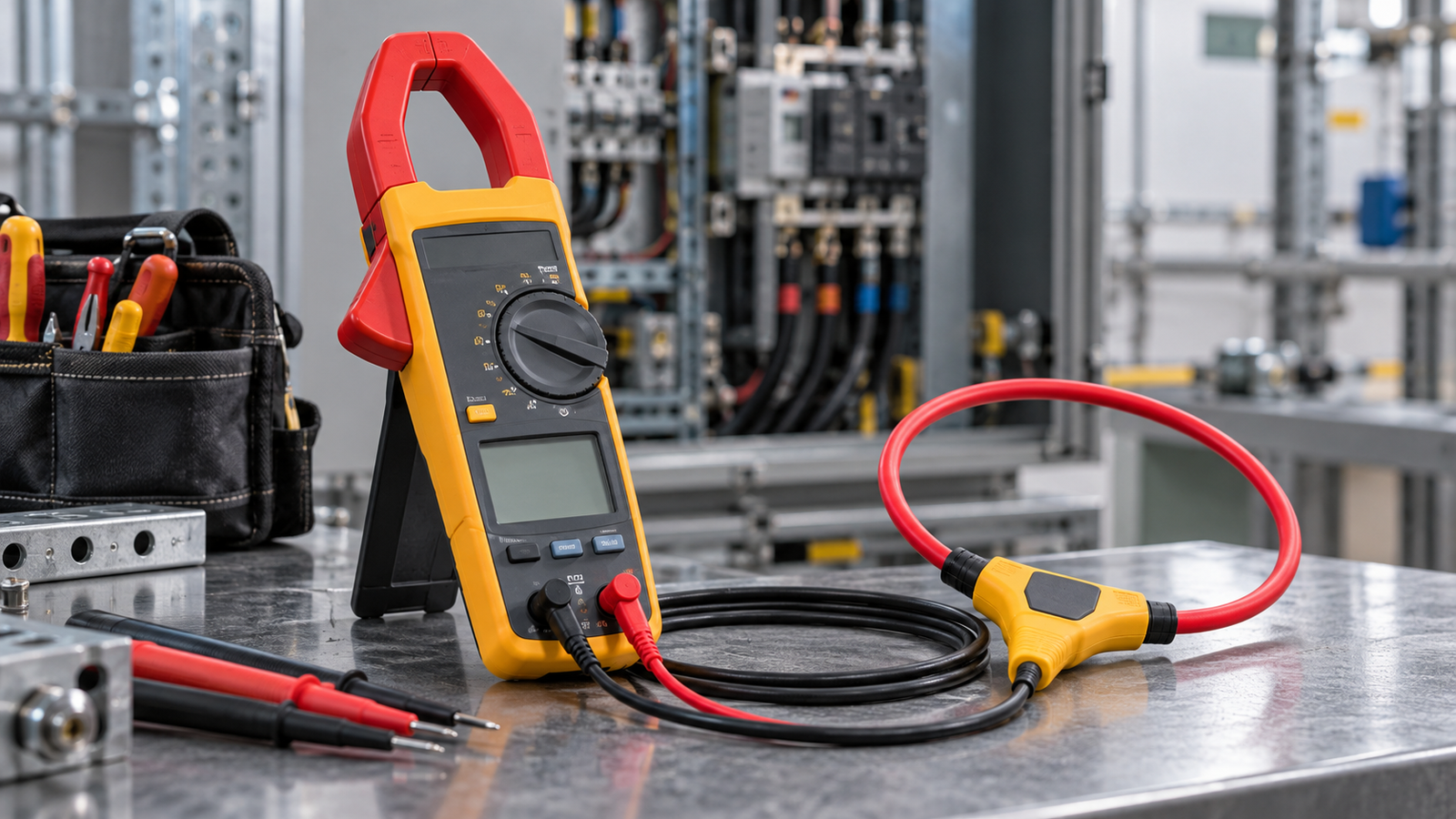
The meter has a control knob and a jaw. In the jaw position it reads AC current and DC current up to 999.9 A. Fluke lists a 34 mm jaw opening. For larger conductors, the box includes an i2500-18 iFlex flexible current probe, 18 inches (48 cm) long, which Fluke rates for AC current up to 2500 A.
With the test leads in the jacks, the meter reads AC and DC voltage up to 600.0 V on the lower range and up to 1000 V on the upper range. It also reads resistance from 600.0 ohms to 60.00 kilohms, and capacitance up to 1000 microfarads. Fluke calls its continuity display Visual Continuity, a bright green screen that the product page says makes continuity easy to detect in noisy work areas.
The 377 FC is a true-rms meter. Fluke’s product page lists a crest factor of 3 at 500 A, 2.5 at 600 A and 1.42 at 1000 A for AC current. A crest factor describes how peaky a waveform is. Readings on distorted waveforms, such as those from some electronic loads, can differ from readings on a pure sine wave, which is why the crest factor figures matter when the load is not a simple motor or heater.
How FieldSense works, and what it needs
FieldSense is the feature that sets this model apart. The user manual describes FieldSense measurement as AC current, voltage and frequency measurement with no electrical contact to live voltage. The display shows voltage and current at the same time. Fluke says the display turns green when a stable FieldSense reading is detected.
The manual is direct on one requirement: every FieldSense measurement requires a ground lead connection. In practice, that means you clip the black test lead to a known electrical ground before you use the mode. Without that connection, the meter cannot make the measurement the mode is designed for. The manual also says FieldSense technology is not intended to measure the output of a variable-frequency drive motor, and it directs you to use the voltage or current settings for that job.
The product page describes testing voltage and current through the clamp jaw without touching a live wire. The sources we opened do not say that FieldSense replaces a test-lead voltage check, so treat it as a screening step rather than the final word on whether a conductor is live.
Specifications Fluke publishes
The table below uses the figures Fluke prints on the 377 FC product page and in its product specification sheet. The spec sheet covers the 377, 377 FC, 378 and 378 FC together, so some figures may apply to more than one model. We did not split those columns, so check the model line on your own unit before relying on any figure.
| Item | Figure Fluke publishes |
|---|---|
| AC current, jaw | Range 999.9 A, resolution 0.1 A, accuracy 2% ±5 digits (45 Hz to 66 Hz) |
| AC current, iFlex probe | Range 2500 A; accuracy 3% ±5 digits (5 Hz to 500 Hz) |
| DC current, jaw | Range 999.9 A, accuracy 2% ±5 digits |
| AC voltage, test leads | 600.0 V and 1000 V ranges, accuracy 1% ±5 digits (20 Hz to 500 Hz) |
| DC voltage, test leads | 600.0 V and 1000 V ranges, accuracy 1% ±10 digits |
| Resistance | 600.0 ohm, 6000 ohm and 60.00 kilohm ranges, accuracy 1% ±5 digits |
| Capacitance | Up to 1000 microfarads, accuracy 1% ±4 digits |
| Safety, IEC 61010-2-032 and -033 | CAT III 1000 V / CAT IV 600 V; pollution degree 2 under IEC 61010-1 |
| Maximum voltage, any terminal to earth | 1000 V |
| Battery | 2 AA IEC LR6 alkaline, life listed as 200 hours |
| Automatic power off | 20 minutes |
| Jaw opening | 34 mm |
| Size and weight | 274 mm x 86 mm x 47 mm; 463 g with batteries |
| Operating temperature and altitude | -10 °C to 50 °C; 2000 m |
| Ingress protection | IP30 with the jaw closed |
The accuracy figures are a fair starting point, but they are not the whole story. Fluke’s product page notes that iFlex accuracy depends on where the conductor sits in the probe loop, and it lists the FieldSense voltage accuracy by wire size: a 3% figure for conductors up to 4/0 AWG and a 5% figure for larger conductors, with the wire positioned as close as possible to the jaw opening.
How to use it safely
Start with the meter itself. The manual warns that the battery door must be closed and locked before you operate the meter, and that you must remove all probes, test leads and accessories before you open the door. Fluke also says to replace the batteries when the low battery indicator shows, because low batteries can produce incorrect readings. The manual tells you to check the calibration seal in the battery compartment when you change batteries. If that seal is damaged, the manual says the product may not be safe to use and should be returned to Fluke.
Next, handle the jaw correctly. The manual says to hold the product behind the tactile barrier, which is the raised guard between your hand and the live conductor, and not to measure current while the test leads are in the input jacks. Keep the leads in mind as you work: the meter reads current through the jaw, and leads left in the jacks while you clamp can give you a false picture of what is happening in the circuit.
The meter also gives a hazardous voltage warning. The manual says the clamp shows a symbol when it senses a voltage of 30 V or more at the clamp input, or when a voltage overload occurs. Treat that symbol as a stop sign, not as a reading to ignore. Use the test leads and a proven voltage check before you work on a conductor that the warning has flagged.
Use the HOLD function with care. The manual warns not to use HOLD to measure unknown potentials, because a held reading does not show what the live circuit is doing now. Live readings are the only way to confirm that a conductor is de-energized.
Capacitance measurements need a discharged capacitor. The manual tells you to discharge the capacitor before you connect the meter, and to follow the discharge steps before you touch the leads. A capacitor that still holds a charge can give a shock even after the power is off.
Finally, the rating on the meter is the limit. The manual says the category rating of a meter, probe and accessory combination is the lowest rating of any individual component. A CAT IV rating on the meter does not raise the rating of a probe that is only rated lower. Check the category of your test leads and accessories, and do not use a meter where the circuit is above the category it is rated for.
Features that change how you work
Fluke Connect is the wireless feature that links the meter to a smartphone app. The product page says it lets you save measurements, log trends and share readings. The page notes that a smartphone, wireless service and a data plan are not included, that the first 5 GB of cloud storage is free, and that Fluke Connect is not available in every country. Check your local availability before you plan a workflow around it.
The product page also describes a three-phase workflow. The meter can calculate phase-to-ground and phase-to-phase values when you take readings on each phase in turn, and Fluke says the phase rotation is calculated and shown in the app. The sources we opened do not describe its performance on unbalanced or harmonic-heavy loads beyond the crest factor figures.
Checks before you buy
Confirm the exact model. Fluke sells the 377 FC, the 378 FC and sibling models that share a spec sheet. The 377 FC includes FieldSense and the iFlex probe. If you need only jaw measurements, a plain 377 may cover your work, but the sources we opened do not give a separate feature list for that version, so compare the model number on the product page and the packing list.
Check the category rating against your work. The 377 FC’s CAT III 1000 V and CAT IV 600 V ratings are the limits Fluke publishes. If you work in a distribution panel or at the service entrance, make sure the category listed matches the location, and make sure your test leads and probes carry a matching rating. A clamp meter does not make an unsafe panel safe, and panel work belongs with a licensed electrician.
Decide whether you need the iFlex probe. The jaw reads up to 999.9 A and has a 34 mm opening. If your work involves currents above that range or conductors that the jaw cannot close around, the flexible probe is the feature that matters. If your work stays within the jaw range, the jaw may be enough.
If you need the meter for quick checks, the non-contact voltage function can help, but it is a screening tool. Compare the meter with the other tools in our guide to true-rms multimeters and our list of AC clamp meters before you decide which format fits the work.
How we chose
This explainer uses three criteria. First, the figures had to appear in Fluke’s own product page, user manual or product specification sheet, all opened on 27 October 2026. Second, the advice on safe use had to come from the manual’s warnings and procedures, not from general guidance. Third, every claim about what the meter does had to match a feature the manufacturer lists. We did not rank the 377 FC against other meters, and this article does not claim that it is the best choice for any job.
What we could not verify
The sources we opened do not give field accuracy under your conditions. The accuracy figures are laboratory figures printed by Fluke, and the spec sheet notes that wire position and field conditions affect the result. We could not check the reading on a real installation.
The spec sheet covers the 377, 377 FC, 378 and 378 FC together. The sources we opened do not give a separate table of differences for each version, so this article does not claim which figures apply only to the 377 FC.
The user manual states that its illustrations show the 378 FC, which is a sibling model. The text describes the 377 FC feature set, but the pictures may not match your unit exactly.
Regional availability of Fluke Connect is not confirmed for every country, and the sources we opened do not say how the app performs on every phone.
We did not find a published test procedure from Fluke for verifying the FieldSense reading on a specific circuit, so this article does not describe one.
FAQ
Is the Fluke 377 FC rated for household mains?
Fluke publishes CAT III 1000 V and CAT IV 600 V for the meter. Whether a particular task falls within that rating depends on the location of the work and the rating of every probe and accessory you use. Read the category section of the manual before you use the meter on mains, and leave panel and service work to a licensed electrician.
Does FieldSense work without a ground connection?
The manual says every FieldSense measurement requires a ground lead connection. Connect the black test lead to a known electrical ground before you use the mode.
What is the iFlex probe for?
The iFlex is a flexible current probe that wraps around large conductors. The included i2500-18 is 18 inches (48 cm) long, and Fluke rates it for AC current up to 2500 A.
Can the 377 FC measure DC current?
Yes, through the jaw. Fluke lists a DC current range of 999.9 A with 2% ±5 digits accuracy on the product page and the spec sheet.
Does the meter need a smartphone?
No. The meter reads on its own display. Fluke Connect adds logging and sharing through the app, and the phone and data plan are not included.
Can I use the meter on a variable-frequency drive motor?
The manual says FieldSense is not intended to measure the output of a variable-frequency drive motor. Use the voltage or current settings for that work, and check the manual for the details of that use.
Bottom line
The Fluke 377 FC fits work that needs a clamp meter with a flexible probe for large conductors, FieldSense for quick non-contact checks, and a published CAT III 1000 V and CAT IV 600 V rating. Before you buy, confirm the exact model, match the category rating to your location, and read the ground lead and battery door rules in the manual.
Sources
- Fluke Corporation, “Fluke 377 FC Non-Contact Voltage True-rms AC/DC Clamp Meter with iFlex,” product page. https://www.fluke.com/en-us/product/electrical-testing/clamp-meters/377-fc (opened 2026-10-27)
- Fluke Corporation, “Fluke 377 FC, Fluke 378 FC Users Manual,” PDF. https://media.fluke.com/e39be797-a100-477e-9b52-b10800c1b563_original%20file.pdf (opened 2026-10-27)
- Fluke Corporation, “Clamp Meter 377/377 FC/378/378 FC Product Specifications,” PDF, Rev. 1, 6/25. https://media.fluke.com/9a4de83e-a5a3-43f9-9a45-b2f8014111bb_original%20file.pdf (opened 2026-10-27)