Fluke 787B
As an Amazon Associate we earn from qualifying purchases.
Fluke 787B ProcessMeter Explained: Functions and Ratings
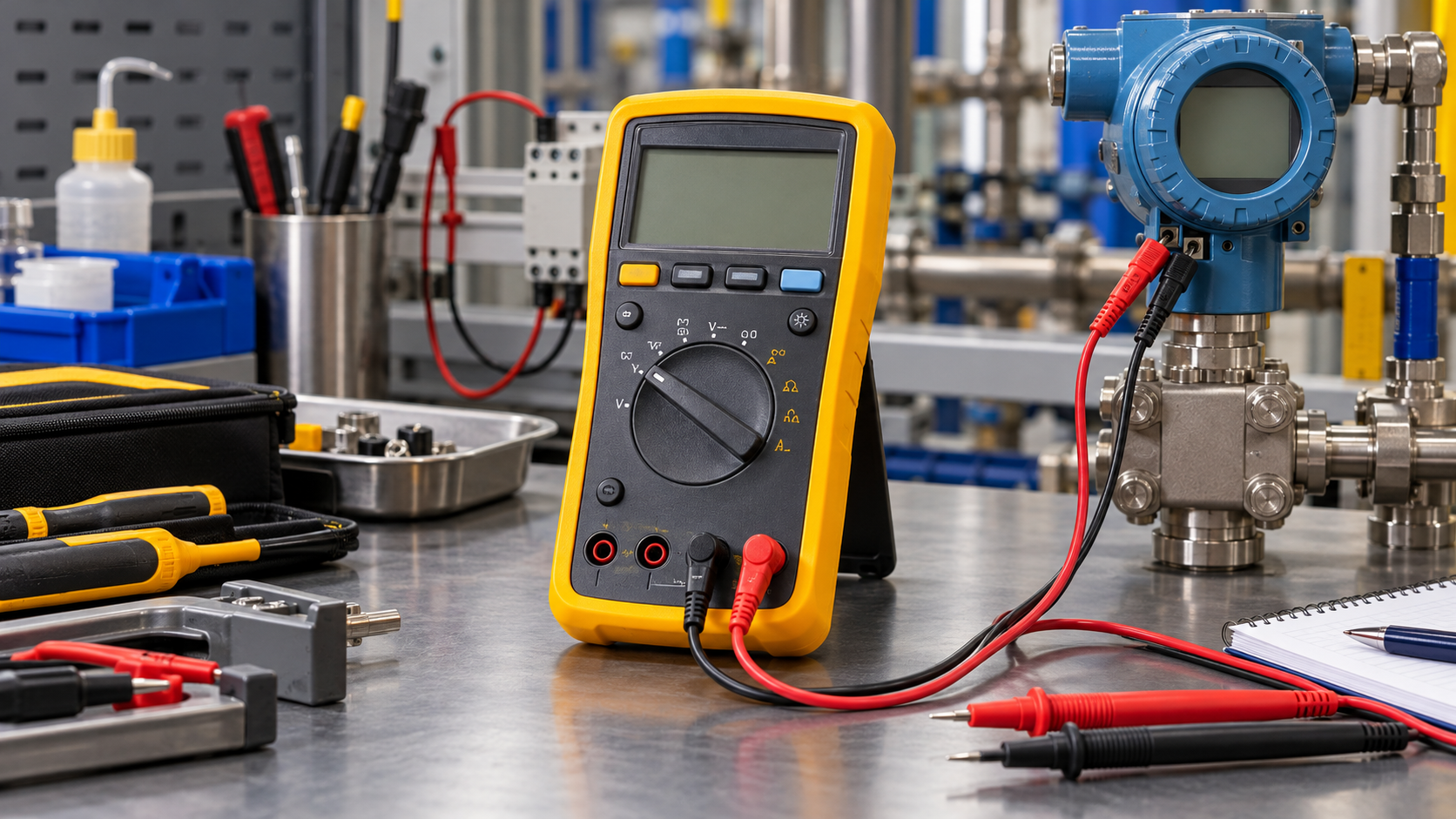
The Fluke 787B is a handheld, battery-operated ProcessMeter. Fluke’s manual describes it as a tool for measuring electrical parameters and for supplying steady or varying signals. That second role is what sets a ProcessMeter apart from a standard multimeter: it can source a current signal to test a device, and it can simulate a transmitter’s output. The manual’s functions suggest its use in process and instrument work, such as checking a current loop, and the manual does not describe household use.
The manual covers both the 787B and the 789, and marks the 24 V loop power supply as a 789-only feature.
Quick answer
- A handheld ProcessMeter that measures electrical quantities and sources or simulates current signals, according to Fluke’s manual.
- The current input is fused with a 440 mA fuse. Fluke’s manual lists the current input as 30 mA.
- Fluke’s manual lists the safety rating as IEC 61010-2-033 CAT IV 600 V and CAT III 1000 V, at pollution degree 2.
- The 24 V loop power supply is marked as a 789-only feature.
What the 787B does
A standard multimeter measures a signal. A ProcessMeter can also produce one. Fluke’s manual describes a source current function, which outputs a current to a device under test, and a simulate transmitter function, which acts like a transmitter sending a current signal to a receiving instrument. Both functions are common in industrial work where a technician checks a loop, a transmitter, or a controller input without the real field device connected.
The manual’s function table shows a current input of 30 mA with a 440 mA fuse, and a voltage input for up to 1000 V that also covers continuity and diode tests. The source and simulate outputs go up to 24 mA. These are the numbers Fluke’s manual gives; they are the figures to compare when you check whether a meter fits a loop job.
The ratings you need to check
Fluke’s manual lists the safety standards as IEC 61010-1 at pollution degree 2, and IEC 61010-2-033 for measurement, with a measurement rating of CAT IV 600 V and CAT III 1000 V. Those are the limits for the meter. Read them as maximums for the circuit type, not as a guarantee of safety.
The manual also includes a safety warning that says not to use the meter in CAT III or CAT IV environments. That warning sits next to the rating table, and the two statements do not reconcile on their own. We could not resolve that difference from the documents we opened, so do not use the 787B in a panel, a switchboard, or a service area until you have read the full warning set and checked the question with Fluke.
Fuses
The current input is fused with a 440 mA fuse. Fluke’s manual says the 30 mA input is fused and that the 1 A input is limited to 440 mA continuous, with 1 A allowed for up to 30 seconds. Those limits matter: a current above the input’s limit can blow the fuse or damage the meter. Check the fuse before you measure current, and replace it only with the specified rating.
The manual’s maintenance section covers fuse replacement. The fuse-replacement chapter is part of the same document as the specifications, so keep it with the meter.
How to use it safely, step by step
- Read the safety information and warnings. The manual’s safety section includes warnings about CAT ratings, test leads, and the measurement environment. Read them before the first use.
- Check the fuse. Confirm the 440 mA fuse is intact and rated correctly before you measure current.
- Inspect the leads. Look for cracked insulation, exposed metal, or damaged tips. The manual says not to use damaged test leads.
- Match the input to the measurement. Use the current input for current, the voltage input for voltage, continuity, and diode tests, and do not connect the leads to the wrong jack.
- Discharge capacitors before resistance or continuity tests. The older 787 manual warns to discharge high-voltage capacitors before testing resistance or continuity. Apply the same caution to the 787B.
- Verify on a known source. Where you can, check the meter’s reading against a known signal before you trust a result.
Process loops and industrial equipment can present hazards beyond a single meter’s rating. Work on energized equipment belongs to a qualified technician following the site’s procedures. A ProcessMeter helps you read a signal; it does not make a live system safe to open.
Power, battery, and build
The 787B is a handheld, battery-operated tool, according to the manual. The manual’s specifications section covers the meter’s electrical and safety data, and the manual includes a battery and fuse replacement procedure. The warranty does not cover fuses or disposable batteries. Check the specifications section of the manual you receive for any physical or environmental figures you need.
How we chose
This article covers the Fluke 787B because it was the keyword requested. It draws on three Fluke manuals we opened and read on 27 October 2026: the 789/787B ProcessMeter manual (revision 4, reissued in 2017), the 787 ProcessMeter manual (revision 3, 2001 reprint), and the 787 ProcessMeter manual from November 2000. The older 787 manuals describe the earlier model in the same line, so we used them to confirm the fuse and category language and not for model-specific figures. We did not compare the 787B with other ProcessMeters in this article.
What we could not verify
- The sources do not state the 787B’s accuracy for every function in one place. Check the specifications table in the manual for each function you need.
- The sources do not give the battery life of the 787B in hours.
- The sources do not state a price, and this article does not cover price.
- The sources do not explain how the meter performs with every loop device or transmitter type.
Buying checklist
- Decide whether you need a source or simulate function. If you only need voltage and current readings, a multimeter may be enough.
- Check whether you need a 24 V loop supply. Fluke’s manual marks it as a 789-only feature.
- Confirm the current fuse rating of 440 mA and check the input limits in the manual.
- Check the safety ratings against the environment where you plan to use the meter: CAT IV 600 V and CAT III 1000 V are the published limits.
Mistakes to avoid
- Assuming the 787B has every feature of the 789. The manual marks some functions as 789 only.
- Measuring current without checking the 440 mA fuse first.
- Using a meter in a CAT III or CAT IV environment without reading the manual’s warnings for that setting.
- Treating a loop test as a safe way to work on a live system.
Related guides
- Best multimeters for AC voltage: a guide to meters for basic voltage checks.
- Best multimeters for DIY work: a guide to meters for home and workshop use.
FAQ
What is a ProcessMeter?
A ProcessMeter measures electrical quantities and can also supply or simulate current signals. Fluke’s manual describes the 787B as a handheld, battery-operated tool for that purpose.
What safety rating does the 787B have?
Fluke’s manual lists IEC 61010-2-033 CAT IV 600 V and CAT III 1000 V, at pollution degree 2.
Does the 787B have a loop power supply?
The manual marks the 24 V loop power supply as a 789-only feature.
What fuse does the current input use?
The current input is fused with a 440 mA fuse, according to the manual.
Can I use the 787B to measure a battery voltage?
The manual’s voltage input covers up to 1000 V, along with continuity and diode tests. Check the manual’s specifications for the exact range you need.
Is the 787B a good choice for home use?
The manual does not describe household use. If you need a meter for household circuits, compare the 787B with a multimeter whose manual covers that work, and check each manual’s ratings before you buy.
Bottom line
The Fluke 787B is a handheld ProcessMeter for measuring electrical quantities and for sourcing or simulating current signals. Its published safety ratings are IEC 61010-2-033 CAT IV 600 V and CAT III 1000 V, its current input uses a 440 mA fuse, and some features belong to the 789 only. Check the manual’s ratings, warnings, and feature list before you choose it for a loop or instrumentation job.
Sources
- Fluke Corporation, 789/787B ProcessMeter Users Manual (English), Rev. 4, https://media.fluke.com/e39f63b2-dd22-4699-9f24-b10800c286dc_original%20file.pdf (opened 27 October 2026)
- Fluke Corporation, 787 ProcessMeter Users Manual (English), Rev. 3, https://assets.fluke.com/manuals/787_____umeng0300.pdf (opened 27 October 2026)
- Fluke Corporation, 787 ProcessMeter Users Manual (English), November 2000, Rev. 1, https://assets.fluke.com/manuals/787_____poeng0100.pdf (opened 27 October 2026)