Digital Oscilloscopes Compared by Listed Specs
As an Amazon Associate we earn from qualifying purchases. Details
Quick answer
- Bandwidth: Keysight recommends at least three times the highest sine frequency you need to measure for analog work, and at least five times the highest clock rate for digital work.
- Sample rate: Keysight recommends a maximum sample rate at least four to five times the scope’s real-time bandwidth.
- Channels: Two channels let you compare an input with an output. Four channels suit multi-signal work. Several listings here do not state a channel count.
- Mains safety: None of the nine listings states a CAT rating. A scope is not a substitute for a meter rated for the circuit. Work on mains circuits and panels belongs to a licensed electrician.
Why the sources and the listings are read this way
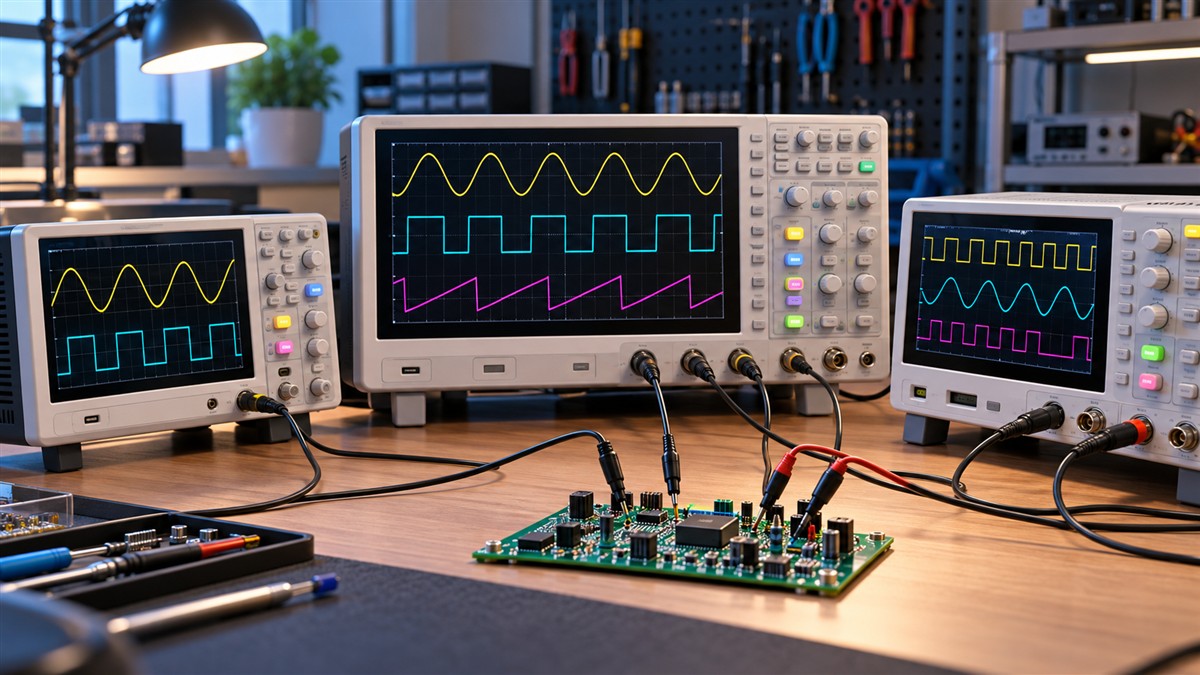
A digital oscilloscope draws voltage against time. That lets you see the shape of a waveform, its frequency, and whether noise sits on top of a steady signal. The trade-off is that a scope needs setup: a time base, a vertical scale, a trigger, and a ground lead connected correctly. A digital multimeter gives one reading at a time. A scope shows what the reading is made of.
Bandwidth is the first number to check because it limits which signals a scope can show faithfully. Sample rate is the second, because it sets how finely the scope captures the signal in time. Keysight’s selection guidance recommends that margin without giving a full derivation in the page we opened. Tektronix’s primer describes a similar relationship between bandwidth and rise time, and gives a range of constants that depend on the shape of the frequency response. The primer also says that the Nyquist theorem gives only a theoretical minimum, and that sampling at twice the highest frequency is usually not enough in practice.
Those rules are general. They do not say that any one listing meets them. For each model below, the check is simple: compare the stated bandwidth with the signal you need to see, then compare the stated sample rate with the stated bandwidth.
How we chose
The nine products come from a single research file, which was checked on 2026-10-27. The file collected listings from three manufacturers. The criteria used here are the figures each listing states in its specification table or its bullet points: bandwidth, sample rate, channel count, memory depth, trigger types, decode support, display size, and included accessories. No figure from memory was added. Where a figure is not in the listing, the table says “not stated”.
Three things about the set should be kept in mind. First, seven of nine products are Siglent, so any comparison here leans toward that brand’s range. Second, the set includes one handheld and one low-bandwidth handheld, which are a different class of instrument from the bench-style models. Third, the research file contains no list of competing models from other manufacturers at the same price point, so this post cannot rank the products against the wider market.
Comparison table
Only figures stated in each listing appear below. “Not stated” means the listing does not give that figure.
| Model (brand) | Bandwidth (listing) | Sample rate (listing) | Channels (listing) | Memory depth (listing) |
|---|---|---|---|---|
| SDS1202X-E (Siglent) | 200 MHz (title) | 1 GSa/s real-time (bullet) | 2 (title) | 14 Mpts (bullet) |
| SDS1104X-E (Siglent) | 100 MHz (title) | Not stated | 4 (title) | Not stated |
| SDS814X HD (Siglent) | 100 MHz (bandwidth table) | 2 GSa/s real-time (table) | 4 (table) | 50 Mpts (bullet) |
| SDS1204X-E (Siglent) | 200 MHz (bullet) | 1 GSa/s (bullet) | 4 (bullet) | 14 Mpts (bullet) |
| SDS1102CML+ (Siglent) | 100 MHz (title) | 1 GSa/s (bullet) | 2 (bullet) | 1 Mpts per channel (bullet) |
| SDS1202X HD (Siglent) | 200 MHz (title) | Not stated | 2 (title) | 10 Mpts for the optional digital channels (table) |
| SDS1052DL+ (Siglent) | 50 MHz (title) | Not stated | Not stated | Not stated |
| ADS5012h (YEAPOOK) | 100 MHz analog (bullet) | 500 MSa/s (bullet) | Not stated | 128 kb (bullet) |
| DSO152 (FNIRSI) | 200 kHz (bullet) | 2.5 MS/s (bullet) | Not stated | Not stated |
Two things stand out in the table. The Siglent models that are stated as 200 MHz or 100 MHz are the only bench-class entries with a bandwidth figure in the title. The two handheld models have much lower sample rates and, in the FNIRSI case, a bandwidth of 200 kHz, which limits them to slow signals.
Product links for the nine models, in the order they appear below:
- SDS1202X-E: View on Amazon
- SDS1104X-E: View on Amazon
- SDS814X HD: View on Amazon
- SDS1204X-E: View on Amazon
- SDS1102CML+: View on Amazon
- SDS1202X HD: View on Amazon
- SDS1052DL+: View on Amazon
- ADS5012h (YEAPOOK): View on Amazon
- DSO152 (FNIRSI): View on Amazon
Bench-class models from Siglent
The seven Siglent listings range from 50 MHz to 200 MHz. The notes below use only the figures each listing states.
SDS1202X-E (200 MHz, 2 channels)
The listing gives 200 MHz and two channels in its title, with a real-time sample rate of up to 1 GSa/s and a record length of up to 14 Mpts. The bullets list serial triggering and decode for I2C, SPI, UART, RS232, CAN and LIN. The listing states product dimensions of 10 x 15 x 17 inches and a weight of 5.5 pounds. The listing does not give a CAT rating. Skip if you need four channels, because this is a two-channel model. Limitation: the listing does not state a bandwidth-to-sample-rate ratio in its bullets, so the check has to be done by hand.
SDS1104X-E (100 MHz, 4 channels)
The title gives 100 MHz and four channels, and the bullets list the same standard decoders as the SDS1202X-E. The listing states that the package includes four passive probes, a USB cable and a calibration certificate. It also mentions 16 digital channels as an optional MSO upgrade. The listing does not give a sample rate, so the sample rate check cannot be completed from this page. Skip if you need a bandwidth above 100 MHz. Limitation: the listing does not state a memory depth.
SDS814X HD (100 MHz, 4 channels, 12-bit)
This listing gives a 12-bit vertical resolution, 4 channels and 100 MHz bandwidth. Its table lists a real-time sample rate of 2 GSa/s and a capture rate of 500,000 waveforms per second. The table also lists a 70 MHz variant and a 200 MHz variant in the same family. The bullet points give 50 Mpts of memory. This is the only Siglent model in the set whose table lists the bandwidth for each family member, so the family figures should be checked against the exact model number before buying. Skip if the 4-channel 100 MHz configuration does not match your signals, since the family table shows other bandwidths. Limitation: the listing gives no CAT rating.
SDS1204X-E (200 MHz, 4 channels)
The bullets give 200 MHz, four channels, 1 GSa/s, and 1 Mpts of FFT memory, with 14 Mpts of memory usable for measurement and math. The listing describes a 7-inch TFT display at 800 x 480 resolution. It lists intelligent triggers including edge, slope, pulse width, window, runt, interval, timeout and pattern. It also lists a vertical scale range from 500 microvolts per division to 10 volts per division. Skip if you need a serial decode function not listed; the listing does not mention serial decode for this model. Limitation: the listing does not state the number of memory points available at each sample rate.
SDS1102CML+ (100 MHz, 2 channels)
The bullets describe a 100 MHz, two-channel model with a maximum real-time sample rate of 1 GS/s and a record length of 1 Mpts on a single channel. The listing lists cursors, math, automatic measurements, a built-in frequency counter, and USB and LAN interfaces. It also says the unit is intended for product design, assembly lines, repair and servicing, and electrical engineering education. Note that the 1 Mpts figure applies to a single channel, so using both channels reduces the usable depth per channel as stated. Skip if you need more than 100 MHz bandwidth. Limitation: the listing does not give a CAT rating.
SDS1202X HD (200 MHz, 2 channels, 12-bit)
The title gives 200 MHz, 12-bit resolution and two channels. The specification table is the most detailed of the set. It lists a long set of trigger types, including edge, slope, pulse width, window, runt, interval, dropout, pattern, video and setup/hold. It also lists serial trigger and decode for I2C, SPI, UART, CAN, LIN, CAN FD (decode only) and FlexRay (decode only). It lists 50+ measurement parameters and an optional 16-channel digital input with up to 1 GSa/s and 10 Mpts. An optional USB arbitrary waveform generator module is listed at 25 MHz and 125 MHz sample rate. The table gives a weight of 12.3 pounds. The listing does not state a real-time sample rate for the analog channels. Skip if you do not need serial decode, because the extra functions add to the decision without changing the basic bandwidth figure. Limitation: the listing states no CAT rating and no analog sample rate.
SDS1052DL+ (50 MHz)
The title gives 50 MHz, and the bullets list USB and LAN interfaces, cursors, math, a built-in frequency counter, automatic measurements, and advanced triggers for isolating specific signals. The listing does not state a channel count, sample rate or memory depth. Because the bandwidth is the lowest in the set, this model is the least suited to fast digital edges. Skip if your signals go above 50 MHz; with the listed bandwidth, the three-times rule from Keysight would limit it to analog signals below about 17 MHz. Limitation: the listing gives few figures beyond bandwidth.
Handheld models: YEAPOOK ADS5012h and FNIRSI DSO152
The two handheld models in the set are very different from each other, and both are different from the bench-class scopes above.
ADS5012h (YEAPOOK, 100 MHz analog, 500 MSa/s)
The bullets give 100 MHz analog bandwidth, 500 MSa/s real-time sampling and a 128 kb record depth. The listing says it can measure peak-to-peak, peak, maximum, minimum, RMS, frequency, cycle and several timing values. The title gives a 2.4-inch TFT display. The listing says the battery is a lithium polymer pack included with the unit, and gives dimensions of 4.5 x 2.9 x 1.4 inches. The listing does not state the number of channels. Skip if you need more than 500 MSa/s or a large record depth, because the listed 128 kb is small compared with the bench models. Limitation: the bandwidth-to-sample-rate ratio is 100 MHz to 500 MSa/s, which is below the four-to-five-times margin Keysight recommends, so fast edges may not be captured faithfully.
DSO152 (FNIRSI, 200 kHz, 2.5 MS/s)
The bullets give 200 kHz bandwidth and 2.5 MS/s real-time sampling. The probe is listed as 10x and is rated for up to 800 V peak-to-peak, which the listing describes as equivalent to 280 V AC, with voltages up to 400 V measured. The listing says the scope supports Auto, Normal and Single trigger modes and has a 2.8-inch HD LCD. The battery is included. The listing does not state a CAT rating for the probe or the unit.
Safety note for this model: a listed maximum voltage on a probe is not a CAT rating. The DSO152 listing gives a voltage capability, but it does not say which measurement category the instrument and probe are rated for. Do not use this scope on mains circuits or on a power panel on the strength of the voltage figure alone. Its sample rate and bandwidth also limit it to slow signals. Skip if you need to see signals above a few hundred kilohertz, or if you need a clearly stated CAT rating for mains work.
What a listing does not tell you
Each listing leaves out figures that affect how a scope performs. The most common gaps in this set are:
- CAT rating: none of the nine listings states a measurement category. Where a probe voltage figure appears, that is not the same as a CAT rating.
- Analog sample rate: several Siglent listings give a sample rate only for the digital option, or give none at all.
- Channel count: the SDS1052DL+, ADS5012h and DSO152 listings do not state a channel count.
- Probe bandwidth: the listings do not state the bandwidth of the probes supplied, which can limit the overall measurement.
- Accuracy and vertical resolution: apart from the 12-bit figure on two Siglent models, the listings give no accuracy specification.
When one of these figures is missing, the honest statement is “the listing does not state this”. It should not be filled in from memory or from a similar model.
Buying checklist
- Write down the fastest signal you plan to view. Multiply it by three for analog work and by five for digital clock work, following Keysight’s guidance. The result is the minimum bandwidth.
- Check the listed sample rate. It should be four to five times the stated bandwidth, following Keysight’s guidance.
- Decide how many channels you need to compare signals at the same time. Two channels are enough for input and output comparison.
- Check the CAT rating in the manufacturer’s manual, not only in the listing. If no CAT rating is stated, do not use the scope on mains circuits.
- Check which probes are included and their rating. The probe, not only the scope, sets the voltage you can measure safely.
- Check whether serial decode, a digital input, or a waveform generator is needed, and whether the listing states it.
Mistakes to avoid
- Buying on bandwidth alone. A 200 MHz scope with a low sample rate can still misrepresent a fast edge. Check both numbers.
- Treating a voltage figure as a safety rating. The DSO152 listing gives a probe voltage capability. That is not a CAT rating, and it does not make the instrument safe for mains work.
- Assuming two channels are enough for every job. The Tektronix primer and the Keysight guidance both point to the number of signals you need to compare as the deciding factor.
- Assuming the family table applies to your exact model. The SDS814X HD listing shows several bandwidths for its family, so the model number must match the figure.
- Reading the listing as a test result. None of these figures comes from an independent test. They are the figures each listing states.
What the sources say about bandwidth and sample rate
Keysight’s selection guidance recommends at least three times the highest sine frequency for analog work, and at least five times the highest clock rate for digital work. It also recommends a maximum sample rate four to five times the real-time bandwidth. The page does not give a separate figure for signals with fast edges but low clock rates, so for those signals this post gives no rule.
The Tektronix primer describes a five-times rule for choosing bandwidth, which it says keeps amplitude error below about 2 percent. It also gives a relationship between bandwidth and rise time, with a constant between 0.35 and 0.45 depending on the frequency response shape. For sampling, the primer says the Nyquist theorem is a minimum, and that a scope should sample at least about 2.5 times the highest frequency component when using sin(x)/x reconstruction, and at least about 10 times when using linear interpolation. Neither source is a product page, and neither compares these nine models.
These rules are applied to the listed figures above, and the results are not a verdict on any model’s measurement quality. The post does not claim that any scope meets the margin in practice.
What we could not verify
- Whether any listed figure is accurate. The post repeats what each listing states and does not check it against an independent source.
- The CAT rating, insulation or measurement category of any model. The listings do not state one, and the post does not supply one.
- The probe bandwidth, probe attenuation accuracy or input impedance for the supplied probes.
- The number of channels, the analog sample rate and the memory depth for the listings that do not state them.
- Whether any model is suitable for a particular automotive, HVAC, or electronics task. The listings do not say, and this post does not assume it.
- How these nine models compare with the full range of digital scopes on the market. The research file covers only these nine products from three manufacturers, and most of them are from one.
FAQ
Is a digital oscilloscope the same as a multimeter?
No. A multimeter shows a single reading such as an average or RMS value. A digital oscilloscope shows the waveform against time, so you can see its shape, frequency and noise. Many electricians and technicians use both, and a scope does not replace a meter rated for the circuit.
Which bandwidth should I choose?
Start with the fastest signal you need to see. Keysight recommends at least three times that frequency for analog work, and at least five times the clock rate for digital work. Among the listings above, the models with 200 MHz or 100 MHz stated bandwidth meet those rules for slower signals, but each check depends on the signal you are measuring.
Why do some listings not state a sample rate?
The listing may leave it out, or give it only for an optional module. The post does not fill that gap. If the sample rate is missing, ask the seller or the manufacturer for the specification sheet before buying.
Are the handheld scopes safe to use on mains?
The listings do not state a CAT rating for the handheld models, so this post does not treat them as mains-rated. Work on mains circuits, power panels and service equipment can kill. That work belongs to a licensed electrician.
Why is most of the data from one manufacturer?
The research file collected seven Siglent listings, one YEAPOOK listing and one FNIRSI listing. This post reports that mix as it is. The data does not show how the whole market is distributed by brand, and no general conclusion about the market should be drawn from it.
Should I buy the scope with the most channels?
Only if you need to compare that many signals at once. Keysight says the number of channels depends on how many signals you need to observe and compare. More channels usually add cost, so choose the count your work needs.
Related guides
For a general introduction to what a scope shows, read our review of a handheld oscilloscope multimeter, which explains where a combined tool fits compared with a dedicated scope. For a meter-only check of voltage and continuity, see our guide to auto-ranging multimeters. Both guides cover the safety limits that apply to any test instrument.
Bottom line
Pick the bandwidth first, check the sample rate second, and count the channels you need third. Use the listing only for the figures it states, and treat a missing CAT rating as a reason not to use the instrument on mains circuits. The nine models here are mostly Siglent, so the comparison is a comparison within that range, not a verdict on digital scopes as a whole.
Sources
- Keysight Technologies, “Tips: How to Select an Oscilloscope Before you Buy – Part I”, keysight.com blog, dated 2020-08-25, opened 2026-10-27. https://www.keysight.com/blogs/tech/bench.entry.html/2020/08/25/tips_on_how_to_selec-2q2u.html
- Tektronix, “Evaluating Oscilloscopes”, primer chapter 3, tek.com.cn, copyright 2026, opened 2026-10-27. https://www.tek.com.cn/document/online/primer/xyzs-scopes/ch3/evaluating-oscilloscopes