How to Test an E-Scooter Battery With a Multimeter
As an Amazon Associate we earn from qualifying purchases.
How to test an e scooter battery with a multimeter comes down to one low-voltage check: set the meter to DC volts, read the pack’s resting voltage with the scooter off and no load, and compare the reading with the value for the pack’s series count. A resting reading gives a rough idea of how much charge the pack holds. It does not show capacity, long-term health, or where the pack’s cutoff sits.
Electrical safety comes first
Work on mains circuits can kill. Before you measure anything, check that the meter’s CAT rating suits the circuit you are testing, and read the rating from the listing or the manufacturer’s manual. Panel and service work belongs to a licensed electrician.
This guide is limited to a scooter battery pack that is already off the charger and disconnected from the scooter’s electrical system. It does not cover mains charging, wall outlets, chargers plugged into the wall, or any work on a panel. If a charger, cord or outlet is part of the problem, stop and take the item to a qualified technician.
Fluke’s safety guide says that shock occurs when the human body becomes part of an electrical circuit. It also says to choose a tool rated for the highest category you could potentially use it in, and to assume every electrical component is energized until it has been positively discharged.
Read the CAT rating from your meter’s label or manual before you start. The sources in this draft do not state a CAT rating for any particular meter, so this draft does not name one.
Quick answer
- Turn the scooter off and disconnect the battery from the scooter, following the scooter’s manual for the disconnect steps.
- Set the meter to DC volts and use a range that is above the pack’s full voltage.
- Place the red probe on the positive terminal and the black probe on the negative terminal.
- Read the resting voltage with no load on the pack, then compare it with the table for the pack’s series count.
What to have ready
You need a digital multimeter that can read DC volts above the pack’s full voltage. A 36 V pack reaches about 42 V when full, and a 48 V pack reaches about 54.6 V, so a meter range that tops out at 20 V is too low for either pack. Fluke’s DC voltage guide says that if you are unsure which range to use, start with the setting that handles the higher voltage. The sources do not say which range a particular meter needs, so check the range table in your meter’s own manual.
Have the scooter’s manual or the battery label at hand. The label or manual usually gives the pack’s rated voltage and the number of cells in series. The series count matters because it decides which voltage table applies. The sources in this draft use the same convention: the 36 V label is a 10-cell pack, and the 48 V label is a 13-cell pack, at 3.6 V nominal and 4.2 V full per cell.
Plan the test for a time when the pack has been charged and then left alone. Battery University’s state-of-charge guide says the battery needs to rest in the open circuit state for at least four hours before the voltage reflects its state of charge. The same page says that charging or discharging just before the reading disturbs the voltage, so a reading taken straight after a ride or a charge is not a clean number.
Step-by-step resting voltage check
Step 1: Turn the scooter off and disconnect the pack. Levy Electric’s scooter guide says to make sure the scooter is turned off and the battery is disconnected from the scooter’s electrical system before measuring. The same guide does not describe model-specific disconnect steps, so use your scooter’s manual for the connector or the mounting arrangement.
Step 2: Let the pack rest. Leave the pack unloaded for a while before the reading. Em3ev’s chart says voltage should ideally be checked after the battery has rested with little or no load. Battery University recommends at least four hours in the open circuit state. Em3ev gives no time period, so the four-hour figure from Battery University is the one this draft uses.
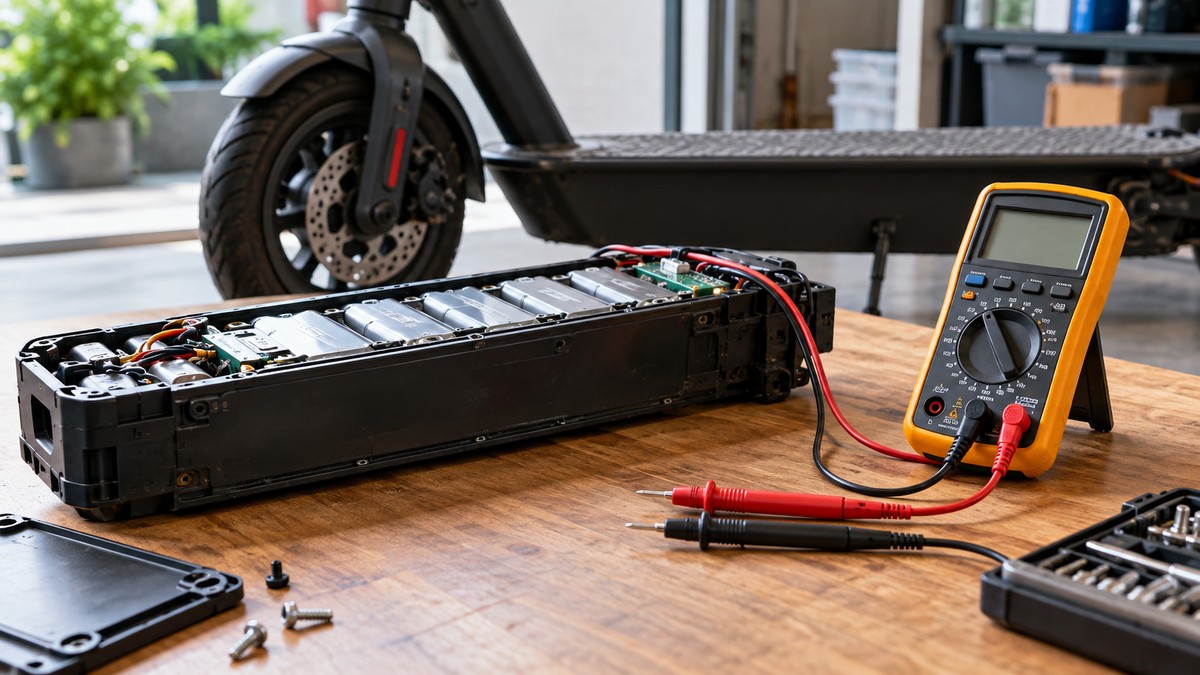
Step 3: Set the meter. Turn the dial to DC volts. Fluke’s battery guide says to select a range that suits the battery, and to use MIN/MAX or AutoHOLD to catch a reading that moves. Insert the black lead into the COM jack and the red lead into the V jack. Choose a range that reads above the pack’s full voltage.
Step 4: Place the probes. Fluke’s DC voltage guide says to connect the black probe to the negative test point and the red probe to the positive test point. For a scooter pack, touch the red probe to the positive terminal and the black probe to the negative terminal.
Step 5: Read the voltage. Wait for the display to settle. If the reading keeps moving, use MIN/MAX or AutoHOLD to hold the value. Write down the number with the pack’s series count and the date.
Step 6: Compare with the table. Use the table in the next section. Find the row for your pack’s series count and the nearest percentage. Do not use the 12 V lead-acid values from Fluke’s battery page for a lithium scooter pack, because those values belong to a different chemistry.
Step 7: Reconnect carefully. When you finish, remove the probes in reverse order: the red lead first, then the black, as Fluke’s DC voltage guide describes. Reconnect the pack by following the scooter’s manual.
Reading the result
The RiderGuide chart gives resting voltages for common lithium-ion packs. It says the table applies to most lithium-ion packs with a 3.6 V nominal cell, 4.2 V full and 3.0 V empty. Those figures are shown below for a few steps of charge level.
| Charge level | 36 V pack (10 cells) | 48 V pack (13 cells) |
|---|---|---|
| 100% | 42.0 V | 54.6 V |
| 80% | 39.6 V | 51.5 V |
| 60% | 37.2 V | 48.4 V |
| 40% | 34.8 V | 45.2 V |
| 20% | 32.4 V | 42.1 V |
Source: RiderGuide chart, values as printed on the page. The percentages are the chart’s estimates. Em3ev says its percentage column is based on resting voltage and should be treated as estimates rather than exact state-of-charge measurements.
A reading close to the 100% value for your series count means the pack is near full and resting. A reading near the 20% value means the pack is low, and it may need charging before you use it. The sources do not give a single figure that identifies a failed pack. Treat a large gap from the table as a reason to look more closely at the pack, not as a diagnosis.
For a per-cell check, Levy Electric’s guide says a fully charged lithium scooter cell shows around 4.2 V, and that anything below 3.5 V per cell usually means the battery needs charging. This is one retailer’s figure. The chart from em3ev uses the same 4.2 V full value, so the two sources agree on the top of the range, but the 3.5 V figure is not confirmed by a second source in this draft. The sources do not give a per-cell threshold for failure.
If your reading is much higher than the table value for your series count, check the series count first. A pack labelled 48 V can have 13 cells, and the sources in this draft also show 14-cell 52 V and 16-cell 60 V packs. Count the rows on the label before you compare.
Why the reading can be misleading
A resting reading is only as good as the conditions around it. Em3ev notes that loaded voltage can temporarily fall because of voltage sag, so a reading taken while the scooter is switched on or while a load is attached is lower than the resting value. Battery University says that charging or discharging a battery just before the reading disturbs the voltage, and the voltage then no longer represents the state of charge.
A pack is a chain of cells in series, and Battery University explains that each cell adds its voltage to reach the total terminal voltage. It also says a battery is only as strong as its weakest link. A pack with one weak cell can show a total voltage that looks acceptable while the weak cell limits the pack’s usable energy. A resting voltage on the terminals cannot show which cell is weak.
Em3ev also says low-voltage cutoff varies by battery management system and controller, so there is no universal empty-voltage setting. The sources in this draft do not give a cutoff value for any particular scooter. Do not treat a figure such as 39 V as a universal cutoff. Em3ev states directly that 39.0 V should not be used as a universal low-voltage cutoff.
Common mistakes
- Testing with the scooter on. A loaded reading sags. Measure with the scooter off and the pack unloaded, as the Step 2 sources describe.
- Reading straight after a ride or a charge. Battery University says the voltage is disturbed by recent charging or discharging, so wait for the rest period.
- Using the wrong chart. Fluke’s 12.6 V figures are for 12 V lead-acid batteries. A lithium scooter pack should be compared with a lithium table for its series count.
- Starting on a low range. Fluke’s DC voltage guide says that if you are unsure, start with the setting that handles the higher voltage.
- Misreading the sign. Fluke’s DC voltage guide says most modern multimeters show a minus sign when the leads are reversed. Read the sign before you record the value.
- Ignoring the terminals. Fluke’s battery guide says to inspect the terminals for corrosion or looseness before testing.
Frequently asked questions
Can I test the pack while the scooter is switched on?
You can measure the voltage while the scooter is on, but that is a loaded reading. Em3ev says loaded voltage can temporarily fall because of voltage sag, so the number will be lower than the resting value. Use the resting reading to compare with the table, and treat a loaded reading as a separate check.
Do I need to disconnect the battery first?
Levy Electric’s guide says to make sure the battery is disconnected from the scooter’s electrical system before measuring. The guide does not give model-specific steps, so the scooter’s manual is the source for how to disconnect the pack safely.
What meter range should I use for a 36 V or 48 V pack?
Choose a DC volts range that reads above the pack’s full voltage. A 36 V pack reaches about 42 V when full, and a 48 V pack reaches about 54.6 V. Fluke’s DC voltage guide says to start with the setting that handles the higher voltage if you are unsure. The sources do not name a specific range for a specific meter.
Is a 39 V reading on a 48 V pack empty?
The sources do not give a universal empty voltage. Em3ev lists 39.0 V as the theoretical lower end of its 13-cell chart and says not to use it as a universal cutoff, because the cutoff depends on the battery management system and the controller. A reading near that value means the pack is low, and the scooter’s manual is the place to check its cutoff.
Does a voltage reading show how long the pack will last?
No. A resting voltage gives a rough state of charge, not capacity or remaining ride time. Battery University says voltage-based state-of-charge measurement is impractical for a battery in active duty, because the battery must rest first. The sources in this draft do not give a method for measuring capacity with a multimeter.
How we chose
The method uses the steps that the sources state for a resting voltage check: the scooter off, the pack disconnected, DC volts selected, the pack unloaded for a rest period, and a reading compared with a table for the pack’s series count. Each step is tied to a source. The lithium chart values come from RiderGuide, the caveats come from em3ev, and the rest-period and disturbance points come from Battery University. The shock mechanism and CAT advice come from Fluke’s safety guide. The sources were fetched on 2026-10-21. No meter model is recommended in this draft, and no product is ranked.
What we could not verify
The sources do not give a rated voltage, disconnect steps or connector layout for any specific e-scooter model. The manufacturer’s manual for the scooter or the pack is the only source for those details, and the draft does not guess them. The sources in this draft also do not give LiFePO4 voltage values, because the LiFePO4 chart that was searched could not be opened. A LiFePO4 pack needs its own table, and the figures in this draft do not apply to it.
No source opened for this draft gives a CAT rating for a specific meter, so the draft does not name one. The sources do not give a cutoff voltage for any scooter pack, and they do not give a per-cell failure threshold. The 3.5 V per cell figure comes from one retailer and is not confirmed by a second source here. The sources also do not give a method for measuring pack capacity with a multimeter.
Related guides
For a general buying guide for multimeters, see the multimeter buying guide. For meters that read battery voltage with a dedicated function, see the battery voltage tester options. For load testing, see the load tester options.
Sources
- Fluke, How to Measure Battery Voltage with a Multimeter. https://www.fluke.com/en-us/learn/blog/digital-multimeters/how-to-test-a-battery-with-a-multimeter
- Fluke, How to Measure DC Voltage with a Digital Multimeter. https://www.fluke.com/en-us/learn/blog/digital-multimeters/how-to-measure-dc-voltage-with-a-digital-multimeter
- Fluke, Guide to digital multimeter safety. https://www.fluke.com/en-us/learn/blog/safety/multimeter-guide
- Levy Electric, How to Test an Electric Scooter Battery with a Multimeter: A Step-by-Step Guide. https://www.levyelectric.com/resources/how-to-test-an-electric-scooter-battery-with-a-multimeter-a-step-by-step-guide
- RiderGuide, Electric Scooter Battery Voltage Chart. https://riderguide.com/guides/electric-scooter-battery-voltage-chart/
- Em3ev, 48V Battery Voltage Chart for eBikes: 13S Charge Levels. https://em3ev.com/?p=43307
- Battery University, BU-903 How to Measure State-of-charge. https://batteryuniversity.com/article/bu-903-how-to-measure-state-of-charge
- Battery University, BU-302 Series and Parallel Battery Configurations. https://batteryuniversity.com/article/bu-302-series-and-parallel-battery-configurations