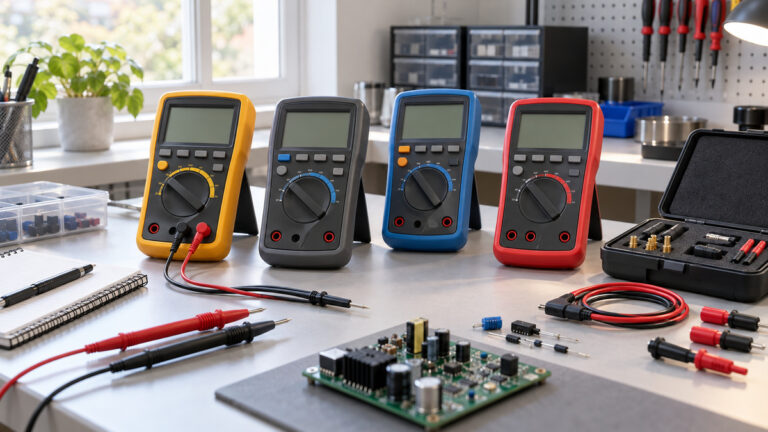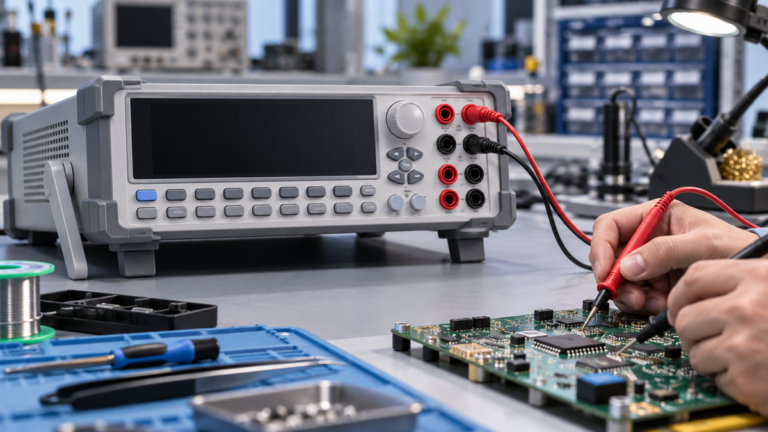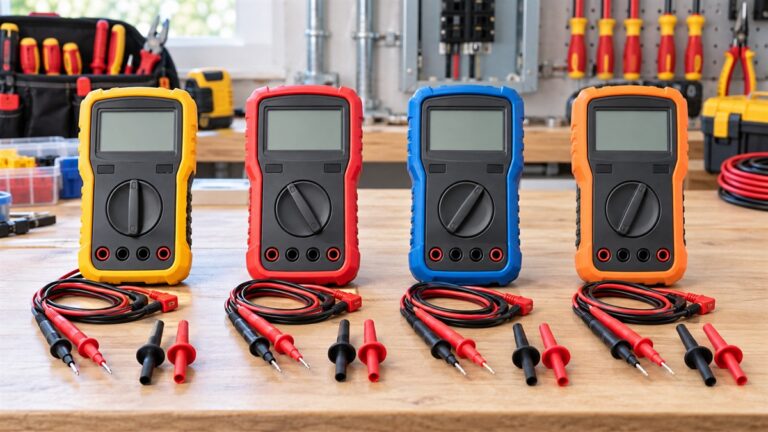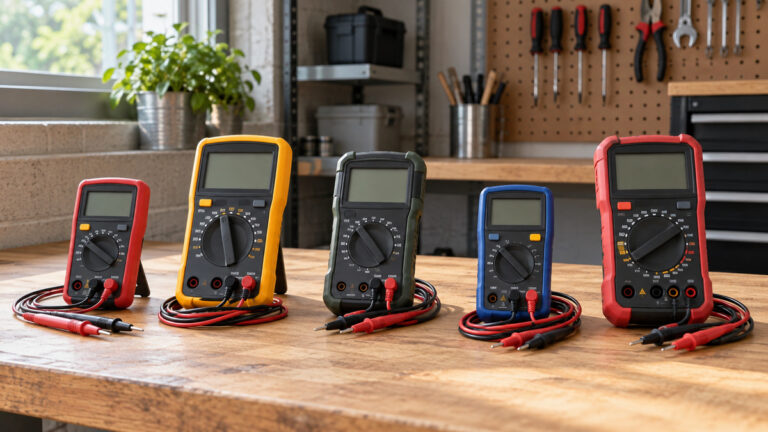
Best Amp Meter Tester: Clamp and Multimeter Picks Compared
As an Amazon Associate we earn from qualifying purchases. Details
Work on mains circuits can kill, so the CAT rating of any meter you use must suit the circuit you are measuring, and panel, service or main-breaker work belongs to a licensed electrician. The person typing best amp meter tester wants a meter that reads current in amps, and wants to know whether that meter is rated for the circuit in front of them. A clamp meter reads AC current around one conductor. A multimeter reads current only in series, with its own fuse. This guide compares six listings by the current ranges, counts and CAT ratings they state, and says where each listing leaves a figure out.
Quick answer
- For AC current with a clamp, the AstroAI CM2K0R and the AstroAI CM4K0R both state a CAT.III 600V rating in their safety line. Neither listing states a CAT IV rating for the meter.
- For AC and DC current with a clamp at higher ranges, the Temirup CM83E lists 60A and 600A ranges for both, and its specification line names CAT IV 600V.
- For a fused handheld meter that reads DC current on small ranges, the AstroAI AM33D lists 200µA, 200mA and 10A ranges, with fuses named for the mA and 10A jacks.
- The FNIRSI DMC-100 is the pick built around graphing and logging. Its listing does not state a CAT rating, so do not use it on mains circuits on the listing alone.
- Do not clamp a conductor to measure voltage. The CM2K0R listing says so directly.
Electrical safety first
The mandatory safety frame has three parts. Each one follows from the listings or from a source this guide opened.
First, the CAT rating describes the place in the installation where the meter may be used, not the meter alone. Tester.co.uk puts it this way: “You need a CAT III-rated tester to measure fixed or hard-wired equipment such as general wiring, bus bars, junction boxes, switches, socket outlets, etc.” It also says: “CAT IV is the highest safety rating available. It is necessary when testing any equipment or systems directly connected to a building’s source of power.” A meter rated for a lower category should not be used at a point where the category is higher. Tester.co.uk also notes that “CAT II testers are used to check household appliances, portable tools and similar modules.”
Second, the rating has to be stated. Not every listing in this set states one. Where a listing gives no CAT rating, this guide writes “the listing does not state a CAT rating” and does not treat that meter as suitable for household mains. Some listings name a CAT rating only in the test-lead text or in a bullet, not in the meter’s own specification line. Those cases are called out in the table and in each pick.
Third, the work limits come from the rules that apply to workers on electrical equipment. The OSHA rule at 29 CFR 1910.333(a)(1) says: “Live parts to which an employee may be exposed shall be deenergized before the employee works on or near them.” A meter does not change that rule. If the work involves a panel, a service entrance or any part of the supply side, it belongs to a licensed electrician.
Comparison table
The table uses only the figures each listing states. A cell that the listing does not give reads “not stated”. Counts come from the title or the specification line, whichever the listing gives.
| Product (ASIN) | Type | Counts | AC current | DC current | CAT rating as stated | Warranty as stated |
|---|---|---|---|---|---|---|
| AstroAI CM2K0R | Clamp meter | 2000 | 2A/20A/200A/400A | Not stated; bullet says it cannot test DC current | CAT.III 600V | Not stated |
| AstroAI AM33D | Handheld multimeter | 2000 | Not a clamp; bullet says it cannot test all AC current | 200µA/200mA/10A | CAT II 600 V; CAT III 300 V | 3 Year Warranty by AstroAI |
| AstroAI CM4K0R | Clamp meter | 4000 | 40A/400A | 40A/400A | CAT.III 600V | Not stated |
| FNIRSI DMC-100 | Clamp meter with graphing | 9999 (title); 10000 (bullet) | AC current up to 600A (bullet) | DC current up to 600A (bullet) | Not stated | Not stated |
| Temirup CM83E | Clamp meter | 6000 | 60A/600A | 60A/600A | Specification line: Cat Iii 600v, Cat Iv 600v, Cat Iii 1000v. Bullet: CAT III 600V | 2 year manufacturer |
| Klein Tools CL120 | Clamp meter | Not stated | Clamp measures AC current | Not stated | Not stated for the meter; the test leads carry CAT III/CAT IV safety caps | See Manufacturer website |
Three rows need a note. The AstroAI AM33D conflicts with itself on sampling speed: its specification line says “3 Times Per Second”, while its bullet says “This Multimeter has a sampling speed of 2 times per second”. The listing does not say which figure is correct, so this guide shows the conflict and does not choose one. The Temirup CM83E gives CAT IV 600V in its specification line but names only “CAT III 600V” in its bullet. The Klein CL120 places its CAT III and CAT IV wording on the test-lead caps, so the meter’s own rating is not stated.
How to read the specification lines
Most of these listings write accuracy as a percentage plus a digit term, such as “±(2.5%+5)” for the CM2K0R’s AC current range or “±(1.0%+3)” for the AM33D’s resistance. The listings do not explain the digit term, and no source this guide opened explains it either. This guide therefore quotes the figures as written and does not translate them into a per-reading error.
Ranges are another place where the listing wording matters. The CM2K0R and CM4K0R list “Auto or Manual” range selection. The AM33D lists “Manual”. The CM83E bullet says “Automatic Range” is a feature. A reader who expects automatic ranging should check which models the listing describes that way and which it leaves manual.
Counts are written in different ways. The AM33D’s specification line describes “2000 Counts” and adds that “The unit symbols will automatically appear according to the measured functions.” The CM4K0R lists “3 ¾, 4000” for its display. The DMC-100’s title and unit count say 9999, while its first bullet says “10000 Counts TRMS Clamp Meter”. A count is one figure among several and does not say how far a meter reads, so this guide reports counts as stated and does not rank meters by count.
Current ranges set the lower limit of what a meter can read in amps. The CM2K0R starts at 2A, the CM4K0R and CM83E start at 40A and 60A, and the AM33D starts at 200µA on its DC range. A reader who expects to measure a few milliamps needs a range that starts that low, and the clamp listings in this set do not give one.
The picks
The picks are ordered by the job they fit, not by any ranking. None of them is recommended for mains work beyond what its own listing states.
AstroAI CM2K0R clamp meter
Best for: AC current checks with a clamp, where the circuit is one the listing’s CAT III 600V rating covers.
Strengths, from the listing: the Safety/Compliances line says “CAT.III 600V; Pollution Level: 2; Altitude <2000m”. The AC current ranges are “2A/20A/200A/400A, 50~60Hz”. The meter has “Auto or Manual” range selection and a “Beep” continuity function. Two 1.5V AAA batteries are included. The bullets list data hold, max/min, auto shut-off, a backlit screen and a flashlight.
Limits, from the listing: the first bullet says “This CM2K0R clamp meter can not test DC Current.” The same bullet says the clamp jaw “is only used to measure current” and warns “Do not measure voltage by clamping the conductor being measured.” The listing does not state a warranty.
Skip if: you need DC current. The listing says this model cannot test it.
AstroAI AM33D digital multimeter
Best for: a fused handheld meter for DC current checks on small ranges, with test leads placed in series.
Strengths, from the listing: the DC current line reads “200µA/200mA/10A ±(1.2% +3)”. The fuse line reads “mA: F250 mA/250 V Fuse;10 A: F10 A/250 V Fuse”. The environmental line gives “CAT II 600 V; CAT Ill 300 V” and pollution level 2. The listing names a “3 Year Warranty by AstroAI”. Its bullets mention a backlit LCD, a continuity buzzer, data hold and a silicone cover.
Limits, from the listing: the bullet says “this meter can not test all AC Current and below 100mV AC Voltage.” Range selection is “Manual”. The sampling speed conflict described above applies here too.
Skip if: you need a clamp. This model uses test leads, and the listing does not describe a jaw.
AstroAI CM4K0R clamp meter
Best for: AC and DC current at the higher end, with frequency and duty cycle checks in the same meter.
Strengths, from the listing: the DC current line is “40A/400A ±(2.5%+5)” and the AC current line is “40A/400A 50~60Hz : ±(2.5 +5)”. The frequency line lists “40Hz/400Hz/4kHz/40kHz/400kHz/4MHz”. The safety line reads “CAT.III 600V; Pollution Level: 2; Altitude <2000m”. A bullet describes a ZERO function that “decreases the data error influenced by the Earth’s magnetic field”. The listing says the meter auto powers off “after 15 minutes inactivity”.
Limits, from the listing: the current ranges start at 40A, so the listing gives no range for small currents. The listing does not state a CAT IV rating. The listed weight is “Approx. 205g”.
Skip if: you need milliamp or small DC readings. The listed ranges begin at 40A.
FNIRSI DMC-100 clamp meter
Best for: logging current over time, using the on-screen graph and the built-in rechargeable battery.
Strengths, from the listing: the first bullet describes a “10000 Counts TRMS Clamp Meter” for “AC/DC current up to 600A”. The second bullet says the meter “stores 8 sets of real-time data plus 30 sets of historical records”. The display is a “2 inch TFT full-color display with 10-level adjustable brightness”. The battery is a “1500mAh lithium battery” with Type-C charging. The specification line includes “Ul 61010-1, Ce Marked, Rohs Compliant”.
Limits, from the listing: the listing does not state a CAT rating. Its last bullet says: “Voltage measurement must be performed with the test leads. The clamp jaws are for current measurement only.” The counts figure differs between the title and unit count (9999) and the first bullet (10000).
Skip if: you need a CAT rating on the meter before any mains use. The listing does not state one.
Temirup CM83E clamp meter
Best for: AC and DC current up to 600A, in a clamp with a backlit screen and a specification line that names CAT IV 600V.
Strengths, from the listing: the AC current line is “60A/600A ±(3.0%+10dgt)” and the DC current line is “60A/600A ±(3.0%+10dgt)”. The specification line reads “Iec 61010-1, Cat Iii 600v, Cat Iv 600v, Cat Iii 1000v”. The temperature range is “-20℃~1000℃”. The listing names a “2 year manufacturer” warranty. The bullets describe an LED flashlight, a backlit screen and a non-contact voltage alarm.
Limits, from the listing: the current ranges begin at 60A. The bullet says “CAT III 600V” and does not mention CAT IV, so the two statements disagree and the listing does not explain the difference. The part number in the specification line is “MESTEK”, while the model is “CM83E-Red”.
Skip if: you need small-current readings, or you need one CAT statement that matches across the whole listing.
Klein Tools CL120 clamp meter
Best for: AC current by clamp, from a known brand, with a lead holder and an optional magnetic hanger for hands-free work.
Strengths, from the listing: the first bullet says the meter “Measures AC current and NCVT via clamp; AC/DC voltage, resistance, and continuity via test-leads”. The listing names “Auto-ranging technology”, a “BACKLIT DISPLAY” and “Max, Data Hold capability”. The meter auto powers off “after 10 minutes” to conserve battery life. The package includes “test leads with CAT III/CAT IV safety caps” and “3 x AAA batteries”. The optional magnetic hanger is listed as “Cat. Nos. 69445 or 69417”.
Limits, from the listing: the listing does not state the meter’s own CAT rating. The CAT III and CAT IV wording refers to the test-lead caps. The listing gives no counts figure and no DC current range. For warranty it says “See Manufacturer website”.
Skip if: you need DC current, or you need a CAT rating for the meter itself.
How we chose
The research record for this query kept 12 listings. Nine are clamp meters, three are handheld multimeters, and six are picked below. The picks are the listings that state a current range, a counts figure or a CAT rating that a reader can check against the job. The rest are left out for reasons given in the How we chose section.
The product list came from the research record for this query, collected on 2026-10-23. The scan kept 12 listings, and this guide features 6 of them. Each listing was read for three things: a stated current range, a stated counts figure and a stated CAT rating. A listing was kept in the picks when it gave at least a current range plus a rating or a count that could be checked against the job. A listing was left out when it described a current range only in a title, when its current figures came with a note that the meter cannot read the current type the reader would need, or when its CAT rating sat only in a bullet that the specification line did not repeat.
The clamp meters left out were the Klein CL220, the ANENG ST181, the Proster PDM-6000NCV and the ruicebao K2026A. The CL220 listing gives AC current through the clamp and no DC range, and no CAT rating for the meter. The ANENG listing says its clamp “can measure only for AC current (not for DC current)” and gives no CAT rating. The Proster listing describes its jaw as measuring “AC current up to 28mm” and gives no CAT rating, only “Ul 61010-1, Iec 61010-2-030” as standards. The ruicebao listing states “CAT III 600V” only inside a bullet, while its specification line gives no CAT rating, so this guide did not use the bullet as the rating for the meter.
The non-clamp multimeters left out were the ANENG SZ301 and the LJPXHHU XL830L. Neither listing states a CAT rating, and neither describes a clamp.
The date the listings were read matters because listings change. The figures above are what the listings showed on 2026-10-23. A reader should check the live listing before buying.
What we could not verify
The sources this guide opened do not give a CAT rating for any specific product. They explain what CAT II, III and IV mean and where each applies. They do not tell a reader whether a particular meter is rated for a particular circuit. That decision rests on the meter’s own label and manual, which are not among the sources here.
The listings leave out several figures a buyer may want. Only the AM33D and the CM83E state a warranty term. The CM2K0R, CM4K0R and DMC-100 state none, and the CL120 points to the manufacturer website. No listing in this set gives a maximum voltage for a clamp jaw, a jaw diameter for the CM2K0R, or a battery life figure that a reader could compare across models.
Some listings disagree with their own text. The AM33D gives a sampling speed of 3 times per second in one place and 2 times per second in another. The CM83E gives CAT IV 600V in its specification line and CAT III 600V in its bullet. The DMC-100 gives 9999 counts in its title and unit count and 10000 counts in a bullet. This guide shows both figures where they appear and does not choose one silently.
The sources do not explain the digit term in the accuracy figures, so this guide quotes them without translating them.
Reading current with a clamp versus a multimeter
A clamp meter reads AC current from around one conductor. The CM2K0R bullet says: “To measure the AC Current you need to clamp the meter around one of the wires and not the whole power cord.” The CM83E bullet makes the same point: “To measure the current you need to clamp the meter around one of the wires and not the whole power cord.” The CM2K0R bullet also asks that the conductor sit in the center of the clamp head.
A multimeter reads current in a different way. The SparkFun tutorial, which this guide opened, explains that “to measure current you have to physically interrupt the flow of current and put the meter in-line.” It adds that the 10A port is “the special port used when measuring large currents (greater than 200mA).” That is why the AM33D and the other handheld meters in this set list separate milliamp and amp ranges, and why their listings give separate fuse ratings for those ranges.
Because a multimeter sits in the circuit, its listed fuse rating and its listed current range are the limits to check before use. The sources here do not describe what happens when those limits are exceeded, so this guide does not say.
Buying checklist
Before buying a meter for amp readings, check these points on the listing and on the meter’s own label. Each one comes from the picks above.
- Does the listing give a CAT rating for the meter itself, in the specification line or on the label? If not, the listing does not state a CAT rating, and the meter should not be used on household mains on the listing alone.
- Does the listing give a current range that includes the current you expect? A clamp that starts at 40A or 60A will show no reading for a small load.
- Does the listing say whether the meter reads DC current? The CM2K0R does not, and the ANENG ST181 does not.
- If you need a multimeter for current, does the listing name a fuse for the current range and its rating? The AM33D does.
- Does the listing give a warranty term? Four of the six picks do not.
- Do the title, the unit count and the bullets agree on the counts figure? The DMC-100 does not.
Mistakes to avoid
Do not clamp a conductor to read voltage. The CM2K0R bullet warns: “Do not measure voltage by clamping the conductor being measured.”
Do not clamp the whole cable. The CM2K0R and CM83E bullets both say to clamp around one wire “and not the whole power cord.”
Do not trust a CAT rating that appears only in a test-lead description. The CL120 listing refers to CAT III and CAT IV on the test-lead caps, not on the meter. A rating for the leads is not a rating for the meter.
Do not place a multimeter in current mode across a source. The SparkFun tutorial says current is measured “in-line”, which means the meter becomes part of the circuit.
Do not assume a meter’s range covers your load. Check the listed range before use, because the clamp listings here start at 40A or 60A.
FAQ
What does the CAT rating on a meter mean?
The CAT rating names the category of the place where the meter may be used. Tester.co.uk says CAT IV “is necessary when testing any equipment or systems directly connected to a building’s source of power.” CAT III applies to fixed wiring such as “general wiring, bus bars, junction boxes, switches, socket outlets.” CAT II testers “are used to check household appliances, portable tools and similar modules.” Each listing states which rating it has, if any.
Can a clamp meter read DC current?
Some can and some cannot. The CM2K0R listing says it cannot test DC current. The CM4K0R and CM83E list DC current ranges, and the FNIRSI DMC-100 bullet describes AC/DC current up to 600A. The ANENG ST181 listing says it measures only AC current.
Why does the table say “not stated” so often?
Because the listing does not give the figure. A cell is marked “not stated” when neither the title, the specification line nor a bullet gives it. This guide does not fill a blank from memory.
Is a multimeter the same as a clamp meter for amps?
No. A multimeter in current mode sits in series, and its current jack is fused. A clamp meter reads current around a conductor without breaking the circuit, according to the clamp bullets in this set. The SparkFun tutorial describes the series method, and the clamp listings describe the clamp method.
Which pick should a homeowner use on a household circuit?
The listings in this set do not give a safe answer for household mains. Several picks state a CAT III 600V rating, but a rating alone does not decide whether a meter suits a particular circuit, and mains work belongs to a licensed electrician. This guide does not recommend a meter for household mains.
What if the listing and the meter disagree?
Use the meter’s own label and manual, and do not use a meter whose listing conflicts with itself until the conflict is resolved. The AM33D and CM83E listings show such conflicts in their own text.
Bottom line
Choose a clamp meter when you need AC current without breaking the circuit, and choose a fused multimeter when you need small DC current in series. Before buying, confirm the CAT rating, the current range and the current type on the listing. If the listing does not state a CAT rating, the meter is not a choice for mains work on the listing alone. For a primer on the continuity function, see the continuity tester guide, and for a non-contact check before any clamp use, see the non-contact voltage detector guide. Neither guide replaces the electrician’s role on mains work..
1. AstroAI Digital Clamp Meter Multimeter 2000 Counts Amp Voltage Tester Auto-ranging with AC/DC (AstroAI CM2K0R clamp meter, 2000 counts)
Pros
- Safety/Compliances line states CAT.III 600V; Pollution Level: 2
- AC current ranges 2A/20A/200A/400A, 50~60Hz
- Auto or Manual range selection
- Two 1.5V AAA batteries included
Cons
- Listing says it can not test DC current
- Clamp jaw is only used to measure current; do not measure voltage by clamping
Best for: AC current checks with a clamp on circuits that the listing's CAT III 600V rating covers
Skip if: you need DC current, which the listing says this model cannot test
View on Amazon (affiliate link)
2. AstroAI Digital Multimeter Tester 2000 Counts with DC AC Voltmeter and Ohm Volt Amp Meter; Measures (AstroAI AM33D digital multimeter, fused)
Pros
- DC current 200µA/200mA/10A
- Fuse protection F250 mA/250 V and F10 A/250 V
- Environmental line states CAT II 600 V; CAT III 300 V
- 3 Year Warranty by AstroAI
Cons
- Bullet says this meter can not test all AC current and below 100mV AC voltage
- Range selection is manual
- Sampling speed conflicts: 3 times per second in specification, 2 times per second in bullet
Best for: DC current checks on small fused ranges with test leads
Skip if: you need a clamp; this model uses test leads
View on Amazon (affiliate link)
3. AstroAI Digital Clamp Meter Multimeter 4000 Counts Auto-ranging Amp Tester Measuring AC/DC Voltage (AstroAI CM4K0R clamp meter, 4000 counts)
Pros
- DC current 40A/400A and AC current 40A/400A
- Frequency and duty cycle functions listed
- ZERO function listed to reduce error from Earth's magnetic field
Cons
- Current ranges start at 40A, so no small-current range is listed
- Listing does not state a CAT IV rating
- Auto power off after 15 minutes of inactivity
Best for: AC and DC current at the 40A to 400A range with frequency checks
Skip if: you need milliamp or small DC readings
View on Amazon (affiliate link)
4. FNIRSI DMC-100 Clamp Meter 9999 Counts TRMS, 600A AC/DC Amp Meter (FNIRSI DMC-100 clamp meter with graphing)
Pros
- Bullet describes AC/DC current up to 600A with TRMS
- Stores 8 sets of real-time data plus 30 sets of historical records
- 1500mAh lithium battery with Type-C charging
- Specification line lists UL 61010-1, CE marked, RoHS compliant
Cons
- Listing does not state a CAT rating
- Voltage must be measured with the test leads; clamp jaws are for current only
- Counts figure differs between title (9999) and bullet (10000)
Best for: logging current over time with a graph and a rechargeable battery
Skip if: you need a CAT rating on the meter before mains use; the listing does not state one
View on Amazon (affiliate link)
5. Digital Clamp Meter Multimeter, TRMS 6000 Counts 600A Current Amp Volt Meter, Auto-Ranging Voltage (Temirup CM83E clamp meter, 6000 counts, 600A)
Pros
- AC current 60A/600A and DC current 60A/600A
- Specification line lists Cat Iii 600v, Cat Iv 600v, Cat Iii 1000v
- Backlit screen and LED flashlight
- 2 year manufacturer warranty
Cons
- Current ranges begin at 60A
- Bullet states CAT III 600V only, which conflicts with the CAT IV line in the specification
- Part number in specification (MESTEK) differs from model CM83E-Red
Best for: AC and DC current up to 600A in a clamp with a backlit screen
Skip if: you need small-current readings or one CAT statement that matches across the listing
View on Amazon (affiliate link)
6. Klein Tools CL120 Digital Clamp Meter, Auto-Ranging 400 Amp AC (Klein Tools CL120 clamp meter)
Pros
- Measures AC current via clamp, with NCVT and AC/DC voltage through test leads
- Auto-ranging and backlit display
- Test leads with CAT III/CAT IV safety caps
- Optional magnetic hanger (Cat. Nos. 69445 or 69417)
Cons
- Listing does not state the meter's own CAT rating; CAT wording refers to the test-lead caps
- No DC current range listed
- Warranty listed as See Manufacturer website
Best for: AC current by clamp with a known brand and a lead holder
Skip if: you need DC current or a CAT rating for the meter itself
View on Amazon (affiliate link)
Each quote above was checked against the text of the pages below, opened with curl on 2026-10-23.
- Tester.co.uk, “Explaining CAT Measurement Categories”:
- SparkFun Electronics, “How to Use a Multimeter”:
- Cornell Legal Information Institute, 29 CFR 1910.333:
Sources
- https://tester.co.uk/advice/explaining-the-cat-measurement-categories
- https://learn.sparkfun.com/tutorials/how-to-use-a-multimeter
- https://www.law.cornell.edu/cfr/text/29/1910.333