How to Choose a Multimeter for Checking Voltage Drop
As an Amazon Associate we earn from qualifying purchases.
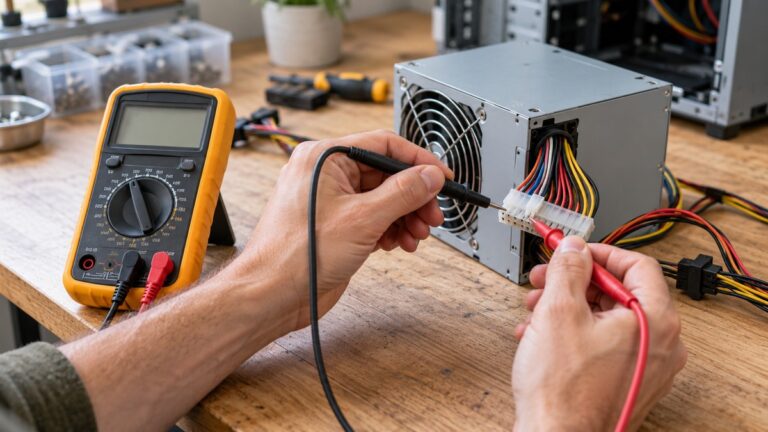
How to choose a multimeter for checking voltage drop comes down to a DC voltage function with a millivolt range, a stated resolution on that range, a capture mode for short events, and a CAT rating that suits the circuit you plan to measure. A voltage drop test reads the voltage lost across a wire, a connector or a component while current flows through it. The sources we opened describe this job on automotive and other low-voltage DC circuits. They do not give one required range, count or model for every case, so this guide explains what to check on a listing and what the sources do not say.
Quick answer
- Choose a meter with a DC millivolt range. Fluke’s starter guide says to select mV DC when drops are expected under 1 V.
- Check that the listing states the resolution on that range. The guide’s example meter shows 0.1 mV on a 600 mV range, but that figure belongs to that one meter.
- Look for AutoHOLD or MIN/MAX, which Fluke’s guide says capture the reading during a crank.
- Match the CAT rating to the circuit. If the listing does not state a CAT rating, the listing does not tell you whether the meter suits the circuit.
Electrical safety first
Work on mains circuits can kill. Before you measure anything, check that the meter’s CAT rating suits the circuit you are testing, and read the rating from the listing or the manufacturer’s manual. Panel and service work belongs to a licensed electrician.
Fluke’s safety guide says to choose a tool rated for the highest category you could potentially use it in, with a voltage rating that matches or exceeds that situation. Tester.co.uk warns that using equipment outside its designated safety rating can be extremely dangerous.
This guide does not give a procedure for live mains, outlets, panels or service wiring. The steps below are for a vehicle’s low-voltage DC system. Fluke’s checklist asks you to keep the vehicle in park or neutral with the parking brake on, and to disable the ignition or fuel system so the engine cannot start during the test. If a listing does not state a CAT rating, write down that the listing does not state a CAT rating, and do not use that meter on any mains circuit.
What a voltage drop test measures
Youcanic’s automotive glossary defines a voltage drop test as a measure of the voltage lost across a conductor, connector or component while current is flowing. A perfect conductor would show no drop, so a measurable drop points to resistance in the path you are testing. Fluke’s automotive overview describes starter circuit voltage drop as voltage loss across cables and terminals during engine cranking, and names damaged cables and high-resistance connections as typical causes.
Youcanic also notes that the test is valuable for starter circuits, for charging circuits (alternator output to battery during charging), and for any circuit where components work but underperform. The meter you choose should therefore read small DC voltages on a low range and hold or record a reading that lasts only a few seconds.
Why the range matters
A drop across a good connection can be small. Fluke’s starter guide says to select the mV DC range if drops are expected under 1 V, and otherwise the next higher DC volts range. Its example meter has a 600 mV range with 0.1 mV resolution, which the guide says lets you see tiny drops.
Fluke’s DC voltage guide notes that some digital multimeters include DC millivolts, and that if you are unsure, you should start with DC voltage because it handles higher voltage. It also says modern DMMs default to autoranging, and that a fixed range is chosen by pressing the RANGE button. The listing should state whether a millivolt setting exists and what its resolution is. The sources do not say how a meter without one would show a small drop.
Features to check on a listing
A DC millivolt range and its resolution
Fluke’s starter guide uses 600 mV with 0.1 mV resolution as an example for one meter. A listing that does not state a millivolt range does not state whether the meter can show a small drop. The sources we opened do not give a minimum resolution for voltage drop work.
Auto-ranging or manual ranging
Electronics Notes describes auto-ranging as a mode where the meter chooses the best range, such as mV or V, for you. It says auto-ranging is much faster for beginners, though manual ranging is sometimes preferred for “bouncy” signals. A drop reading can move while an engine cranks, so check which mode the listing says the meter uses on DC volts, and whether a fixed range can be selected.
Capture modes: AutoHOLD and MIN/MAX
Fluke’s starter guide describes AutoHOLD as latching the first stable voltage reached during the crank. MIN/MAX records the maximum reading through the entire crank event, which the guide recommends for peak drop. The guide also labels AutoHOLD as available on one Fluke model only, the 88V. A capture mode belongs to a specific model, so read the listing for the model you consider.
CAT rating and voltage rating
Tester.co.uk describes CAT II as the category for circuits connected to mains sockets, such as household appliances and portable tools. It describes CAT III as the category for fixed wiring, bus bars, junction boxes, switches and socket outlets, and CAT IV as the highest safety rating, for equipment directly connected to a building’s source of power. Fluke’s CAT guide gives the same progression, placing CAT III in fixed installations.
Neither source ties these categories to a 12 V battery job, and the sources we opened do not link them to a voltage drop test on a vehicle. Match the rating to the circuit as the manual describes it. A CAT rating does not make a meter safe for household mains by itself.
Counts and resolution
Electronics Notes explains a figure such as “2000-count” or “6000-count” as the number of increments the meter can display before it has to change range. A listing that does not state its count does not state how fine the display is.
Low impedance mode
Electronics Notes says some high-end meters have a low impedance (LoZ) mode that reduces stray readings from nearby wires. The sources we opened do not say which models offer it, or how it would change a voltage drop reading. Treat a stated LoZ mode as a listed feature only.
How we chose
The criteria in this guide come from the method the sources describe: a DC voltage range that can show small drops, a stated resolution on that range, a capture mode for a brief crank, the auto or manual ranging behavior, and a CAT rating that matches the circuit. We opened eight pages, listed at the end of this guide, and kept only statements that the fetched text supports. Each quote was checked against the fetched text before use.
We left out pages that rank, price or sell meters. The sources we opened do not rank meters, so this guide does not recommend any model.
Preparation
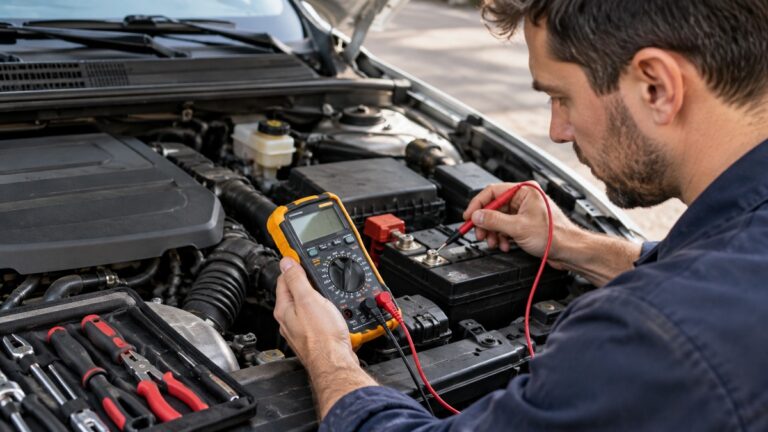
Set up the meter as Fluke’s starter guide describes. Insert the black lead into COM and the red lead into V/Ω, turn the dial to DC volts, and select mV DC if you expect a drop under 1 V. Fluke’s tips say to probe bare metal, because paint or corrosion skews the result.
Fluke’s safety checklist asks you to put the vehicle in the park or neutral position with the parking brake on, to keep hands and leads clear of moving parts, and to avoid shorting terminals with the probes. The sources we opened do not describe battery-handling steps beyond these checks.
Steps for a starter circuit check
These steps follow Fluke’s starter guide. They describe a low-voltage DC measurement on a vehicle and do not cover any mains work.
- Set up the meter as described in the preparation section.
- Set the capture mode. AutoHOLD latches the first stable voltage reached during the crank, and MIN/MAX records the maximum reading for peak drop.
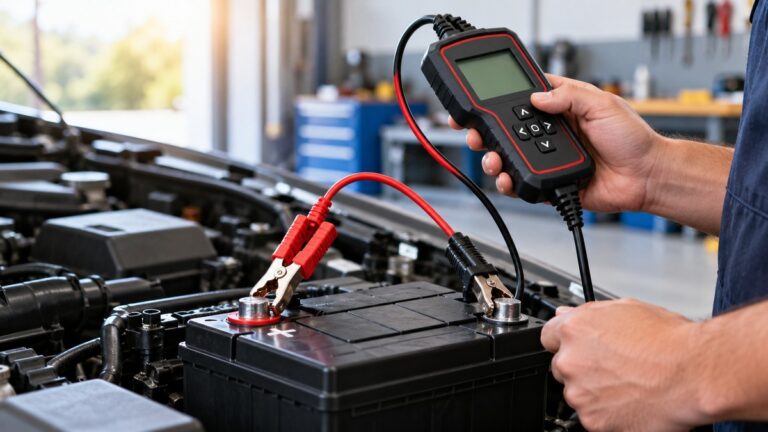
- Touch the red probe to the battery positive post and the black probe to the starter motor battery stud. Fluke says this measures the drop across the positive cable and its connections.
- Complete the safety checklist so the engine cannot start, then crank for 4 to 5 seconds while you watch the meter. The guide says AutoHOLD or MIN/MAX captures the result.
- Move the black probe to the starter housing or engine block, and the red probe to the battery negative post. Crank again and compare the drop with the figures in the next section. Fluke says to test both sides, because the positive and ground measurements together tell the full story.
Reading the results
Fluke gives an acceptable total drop of 0.2 to 0.5 V for a starter circuit. It gives about 0.3 V on the positive side and about 0.2 V or less on the ground side as the guideline values, and says anything higher suggests corrosion, loose terminals or damaged cables.
Youcanic gives related maximums: 0.1 V across any single connection, 0.2 V for ground cables, 0.3 V total for the entire positive or negative side, and 0.5 V total for the complete circuit. The two sources broadly agree, but neither gives a value for a particular vehicle. Treat both as general benchmarks, and check the manufacturer’s specification before you decide that a reading is out of range.
Common mistakes
- Testing on paint or corroded metal. Fluke says paint or corrosion skews the result.
- Testing only one side. Fluke says the positive and ground measurements together give the full picture.
- Choosing a DC range that is too high for a small drop. Fluke says to select mV DC when a drop is expected under 1 V.
- Skipping the vehicle checklist. Fluke asks for park or neutral, the parking brake, and clear hands and leads.
- Cranking many times without checking the cables. Fluke says warm or hot cables after repeated cranks may indicate internal failure.
Listing checklist
The table lists what each source says about a feature and what to read on the listing. Where a listing does not state a figure, write that down.
| Feature | What the sources say | What to check on the listing |
|---|---|---|
| DC millivolt range | Fluke’s starter guide advises mV DC for drops under 1 V | Whether a mV DC range is stated, and its resolution |
| AutoHOLD or MIN/MAX | AutoHOLD latches the first stable reading; MIN/MAX records the maximum (Fluke) | Whether either mode is stated, and for which model |
| Auto or manual ranging | Auto-ranging picks the range; manual is sometimes preferred for unsteady signals (Electronics Notes) | Which mode the meter uses on DC volts, and whether a fixed range can be selected |
| CAT rating | CAT II, III and IV describe different installations (Tester.co.uk, Fluke) | The stated CAT rating and voltage rating, or the words “the listing does not state a CAT rating” |
| Counts | Counts describe how many increments a display shows before a range change (Electronics Notes) | The stated count |
| Low impedance mode | Some high-end meters have a LoZ mode (Electronics Notes) | Whether a LoZ mode is stated; the sources do not say how it changes a drop reading |
What we could not verify
The sources we opened do not say which meter models suit voltage drop work. They do not give a required count, a required millivolt resolution, or a required input impedance for this job. The 600 mV range and 0.1 mV resolution belong to the meter in Fluke’s starter guide. No listing or manual for that meter was opened for this guide, so those figures are not confirmed for any other model.
The guideline drops from Fluke and Youcanic agree on the main numbers, but neither gives a value for a specific vehicle. The sources do not say how drop readings change with temperature or battery state of charge, and they do not limit how many times the engine may be cranked. No model listing was opened, so this guide cannot state any model’s CAT rating. The sources we opened do not cover live mains, panels, outlets or service wiring, and this guide does not describe that work.
FAQ
Which DC range should I start with?
Fluke’s starter guide says to select mV DC if drops are expected under 1 V, and to choose the next higher DC volts range otherwise.
Why use AutoHOLD or MIN/MAX?
Fluke’s guide says the starter reading happens during a short crank. AutoHOLD latches the first stable reading, and MIN/MAX records the maximum through the whole crank.
Is a CAT rating enough to make a meter safe for household mains?
No. The rating is one check among several. Read it from the listing or manual, and do not use the meter on household mains based on this guide.
What does a negative reading mean?
Fluke’s DC guide says that when the probes touch opposite terminals from what the meter expects, a negative symbol appears on the display.
Does a low impedance mode fix stray readings?
Electronics Notes says some high-end meters have a LoZ mode that reduces stray readings. The sources do not say which models have it, or how it affects a voltage drop reading.
Related guides
Sources
- https://www.fluke.com/en-us/learn/blog/digital-multimeters/how-to-check-starter-circuit-voltage-drop-with-a-multimeter
- https://www.fluke.com/en-us/learn/blog/digital-multimeters/common-automotive-testing-with-a-multimeter
- https://www.fluke.com/en-us/learn/blog/safety/multimeter-guide
- https://www.fluke.com/en-us/learn/blog/electrical/cat-ratings-explained
- https://www.fluke.com/en-us/learn/blog/digital-multimeters/how-to-measure-dc-voltage-with-a-digital-multimeter
- https://www.youcanic.com/glossary/voltage-drop-test/
- https://www.tester.co.uk/advice/explaining-the-cat-measurement-categories
- https://www.electronics-notes.com/store-shop/test-equipment-reviews/digital-multimeter-dmm-buyers-guide.php