How to Test a 12 Volt Socket With a Multimeter
As an Amazon Associate we earn from qualifying purchases.
How to test a 12 volt socket with a multimeter means measuring its DC voltage with the engine off and again with the ignition in the accessory or on position, then checking the socket’s fuse if nothing shows. The method covers the 12 volt accessory socket of a passenger car or a motorcycle, and it stays on the outside of the socket. This guide does not cover airbag systems or the high-voltage systems in hybrid and electric vehicles, and it gives no steps for them.
Electrical safety comes first
Work on mains circuits can kill. The HSE leaflet Electrical safety and you says that “normal mains voltage, 230 volts AC, can kill” (HSE, INDG231). OSHA lists electric shock, electrocution, fires and explosions among the dangers its electrical standards address (OSHA). Japan’s National Institute of Occupational Safety and Health notes that 50 mA of alternating current flowing from one hand to both feet for more than one second causes ventricular fibrillation and death (JNIOSH). This guide covers only a 12 volt socket inside a vehicle. It gives no steps for mains outlets, consumer units or service wiring.
Before you measure anything, check that the meter’s CAT rating suits the circuit you are testing, and read the rating from the listing or the manufacturer’s manual. B&K Precision describes Category II as portable equipment and appliances, Category III as fixed installations at the distribution level of AC main power, and Category IV as the service-level supply outside a building (B&K Precision). Fluke advises choosing a tool rated for the highest category you could encounter, and says the ratings are usually near the input jacks (Fluke). The GAMBICA guide states that a tool with no CAT rating must not be connected to the mains (GAMBICA). For what a Category III label means, see a 600V CAT III explainer for multimeters.
The sources we opened do not assign a CAT category to a 12 volt vehicle circuit, so this guide does not assign one either. Read the rating from your meter’s manual or from the marking near its input jacks.
Panel and service work belongs to a licensed electrician. OSHA defines a qualified person as someone trained in, and skilled at, electric equipment and installations and the hazards involved (OSHA, 1910.399). HSE uses the word competent for suitable training, skill and knowledge (HSE, INDG231). The sources we opened do not name a license, and licensing rules differ by place, so the license requirement here is guide policy rather than a finding from the sources.
Battery safety comes before any reading
The socket sits beside a 12 volt battery, so battery handling comes first. HSE advises wearing gloves and suitable eye protection, preferably goggles or a visor, and emptying your pockets of metal objects that could bridge the terminals (HSE, INDG139). HSE also notes that “A tiny spark is all that is needed to ignite the gases”, so keep flames, sparks and hot objects away from the battery. Discover Battery’s automotive battery data sheet calls for eye and face protection, and for use only outdoors or in a well-ventilated area (Discover Battery). The Crown battery data sheet adds that hydrogen gas forms during charging and operation, and says to keep vent caps on and to cover the terminals to prevent short circuits (Crown Battery). HSE lists serious chemical burns to the face, eyes and hands among battery injuries (HSE, INDG139).
When you touch the terminals for the reference reading, use insulated handles (HSE, INDG139) and keep the probes apart (Narva). The sources we opened do not describe a battery disconnection sequence for a socket check, so this guide does not include one.
Quick answer
- Battery safety comes first: eye protection, insulated handles, and no metal bridging the terminals.
- Read the socket with the engine off, then with the ignition in ACC or ON, and keep the plug out during both readings.
- Compare each socket reading with the battery terminals, where about 12.6 V means a fully charged battery in Fluke’s table.
- If the socket reads zero, check the fuse in continuity mode with the circuit powered off, and use your owner’s manual for the rating.
Tools and meter setup
You need a digital multimeter with a DC volts setting, its two test leads, and the owner’s manual for the vehicle or motorcycle. Turn the dial to DC volts, put the black lead in the COM jack and the red lead in the V jack (Fluke, DC voltage guide). Modern meters default to autoranging for the function selected on the dial (Fluke, DC voltage guide). If you are still choosing a meter for vehicle work, see a roundup of auto voltage testers for vehicle circuits.
Read the power limit in your manual before you plug anything in. Mazda’s manual says accessories must not require more than 120 W (DC 12 V, 10 A) (Mazda). Nissan’s Juke manual gives the same 120 W (10 A) limit (Nissan), while Hyundai’s NX4 manual says devices should draw less than 180 W with the engine running (Hyundai). The limits differ, so follow the number in your own manual. The test itself needs nothing plugged in.
Step by step: measure the socket voltage
Keep the engine off for the first two readings. The manuals warn about battery drain from long engine-off use, so keep each reading short.
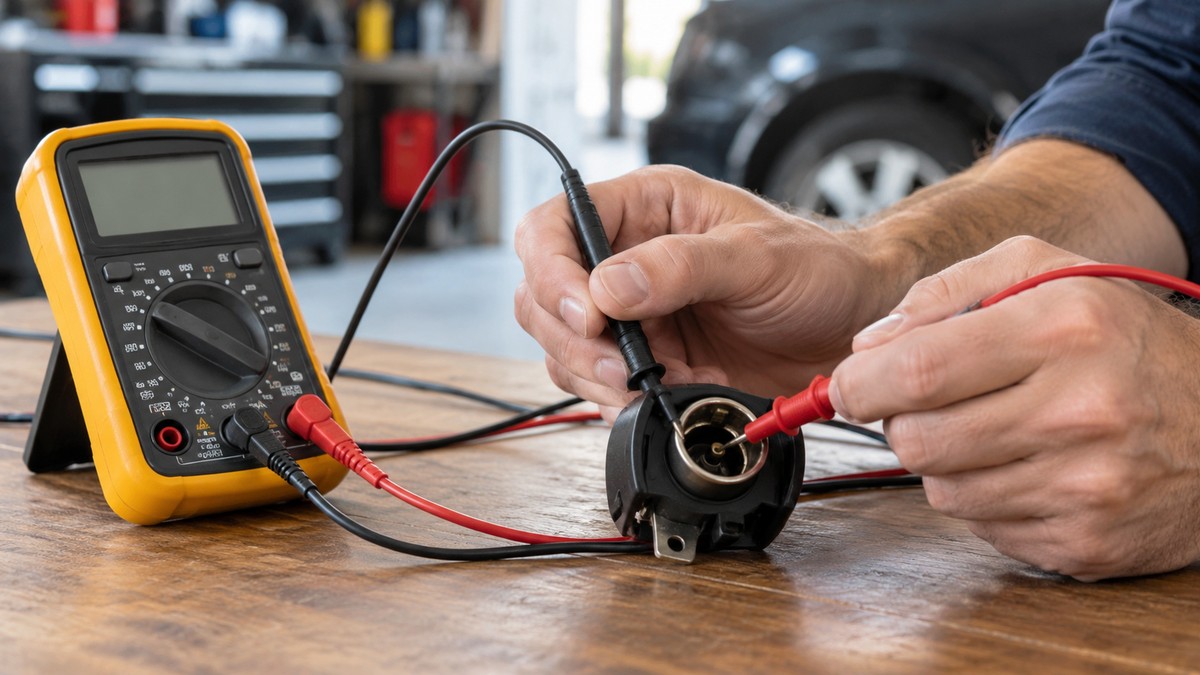
- Engine off, ignition off. Leave the socket empty. Place the red probe firmly in the center of the socket and the black probe on the metal side, keeping the two probes apart (Narva). Read the display and write the value down.
- Ignition to ACC or ON, engine still off. Mazda’s manual says the ignition must be switched to ACC or ON for the socket to work (Mazda). Narva describes the Accessory position, or ignition on without starting the engine on a push-button car (Narva). Take the second reading with the probes in the same place.
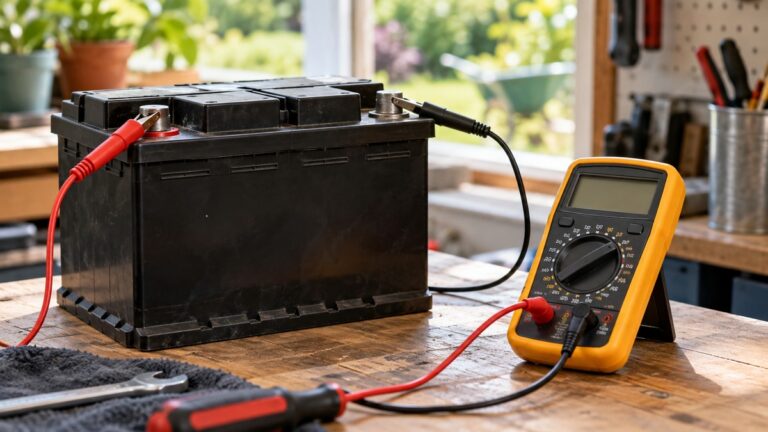
- Read the battery for comparison. Touch the red lead to the positive battery terminal and the black lead to the negative terminal, then read the voltage (Fluke, battery voltage guide).
- Record the three values. Note the socket with the ignition off, the socket with the ignition in ACC or ON, and the battery terminals.
If the socket reads zero, check the fuse
Narva’s guide says a blown fuse usually follows metal touching the socket or a device drawing too much power, and it places the fuse check ahead of the wiring check (Narva). Spare fuses are often kept in the fuse box (Narva). Use your owner’s manual to find the socket’s fuse. The sources we opened do not give a fuse number or rating for any socket.
To check a fuse, turn the ignition off and make sure the circuit is powered off (Fluke, fuse guide). Remove a glass or ceramic fuse from its holder, or disconnect a blade fuse from the fuse box (Fluke, fuse guide). Set the meter to continuity mode, which Fluke prefers because it gives an audible signal (Fluke, fuse guide). Touch the probes together first and confirm the beep. Then touch the probes to the metal ends or prongs of the fuse. A beep means the fuse is good, and no beep means it is blown (Fluke, fuse guide). In resistance mode, a reading at or near zero ohms means the fuse is intact (Fluke, fuse guide). For the full fuse method, see a separate guide to checking fuses with a multimeter.
If a new fuse blows straight away, stop here. Narva’s next step is a wiring check that involves removing trim, which this guide does not describe. Replace a blown fuse only with the correct rating from your owner’s manual.
Motorcycle sockets
The Honda Gold Wing manual we opened says the terminal and socket “provide 12V DC power for electrical accessories” (Honda). When both are in use, each accessory should draw 60 watts (5 amps) or less. The manual also warns that higher current demands may blow a fuse or discharge the battery (Honda). That copy does not state a key position for the socket, so check your model’s manual for the key position, the rating and the fuse. The meter steps above still apply.
How to read the results
Battery values come first. Fluke’s battery guide gives about 12.6 V for a fully charged battery, about 12.4 V for roughly 75 percent, about 12.2 V for roughly 50 percent, and below 12.0 V as likely discharged or weak (Fluke, battery voltage guide). These values describe the battery, not the socket.
The sources we opened do not give a target reading for the socket. Narva’s guide says a reading below 12 V, or no reading at all, with the key in the Accessory position points to a fault in the wiring or the socket, but only after the fuse and device checks (Narva). Because Mazda’s manual says the ignition must be in ACC or ON, a zero reading with the ignition off is consistent with that manual (Mazda).
Some manuals say to use the socket only with the engine running (Hyundai, Nissan). An engine-off reading is therefore a check, not normal use.
Common mistakes
- Leaving a device plugged in during the engine-off check. Mazda, Hyundai and Nissan all warn that long use with the engine off can drain the battery.
- Pushing the plug in only partway. Hyundai’s manual says to push the plug in as far as it goes, and warns that the plug may overheat and the fuse may open.
- Letting the probes touch. Narva says the red and black probes must not touch.
- Testing a fuse while it is still in place. Fluke says to remove the fuse from its holder, or disconnect a blade fuse, before testing it.
- Exceeding the power limit. Mazda and Nissan give 120 W (10 A) as the limit, Hyundai gives 180 W with the engine running, and Honda gives 60 W (5 A) per accessory on its touring motorcycle when the terminal and socket are both in use. Use the figure in your own manual.
- Plugging in a cigarette lighter unit. Nissan’s manual says its power outlet is not designed for use with a cigarette lighter unit.
- Misreading a minus sign. Fluke says a negative symbol appears when the probes touch opposite terminals, so check the polarity before you judge the value.
Frequently asked questions
Do I need the engine running to test a 12 volt socket?
It depends on the vehicle. Hyundai and Nissan say to use the outlet with the engine running, and Mazda requires the ignition in ACC or ON while warning against long use with the engine off or idling. This method uses short engine-off readings as a check only.
Why does my socket read zero with the key off?
Mazda’s manual says the ignition must be switched to ACC or ON for the socket to work. A zero reading with the key off is therefore consistent with that manual, so take the ACC or ON reading to judge the socket.
Can I leave a charger plugged in while I measure?
No. Plugged-in use with the engine off is the situation the manuals warn about. Hyundai says extended use of the accessory plug with the engine off may discharge the battery.
Does a blown fuse always mean the socket has failed?
No. Narva links most blown fuses to metal touching the socket or to a device that draws too much power. Check the fuse first, and do not assume the socket itself has failed.
Which battery reading means the battery is low?
Fluke’s battery guide treats about 12.2 V as roughly 50 percent charged, and says a reading below 12.0 V is likely discharged or weak. A reading near 12.6 V indicates a fully charged battery in the same table. Those figures describe the battery, so a low socket reading needs a separate check.
Does the same method work on a motorcycle?
The meter steps are the same, but the power rules and key position come from the motorcycle’s manual. The Honda Gold Wing manual we opened sets a combined 60 W (5 A) limit when the terminal and socket are both in use, and it does not state a key position for the socket.
Bottom line
Handle the battery first, measure the socket with the engine off and then with the ignition in ACC or ON, and check the fuse in continuity mode before you change anything. Use the ratings in your own owner’s manual.
How we chose
We set the order of this guide from what the sources support: battery safety and meter setup first, then the socket readings, then the fuse. Owner’s manuals gave the socket ratings, ignition positions and battery warnings, because those figures differ by make and model. Fluke, B&K Precision and the GAMBICA guide covered meter setup, fuse testing, battery reference values and CAT categories. HSE, OSHA, JNIOSH and two battery data sheets covered the hazard statements. We did not use retailer pages for any procedure or safety claim. The Narva page is written by a company that sells 12 volt accessories, and it is cited here only for probe placement and the Accessory position. Three pages returned 403 when opened and were not counted. We opened the pages on 2026-10-21, checked each quoted phrase against the text we retrieved, and paraphrased any phrase that did not match.
What we could not verify
- The sources we opened do not give a target reading for a 12 volt socket. The battery values and one brand’s low-voltage warning are the only readings we could cite.
- The sources do not give a fuse number or rating for any socket. Use your owner’s manual.
- The sources do not assign a CAT category to a 12 volt vehicle circuit. This guide names no meter model, so it gives no CAT rating for any model.
- No battery disconnection sequence for a socket check appears in the pages we opened, so none is given here.
- The sources we opened do not name a license for panel or service work, and licensing rules differ by place.
- Ratings, ignition positions and battery warnings vary by make and model. The manuals we opened cover a Mazda CX-5, a Hyundai NX4 (2025), a Nissan Juke (2024) and one Honda Gold Wing touring motorcycle. We cannot say how other vehicles behave.
- The Honda copy we opened is hosted on a parts retailer’s site rather than on Honda’s own site, and it does not state a key position for the socket.
- The Narva guide comes from a company that sells accessories, so it is not a source for ratings.
- The Crown battery data sheet carries an effective date of 6/1/15, so its details may be dated.
Sources
- Fluke, How to Measure DC Voltage with a Digital Multimeter: https://www.fluke.com/en-us/learn/blog/digital-multimeters/how-to-measure-dc-voltage-with-a-digital-multimeter (opened 2026-10-21)
- Fluke, How to Check a Fuse with a Multimeter: https://www.fluke.com/en-us/learn/blog/digital-multimeters/how-to-check-fuse-with-multimeter (opened 2026-10-21)
- Fluke, How to Measure Battery Voltage with a Multimeter: https://www.fluke.com/en-us/learn/blog/digital-multimeters/how-to-test-a-battery-with-a-multimeter (opened 2026-10-21)
- Fluke, Guide to digital multimeter safety: https://www.fluke.com/en-us/learn/blog/safety/multimeter-guide (opened 2026-10-21)
- B&K Precision, What do the input CAT ratings mean?: https://www.bkprecision.com/knowledge/technical-notes/5/what-do-the-input-cat-ratings-mean (opened 2026-10-21)
- GAMBICA, Guide to Overvoltage Categories and Measurement Categories: https://www.gambica.org.uk/static/d96bb734-348d-478e-b0cba3b50fc35940/Guide-to-Overvoltage-Categories-and-Measurement-Categories.pdf (opened 2026-10-21)
- HSE, Electrical safety and you (INDG231): https://www.hse.gov.uk/pubns/indg231.pdf (opened 2026-10-21)
- HSE, Using electric storage batteries safely (INDG139): https://www.hse.gov.uk/PUBNS/indg139.pdf (opened 2026-10-21)
- OSHA, Electrical: https://www.osha.gov/electrical (opened 2026-10-21)
- OSHA, 29 CFR 1910.399 Definitions: https://www.osha.gov/laws-regs/regulations/standardnumber/1910/1910.399 (opened 2026-10-21)
- JNIOSH, Safety Digest No. 25: https://www.jniosh.johas.go.jp/en/publication/sd/sd-no25.html (opened 2026-10-21)
- Crown Battery, Non-spillable lead acid battery safety data sheet (hosted by the University of Nebraska): https://cms.unl.edu/business-and-finance/university-operations/custodial/sites/unl.edu.business-and-finance.university-operations.custodial/files/media/file/crownVRL.pdf (opened 2026-10-21)
- Discover Battery, Automotive battery safety data sheet: https://discoverbattery.com/s4x_files/resources/automotive-battery-sds-.pdf (opened 2026-10-21)
- Mazda, CX-5 owner’s manual, Accessory Sockets: https://owners-manual.mazda.com/gen/en/cx-5/cx-5_8ft1ee17b/contents/06040400.html (opened 2026-10-21)
- Hyundai, NX4 (2025) owner’s manual, Power outlet: https://ownersmanual.hyundai.com/full_webhelp/NX4/2025/en_US/id875e1de4ae2.html (opened 2026-10-21)
- Nissan, Juke (2024) owner’s manual, Power outlet: https://www.nissan.ie/ownership/car-owner-manual/manuals/iom/juke/0f16/e1/2024/power-outlet-1.shtml (opened 2026-10-21)
- Honda, Gold Wing (GL1800) owner’s manual, Accessory terminal and socket (copy hosted by a parts retailer): https://www.bike-parts.fr/thumbs/pdf_url/img/owner_manuals/owner_GL1800BF_BAF_EN/2500_2500/0056.pdf (opened 2026-10-21)
- Narva, Why isn’t my 12V accessory power socket working?: https://narva.com.au/narva-university/blogs/12v-socket-issue (opened 2026-10-21)