Test Light With Voltmeter
As an Amazon Associate we earn from qualifying purchases. Details
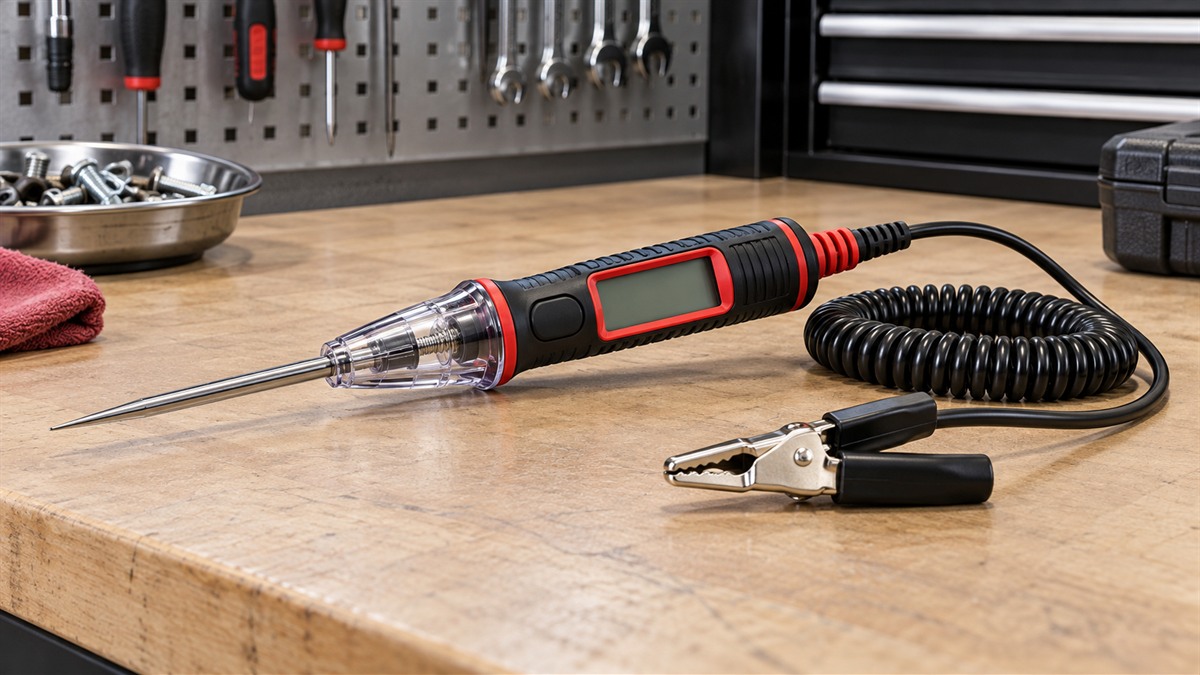
A test light with a voltmeter is a probe-style circuit tester that lights up on a live circuit and also shows the voltage on a small display. It sits between a plain bulb test light and a full multimeter: quick to use on a fuse box or a connector, but with a number instead of just a glow. The five listings below were all opened on 2026-10-17, and every specification comes from the listing text, including the places where a listing contradicts itself. “Best for” means the best fit for the stated job, not a result from my own bench, because I have not run these tools.
Quick answer
If you want the widest stated voltage range in a single probe, look at the ATOBLIN AT-180, which states 3-120V DC. If you want 60V with a stated 102-inch spring wire, the AWBLIN NS-836 is the one. If you want a 0.1V resolution stated on a 48V probe, the WINAMOO is the listing that says so. If you want a probe plus a set of leads and terminal ends, the AWBLIN 836A 18-piece kit and the ATOBLIN 825 kit are the two bundles, and the ATOBLIN 825 listing has the most contradictions to settle first.
| Listing | Voltage range stated | Form | Wire or leads | Rating wording | Weight |
|---|---|---|---|---|---|
| ATOBLIN AT-180 | 3-120V DC | Single probe | Spring wire stretches to 96 inches | CE, RoHS | 4.2 ounces |
| AWBLIN NS-836 | 3-60V DC | Single probe | Spring wire stretches to 102 inches | UL, IEC, CE | 5.6 ounces |
| WINAMOO WITL111A | 3-48V | Single probe | 96-inch spring wire | CE, UL | 7.1 ounces |
| AWBLIN 836A | 3-72V DC | 18-piece kit | Plugs, probes and an alligator clip | Not stated | 1.19 pounds |
| ATOBLIN 825 | 3-36V in the title; 1-72V readout in a bullet | Probe kit | 14 flexible test leads and a power cable with battery clamps | Not stated | 1.23 pounds |
What this kind of tester does
All five listings describe the same basic arrangement. You attach the alligator clip to a ground point, touch the probe to the circuit and read the display. All five state that the tester shows polarity with two colors: red for positive and green for negative. The AWBLIN NS-836 listing says you can attach the clamp to either negative or positive ground, which it calls bidirectional testing.
These are low-voltage DC tools. Four listings put DC in the title or the range, and the WINAMOO listing does not say DC in the text I read. None of the five describes use on AC mains. If the job is household wiring rather than a vehicle or battery circuit, use a meter or tester that states AC mains use on its own listing.
What to check before you choose
The voltage range, and the headroom you need
The stated top ends are 36V, 48V, 60V, 72V and 120V. Pick a range with margin above the highest circuit you will probe. For a 12V car system every listing is well above it. For a 24V truck system the 48V WINAMOO has 24V of headroom, and the 60V AWBLIN has 36V. The range starts at 3V or 1V, so none of these is a tool for millivolt-level signals.
Resolution and readout
Only the WINAMOO listing states a resolution: 0.1V. The others describe an LED digital display without a resolution. If you want to compare battery voltage readings to a decimal place, the WINAMOO is the only listing that tells you it can.
Wire length and accessories
Three listings state a spring wire length: 102 inches for the AWBLIN NS-836, 96 inches for the ATOBLIN AT-180 and 96 inches for the WINAMOO. The two kits replace the long wire with sets of leads and terminal ends. The AWBLIN 836A lists 7 male and 7 female plugs of different sizes, 2 test probes, an alligator clip and a black carrying case. The ATOBLIN 825 lists 14 flexible leads, a large probe, a small probe, a mini alligator clip, a long power cable with battery clamps and a hard case.
Power and the odd detail fields
Several detail tables label the power source “Corded Electric” even though the products clip onto a vehicle battery or ground. The WINAMOO, the AWBLIN 836A and the ATOBLIN 825 all carry that label, and the AWBLIN NS-836 and ATOBLIN AT-180 say battery powered. The listings do not explain the field. Treat it as a catalog label rather than a description of the circuit you test.
The five listings
1. ATOBLIN AT-180 Test Light, 3-120V DC (Widest stated range)
Specs from the listing (checked 2026-10-17):
- Voltage range: 3-120V DC; Maximum Operating Voltage 120 volts
- Display: LED digital display with red/green polarity indication
- Spring wire: stretches to 96 inches
- Features: built-in circuit board chip described as safer than a traditional test light; integrated needle guard
- Item Weight: 4.2 ounces
- Item Dimensions: 5.91 x 1.18 x 5.91 inches
- Details table: Specification Met: CE, RoHS; Model AT-180; included component listed as “test light”
The listing says the wider range is an upgrade over testers that measure to 48V. The dimensions of 5.91 x 1.18 x 5.91 inches do not look like a probe-style tool, so they may describe the package.
Pros
- Highest stated range of the five
- Lightest listing at 4.2 ounces
Cons
- No resolution stated for the display
- The details table lists only “test light” as included
Best for: someone who may probe circuits above 60V DC and wants the widest stated range.
Skip if: you want a stated display resolution or a kit of leads.
View on Amazon (affiliate link)
2. AWBLIN NS-836 Test Light with Voltmeter, 3-60V DC (Longest stated wire)
Specs from the listing (checked 2026-10-17):
- Voltage range: 3-60V DC; Maximum Operating Voltage 60 volts of direct current
- Display: LED digital; red light for positive polarity and green for negative
- Spring wire: stretches to 102 inches
- Testing mode: bidirectional; the clamp can go to either negative or positive ground
- Compatible devices: vehicles with 12V or 24V electrical systems (cars, trucks, motorcycles)
- Item Weight: 5.6 ounces
- Details table: Specification Met: UL, IEC, CE; Model NS-836; 1-year quality assurance and 12-month refund wording
The “UL, IEC, CE” entry is the listing’s own wording, and I did not verify it against a certificate.
Pros
- Longest stated spring wire at 102 inches
- Names bidirectional testing and a polarity LED
Cons
- The “Compatible devices” field limits use to 12V or 24V vehicle systems, while the range is 3-60V
- No display resolution stated
Best for: vehicle work where a long reach wire matters.
Skip if: you need a range above 60V.
View on Amazon (affiliate link)
3. WINAMOO Automotive Test Light with Voltmeter, 3-48V (Only one with a stated 0.1V resolution)
Specs from the listing (checked 2026-10-17):
- Voltage range: 3-48V; Maximum Operating Voltage 48 volts
- Display: bright LED display with 0.1V resolution; dual-color polarity indication (red positive, green negative)
- Spring wire: 96 inches, with a large alligator clip
- Probe: sharp stainless steel probe with a protective sleeve
- Uses named: car battery voltage and 3V to 48V systems, including “alternator tester functionality” for car, truck, SUV and boat charging systems
- Item Weight: 7.1 ounces
- Item Dimensions: 11.1 x 4.2 x 1.4 inches
- Details table: Specification Met: CE, UL; Model WITL111A; Power Source “Corded Electric”
Pros
- Resolution is stated at 0.1V
- Names charging-system checks
Cons
- Lowest stated top range of the single probes
- The text I read does not say DC
Best for: checking battery and charging-system voltage on 12V and 24V vehicles.
Skip if: you need a range above 48V or a stated DC rating.
View on Amazon (affiliate link)
4. AWBLIN 836A 18-Piece Test Light Probe Kit, 3-72V DC (Plug set and probes)
Specs from the listing (checked 2026-10-17):
- Voltage range: 3-72V DC; Maximum Operating Voltage 72 volts of direct current
- Kit contents: 1 test light, 7 male flat and round plugs, 7 female flat and round plugs, 2 test probes, 1 alligator clip and a black carrying case
- Display: LED digital with red/green polarity
- Item Weight: 1.19 pounds; the bullet says the whole package weighs 0.55 kg
- Details table: Model 836A; “with Voltmeter, 18 Pieces Multi Function Auto Fuse Voltage Tester Electric Probe Test Kit”; one-year warranty
Pros
- Plugs sized for different terminals in one case
- The two weights agree (1.19 pounds is about 0.54 kg)
Cons
- Heavier and bulkier than a single probe
- No display resolution stated
Best for: someone who needs to reach different connector types.
Skip if: you want a lone probe for fuse boxes.
View on Amazon (affiliate link)
5. ATOBLIN 825 Test Light Probe Kit with Voltmeter (Kit with a power cable and rocker switch)
Specs from the listing (checked 2026-10-17):
- Voltage range: the title says 3-36V DC power circuit; a bullet says readings from 1V to 72V DC while the tester operates from a 3-36V DC power source
- Kit contents: the digital test light, a long power cable with battery clamps, 14 flexible leads with different terminal ends, a large probe and a small probe, a mini alligator clip and a hard carrying case
- Extra functions: continuity testing, and a rocker switch that delivers positive or negative battery power to compatible DC components
- Item Weight: 1.23 pounds
- Details table: Model 825; Maximum Operating Voltage 36 volts; Power Source “Corded Electric”
The title and the bullets give two different numbers. The most direct reading is that the unit is powered from 3-36V and that its display can show 1V to 72V, but the listing does not say that in plain words, so confirm it with the seller.
Pros
- Adds continuity testing and a way to power small components from the kit
- Includes flexible leads for crowded connectors
Cons
- The voltage range is stated two different ways
- The listing describes the rocker switch that sends battery power to components only briefly, so read the manual before using that function
Best for: someone who wants a probe and a power cable in one kit.
Skip if: you want a single, unambiguous voltage range.
View on Amazon (affiliate link)
Worked example: matching the probe to the circuit
For example, suppose you work on a 12V car and a 24V truck, and you also want to check a 48V battery bank. Compare the stated ranges. All five cover 12V and 24V. For the 48V bank, the WINAMOO’s 48V ceiling gives no margin, so the 60V AWBLIN NS-836 (12V of headroom) or the 120V ATOBLIN AT-180 (72V of headroom) fits better. If you want to read to a tenth of a volt, only the WINAMOO states 0.1V resolution, so you would have to choose between a stated resolution and extra range. This is a planning comparison from listed figures, not a bench result, and the AT-180’s wider range is stated by the listing rather than verified here.
Related guides
For nearby automotive testers, see the 12V tester light guide, the car wire tester guide and the digital voltage meter for car guide.
Frequently asked questions
Which of these has the highest stated voltage range?
The ATOBLIN AT-180 states 3-120V DC. The AWBLIN 836A kit states 3-72V DC and the AWBLIN NS-836 states 3-60V DC.
Which one states a display resolution?
Only the WINAMOO, which states 0.1V.
Do any of these test household AC mains?
None of the five listings describes AC mains use. Four state DC ranges, and the WINAMOO text I read does not say DC at all.
Why does the ATOBLIN 825 list two voltage ranges?
Its title gives 3-36V DC and one bullet gives a 1V to 72V reading range with a 3-36V power source. The listing does not reconcile the two, so ask the seller before you rely on either figure.
Final recommendation
For the widest stated range, the ATOBLIN AT-180. For the longest stated wire, the AWBLIN NS-836. For a stated 0.1V resolution on 12V and 24V vehicle work, the WINAMOO. For plugs and probes in one case, the AWBLIN 836A. For a kit with a power cable and continuity, the ATOBLIN 825, once its voltage range is confirmed. Match the top of the range to the highest circuit you will probe, and treat all of them as low-voltage DC tools unless a listing says otherwise.