Best Clamp Meter: AC Current, True RMS and Logging Compared
As an Amazon Associate we earn from qualifying purchases. Details
A clamp meter measures current by opening its jaws around a conductor instead of breaking the circuit, which is why this tool appeals to electricians, technicians and careful DIY users. Three clamp meters in this list fit the keyword. This guide compares them by current type, stated range, True RMS, logging features and included parts. Voltage and resistance on these tools usually come through the test leads rather than the jaws, so the guide also shows which function sits where.
Quick answer
For AC current on a simple, backlit meter, the Klein Tools CL120 lists a 400-amp AC range with auto-ranging. For True RMS and temperature in one clamp, the Fieldpiece SC260 names both. For AC and DC current with graph recording, the FNIRSI DMC-100 covers the widest current type, up to 600 amps, but its count figures disagree inside the listing. Check the current type first, then the range, then the features you will actually use.
Safety first
Work on mains circuits can kill. The meter’s CAT rating has to suit the circuit you measure, and the rating belongs in the manual or the listing. None of the three listings gives a clear CAT rating for the meter body. The Klein listing names CAT III and CAT IV safety caps on its test leads, and the FNIRSI listing names UL 61010-1 and CE marking instead. Panel or service work belongs to a licensed electrician, not to a meter. OSHA lists contact with power lines and a lack of ground-fault protection among the most frequent causes of electrical injuries, and its rule for listed equipment says it must be used according to the instructions included with the listing or label.
What a clamp meter measures
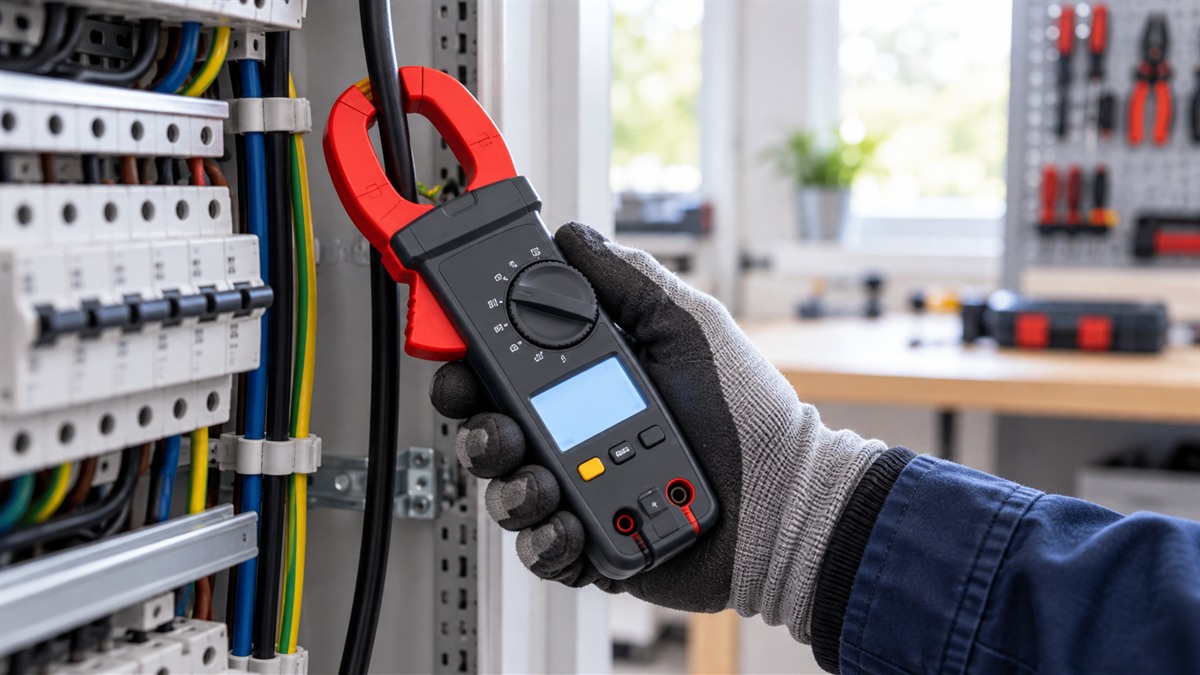
A current clamp has jaws that open around a conductor to measure current without contact. Clamps are typically used to read AC, and some clamp meters measure 1000 A and more. Two sensor designs matter here. The current transformer type works only with AC or pulse waveforms, while the Hall effect type measures both DC and AC. None of the three listings names its sensor design, so the current type stated on each listing is the best guide you have.
Clamp meters also help with leakage. Leakage is a gradual transfer of electrical energy across a boundary that is normally insulating. Unwanted leakage current can cause damage, fires, RF noise or electrocution. It can be measured by comparing the current at one point in a circuit with the current at another, and two clamp readings are one way to make that comparison.
Current readings also connect to protection. A circuit breaker protects a circuit from current in excess of what the equipment can safely carry, and unlike a fuse it can be reset. A fuse is a sacrificial device: once it has operated, it is an open circuit and must be replaced. A clamp reading tells you how much current a conductor carries at the moment you measure it. It does not tell you the rating of the breaker or fuse that protects it, because that rating is printed on the protective device itself. Comparing the two is a reason to measure, not a substitute for reading the device.
Flexible probes are a different design. A Rogowski coil is a helical coil of wire with no metal core, used for measuring alternating current or high-speed current pulses. None of the three clamps in this list is described as a Rogowski design, so the rest of this guide assumes a jaw-style clamp.
True RMS and why it matters
A true RMS converter gives a more correct value than averaging meters. Averaging meters use a correction factor that is valid only when the input signal is sinusoidal, and distortion or offsets lead to errors in those meters. A True RMS reading matters most where the waveform is not a clean sine wave.
Two of the three listings state True RMS. The Fieldpiece listing names True RMS in its bullets, and the FNIRSI listing gives TRMS measurement for AC and DC current. The Klein listing does not mention True RMS, so do not assume it. The guide treats that as a difference between the models, not a verdict on the Klein.
What matters for this keyword
Five things change the answer for this keyword.
Current type. The Klein listing measures AC current through the clamp. The Fieldpiece listing gives AAC readings, which are AC amperage. The FNIRSI listing covers AC and DC current. If you need DC current from the clamp jaws, only the FNIRSI listing says so.
Range. The Klein listing gives a 400-amp AC range and says auto-ranging selects the right range. The FNIRSI listing gives up to 600A. The Fieldpiece listing does not state a current range.
True RMS. Fieldpiece and FNIRSI state it. Klein does not mention it.
Display and logging. The Klein listing names a backlit display, data hold and max readings, with auto power-off after 10 minutes. The FNIRSI listing names a 2-inch TFT screen, graph recording, 8 sets of real-time data and 30 sets of historical records. The Fieldpiece listing names a backlight, temperature and capacitance.
Included parts. The Klein package includes a carrying case, test leads with CAT III and CAT IV safety caps, instructions and 3 AAA batteries. The FNIRSI package includes the clamp, two multimeter pens, a temperature probe and a Type-C cable. The Fieldpiece listing names only the meter.
Reading the spec lines
The spec lines look similar, but they say different things. The Klein listing gives a “Double Insulation Safety Rating” and “Ce Certified” under specification met. The FNIRSI listing gives “Ul 61010-1, Ce Marked, Rohs Compliant”, which names a safety standard. The Fieldpiece listing gives “Oem” under specification met, which describes a manufacturer label rather than a safety standard, so do not read it as a safety rating.
The Fieldpiece weight field reads 0.27 g, which does not fit a handheld clamp meter with a 9.1-inch item length. Rely on neither weight until the manufacturer confirms it. The Klein weight is 9.76 ounces, and the FNIRSI weight is 6.72 ounces. Both weights come from their own listings and are not in conflict with other fields in those listings.
Reading the display functions
Several display functions show up across these listings, and each does a different job. Data hold freezes the number on the screen so you can read it after the jaws come off the conductor. The Klein listing names data hold alongside a max function, which keeps the highest reading seen during a measurement. Auto-ranging, named on the Klein listing, chooses the measurement range for you, so you do not switch ranges by hand. A backlight, named on the Klein, Fieldpiece and FNIRSI listings in some form, helps when the display sits in a dim panel or engine bay. The FNIRSI listing also names brightness levels, which matters when you read the screen outdoors.
Counts describe the display resolution, meaning how fine a reading the meter can show. Two clamp meters with the same range can show different resolution if their counts differ. The FNIRSI listing gives conflicting counts, so check the manual for the figure that applies before you compare resolution across models.
How the three listings compare
| Listing | Current the clamp reads | Stated current range | True RMS stated | Voltage read through | Extras named |
|---|---|---|---|---|---|
| Klein Tools CL120 | AC | 400 amp AC, auto-ranging | not mentioned | test leads | backlit display, data hold, max, auto power-off after 10 minutes |
| Fieldpiece SC260 | AC (AAC and VAC readings) | not stated | yes | not stated | temperature, capacitance, backlight, NCV, swivel magnet |
| FNIRSI DMC-100 | AC and DC | up to 600A | yes | test leads | graph recording, Type-C charging, 2-inch TFT display |
How to choose
- Choose by current type first. Klein and Fieldpiece read AC current in their listings. FNIRSI reads AC and DC.
- Choose True RMS when the waveform may be distorted. Fieldpiece and FNIRSI state True RMS. Klein does not.
- Choose by range when your current is high. Klein names 400 amps AC and FNIRSI names 600A. Fieldpiece names no range, so confirm it in the manual.
- Choose logging when you need a trend. FNIRSI is the only listing here with graph recording.
- Choose a kit when you need leads and a case. Klein includes both. Fieldpiece lists the meter only.
For a broader set of clamp options, see best AC DC current clamp meter and best true RMS digital clamp meter.
1. Klein Tools CL120 Digital Clamp Meter, Auto-Ranging 400 Amp AC (Best for AC current)
Specs from the listing (checked 2026-10-11):
- Item Dimensions: 8.45 x 3.51 x 1.51 inches
- Item Weight: 9.76 ounces
- Specification Met: Double Insulation Safety Rating, Ce Certified
Pros
- The listing says the clamp measures AC current, and the test leads handle AC and DC voltage, resistance and continuity.
- Auto-ranging picks the measurement range, and the listing gives auto power-off after 10 minutes to save battery.
- The package includes a carrying case, test leads with CAT III and CAT IV safety caps, instructions and 3 AAA batteries.
Cons
- The listing gives a 400 amp AC range and names no DC current measurement through the clamp.
- The listing gives its warranty on the manufacturer's website rather than in the listing itself.
Best for: Electricians and DIY users who work with AC current and want a backlit display and a carrying case.
Skip if: You need DC current through the clamp, or a current range above 400 amps.
View on Amazon (affiliate link)
2. Fieldpiece Compact HVACR Clamp Multimeter SC260 – True RMS Clamp Meter with Temperature (Best for True RMS and temperature)
Specs from the listing (checked 2026-10-11):
- Item Dimensions: 3.5 x 3 x 9.1 inches
- Included Components: Meter
- Specification Met: Oem
Pros
- The listing names True RMS, temperature, capacitance and a backlight in one clamp meter.
- The listing describes a sturdy swivel magnet for hands-free measurements.
- The listing says it is designed for electrical HVACR service in hot and cold environments.
Cons
- The listing gives AAC amperage readings, and it names no DC current measurement.
- The included components show only the meter, so leads and a case are not in the box.
Best for: HVAC and electrical technicians who want True RMS and temperature in one clamp.
Skip if: You need DC current, or you want leads and a case in the box.
View on Amazon (affiliate link)
3. FNIRSI DMC-100 Clamp Meter 9999 Counts TRMS, 600A AC/DC Amp Meter (Best for AC and DC with logging)
Specs from the listing (checked 2026-10-11):
- Unit Count: 9999 Count
- Specification Met: Ul 61010-1, Ce Marked, Rohs Compliant
- Item Weight: 6.72 ounces
Pros
- The listing says it measures AC and DC current up to 600A with True RMS.
- The listing says it stores 8 sets of real-time data and 30 sets of historical records, with graph recording on the screen.
- The 2-inch TFT display has 10-level brightness and shows voltage and current at the same time, according to the listing.
Cons
- The listing gives 10000 counts in its bullets and style, but 9999 count in its unit count field. Rely on neither until the manual confirms it.
- The listing says voltage must be measured with the test leads, and the clamp jaws are for current measurement only.
Best for: Technicians who want to graph current over time, including automotive and home diagnostics with both AC and DC current.
Skip if: You want to read voltage through the clamp jaws, since this listing says voltage uses the leads.
View on Amazon (affiliate link)
Worked example: a 150-amp load
The Klein range is 400 amps, so the headroom is 400 ÷ 150 = 2.67 times the load. The FNIRSI range is 600 amps, so its headroom is 600 ÷ 150 = 4 times the load. Both ranges cover 150 amps of AC current, and the FNIRSI range leaves more room above the load.
The example stops at range headroom. It does not show whether either meter is rated for your circuit, which depends on the CAT rating and the manual. Current type matters too. If your load were DC, only the FNIRSI listing would apply. For a question about whether a clamp meter can read the current type in your work, see can clamp meter measure DC current.
Common mistakes
- Assuming a clamp reads DC. The Klein listing measures AC current through the clamp, so DC current needs a tool whose listing says it reads DC.
- Reading voltage through the jaws. The FNIRSI listing says voltage must be measured with the test leads, and its clamp jaws are for current only.
- Trusting one count figure. The FNIRSI listing gives two different count figures, so check the manual before relying on either.
- Assuming the meter comes with leads. The Fieldpiece listing names the meter only.
- Skipping the CAT rating. The Klein leads carry CAT III and CAT IV caps, but the listing does not give the rating for the meter body.
FAQ
Can a clamp meter measure voltage?
Some can, through the test leads rather than the jaws. The Klein and FNIRSI listings both describe voltage through the leads. The Fieldpiece listing gives VAC readings, but it does not say which input they use.
Can a clamp meter measure DC current?
Only the FNIRSI listing says so, and it covers AC and DC current up to 600A. The Klein listing reads AC current through the clamp, and the Fieldpiece listing gives AAC readings.
What is a True RMS clamp meter?
A True RMS meter gives a more correct value than an averaging meter when the signal is not a clean sine wave. Averaging meters rely on a correction factor that holds only for sinusoidal input.
Do I need True RMS for a simple AC check?
The listings do not say. The safer answer for distorted signals is True RMS, since averaging meters can read wrong when distortion is present. For a plain sine wave, an averaging meter can be adequate, so check the work you do.
What does “counts” mean on a clamp meter?
Counts describe the resolution of the display. The FNIRSI listing gives 10000 counts in one place and 9999 count in another, so the two figures conflict. Rely on neither until the manual confirms the number.
Why does auto-ranging matter?
The Klein listing says auto-ranging selects the appropriate range for accurate results. It saves time when you do not know the current beforehand, but the meter’s stated range still sets the limit.
Is a clamp meter safe for household mains?
Only if the CAT rating suits the circuit. The listings do not give a CAT rating for the meter body, so the manual decides it, and no listing here should be treated as safe for household mains without that check.
Bottom line
Choose the Klein listing for AC current and a simple backlit meter, the Fieldpiece listing for True RMS and temperature in one clamp, and the FNIRSI listing for AC and DC current with graph recording. Confirm the FNIRSI counts in the manual before you rely on them. Check the current type, the range and the CAT rating before you measure any mains circuit.
Sources
- Measurement category, Wikipedia: CAT classification and IEC 61010-1 transient withstand disclosure
- Current clamp, Wikipedia: jaw design, AC and Hall effect sensor types, clamp range
- True RMS converter, Wikipedia: averaging meter correction factor and sinusoidal input
- OSHA, Electrical: most frequent causes of electrical injuries
- 29 CFR 1910.303, Cornell Law: listed equipment used according to listing or label instructions