Keithley 2100 Digital Multimeter: Specs and What to Check
As an Amazon Associate we earn from qualifying purchases.
Keithley 2100 Digital Multimeter: Specs and What to Check
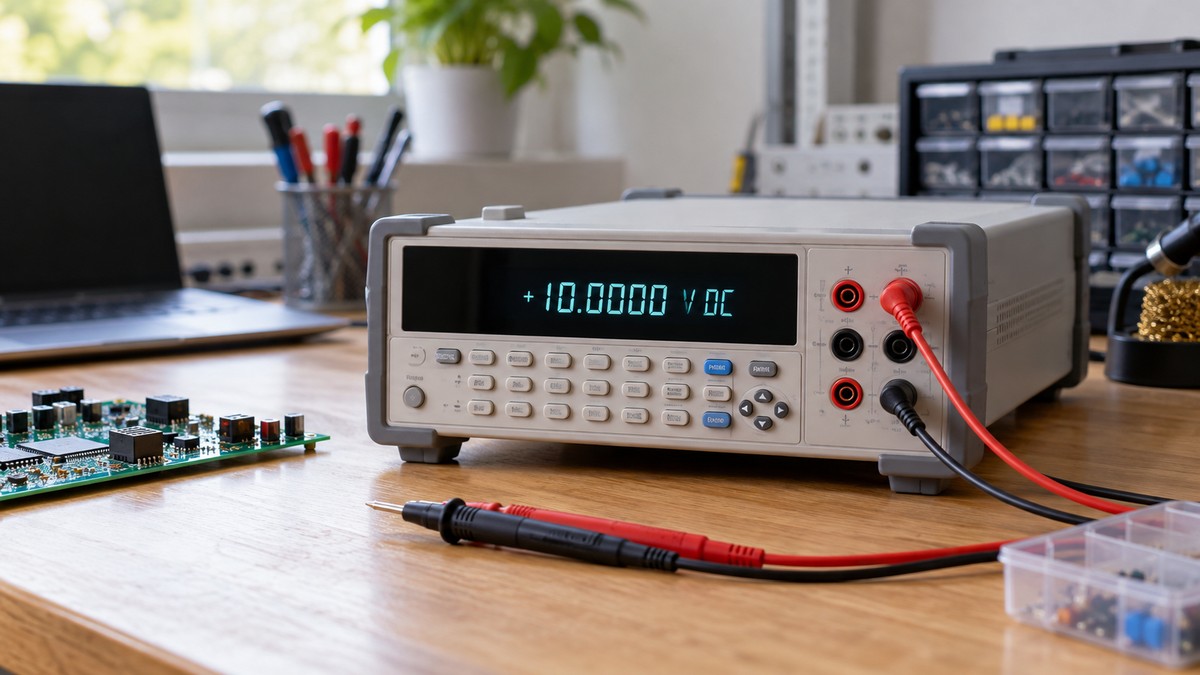
The Keithley 2100 is a 6½-digit benchtop-style digital multimeter with a USB interface. Keithley is now a Tektronix brand, and Tektronix publishes its specification sheet, user manual and product page. According to those documents, the 2100 combines a 0.0038% basic DC voltage accuracy on its 10 V range with 6½-digit resolution, and it has 11 measurement functions and 8 math functions. It is built for lab, bench and computer-controlled use. The documents we opened do not state a CAT category rating for the meter as a field tool, so this article does not treat it as a mains-rated handheld.
Quick answer
- Resolution: 6½ digits, according to the Tektronix product page.
- Basic DC voltage accuracy: 0.0038% on the 10 V range, 1-year, per the Tektronix product page.
- Remote interface: TMC-compliant USB 2.0, Type B connector, per the spec sheet and the datasheet page.
- Input protection: 1000 V on all ranges with a 2 W input, per the spec sheet.
- Read the spec sheet footnote on the LO and SENSE terminal markings before you connect the meter to any live circuit.
What the Keithley 2100 is built for
A 6½-digit meter sits between a handheld multimeter and a precision laboratory instrument. The extra digits matter when you need to see small changes in a voltage, such as checking a reference supply, logging a sensor over time or comparing two parts against a tight tolerance. The 2100 is designed around that kind of work. Its USB port lets a computer read it through SCPI commands, which is the reason it shows up in test benches and small automated setups.
That focus also explains what the meter is not. It is a bench instrument with a USB cable, not a clamp meter, not a non-contact tester and not a rugged site tool. If your main job is checking a breaker, a receptacle or a car battery in the field, a handheld meter with a suitable CAT rating is usually the better fit. Our roundup of multimeters for electricians covers that category, and our step-by-step guide explains the basic measurement sequence that applies to any meter.
Specifications the manufacturer publishes
The table below lists only figures we opened in Tektronix’s own documents. Where a figure is not in those documents, the cell says so.
| Feature | What Tektronix states | Where we read it |
|---|---|---|
| Resolution | 6½ digits | Product page; spec sheet |
| Basic DC voltage accuracy | 0.0038% + 0.0006% of reading + % of range, 10 V range, 1 year, 18 to 28 °C | Datasheet page; product page gives 0.0038% |
| Reading rate | 50 triggered readings/s over USB at 6½ digits; over 2000 readings/s at 4½ digits into the internal buffer | Datasheet page |
| Interface | USB-compatible Type B connection; TMC-compliant USB 2.0 | Spec sheet; datasheet page |
| Input protection | 1000 V all ranges (2 W input) | Spec sheet |
| Functions | 11 measurement functions, 8 math functions | Product page |
| Power | 100, 120, 220 and 240 V supply; 50/60 Hz auto-detected; 25 VA max | Spec sheet |
| CAT category rating | Not stated as a CAT category. The spec sheet gives terminal marking limits instead (see below) | Spec sheet |
The reading rate row shows a trade-off that the marketing summary can hide. At the full 6½-digit setting, the datasheet gives 50 triggered readings per second over USB. Drop to 4½ digits and the figure rises above 2000 readings per second, but into the internal buffer rather than over the remote link. Decide which setting your work needs before you assume a high speed will be available for every measurement.
The terminal marking footnote
The spec sheet lists 1000 V as the input protection on all ranges, and that number is the one most buyers notice first. The footnote tells a different story for part of the front panel. It says the LO jack is marked 500 V peak against ground, and SENSE HI to LO is marked 200 V peak. The footnote sets this against a 600 V CAT II and/or 1000 V CAT I label against ground under IEC 61010-1. In plain terms, the marking on the terminals and the headline protection figure are not the same thing, and the lower marking controls how you connect the meter to a higher-voltage source.
For a beginner, the practical rule is simple. Do not connect the 2100 to a mains circuit because the 1000 V figure looks high. Check the marking on the terminal you plan to use, check the circuit category you are working on, and stop if you are unsure. Work on mains panels, service entrances and live receptacles is work for a licensed electrician.
Points to check before you buy
- Confirm the variant. The Tektronix product page lists the 2100/100, 2100/120 and 2100/220 as separate ordering options. The datasheet page also refers to a 2100/230-240 variant. The power requirement and line voltage depend on the variant, so match the variant to the supply you will use.
- Decide the digit setting first. The 6½-digit rate of 50 readings per second is the number to plan around for remote logging. The higher figure applies at 4½ digits.
- Check the USB-only interface. The spec sheet and datasheet we opened list USB as the remote interface. They do not describe a GPIB or LAN option for the 2100. If your system needs a different bus, verify that before you buy.
- Read the terminal marking footnote. The LO and SENSE markings are lower than the headline input protection, and they set the practical limit for certain connections.
- Check the accessories. The sources we opened do not list the test leads included with the meter. Look at the seller’s description and compare it against your needs.
Where the 2100 fits in a meter shortlist
Buyers often compare a 6½-digit bench meter against a handheld meter, and the two are used for different jobs. A bench meter with USB control is useful when you measure the same quantity over and over and want the numbers in a file. A handheld meter is useful when you move between outlets, batteries and fuses all day. The 2100 belongs in the first group. If you need a meter for electrical trade work, read our guide to multimeters for electricians and compare the CAT rating and the probe set rather than the digit count alone.
How we chose
This article covers the Keithley 2100 because it was on the assigned keyword list. We opened four Tektronix pages on 2026-10-27: the product page for the 2100 Series, the SPEC-2100 Rev. D specification PDF, the 2100-900-01 Rev. F user’s manual PDF and the broad-purpose digital multimeter datasheet page. We did not use reseller pages, used-equipment sites or review sites for any figure. We did not compare prices, ratings or buyer feedback, and we left out other Keithley models because they were not part of this assignment.
What we could not verify
- Accuracy figures for ranges other than the 10 V DC range that we read. The full accuracy tables sit in the specification PDF and we did not transcribe every row.
- A CAT category rating for the 2100 used as a handheld or field meter. The sources we opened do not state one.
- Whether every ordering variant has the same accuracy and reading rate.
- What test leads and accessories come in the box.
- Whether the 2100 is suitable for any specific automotive, mains or industrial task. Those depend on the circuit and the procedure, which the documents we read do not cover.
Frequently asked questions
Is the Keithley 2100 a handheld meter?
The documents we opened describe it as a benchtop-style 6½-digit USB multimeter. They do not describe it as a handheld field tool, and they do not state a CAT category for field use. Treat it as a bench instrument.
What is the basic DC voltage accuracy?
Tektronix states 0.0038% + 0.0006% of reading + % of range on the 10 V range, for one year, at 18 to 28 °C. Accuracy on other ranges is in the full specification PDF.
Why are the reading rates different?
The rate depends on the number of digits. The datasheet gives 50 triggered readings per second over USB at 6½ digits, and more than 2000 readings per second at 4½ digits into the internal buffer.
Does the 2100 have a CAT rating?
The spec sheet we read does not state a CAT category. It gives terminal marking limits instead, and it asks you to read those markings before connecting the meter.
What interface does it use?
The documents we opened list a TMC-compliant USB 2.0 interface with a Type B connection. They do not list GPIB or LAN for the 2100.
Can a beginner use it for household electrical checks?
This article does not recommend that. Household mains work, outlets and panels need a meter with a suitable CAT rating for the circuit, and panel or service work belongs to a licensed electrician.
Bottom line
The Keithley 2100 is a precise 6½-digit USB bench multimeter, with a published basic DC voltage accuracy of 0.0038% on the 10 V range. Buy it for lab or computer-controlled measurement, check the variant and the terminal marking footnote, and do not use it as a substitute for a CAT-rated handheld meter on mains circuits.
Sources
- Tektronix, Keithley 2100 Series: 6.5 Digit USB Multimeter, product page, https://www.tek.com/en/products/keithley/digital-multimeter/2100-series (opened 2026-10-27)
- Tektronix, Model 2100 6½-Digit Resolution Digital Multimeter Specifications, SPEC-2100 Rev. D, Aug 2018, https://download.tek.com/document/SPEC-2100-01D_Aug_2018.pdf (opened 2026-10-27)
- Tektronix, Model 2100 6½-Digit Resolution Digital Multimeter User’s Manual, 2100-900-01 Rev. F, Aug 2018, https://download.tek.com/manual/2100-900-01F_Aug_2018_user.pdf (opened 2026-10-27)
- Tektronix, Broad Purpose Digital Multimeters datasheet page, https://www.tek.com/en/datasheet/broad-purpose-digital-multimeters-0 (opened 2026-10-27)