Keithley 6517B Electrometer: What It Measures and What to Check
As an Amazon Associate we earn from qualifying purchases.
Keithley 6517B Electrometer: What It Measures and What to Check
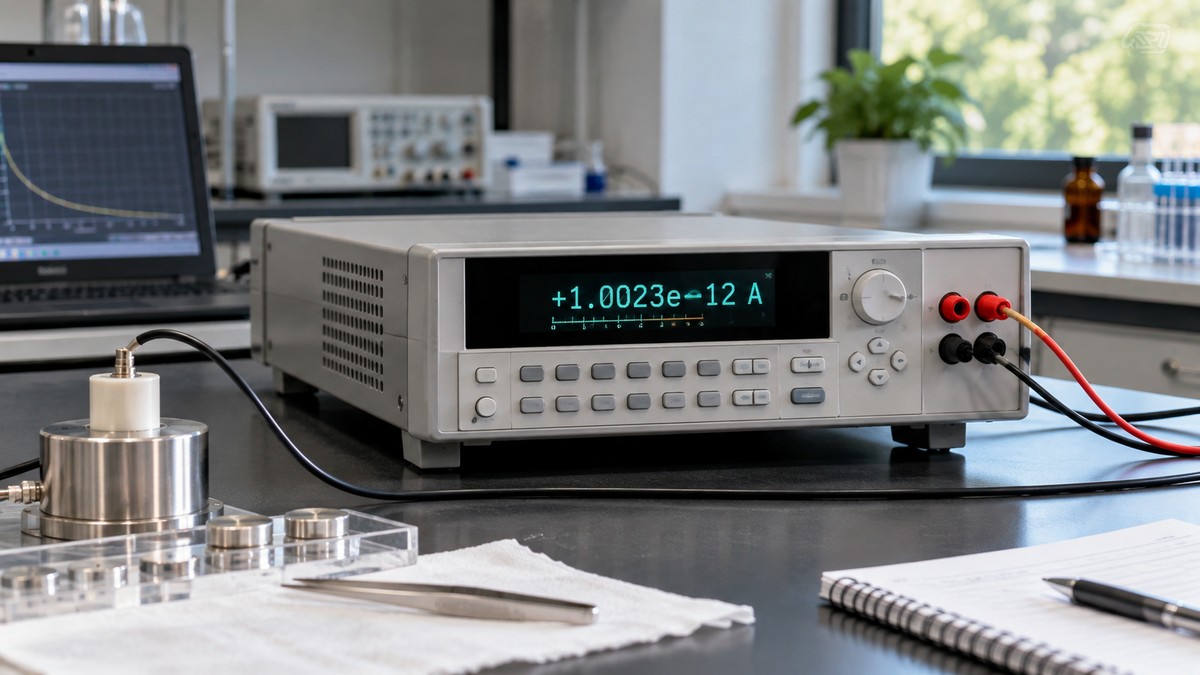
The Keithley 6517B is a bench electrometer and high resistance meter. Keithley’s user manual says it measures volts, amps, resistance and charge (coulombs), and it has a built-in bipolar voltage source of up to plus or minus 1000 V for resistance tests. It is built for very small currents and very high impedances, such as sensor, insulation and leakage work. It is not a general-purpose handheld multimeter, and the pages we opened do not describe it for household mains wiring.
Quick answer
- Four functions: volts, amps, resistance (ohms or resistivity) and coulombs. The front panel labels them V, I, R and Q.
- Voltage input impedance is listed as greater than 200 TΩ in parallel with 20 pF (spec sheet, volts section).
- Input bias current is listed as less than 3 fA at calibration temperature.
- The manual is Rev. A from June 2008. Check Keithley’s site for newer revisions before you rely on any figure.
What an electrometer does, in plain terms
An electrometer is built for very small signals. The 6517B’s spec sheet lists an input bias current below 3 fA and an input impedance above 200 TΩ, which means its input draws almost no current from the circuit under test. The 6517B covers this job across four functions, and the spec sheet gives a separate table for each.
That sensitivity has a cost in setup. At these levels, leakage through cables and fixtures can matter. The manual’s measurement sections give steps for managing this: zero checks, guarding, and low-leakage fixtures. Those steps are part of using the instrument as documented.
What the spec sheet lists
The table below uses only the figures printed in Keithley’s SPEC-6517B Rev. A sheet. The accuracy column reads as “percent of reading plus counts,” measured at 18 to 28 °C for one year. Keithley’s notes say the figures apply after the instrument is properly zeroed, with the stated integration settings.
| Function | Ranges listed | What the sheet states |
|---|---|---|
| Volts | 2 V, 20 V, 200 V | 5½-digit resolution. 1-year accuracy of 0.025 + 4 on 2 V, 0.025 + 3 on 20 V, 0.06 + 3 on 200 V. Input impedance greater than 200 TΩ in parallel with 20 pF. |
| Amps | 20 pA through 20 mA (ten ranges) | Input bias current below 3 fA. Preamp settling to 10 % of final value is typically 0.5 s with damping off and 2.0 s with damping on, on the pA ranges. |
| Coulombs | 2 nC, 20 nC, 200 nC, 2 µC | Accuracy depends on the time between zeroing and measurement, as the footnote explains. |
| Ohms | 2 MΩ up to 200 TΩ (ranges listed from 2 MΩ to 200 TΩ) | Auto V-source uses 40 V on the lower ranges and 400 V on the 2 TΩ to 200 TΩ ranges. The sheet says the voltage source settling time is added to the preamp settling time in the amps specification. |
The spec sheet also lists input bias current noise below 750 aA peak to peak on the 20 pA range with the input capped, and CMRR above 120 dB at DC and at 50 Hz or 60 Hz on the volts section. Those figures matter most when you care about very small signals. For everyday bench voltage work, they are far beyond what most users need, which is why the rest of this article focuses on setup and limits.
Why the zero check matters
The manual says to enable zero check before changing between the V, I, R and Q functions, to avoid erratic operation. The Z-CHK key controls it. When zero check is on, the display shows “ZeroCheck.” For amps measurements, the manual also tells you to zero-correct the instrument to get the best accuracy on low currents, using the RANGE keys to choose the range before you zero it.
This is the first habit to build, because the manual names it as the way to avoid erratic operation.
Guarding and cables
The manual recommends guarding for voltage measurements where the source impedance is high, which it describes as above 109 ohms. It also says guarding helps when you use long input cables, because it cancels the effect of cable capacitance that would otherwise slow the reading. The rear panel has an INPUT connector, a GUARD setting, and a COMMON connector, and the manual explains which setting to use for each measurement type.
For resistance work, the manual is direct: accurate high-resistance measurements require a low-leakage test fixture. Plan for that before you order, since the fixture and cables are part of the setup the manual describes.
Resistance and resistivity
The R function covers ordinary resistance and, with the right fixture, resistivity. The manual describes a resistivity setup that uses a separate surface or volume switch position on a fixture, which the meter senses through an interlock cable. The procedure in the manual is written for “BENCH” default settings, and it asks you to select the lowest range that shows leakage current, then use relative mode to cancel it before measuring.
If your work is insulation resistance on cables or motors, do not assume this meter is the right tool just because it reaches into the teraohm range. Insulation testers are built around safety procedures and test voltages that the 6517B manual does not describe as an insulation tester. Check the job’s requirements first.
Charge measurements
The Q function measures charge in coulombs. The manual describes an auto discharge option that resets the charge reading to zero when a chosen charge level is reached, so the integrator restarts from zero. This is useful for long charge-integration runs. The spec sheet notes that the coulombs accuracy depends on how long it has been since the charge was acquired, so timing matters for the result.
Options, accessories and interfaces
The manual lists cables and adapters for the 6517B, including high-voltage banana cables rated at 1000 V and a barrel adapter that joins two triaxial cables. It also lists case and rack mount kits. Before you buy, check the accessory list against the connectors and fixtures your setup needs, and confirm the remote interface you plan to use. The manual covers GPIB and RS-232 configuration in its interface sections.
Safety basics the manual stresses
The manual’s safety section says the product is intended for qualified personnel who recognise shock hazards. It also warns not to touch the product, test cables or other instruments while power is applied to the circuit under test, and to remove power and discharge capacitors before connecting or disconnecting cables or jumpers. Do not use this meter to test household wiring or any live panel. For mains work, use a meter with a clear measurement category rating that suits the circuit.
What to check before you buy
- The revision you are buying. The manual and spec sheet we opened are both dated June 2008. The manual says the latest specifications are on Keithley’s website, so ask the seller or check the current documents.
- Your measurement type. If you mainly measure currents below a nanoamp, or resistances above a gigaohm, the spec sheet’s amps and ohms tables are the page to read first.
- Your leakage budget. Plan your cables, fixture and environment before buying. The manual repeatedly points to leakage as the main source of error.
- Your interface. Confirm whether you need GPIB, RS-232 or manual front-panel use only.
- Your settling time. On the pA ranges the sheet lists about 0.5 seconds with damping off and about 2 seconds with damping on. Plan measurement speed around that.
- Your temperature. The stated accuracy applies from 18 to 28 °C. Outside that band the sheet gives a temperature coefficient for each function.
Common mistakes the manual warns about
- Changing functions without enabling zero check first, which the manual says can make readings erratic.
- Skipping zero correction on the amps ranges when you need the best low-current accuracy.
- Using long, unguarded cables for high-impedance voltage measurements.
- Assuming the 1000 V source is a general-purpose supply. It is a bipolar source inside a measurement workflow, with its own limits and procedures.
How we chose
This article covers the Keithley 6517B because it is on this batch’s list of models. We did not rank it against other meters. The criteria are simple: the figures come only from Keithley-authored documents we opened on 2026-10-27, and each figure is attributed to its document. The manual and spec sheet are both Rev. A from June 2008.
What we could not verify
The pages we opened do not give a measurement category (CAT) rating for the 6517B, so this article does not state one. Page 6 of the manual mentions measurement categories in its general safety text without assigning one to this instrument. They also do not give a full accessory list. The manual says the full specifications are in the Reference Manual appendix, which we did not open. A newer revision of the manual may exist; we did not open one.
FAQ
Is the Keithley 6517B a multimeter?
It measures volts, amps and resistance, so it overlaps with a multimeter. But it is built for very low currents and very high impedances, and its setup steps are different. For everyday voltage and continuity checks, a standard multimeter is simpler.
What does “electrometer” mean?
An electrometer is a meter with an input stage that draws almost no current, so it can measure tiny currents, charges and very high resistances without loading the circuit.
Why does zero check matter?
The manual says to enable zero check before switching functions, to avoid erratic operation. Zero correction on the low-current ranges is a separate step that improves accuracy.
Do I need guarding?
The manual recommends guarding for high-impedance voltage measurements and for long input cables. For a low-impedance circuit with short leads, it matters less.
Can I use it on household wiring?
The pages we opened do not describe it for mains wiring, and the safety section is written for qualified personnel. Use a meter with a clear rating for the circuit you are measuring.
Bottom line
Buy the 6517B only if your work needs femtoamp-level current, high-impedance voltage, or teraohm resistance measurements, and you are ready to manage leakage. For ordinary household or automotive electrical work, a standard multimeter with a clear CAT rating is the better tool. For a quick comparison of meter types, see our guides to true RMS multimeters and multimeters for electricians.
Sources
- Keithley Instruments, Model 6517B Electrometer User’s Manual, document 6517B-900-01 Rev. A, June 2008, pages 1-2, 16-21 and 31-40 (Section 1 overview and options, Section 3 basic measurements). Opened 2026-10-27 from a copy hosted at https://xdevs.com/doc/Keithley/6517/6517B-900-01–A-Jun2008–User.pdf
- Keithley Instruments, SPEC-6517B Model 6517B Electrometer / High Resistance Meter Specifications, Rev. A, June 2008, pages 1-3 (volts, amps, coulombs, ohms). Opened 2026-10-27 from a copy hosted at https://docs.ampnuts.ru/eevblog.docs/Keithley/6517B/doc/SPEC-6517B%20%28A%20-%20Jun%202008%29%28Customer%29.pdf