How to Check an AA Battery with a Digital Multimeter
As an Amazon Associate we earn from qualifying purchases.
How to check an AA battery with a digital multimeter takes one DC voltage reading across the cell’s two terminals, with the cell out of its device and not shorted. A reading means little without a figure to compare it with. Energizer lists a nominal voltage of 1.5 volts for its alkaline AA. Ansmann lists a nominal 1,5 V (its sheet uses a decimal comma) and an off-load range of 1,57 to 1,62 V. This guide covers one alkaline AA primary cell on the bench. It does not cover rechargeable AA cells, coin cells, lithium cells or charging.
Electrical safety comes first
Mains wiring can kill, so this guide keeps every step on a single battery, away from any live circuit. Before you measure anything, check that the meter’s CAT rating suits the circuit you are testing, and read that rating from the listing or the manufacturer’s manual. Panel and service work belongs to a licensed electrician.
CAT is the overvoltage category a meter is built for, and the rating must match the circuit. The Fluke safety guide advises choosing a tool rated for the highest category you could potentially use it in. Ratings differ from model to model. The Etekcity MSR-R500 manual states CAT I 600V and CAT II 300V for that meter. The Wavetek 34XR manual rates its meter for Installation Category III 600V and recommends it for local-level circuits rather than primary supply lines.
A single AA cell reads about 1.5 V, far below the levels that the Fluke 12 manual calls a shock hazard, which it places above 60 V DC or 30 V AC RMS. The PDX page’s energized electrical work program defines the term as work on or near exposed energized parts of 50 volts or greater. The same page reports 159 occupational fatalities from exposure to electricity in 2018, citing Bureau of Labor Statistics data. The Fluke safety guide says shock occurs when the human body becomes part of an electrical circuit, and it asks readers to be aware of spikes such as transient overvoltage and arc flashes. The PDX page adds that currents entering the body, even at levels as low as 3 milliamperes, can cause serious injuries.
Keep panel and service work with a licensed electrician. The UVM electrical safety page says that only licensed electricians are authorized to replace plugs or splice cords. OSHA standard 1910.333 allows only qualified persons to work on electric circuit parts that have not been de-energized. The PDX page describes qualified persons as employees who hold electrical licenses and receive specific training.
This guide stops at the battery. It gives no steps for outlets, panels, service wiring or any energized circuit. If a task needs one of those, stop and call a licensed electrician.
Quick answer
- Set the meter to DC volts, with the red lead in V/Ω and the black lead in COM.
- Compare the reading with the datasheet figures: Energizer lists 1.5 volts nominal, and Ansmann lists 1,57 to 1,62V off load.
- Keep the probe tips apart and never short the cell, because a short circuit can make it overheat and vent gases.
What you need before you start
You need a digital multimeter with a DC volts function, its two test leads, and one alkaline AA cell removed from its device. The Energizer sheet lists the designations ANSI-15A and IEC-LR6 for its alkaline AA, and the Ansmann sheet lists LR6 (AA). Look for one of those names on the label. The Energizer sheet gives the chemical system as zinc-manganese dioxide, with no added mercury or cadmium. If the label names a rechargeable chemistry, the cell falls outside this guide. If you want a meter used only for batteries, see our roundup of battery voltage testers.
Check the meter before you rely on it. The Fluke safety guide says to check the meter, test probes and accessories for physical damage. The Fluke 12 manual says not to use the meter if the meter or test leads look damaged, or if you suspect the meter is not operating properly. The Fluke guide also says never just to assume the meter works, and to confirm it on a known voltage source or a proving unit.
Look at the cell before you test it. The Fluke battery page says to inspect battery terminals for corrosion or looseness before testing. That page’s examples cover car batteries, so only the inspection step is taken from it.
The Ansmann off-load figure for a cell after one year is stated for storage at 20 °C. A cell kept far from that temperature is outside the conditions that figure describes, so note where the cell has been stored. The Energizer sheet gives an operating temperature range of -18 °C to 55 °C (0 °F to 130 °F), and the Ansmann safety sheet says elevated temperatures can result in shortened battery life.
Set the meter and take the reading
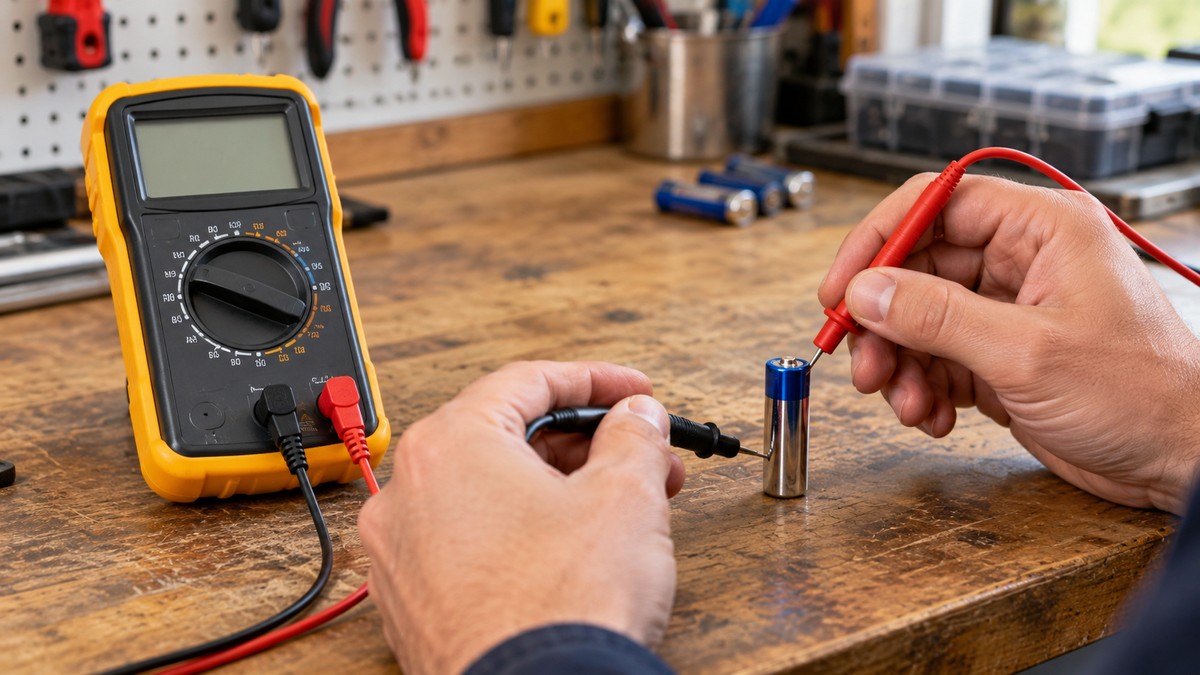
- Put the black lead in the COM jack and the red lead in the V/Ω jack. The Fluke battery page gives the same pairing: “Red lead in V/Ω, black lead in COM.”
- Turn the dial to DC volts. The Fluke page says to set the dial to VDC (DC volts). Its examples use car batteries, so only this setting is taken from it.
- Pick the range. The Fluke 12 manual says the meter “defaults to autorange when you turn it on.” The same manual has a manual range mode, in which you select and lock the meter in a range. The Wavetek manual says to “Use autorange for all initial measurements” and then, when appropriate, to use the RANGE button to select and lock a range. On a manual-range meter, the Etekcity manual says that when the voltage is unknown, you should use the maximum range and reduce it. Its DC volts ranges are 200 mV, 2000 mV, 20 V, 200 V and 500 V. By our own reasoning, a fresh AA cell reads under 2 V, so the 2000 mV range (2 V) is the lowest range that fits it.
- Touch the red lead to the positive (+) terminal and the black lead to the negative (−) terminal. The Fluke page gives this polarity: “Touch the red lead to the positive (+) battery terminal.”
- Read the display. The Fluke 12 manual says that if the range is too low, the display shows OL (overload). The Fluke guide adds that some meters show a visual warning on the display for irregularities such as unsafe voltages of 30 V or greater at the test probes. The Wavetek manual says an overload “should be immediately corrected by selecting a higher range.”
Compare the reading with the datasheet figures
Two datasheets give the figures below for alkaline AA cells. The table keeps each sheet’s wording, so the numbers match what the sheets print.
| Figure | Value as the sheet gives it | What the sheet says it describes | Source |
|---|---|---|---|
| Nominal voltage | 1.5 volts | Nominal voltage | Energizer |
| Nominal voltage | 1,5V | Nominal voltage | Ansmann |
| Off-load voltage | 1,57 to 1,62V | No condition printed beside this row | Ansmann |
| Off-load voltage | 1,55 to 1,62V | New battery after 1 year storage at 20 °C | Ansmann |
| End voltage in a capacity rating | 0.8 V | Continuous discharge to 0.8 volts at 21 °C (Energizer); end voltage (Ansmann) | Energizer; Ansmann |
| Shelf life | Up to 5 years | Under proper storage conditions | Ansmann |
The off-load range sits above the 1.5 V nominal figure, so a cell read off load should not be expected to show exactly 1.5 V. The sources we opened do not say what a reading below 1,55 V means for a cell in use.
The Energizer sheet also gives a nominal internal resistance of 150 to 300 milliohms for a fresh cell. The sources we opened do not say how that figure shows up in a no-load voltage reading.
Keep the terminals apart
Short-circuiting is the main hazard in this method. The Lincolnshire County Council advisory says many batteries will overheat and vent gases if short-circuited. It adds that alkaline cells, particularly the high-capacity types, can produce much higher currents that cause overheating. It also reports burns from metal connection boxes during short circuits with high-powered AA cells. The same advisory says to avoid rechargeable batteries for circuit work, because they can produce very high current when short-circuited.
The Ansmann safety data sheet for its LR6 (AA) alkaline cell says “DO NOT short circuit or install incorrectly,” and it asks readers to avoid mechanical or electrical abuse. The Varta sheet, which covers alkaline cells in all sizes, warns against short-circuiting, heating above 85 °C and several other misuses.
For cells being stored or discarded, the Illinois State University page says all batteries should have both terminals covered with clear tape to prevent short-circuiting and fires. The same page says alkaline batteries, including AA, are not hazardous and do not qualify as universal waste.
Our own reasoning from these sheets: the two probe tips are metal, so keep them apart while both sit on the cell, and do not rest the cell on metal during the reading. The bench method needs only one lead on each terminal.
Common mistakes
- Leaving the dial on AC volts. The Fluke page specifies DC volts for battery readings.
- Setting the dial to resistance. The Etekcity manual says not to measure voltages when the meter is set to measure resistance.
- Ignoring an OL display. The Wavetek manual says to select a higher range rather than accept the overload.
- Running the range too high. The Fluke 12 manual says a range that is too high shows fewer digits of resolution.
- Using leads that look damaged. The Fluke 12 manual covers this case, and the Fluke safety guide makes the same point about probes.
- Letting the probe tips touch while both are on the cell. The Varta and Ansmann sheets name short-circuiting as a hazard.
- Treating 1.5 V as the figure a new cell must show. The Ansmann sheet gives 1,57 to 1,62V off load.
How we chose
The criteria are simple. Battery figures come only from datasheets that name the AA size, the LR6 designation or ANSI-15A, so sheets for 9 V, AAA and 23A cells are left out. Procedure steps come only from meter manuals and a Fluke page that describe a DC volts reading. Each safety statement is backed by at least three sources. We read 18 pages on 2026-10-22 and cite 14 of them. The four left out cover other cell sizes: a 9 V datasheet from Panasonic, a 9 V datasheet from Farnell, an AAA datasheet and a 23A datasheet. A Cornell electrical safety page returned HTTP 403, so it does not count.
What we could not verify
The sources we opened do not give a dead-battery reading or a pass-fail line for an AA cell. They give no off-load figure for a cell older than one year, and they do not say how a no-load reading relates to load performance, so this guide does not treat the reading as a load test. The Ansmann sheet prints no condition beside its 1,57 to 1,62V row, so this guide does not say whether that row describes a fresh cell only. The sources we opened do not give a CAT rating for the meter a reader owns. The CAT figures above belong only to the three models named in their manuals. The Fluke battery page uses car battery examples, which fall outside this guide, so none of its car figures are used.
Frequently asked questions
Should I use the AC volts setting to check an AA battery?
No. The Fluke page specifies the DC volts position for battery readings.
What voltage should a new alkaline AA read?
The Ansmann sheet gives 1,57 to 1,62V off load, with no condition printed beside that row, and the Energizer sheet gives 1.5 volts as the nominal voltage. The sources we opened give no single target reading for a new cell.
Does an older AA cell read lower?
The sources we opened do not quantify that. The Ansmann sheet gives 1,55 to 1,62V for a new battery after one year of storage at 20 °C, and it says the shelf life is up to 5 years under proper storage conditions.
What reading means the cell is dead?
The sources we opened do not give a dead-battery reading. The 0.8 V figure appears only as an end voltage in a capacity test, which makes it a test endpoint rather than a verdict on one cell.
Can I check a cell by touching both terminals together?
No. A short circuit can make a cell overheat and vent gases, according to the Lincolnshire advisory. Keep the two probe tips apart and use one lead on each terminal.
Does a voltage reading show how the cell performs under load?
The sources we opened do not say, and this guide does not include a load test. For a separate walk-through of load testing a battery with a multimeter, see that guide.
Sources
- https://www.fluke.com/en-us/learn/blog/safety/multimeter-guide
- https://fluke.com/en-in/learn/blog/digital-multimeters/how-to-test-a-battery-with-a-multimeter
- https://xdevs.com/doc/Fluke/FLUKE%2012%20User.pdf
- https://xdevs.com/doc/Wavetek/34xr_manual.pdf
- https://etekcity.com/cdn/shop/files/HOHIHT03E-MSR-R500_UT33D_-Digital-Multimeter-Manual-US-A4—WEB.pdf
- https://static.rapidonline.com/pdf/1333035_da_en_01.pdf
- https://www.farnell.com/datasheets/86310.pdf
- https://professionals.lincolnshire.gov.uk/downloads/file/933/hsb18-high-powered-aa-batteries
- https://static.rapidonline.com/pdf/85-8011s_v1.pdf
- https://static.rapidonline.com/pdf/57-5192s_v1.pdf
- https://ehs.illinoisstate.edu/health/management/universal-waste/batteries/
- https://www.pdx.edu/environmental-health-safety/electrical-safety
- https://www.osha.gov/laws-regs/regulations/standardnumber/1910/1910.333
- https://www.uvm.edu/safety/electrical-safety