Best Commercial Electric Voltage Detector
As an Amazon Associate we earn from qualifying purchases. Details
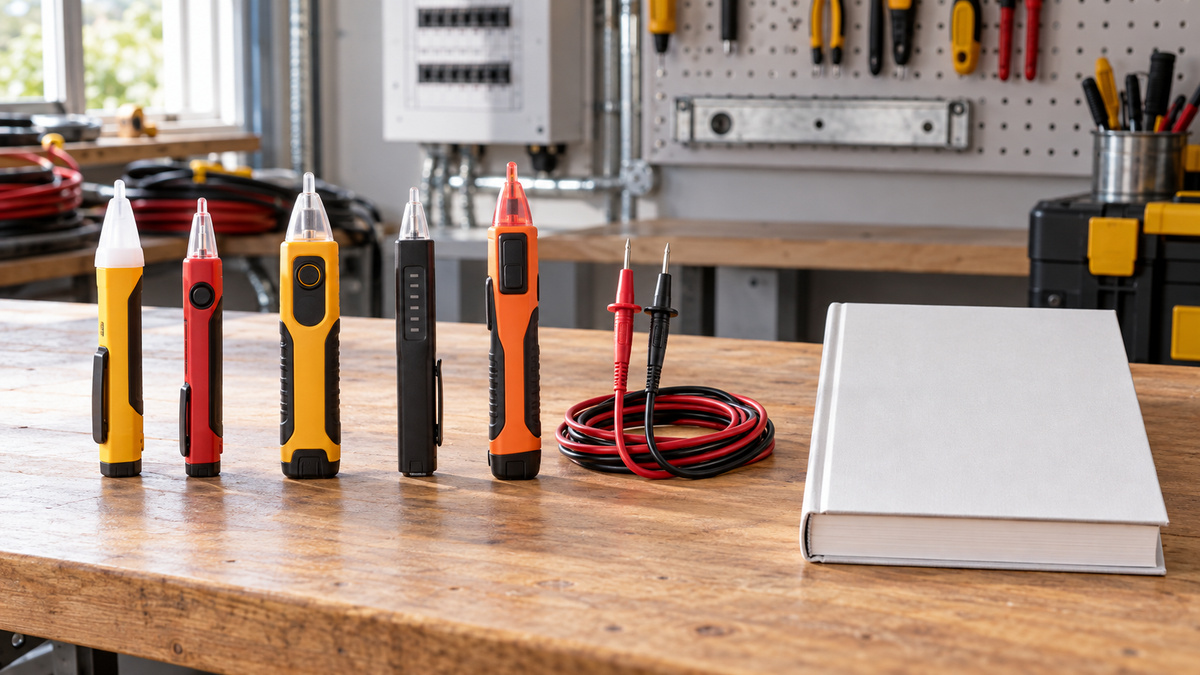
A commercial electric voltage detector is a pen-style tool that warns you when AC voltage is present, usually without touching the conductor. It tells you live or not live; it does not give you a number. This guide compares five battery-powered detectors by their stated voltage range, alert type and safety rating, so you can pick one for tracing and presence checks.
Electrical work can expose you to lethal energy. Never open a service panel or probe a live mains circuit unless you are qualified, and send panel or service work to a licensed electrician. Only one listing in this group states a CAT rating, so treat the others as unrated and follow the manual.
Quick answer
The Neoteck is a simple 12-1000V AC pen with different alarm sounds and LED levels to tell live and null wires apart. The VENLAB adds two sensitivity modes, High (12V-1000V) and Low (48V-1000V). The Klein NCVT7 adds an LCD bar graph, an audible alert and a 3-color LED tip. The Westinghouse is the only one here that states a safety rating: CAT IV 1000V with IP67 protection and dual range 12V-1000V AC. The fifth model is a 6 inch detector for 50 to 1000VAC with no CAT rating stated.
Comparison table
| Detector | Stated range | Indication | Safety rating stated | Size or weight stated |
|---|---|---|---|---|
| Neoteck non-contact detector | 12-1000V AC | Different alarm sounds and LED indicator levels | No CAT rating | Not stated |
| VENLAB dual range tester | High 12V-1000V; Low 48V-1000V | Switchable sensitivity | No CAT rating | 0.05 kg |
| Klein Tools NCVT7 | Range not stated in the facts available | LCD bar graph, audible alert, 3-color LED tip | No CAT rating | Not stated |
| Westinghouse pen | Dual range 12V-1000V AC | Flashlight and worklight | CAT IV 1000V; IP67; UL 61010-1, CSA C22.2, IEC 61010-2-030 | 6.3 x 0.9 x 1 inches |
| 6 inch voltage detector | 50 to 1000VAC | Presence check | No CAT rating | Listed 2 x 8 x 1 inches |
Product reviews
Neoteck Non Contact Voltage Detector, 12-1000V AC
An orange, battery-powered pen that detects AC from 12 to 1000V. The listing says you can tell the live wire from the null wire by the level of alarm sound and LED indicator. A bullet notes it is not suitable for Christmas light testing.
Who it suits: Someone who wants a plain presence pen with graded alarm levels.
Pros
- Low 12V start of range.
- Alarm sound and LED level change with signal strength.
Cons
- No CAT rating stated.
- No numeric reading.
- Not suitable for Christmas light testing, per the listing.
Skip if: you need a stated CAT rating or a measured voltage.
View the Neoteck detector on Amazon (affiliate link)
VENLAB Non Contact Voltage Detector, Dual Range
A blue, battery-powered voltage tester that switches between two sensitivity modes: High for 12V-1000V and Low for 48V-1000V. It weighs 0.05 kg. The included-components field lists one voltage tester and two AAA batteries, so batteries are named but no leads or clamps.
Who it suits: A user who wants to switch between a High mode that starts at 12V and a Low mode that starts at 48V, depending on the job.
Pros
- Two selectable sensitivity ranges.
- Light at 0.05 kg.
- Batteries included.
Cons
- No CAT rating stated.
- No numeric reading.
Skip if: you want one fixed range or need a stated CAT rating.
View the VENLAB detector on Amazon (affiliate link)
Klein Tools NCVT7 Non-Contact Voltage Tester with LCD Signal Strength Display
An orange and black non-contact tester with an LCD signal-strength bar graph, a 3-color LED tip and an audible alert whose rate follows the bar graph. It is battery powered and sold as one unit. The facts we have do not give a voltage range or a CAT rating.
Who it suits: Someone tracing a source who wants to see signal strength rise as the tip gets closer.
Pros
- Bar graph shows signal strength.
- Audible alert that speeds up with the bar graph.
- 3-color LED tip.
Cons
- No CAT rating stated.
- Voltage range is not given in the facts available, so check the listing.
Skip if: you need a stated CAT rating or want a plain on/off pen.
View the Klein Tools NCVT7 on Amazon (affiliate link)
Westinghouse Non-Contact Voltage Tester Pen with Flashlight and Worklight
A black, battery-powered pen with dual range 12V-1000V AC, a flashlight and a worklight. It measures 6.3 x 0.9 x 1 inches. The listing states IP67 dust and water protection, a CAT IV 1000V safety rating, and certification to UL 61010-1, CSA C22.2 and IEC 61010-2-030.
Who it suits: A user working in harsh or dark places who wants a stated safety rating on a pen.
Pros
- The only listing here with a CAT rating, CAT IV 1000V.
- IP67 protection.
- Built-in flashlight and worklight.
Cons
- The stated rating still has to match your circuit; confirm it in the manual.
- More features to learn than a basic pen.
Skip if: you want the smallest possible pocket pen.
View the Westinghouse pen on Amazon (affiliate link)
Voltage Detector, 6 In. L, 50 to 1000VAC
A red, battery-powered AC detector with a 50 to 1000VAC range. The listing records AC voltage as the measurement type and gives item dimensions of 2 x 8 x 1 inches, which differs from the 6 inch length in the title, so check the page. A bullet states the country of manufacture as the United States.
Who it suits: Someone who only needs presence checks on standard mains voltage and does not need low-voltage sensitivity.
Pros
- Simple presence detector for 50 to 1000VAC.
- Made in the United States, per the listing.
Cons
- No CAT rating stated.
- The stated range starts at 50VAC, higher than the 12V pens.
- Size figures in the listing do not agree.
Skip if: you need sensitivity below 50VAC or a stated CAT rating.
View the 6 inch voltage detector on Amazon (affiliate link)
Buying checklist
- Decide whether you need a presence alert or a measured value. Every model here is a presence detector; use a multimeter for a number.
- Check the starting voltage: 12V for the Neoteck, VENLAB (High) and Westinghouse, 48V for VENLAB (Low), 50V for the 6 inch detector.
- Find the CAT rating. Only the Westinghouse states one, CAT IV 1000V. If none is stated, keep the detector away from household mains work.
- Look at the indication: alarm levels, bar graph, LED tip or flashlight.
- Check batteries: all five are battery powered, and the VENLAB lists two AAA batteries in the box.
- Test the detector on a known live source before and after each use, and follow the manual.
Three buying situations
You trace a live source: the Klein NCVT7 bar graph and audible alert show signal strength change as you move closer. You work in harsh or dark spaces: the Westinghouse adds IP67, a flashlight and a worklight, plus a stated CAT IV 1000V rating. You want a choice of sensitivity: the VENLAB offers High from 12V and Low from 48V.
FAQ
Which models detect down to 12V AC?
The Neoteck lists 12-1000V AC, the VENLAB lists 12V-1000V in High sensitivity with 48V-1000V in Low, and the Westinghouse lists dual range 12V-1000V AC. The 6 inch detector starts at 50VAC. Confirm each range on the current product page.
Does the VENLAB include what I need to start?
Its included-components field lists one voltage tester and two AAA batteries. No leads or clamps are named, and none are needed for a non-contact pen. Check the current product page if anything seems missing.
Can the Klein NCVT7 be used on household mains?
Do not assume so. The Klein NCVT7 listing does not state a CAT rating, and a suitable CAT rating must match the circuit. Check the listing and manual before use, and let a licensed electrician handle panel or service work.
What protection does the Westinghouse pen list?
The listing states IP67 dust and water protection and a CAT IV 1000V safety rating, with certification to UL 61010-1, CSA C22.2 and IEC 61010-2-030. Confirm in the manual that the rating suits your circuit.
Can a voltage detector give me an exact voltage?
No. These pens show that voltage is present and, on some models, how strong the signal is. When you need a number, use a multimeter. Check the manual to see how each indication maps to a result.
Why does CAT information matter?
Measurement category classifies live circuits by the energy available and the impulse voltage, and it is separate from the displayed range. A detector with no stated CAT rating should not be treated as approved for household mains. Follow the manual and local electrical rules.
Final note
Choose the Neoteck for a simple 12-1000V AC pen, the VENLAB for switchable sensitivity, the Klein NCVT7 for a bar graph with a 3-color tip, and the Westinghouse if you want IP67 and a stated CAT IV 1000V rating. Skip any detector that omits a range or CAT statement you need, and leave panel or service work to a licensed electrician.
For related reading, see Klein Non Contact Voltage Detector: Top 6 Picks Compared, How to Use a Non Contact Voltage Detector and AC Voltage Detector: Options for Home and Shop.