Best Commercial Electric GFCI Outlet Circuit Analyzer Tester
As an Amazon Associate we earn from qualifying purchases. Details
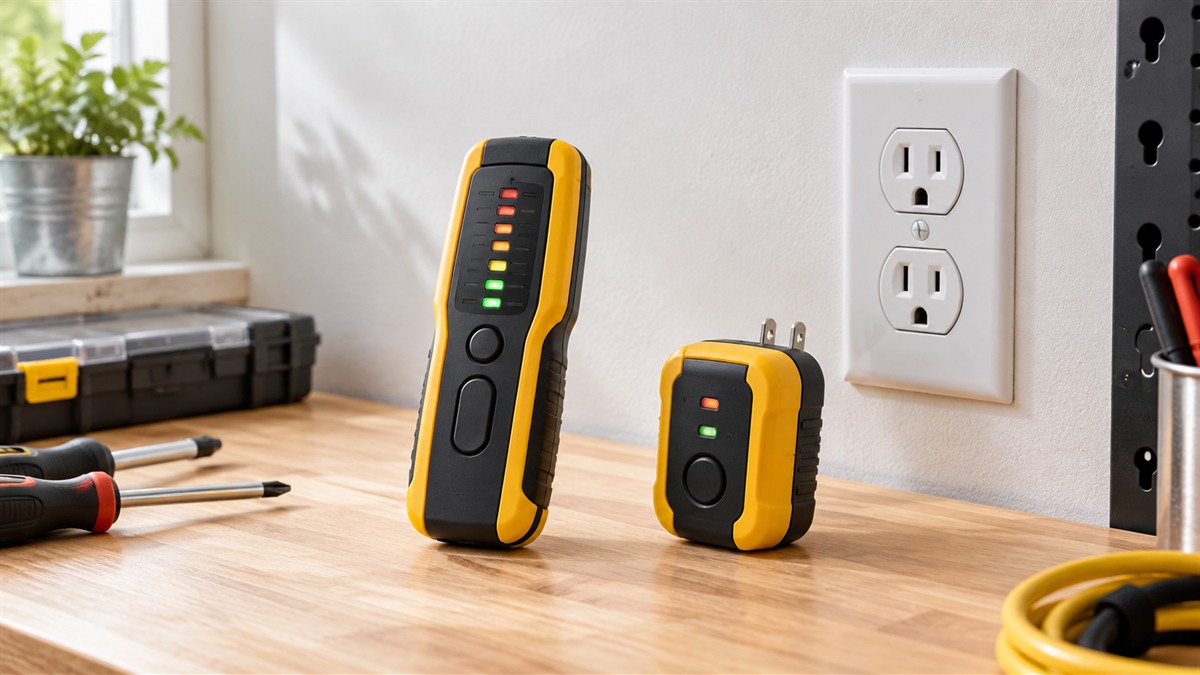
A commercial electric GFCI outlet circuit analyzer tester is usually a kit with two parts: a transmitter that plugs into an outlet and a receiver that helps find the matching breaker. Most kits also test outlet wiring and check whether a GFCI device trips. This guide explains what those functions do, which listing details decide whether a kit fits your circuits, and what to confirm before you buy. None of the listings below is sold under the Commercial Electric name, so the guide covers the product type rather than one brand.
Quick answer
Choose by the function you need first. The 90-135V kit has a stated AC range and several adapters, and its CAT II 135V statement appears in a bullet that is cut off. The KUYTN V100X combines a breaker finder, a GFCI tester and a multimeter in one case, but its included-parts field conflicts with the title. The seven-wiring-faults kit names seven wiring conditions on its LCD and shows live voltage and frequency, but it does not state a voltage range. The Vansdon BF-2000 states CAT II 300V and a GFCI trip test, but its circuit ranges and dimensions need checking. Confirm the voltage range and the category against the circuit you plan to test before you buy.
What a GFCI outlet circuit analyzer tester does
Most kits in this category combine three jobs. A circuit breaker finder helps you identify which breaker feeds an outlet or a light. An outlet tester checks the wiring at the receptacle for conditions the listing names, such as open ground, open neutral or reversed polarity. A GFCI tester checks whether a GFCI device trips when it is tested. The listings in this guide describe all three jobs, though each one words them differently, so read the exact wording before you assume a function is included.
A residual-current device, also called a GFCI, interrupts a circuit when the current in the line and neutral conductors is unequal. That imbalance indicates current leaking to ground or to an unintended path. A GFCI trip test checks that the device responds to that imbalance. A trip confirms the device’s own response. It does not confirm every wiring condition on the circuit behind the outlet.
The reason ground matters is practical. OSHA lists a path to ground that is missing or discontinuous, and lack of ground-fault protection, among the most frequent causes of electrical injuries. An outlet test that reports open ground or no GFCI protection is a result to act on, and the action is to stop and call a licensed electrician, not to keep testing.
A test light, also called a voltage tester or mains tester, checks for the presence of electricity and is simpler than a measuring instrument. A breaker finder kit reads more than presence, so the listing’s list of functions tells you which job the kit can do. Do not assume a kit does a job its listing does not name.
What to check for this search
Voltage range matched to your circuit
The range is the first limit to check. The listings in this guide state different ranges, and one does not state a range at all. A kit that stops at a given voltage will not work on a circuit outside that range, and a range stated for AC circuits does not tell you whether the kit reads DC. Compare the stated range with the circuit you plan to test. Do not assume a kit covers a 240 V circuit unless its listing says so.
Fault names and what they mean
A readout that names a condition is only as useful as the listing’s definition of it. Open ground matters because a missing path to ground is one of the OSHA causes of injury. Open neutral, missing live and reversed polarity describe other wiring conditions, and each one has its own fix. The manual should explain the fix, and a licensed electrician should make the repair. A readout is a starting point for that conversation, not a complete wiring inspection.
GFCI test and trip function
A GFCI trip test is useful when the kit states one. Check whether the listing describes a trip test function, a GFCI tester, or only a general outlet check, because those are not the same test. If the GFCI device does not trip when tested, stop and call a licensed electrician. A passing trip test is a useful result, but it does not clear the rest of the wiring.
Certification and category
Read the category statement exactly as written. CAT II is the category for measurements on circuits directly connected to the low-voltage installation. CAT IV is the category for measurements at the source of the high-voltage installation. IEC 61010-1 requires that the transient withstand capability of the equipment be made known to the user. A certification mark such as ETL or UL is not a category statement, and it does not state a voltage limit for each function. Where the listing gives no category, treat the kit as unrated for mains work.
OSHA 29 CFR 1910.303(b)(2) says listed or labeled equipment must be installed and used in accordance with any instructions included in the listing or labeling. The listing is therefore part of the safe-use requirement, not only a sales page.
Kit contents, adapters and batteries
Adapters change what the kit can reach. A light socket adapter lets you test a lighting circuit from the fixture. A 3-prong to 2-prong adapter reaches older two-slot outlets. An alligator clip adapter grips bare wire. Check which adapters the listing includes, how the batteries are supplied, and whether the box contents match the title. Some listings in this guide contradict themselves on box contents, so confirm the list before you buy.
How to choose a GFCI outlet circuit analyzer tester
Start with the job, then match the kit to it:
- Choose a kit with a stated voltage range that covers your circuit. If the range is missing, skip the listing.
- Choose a kit that states a category rating if you will test mains equipment. A category that is not stated is not a basis for mains work.
- Choose a kit that names a GFCI trip test if your work includes outlets with GFCI protection.
- Choose a combined multimeter kit only if you need the readings, because each function in a combined case still has its own limits.
For a plain outlet check, a best AC outlet tester guide or a receptacle tester with GFCI diagnosis may fit the job with fewer functions. For an open ground question, see the open ground on outlet tester guide. If you need a clamp for current, the commercial electric AC clamp meter guide covers that tool.
Before you buy, check the same items on every listing: the stated voltage range, the category, the named fault conditions, the GFCI test wording, the adapters, the batteries and the warranty. Write down any item the listing does not state. A missing range or category is a reason to skip, not a detail to fill in yourself.
Picks for this keyword
At a glance: the 4 picks, by their own spec fields
| Pick | Range / rating | Flag |
|---|---|---|
| FTCT 01 (90-135V kit with adapters) | 90-135V AC; CAT II 135V stated in a cut-off bullet | Range stops at 135V; confirm the full CAT statement before use |
| V100X (finder with multimeter) | 300V for the finder/GFCI function, 600V for the multimeter function | Included Components field says only “adapter,” conflicting with the 3-piece kit shown in title/bullets; no CAT rating stated |
| 7 Wiring Faults Finder | No voltage range stated; 100mA max alternating current (a current figure, not a voltage limit) | Batteries listed as 4x 1.5V but not confirmed installed |
| Vansdon BF-2000 | CAT II 300V stated; bullets give both 90-150V and 90-120V AC ranges — conflict | Item dimensions read 10 x 2 x 50 inches — implausible for a handheld kit; brand field says Vansdon, manufacturer field says Oudong |
Specs are from each product’s Amazon listing, checked 2026-10-11 through 2026-10-13. Every listing has at least one internal conflict (voltage range, item count, or dimension) — confirm the exact figure on the current listing before buying.
1. Circuit Breaker Finder Kit with GFCI Outlet Tester for 90-135V AC Circuits,includes Light Socket (Best for a 90-135 V kit with adapters)
Specs from the listing (checked 2026-10-11):
- Specification Met: ETL
- Included Components: 1 circuit breaker finder kit,3 batteries,1 user manual,1 accessory kit
- Power Source: Battery Powered
- Model: FTCT 01
- Measurement Type: Voltmeter
Pros
- The title and bullets state a 90-135V AC circuit range, with a 90-135V display described in the bullets.
- Includes light socket, 3-to-2 prong and alligator clip adapters, plus three batteries, per the listing.
- The specification lists ETL, and a bullet describes an IEC61010-1 transmitter battery compartment.
Cons
- The CAT II 135V statement appears in a bullet that is cut off, so the full rating needs confirming.
- The stated range stops at 135V, so the listing does not cover higher-voltage circuits.
- The specification names the product as a voltmeter, and the listing does not describe a separate current function.
Best for: Testing outlets and circuits that sit inside 90-135 V AC, where the adapters are useful.
Skip if: Your circuit sits outside 90-135 V, or you need a CAT rating above the 135 V statement.
View on Amazon (affiliate link)
2. Circuit Breaker Finder Kit, Electrical Circuit Tracer with Digital Multimeter, GFCI Outlet Tester (Best for a finder with a multimeter)
Specs from the listing (checked 2026-10-13):
- Included Components: adapter
- Power Source: Battery Powered
- Part Number: V100X
- Style: Industry
- Brand: KUYTN
Pros
- Bundles a circuit breaker finder, a GFCI outlet tester and a digital multimeter in one carrying case, per the bullets.
- Lists multimeter measurements that include AC and DC voltage, DC, resistance, capacitance, diodes, transistors, continuity and battery voltage.
- The bullets state up to 600V detection for the multimeter function.
Cons
- The Included Components field reads only adapter, which conflicts with the three-piece kit in the title and bullets, so rely on neither.
- The bullets give 300V detection for the finder and GFCI function and 600V for the multimeter, so the voltage limit depends on the function.
- The listing does not state a CAT rating or a fuse rating for the multimeter function.
Best for: Shoppers who want a finder, a GFCI tester and a multimeter in one case for mixed household and light trade checks.
Skip if: You need a stated CAT rating, or a box list that matches the title, before you buy.
View on Amazon (affiliate link)
3. Circuit Breaker Finder Kit – 1-Second Breaker ID, 7 Wiring Faults Diagnosis, Live Voltage & Hz (Best for named wiring faults)
Specs from the listing (checked 2026-10-13):
- Specification Met: Ul Listed
- Included Components: Circuit Breaker Finder Transmitter, Receiver, 1.5v Battery*4,
- Maximum Alternating Current: 100 milliamps
- Measurement Type: Voltage
- Power Source: Battery Powered
Pros
- The LCD names seven wiring conditions, including open ground, open neutral and live and ground reversed, per the bullets.
- The transmitter shows live voltage and circuit frequency in Hz, which the bullets describe as more than a basic outlet tester gives.
- Includes NCV detection, a built-in flashlight, a light socket adapter, a 3-to-2 prong adapter and an alligator clip adapter.
Cons
- The listing does not state the voltage range the finder supports, which the other picks do state.
- A Maximum Alternating Current field reads 100 milliamps, and the listing does not explain what that rating covers.
- The batteries are listed as four 1.5v units, but the listing does not say whether they come installed.
Best for: Users who want named fault readouts, a frequency display and an all-in-one storage case for outlet and light circuits.
Skip if: You need a stated voltage range or a CAT rating before you test.
View on Amazon (affiliate link)
4. Vansdon Circuit Breaker Finder with LCD, GFCI Outlet Tester,Circuit Tracer (Best for a stated CAT II 300 V rating)
Specs from the listing (checked 2026-10-13):
- Specification Met: Cat II 300v
- Warranty Description: 2 Years Manufactuer
- Included Components: Circuit Breaker Finder Tool Set
- Model: BF-2000
- Manufacturer: Oudong
Pros
- States CAT II 300V in the specification field and in a bullet.
- Lists a GFCI trip test function alongside a breaker locator and an outlet tester in one device.
- The warranty description states 2 Years from the manufacturer.
Cons
- The bullets give both 90-150 V and 90-120V AC circuit ranges, so the working range needs confirming before purchase.
- The Item Dimensions field reads 10 x 2 x 50 inches, which does not describe a handheld kit, so the field is not reliable.
- The brand field reads Vansdon while the manufacturer field reads Oudong, so confirm the maker before contacting support.
Best for: Users who need a stated CAT II 300V rating and a GFCI trip test on residential or light commercial outlets.
Skip if: You need a confirmed working range that covers 120 V circuits, or a rating above CAT II 300V.
View on Amazon (affiliate link)
The 90 to 135 V kit with adapters
The 90 to 135 V kit is a breaker finder kit with a GFCI outlet tester. Its listing states a 90-135V AC circuit range in the title and bullets. The kit includes a light socket adapter, a 3-to-2 prong grounding adapter and an alligator clip lead. The specification field lists ETL, and a bullet describes an IEC 61010-1 transmitter battery compartment. The bullets name one 9V battery and two AAA batteries, which matches the three-battery count in the specification. The CAT II 135V statement appears in a bullet that is cut off, so read the full listing before you rely on it.
Choose this kit if your circuit sits inside 90-135 V and you want the adapters in the box. Skip it if the circuit is outside that range, or if you need a CAT rating above the 135 V statement.
The finder, GFCI tester and multimeter in one case
The KUYTN V100X bundles a circuit breaker finder, a GFCI outlet tester and a digital multimeter in one carrying case. Its bullets list AC and DC voltage, DC, resistance, capacitance, diode, transistor, continuity, battery voltage and NCV detection. The bullets give 300V detection for the finder and GFCI function, and up to 600V for the multimeter. The included-components field says only “adapter”, which conflicts with the three-piece kit in the title and bullets, so rely on neither until the box contents are confirmed. The listing does not state a CAT rating.
Choose this if you want a multimeter in the same case as the finder. Skip it if you need a clear category rating, or if the kit list matters to you before purchase.
The kit with named wiring faults and a Hz display
The seven-wiring-faults kit is a breaker finder kit with an LCD that names seven wiring conditions, including open ground, open neutral, missing live and live and ground reversed. The transmitter shows live voltage and circuit frequency in Hz. The listing also includes NCV detection, a built-in flashlight, a light socket adapter, a 3-to-2 prong adapter and an alligator clip adapter. The listing does not state a voltage range for the finder or a CAT rating. A field labeled Maximum Alternating Current reads 100 milliamps, and the listing does not explain what that rating covers. Its batteries are listed as four 1.5V units, but the listing does not say whether they come installed.
Choose this if you need named fault readouts and a frequency display. Skip it if you need a stated voltage range or a CAT rating before you test.
The kit with a stated CAT II 300V and a GFCI trip test
The Vansdon BF-2000 is a breaker locator and tracer with an LCD, an outlet tester and a GFCI tester in one kit. Its specification field and bullets state CAT II 300V. The bullets describe a GFCI trip test function and a supported voltage range of 90-150 V, while another bullet gives 90-120V AC circuits. Confirm the working range before you buy. The item dimensions field reads 10 x 2 x 50 inches, which does not describe a handheld kit, so rely on neither figure. The brand reads Vansdon, and the manufacturer field reads Oudong. The warranty description gives a 2-year manufacturer warranty.
Choose this if you want a stated CAT II 300V rating and a GFCI trip test. Skip it if you need a confirmed working range that covers 120 V circuits, or a rating above CAT II 300V.
This is an assumed time estimate, not a measured time and not a figure from any listing. Suppose an electrician’s helper checks 12 outlets in one building. Each outlet gets a circuit trace and a GFCI check. The trace is planned at 3 minutes per outlet, and the GFCI check at 1 minute per outlet. The trace time is 12 times 3 = 36 minutes. The GFCI time is 12 times 1 = 12 minutes. The outlet time is 36 + 12 = 48 minutes. The plan also allows two breaks of 5 minutes each, which adds 2 times 5 = 10 minutes. The total planned time is 48 + 10 = 58 minutes. Any outlet that shows open ground or a GFCI that does not trip goes to a licensed electrician before the round continues.
Safety before you test
Work on mains circuits can kill. OSHA’s list of frequent electrical injury causes includes contact with power lines, lack of ground-fault protection, a path to ground that is missing or discontinuous, equipment not used in the prescribed manner, and improper use of extension and flexible cords. Ways to reduce the risk include insulation, guarding, grounding, electrical protective devices and safe work practices. The meter’s CAT rating must suit the circuit you test.
Do not open a live panel or remove a panel cover to use a breaker finder. Panel and service work belongs to a licensed electrician. Follow the instrument manual and local electrical rules at every step. Remove any test adapter, including a grounding adapter used for testing, once the test is finished. Do not use a transmitter or receiver that is cracked, wet or has damaged leads.
Fuses and circuit breakers protect the circuit from current above what the equipment can safely carry. A fuse is a sacrificial device and must be replaced after it operates. A circuit breaker can be reset. Neither device is a test method, and a breaker finder does not make a live panel safe to work on.
Mistakes to avoid
- Searching for a Commercial Electric name and expecting a match. None of the listings in this guide is sold under that name, so match the function, range and category instead.
- Using a kit on a circuit outside its stated voltage range.
- Treating one fault name as a full wiring inspection.
- Assuming a GFCI trip test confirms every wiring condition behind the outlet.
- Leaving a grounding adapter in place after the test.
- Opening a live panel to use a breaker finder.
- Confusing a multimeter’s voltage limit with the kit’s detection range, which can differ.
- Buying from a listing whose box contents contradict its title, without checking the kit list.
The 90 to 135 V kit against a 240 V circuit
The 90 to 135 V kit has a stated range of 90 to 135 V AC, a span of 45 volts. Subtracting 135 from 240 gives 105 volts above the top of that range, so a 240 V circuit falls outside what this kit is listed to cover.
FAQ
What does a circuit analyzer do that a plain outlet tester does not?
A kit with a breaker finder helps you identify which breaker feeds an outlet, and a GFCI trip test checks the GFCI device. A basic outlet tester checks the outlet. The exact functions depend on the listing, so compare the named functions before you assume one kit does more than another.
Does a GFCI outlet tester replace a GFCI device?
No. A GFCI device, also called a residual-current device, interrupts a circuit when current in the line and neutral conductors is unequal. A tester checks the device or the wiring. It does not replace the protection.
Is any listing in this guide a Commercial Electric product?
No. The four listings here are sold under other brand names. The guide covers the product type, so match the function, range and category to your circuit.
What voltage range do I need?
It depends on the circuit you plan to test. Compare the range stated on the listing with the circuit’s voltage. The listings here state ranges of 90-135V, 90-150V and 90-120V, and one does not state a range. Do not assume a kit covers a 240 V circuit unless the listing says it does.
Can a kit with a 135V range be used on 240V?
Not on the basis of the listing. The first pick states a 90-135V AC range, and nothing in its listing covers 240 V. Use a kit whose stated range covers the circuit, and check the manual.
What does a GFCI trip test show?
It shows whether the GFCI device trips when tested. A trip is a useful result for that device. It does not confirm every wiring condition behind the outlet, so read the listing’s wording about the test.
Who should handle a failed outlet test?
A licensed electrician. Open ground, no GFCI protection or a GFCI that does not trip all call for professional diagnosis. This guide does not give repair steps for those conditions.
Bottom line
Choose the kit whose stated voltage range covers your circuit and whose category statement you can read in full. If you need named wiring faults and a frequency display, the seven-wiring-faults kit fits once you confirm its range. If you want a multimeter in the same case, the KUYTN V100X fits once its box contents are confirmed. For any result that shows open ground or a GFCI that does not trip, stop and call a licensed electrician.
Sources
- Residual-current device (Wikipedia): how a GFCI interrupts a circuit when line and neutral currents are unequal
- Measurement category (Wikipedia): the IEC CAT classification and what the categories cover
- OSHA electrical safety: common causes of electrical injuries and ways to reduce the risk
- OSHA 29 CFR 1910.303: listed equipment must be used in accordance with its listing instructions
- Circuit breaker (Wikipedia): how a circuit breaker protects against excess current
- Test light (Wikipedia): what a voltage tester or test light checks