Best 12v Voltmeter: 5 Options for Car and Battery Checks
As an Amazon Associate we earn from qualifying purchases. Details
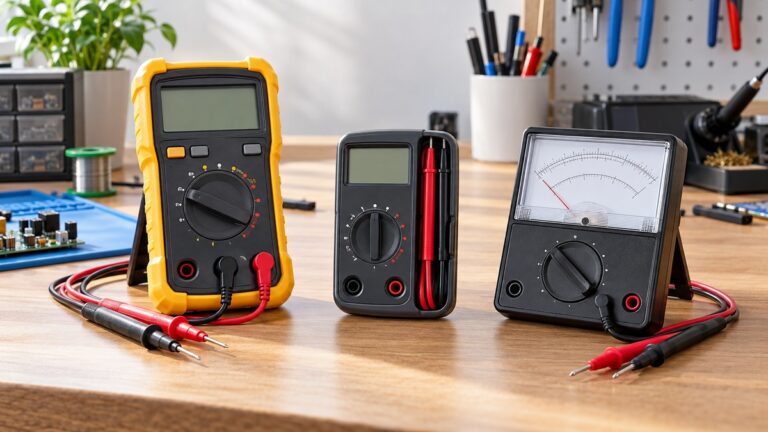
A 12v voltmeter reads the voltage of a car, boat or small battery system, and the useful ones show it in a form you can trust at a glance. Five of the product products fit: two vehicle-style digital testers, a pocket multimeter, a case-style multimeter and an auto-ranging multimeter. This guide compares them on the voltage range around 12V, display resolution, stated accuracy, safety rating and what the listing leaves out. It also tells you when a simple tester is enough and when a full multimeter earns its place. USB power meters, test lead kits and a pen meter were set aside because they do not read a 12V system the way a voltmeter does.
Quick answer
Choice the first choice if you only read vehicle voltage and want a probe with a 96 inch cord and a 0.1V display step. Choice the second if you want a vehicle tester that states a 12V and 24V use, a 1V to 72V reading range and a hard case. Choice the third for a conventional multimeter with a stated CAT II 600 V rating and a 3 Year Warranty. Choice the fourth if you want a dedicated battery test mode listed for 12V, 9V and 7.5V cells. Choice the fifth for auto-ranging and a stated CAT II 600V rating.
If you plan to measure anything beyond vehicle circuits, check each listing’s safety rating first. Mains circuits can kill, and panel or service work belongs to a licensed electrician.
What to check before you buy a 12v voltmeter
A 12V job has its own priorities. You do not need a 600V range for a battery, but you do need a display that separates 12.0 from 12.6 clearly, and a probe that reaches the battery.
Range around 12V
The top choice states 3V-48V. The second reads 1V to 72V DC. The third offers DC ranges of 200mV, 2V, 20V, 200V and 600V, so the 20V range is the natural fit for 12V. The fourth lists a DC range of 200mV~600V and a battery test for 12V, 9V and 7.5V. The fifth lists 0.8V~600V. Any range that includes 12V works on paper. What changes is how the display splits the reading.
Display and resolution
The first states a 0.1V resolution on an LED display. The third has 2000 counts and the fifth 4000 counts. The fourth is also a 2000 Count meter with an LED screen. Counts describe how finely the display can divide a range. A higher count gives a finer step, though you should check the actual step on the range you use.
Stated accuracy
The third lists DC voltage at ±(0.5%+3), the fourth ±(1%+5) and the fifth ±(1.0%+5) on DC. The first and second give no accuracy figure in the listing. If you care about knowing how far a reading may be off, only the three multimeters give you the numbers.
Safety rating
The third lists CAT II 600 V; CAT Ill 300 V, the fifth CAT II 600V. The first, second and fourth state no CAT rating. For a car battery the category matters less, but if you plan to use the meter on household outlets, an unstated rating is a reason to look elsewhere. Measurement category is an IEC classification by the energy available and the impulse voltages at a point in the circuit, and the required impulse withstand ranges from 500 V (CAT II, 50 V) to 12,000 V (CAT IV, 1000 V).
Reach and form
The first has a 96 inch spring wire and the second a long cable with battery clamps and 14 flexible leads. The multimeters use standard test leads. Weight runs from about 0.1 kg for the fifth to 0.15 kg for the third and 558 g for the second.
Voltmeters that fit a 12v voltmeter search
Five products qualify. Each card shows specs, pros and cons from the listing.
1. WINAMOO Automotive Test Light with 3-48V LED Digital Voltage Display, Auto Circuit Tester (Best simple vehicle voltage tester)
Specs from the listing (checked 2026-10-11):
- Brand: WINAMOO
- Power Source: Corded Electric
- Item Weight: 200 g
- Measurement Type: Voltmeter
- Item Dimensions: 11.1 x 4.2 x 1.4 inches
- Specification Met: CE, UL
Pros
- Lists 3V-48V with 0.1V resolution on an LED display
- 96 inch spring wire with a large alligator clip
- Weighs 200 g with CE and UL listed
Cons
- Voltmeter only, with no resistance, continuity or current
- The listing gives no accuracy figure or CAT rating
Best for: Quick battery and fuse voltage checks on a vehicle.
Skip if: You need resistance, continuity, current or a stated safety category.
View on Amazon (affiliate link)
2. Automotive Test Light Probe Kit, 3-36V DC Power Circuit Probe Tester with Voltmeter, Auto (Best wide-window kit with leads)
Specs from the listing (checked 2026-10-11):
- Brand: ATOBLIN
- Power Source: Corded Electric
- Item Weight: 558 g
- Style: LED Digital Display
Pros
- Reads 1V to 72V DC and is described for 12V and 24V automotive systems
- 14 flexible leads, battery clamps, probes and a hard carrying case
- Rocker switch can deliver positive or negative battery power to compatible components
Cons
- Heavy at 558 g and not pocketable
Best for: Garage use where one kit covers leads, clamps and polarity checks.
Skip if: You want a pocket meter or AC readings.
View on Amazon (affiliate link)
3. AstroAI Digital Multimeter Tester 2000 Counts with DC AC Voltmeter and Ohm Volt Amp Meter; Measures (Best stated accuracy and CAT rating)
Specs from the listing (checked 2026-10-11):
- Brand: AstroAI
- Power Source: Battery Powered
- Item Weight: 0.15 kg
- Environmental Conditions: CAT II 600 V; CAT Ill 300 V
- DC Voltage: 200mV/2V/20V/200V/600V ±(0.5%+3)
- Digital Display: 2000 Counts. The unit symbols will automatically appear according to the measured functions
- Warranty Description: 3 Year Warranty by AstroAI
Pros
- DC accuracy of ±(0.5%+3) on a 2000 count display
- Lists CAT II 600 V; CAT Ill 300 V
- 3 Year Warranty and DC current to 10A
Cons
- Power field says 2 x 1.5 V AAA while the package lists a 9V battery, and the dimension field of 42.52 inches cannot be right
- Range selection is manual, so you must set the dial yourself
Best for: Users who want a conventional multimeter with published accuracy.
Skip if: You want auto-ranging or consistent listing details.
View on Amazon (affiliate link)
4. ANENG Digital Multimeter with Case,DC AC Voltmeter,Ohm Volt Amp Meter (Best with a battery test mode)
Specs from the listing (checked 2026-10-11):
- Brand: ANENG
- Power Source: Battery Powered
- DC Voltage: Range:200mV~600V;Resolution:0.1mV~1V;Accuracy:±(1%+5)
- Max Count: 2000 Count
- Weight: 155g
- Battery Test: 12V/9V/7.5V Battery
Pros
- Battery test lists 12V, 9V and 7.5V cells
- DC voltage 200mV~600V with ±(1%+5) accuracy
- Includes NCV sensing and anti-burn double fuses
Cons
- The listing does not state a CAT rating
- The included-components field is blank and some text refers to a dehumidifier
Best for: Hobbyists who test several battery types.
Skip if: You need a stated safety category or a clean listing.
View on Amazon (affiliate link)
5. TM-510 Digital Multimeter, 4000 Counts, Smart Measurement, Auto-Ranging Voltmeter; Voltage Tester (Best auto-ranging with CAT II)
Specs from the listing (checked 2026-10-11):
- Brand: TESMEN
- Power Source: Battery Powered
- Item Weight: 0.1 kg
- Display: 4000 counts
- Measurable Voltage: 0.8 ~ 600 v
- DC Voltage: 0.8V~600V; ±(1.0%+5)
- Note: CAN'T MEASURE CURRENT
- Included Components: 1*TM-510 Multimeter; 2*Test Leads; 2*AAA Batteries; 1*Storage Bag; 1*User Manual
Pros
- Auto-ranging 4000 count display with DC voltage 0.8V~600V
- Lists CAT II 600V, CE, UKCA and RoHS
- Includes leads, 2 AAA batteries and a storage bag
Cons
- The spec table says it cannot measure current
- DC accuracy of ±(1.0%+5) is looser than the third choice
Best for: Users who want no range dial and a stated category.
Skip if: You need current readings.
View on Amazon (affiliate link)
How each choice behaves for 12V work
Top choice: the vehicle-style LED tester
This is an automotive test light with a voltage display. The listing states 3V-48V, 0.1V resolution, a bright LED display, a sharp stainless steel probe, a large alligator clip and 96 inch spring wire. It weighs 200 g and measures 11.1 x 4.2 x 1.4 inches. It lists bidirectional polarity lights and CE and UL.
For a quick battery or fuse check it is the simplest. Limits: it is a voltmeter only, it gives no accuracy figure and no CAT rating, and it needs a vehicle supply. Skip it if you want resistance, continuity or current.
Second choice: the tester with a wide reading window
The second choice reads 1V to 72V DC and operates from a 3-36V DC power source. The listing says it helps you troubleshoot 12V and 24V automotive electrical systems. It weighs 558 g and includes 14 flexible test leads, a long power cable with battery clamps, sharp probes, an alligator clip and a hard carrying case. A rocker switch delivers positive or negative battery power to compatible DC components.
It is the biggest and heaviest in the group. The listing gives no accuracy figure and no CAT rating. Skip it if you want something that fits in a pocket or reads AC.
Third choice: the conventional multimeter with stated ratings
This 2000 count multimeter lists DC voltage ranges of 200mV, 2V, 20V, 200V and 600V with ±(0.5%+3) accuracy, DC current to 10A, CAT II 600 V; CAT Ill 300 V, fuse protection and a 3 Year Warranty. It includes a 9V battery, two test leads and a manual. It states manual range selection.
Check the contradictions before buying. The power field says 2 x 1.5 V AAA Batteries while the package lists a 9V battery. A bullet gives a sampling speed of 2 times per second while the spec says 3 Times Per Second. The dimension field of 1.77 x 5.47 x 42.52 inches cannot be right for a handheld. Rely on none of these. Skip it if you want auto-ranging.
Fourth choice: the multimeter with a battery test mode
The fourth choice lists a battery test for 12V, 9V and 7.5V cells, DC voltage of 200mV~600V with ±(1%+5) accuracy, AC and DC current to 10A, capacitance and a 2000 Count display. It weighs 155g and ships with a silicone case according to a bullet. It adds NCV sensing, live detection and smart anti-burn with double fuses.
Gaps: the listing does not state a CAT rating, and the included-components field is just a slash. Some text refers to a dehumidifier, which is not about vehicle work. Skip it if you want a stated safety category.
Fifth choice: auto-ranging with a stated rating
The fifth choice is a 4000 count auto-ranging multimeter with a stated CAT II 600V rating, CE, UKCA and RoHS. It measures AC and DC voltage from 0.8V to 600V, resistance and continuity. It weighs 0.1 kg, includes two test leads, 2 AAA batteries, a storage bag and a manual, and it has non-contact voltage detection and data hold.
The spec table says it cannot measure current. If you need an amp reading on a battery drain, skip it.
Side-by-side comparison
| Feature | First | Second | Third | Fourth | Fifth |
|---|---|---|---|---|---|
| Voltage range | 3V-48V | 1V to 72V DC | 200mV to 600V DC | 200mV~600V DC | 0.8V~600V |
| Resolution or counts | 0.1V | Not stated | 2000 counts | 2000 Count | 4000 counts |
| DC accuracy | Not stated | Not stated | ±(0.5%+3) | ±(1%+5) | ±(1.0%+5) |
| CAT rating | Not stated | Not stated | CAT II 600 V | Not stated | CAT II 600V |
| Current | No | No | Up to 10A | Up to 10A | Cannot measure |
Which one to choose
You only check a car battery and fuses. The top choice is the simplest. The second adds range and a case, but its listing gives no accuracy.
You want to know how far a reading may be off. Choose the third, fourth or fifth, because they give accuracy numbers. The third has the tightest stated DC figure.
You also work on household electronics. The third and fifth state CAT II 600 V or 600V. Do not use an unrated meter on mains.
You want auto-ranging with no dial to set. The fifth is the one.
For related guides, see a DC voltmeter, a battery voltmeter, a car lighter voltmeter and a 12v test light.
Suppose a battery reads 12.00 V on the third choice’s 20V range. A 2000 count meter on a 20V range divides it into steps of about 20 ÷ 2000 = 0.01 V. We assume the display shows two decimals on that range, which you should confirm in the manual.
The stated accuracy is ±(0.5%+3), meaning 0.5% of the reading plus 3 counts. Percentage part: 12.00 × 0.005 = 0.06 V. Counts part: 3 × 0.01 = 0.03 V. Total: 0.06 + 0.03 = 0.09 V. So the display could read anywhere from 12.00 − 0.09 = 11.91 V to 12.00 + 0.09 = 12.09 V. Check: 0.06 + 0.03 = 0.09, and 12.09 − 11.91 = 0.18, which is twice 0.09.
For the top choice, the listing states a 0.1V resolution but no accuracy. A reading of 12.0 V on a display that steps in 0.1V gives no stated bound at all, and the display step alone is 0.1 V. That is 0.1 ÷ 0.09 ≈ 1.1 times the third choice’s stated error.
Cord reach is a second setup question. A 96 inch cord is 96 ÷ 12 = 8 ft, and 8 × 12 = 96 confirms it. If your battery sits 7 ft from the point you want to probe, the 8 ft cord has 8 − 7 = 1 ft to spare.
What this changes: if your choice depends on a tenth of a volt, buy for stated accuracy, not for display size.
Worked example: comparing the top of two DC ranges
The top choice lists a 3-48V range, and the second choice reads 1V to 72V DC. The difference between the two upper values is 72V minus 48V, which equals 24V. Confirm that the upper value covers the battery or system voltage you plan to measure before choosing.
Common mistakes with a 12V voltmeter
- Treating an unstated accuracy as good. The first and second listings give no accuracy figure.
- Assuming any range works. A 600V range includes 12V, but a coarse range may show fewer useful decimals.
- Believing a contradictory listing. The third choice lists two different battery types and an impossible dimension. Check the manual.
- Using an unrated meter on mains. Choices one, two and four show no CAT rating in their listings. Keep them to vehicle work.
- Ignoring battery safety. Handle the battery and terminals carefully and follow the vehicle manual. Do not use these tools on airbag circuits or high-voltage hybrid and EV systems.
For other formats, see a digital voltmeter and a 12v DC voltage detector.
FAQ
What is a 12v voltmeter used for?
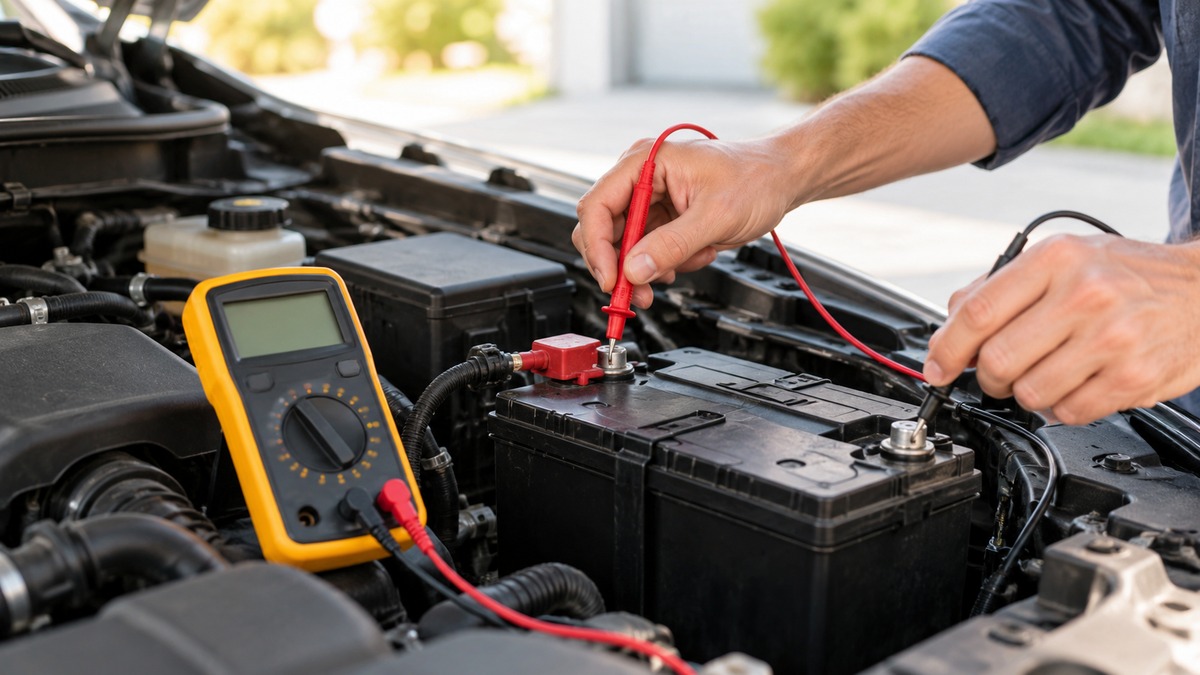
It reads the voltage of a car, boat or small battery system. Typical uses are checking a battery at rest, a fuse, or the supply at a connector.
Do I need a CAT rating for a car battery?
Not for a battery on its own. A rating becomes important if the same meter will also touch household or building circuits. Only the third and fifth state one.
Which choice has the finest display step?
The first lists 0.1V resolution. For the multimeters, the step depends on the range, so check the manual. The fifth has 4000 counts against 2000 for the others.
Can a simple tester be accurate enough?
Only the listings with accuracy figures let you answer that. The third, fourth and fifth give them. The first and second do not.
Does auto-ranging matter for 12V?
It saves turning a dial. The fifth is the only auto-ranging choice. The third states manual range selection.
Can I measure current with these?
The third and fourth list current up to 10A. The fifth cannot measure current. The first and second are voltage testers.
What if the listing contradicts itself?
Trust none of the conflicting fields. The third choice has the clearest example, so read its manual or ask the seller.
Bottom line
Choose the top choice for quick vehicle voltage checks with a long cord, the second for a wider 1V to 72V window in a case, the third for the clearest stated accuracy and CAT II 600 V rating, the fourth for a battery test mode, and the fifth for auto-ranging with CAT II 600V. If a tenth of a volt matters, choice a meter that states its accuracy.
Sources
- Measurement category (Wikipedia): explains CAT classification and the 500 V to 12,000 V impulse withstand range