How to Test a Light Switch with a Voltage Tester
As an Amazon Associate we earn from qualifying purchases. Details
A non-contact voltage tester is the simplest first check on a light switch. It senses AC voltage through the cable insulation, so you do not touch a wire to start. This guide walks through the check, then lists the four testers whose listings suit a switch circuit, with the range, alert and rating each listing states. Listing data was checked on 11 October 2026.
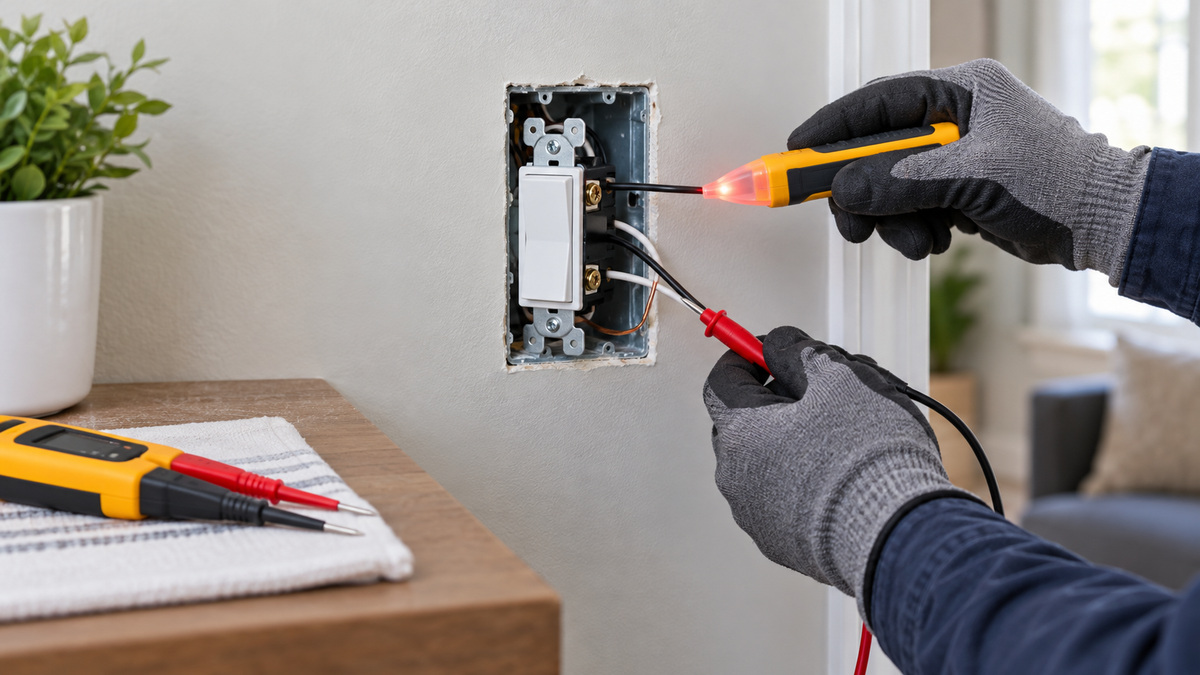
Quick answer: turn the light on and off at the switch, hold a non-contact tester near the switch box and cable, and watch for the signal. A flashing light or a beep means voltage is present. A quiet tester does not prove the circuit is dead, so treat it as a first check only.
What you need before you start
The job needs a non-contact tester with a range that covers mains voltage, and a way to confirm the tester itself works. The four pens in this guide list ranges that start between 12 V and 90 V and run up to 1000 V AC. Each one is battery powered according to its listing.
- Range: the tester should list an AC range that includes the voltage in your wall. The Klein and Neoteck listings start lower than the Fluke, so they cover a wider span.
- Self-check: the Fluke listing says the tester runs a continuous self-test, and the Klein listing says a green LED shows it is operational.
- Batteries: check the battery level before a job, because a flat battery gives no signal and looks the same as a dead circuit.
How the check works, step by step
- Check the tester on a known live source first, such as a working outlet, so you know the alert works.
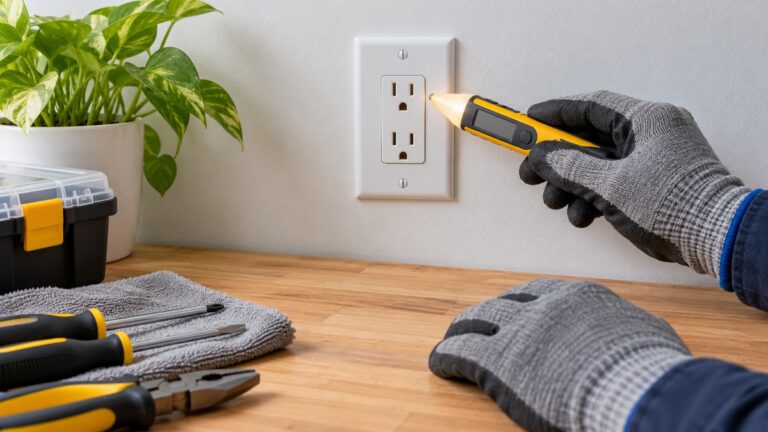
- Turn the light on at the switch. Hold the tip near the switch box and the cable entering it, and note whether the tester signals.
- Turn the light off at the switch and repeat the check. A change in signal shows the switch is on the circuit you are testing.
- Test the tester again on the known live source. If its alert has stopped, the earlier quiet result tells you nothing.
Non-contact testers are a first check. If you need to open the switch box, turn the power off at the breaker first, and confirm it is off with a meter that you have checked on a live source.
The four testers the listings name
Fluke 1AC II VoltAlert (B000EJ332O)
The Fluke is listed at 90 V to 1000 V AC, and its title names a CAT IV rating. The listing says the tip glows red and a beeper sounds when voltage is detected. One bullet gives an alternative range of 200 V to 1000 V AC, and the bullets we hold do not say how to select it. Check the Fluke 1AC II on Amazon.
Klein Tools NCVT1P (B099SJ6469)
The Klein is listed at 50 V to 1000 V AC. Its listing says a green LED shows the tester is working, and that it flashes red and beeps on detection. The bullets name light switches among the places it detects AC voltage, alongside cables, circuit breakers and outlets. No CAT rating appears in the Klein listing data we hold. Check the Klein NCVT1P on Amazon.
Neoteck Non Contact Voltage Detector (B01JYCVU2Q)
The Neoteck is listed at 12 V to 1000 V AC. Its bullets say it separates live and null wires by alarm sound level and LED, which is useful when you are working out which conductor is which at a switch. One bullet carries a CE CAT III 600 V certificate line. Check the Neoteck detector on Amazon.
MXCOIRTP Voltage Tester (B0D7LWBYVW)
The MXCOIRTP has three AC ranges, 12 V, 48 V and 70 V up to 1000 V. Its listing describes three sensitivity modes, and a detection light and tail flashlight that help in a dim switch box. The listing data we hold does not state a CAT rating. Check the MXCOIRTP on Amazon.
Worked example: does the range matter at a switch?
For example, assume a switch on a 120 V circuit. The Fluke floor of 90 V and the Klein floor of 50 V both sit below 120 V, so either pen covers the reading. The upper limit of 1000 V is far above it. A switch on a 12 V low-voltage circuit is different. Only the Neoteck and the MXCOIRTP ranges start at 12 V, so the Fluke and Klein would be the wrong tool for that job on their listed figures.
What the listings do not say
None of the four listings says how far from a cable the tester will still detect voltage, so the distance you can hold it from the switch box is unknown from the listing data. The listings also do not say how each tester reacts to two-wire switch circuits or to dimmers, so check the tester on the circuit before you rely on a quiet result.
Frequently asked questions
Can a non-contact tester tell me a light switch is off?
No. It can show that voltage is present, and a quiet tester does not prove the circuit is dead. Confirm with a meter that you have checked on a known live source.
Which tester covers a 120 V switch?
All four pens list ranges that include 120 V on the figures given. The Fluke starts at 90 V, the Klein at 50 V, and the Neoteck and MXCOIRTP at 12 V.
Why test the tester first?
A tester with a flat battery or a faulty alert gives the same silent result as a dead circuit. Testing it on a known live source before and after the job shows whether the silence means anything.
Do I need to turn off the breaker?
If you need to open the switch box, turn the power off at the breaker and confirm it is off before you touch any wire. A non-contact tester alone does not make an open box safe.
Conclusion
Use a non-contact tester to check a light switch in four steps: test the tester, check the switch on and off, compare the results, and test the tester again. The Fluke, Klein, Neoteck and MXCOIRTP listings each give a range that suits a standard switch, with the Neoteck and MXCOIRTP starting lowest at 12 V. Treat any quiet result as a first check, not a final answer.
For more on the tester itself, see how do voltage testers work and how to use a non-contact voltage detector. For outlets and wiring checks, see best wall socket tester, test wall outlet, and best live wire tester.
Fluke 1AC II on Amazon · Klein NCVT1P on Amazon · Neoteck detector on Amazon · MXCOIRTP tester on Amazon