Best Tester Buzzer for Home Electrical Checks
As an Amazon Associate we earn from qualifying purchases. Details
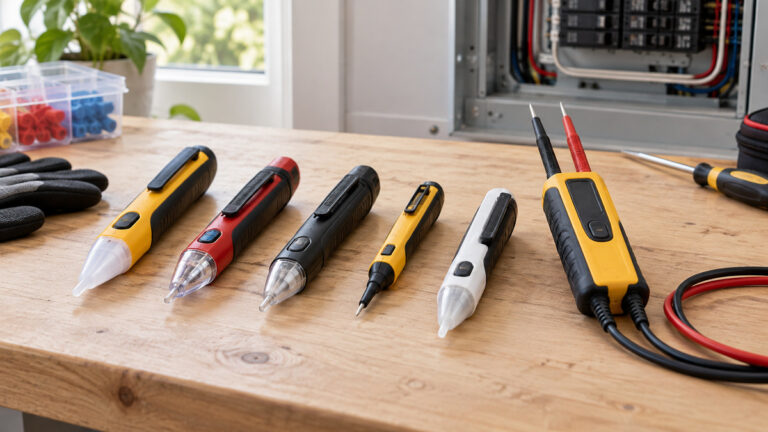
A tester buzzer is a meter or pen that sounds an alarm when it finds voltage or continuity, so you can keep your eyes on the wire or outlet. The six picks below are home-electrical listings whose titles or bullets name a buzzer, beeper or audible alarm. Each card quotes the listing as the seller states it, and the date each listing was checked is shown on the card.
Quick answer: for a pen that beeps when a live wire is near, the Fluke 1AC II, Klein NCVT1P and MXCOIRTP MT01 all name an audible alarm in their titles or bullets. For a multimeter with a continuity buzzer, the AstroAI AM33D is the listing to check. Confirm the voltage range against the circuit you plan to check, because the listed minimums differ.
The six picks at a glance
| Tool | Voltage range (as listed) | Alarm (as listed) | Other listed features |
|---|---|---|---|
| Fluke 1AC II VoltAlert (B000EJ332O) | 90 to 1000 volts AC (specs), or 200 to 1000 volts (bullet) | Beeper, with audible and silent modes | CAT IV rating, 2-year warranty |
| Klein Tools NCVT1P (B099SJ6469) | 50 to 1000 volts AC | Beeping alert and flashing red LED | Auto power-off, 6.6-foot drop protection |
| MXCOIRTP MT01 (B0D7LWBYVW) | 12, 48 and 70 to 1000 volts AC | Buzzer with three sensitivity modes | Flashlight, breakpoint finder |
| Neoteck PM8908C (B01JYCVU2Q) | 12 to 1000 volts AC | Audible beeps and LED alerts | Flashlight, 18-month warranty |
| Zoyi DB02 (B0BCKB6DF7) | 12 to 1000 volts AC, or 48 to 1000 volts | Beeping and red light for voltage | Break-point testing, flashlight |
| AstroAI AM33D multimeter (B01ISAMUA6) | Up to 600 volts AC and DC | Continuity buzzer | 2000 counts, 3-year warranty |
How we chose these six
We kept a listing when its title or bullets name a buzzer, beeper or audible alarm, and when the tool is for home electrical checks. The listing data for all six was checked on 11 October 2026. Nothing in this roundup reports personal use of any tool.
- Audible alarm: the listing must name a buzzer, beeper or audible alarm.
- Home use: the Autel PowerScan and WINAMOO test lights are automotive tools, so they are left out of a home-checks roundup. The Apera and NOYAFA listings are for water quality and network cables.
- Conflicts: where a listing gives two figures that do not agree, we show both.
1. Fluke 1AC II VoltAlert Non-Contact Voltage Tester
The title states a pocket-size non-contact tester for 90 to 1000 volts AC, with an audible beeper and a CAT IV rating. The bullets state that the tip glows red and a beeper sounds when voltage is detected, and that the tool runs a continuous self-test. The listing states an audible and silent mode (checked 2026-10-11).
The listing gives two voltage ranges that do not agree. The specs state 90 volts AC to 1000 volts AC, while one bullet states 90 volts to 1000 volts AC or 200 volts to 1000 volts AC. The listing does not say which applies to the mode you would use, so check the manual. The listing gives a weight of 59 g and states that two AAA alkaline batteries are included, with a battery life of more than one year.
Check the Fluke 1AC II on Amazon
2. Klein Tools NCVT1P Voltage Tester
The listing states a non-contact voltage pen with audible and flashing LED alarms, and a range of 50 to 1000 volts AC. The bullets say the LED glows green when the tester is working and flashes red with a beeping alert when voltage is detected. The listing names cables, outlets, switches and breakers as places it detects voltage (checked 2026-10-11).
The listing states an auto power-off feature, a clip for a pocket, and 6.6 feet (2 m) of drop protection. The specs give a CAT IV 1000 V rating, a weight of 22.68 g and a size of 5.5 by 0.72 by 1 inches. The listing says two AAA batteries are included.
Check the Klein NCVT1P on Amazon
3. MXCOIRTP MT01 Non-Contact Voltage Detector
The title states three AC ranges, 12 volts, 48 volts and 70 to 1000 volts, with a buzzer alarm and a flashlight. The bullets state three sensitivity modes. The listing says the tool starts in low sensitivity with one buzz, and that pressing the S button moves it to a medium mode with two buzzes (checked 2026-10-11).
The bullets name a built-in detection light and a tail flashlight, and the listing says the power indicator flashes three times when the battery is below 2.5 volts. It states a pen hook for a shirt pocket. The bullets say it checks circuit breakers, lighting fixtures, switches and outlets. The listing gives a 1-year warranty and does not give a CAT rating.
Check the MXCOIRTP MT01 on Amazon
4. Neoteck PM8908C Non-Contact Voltage Detector
The listing states a range of 12 to 1000 volts AC. The item highlights say it identifies live and null wires with audible beeps and LED alerts, and the bullets say the alarm sound and LED level differ between live and null wires. The listing says the LED lights as long as voltage is detected (checked 2026-10-11).
The listing states a flashlight for dark outlets and a CE, CAT III 600 V and RoHS certificate. It gives an 18-month warranty and a weight of 65 g, and it includes two 1.5 volt AAA batteries. The listing adds a note that it is not suitable for testing Christmas lights.
Check the Neoteck PM8908C on Amazon
5. Zoyi DB02 AC Voltage Detector
The title states a dual-range non-contact pen for 12 to 1000 volts and 48 to 1000 volts. The bullets state a break-point function for locating breaks in wires and cables, a built-in flashlight, and audible and visual indicators. The listing says a red light and a beep signal voltage, and a green light indicates lower sensitivity (checked 2026-10-11).
The specs give a size of 6.14 by 0.9 by 1.1 inches and a CE mark. The listing does not give a CAT rating or a weight, and it includes one voltage tester and a user manual.
6. AstroAI AM33D Digital Multimeter
This is a multimeter, not a pen. The bullets state a continuity buzzer, plus AC and DC voltage, DC current, resistance and diode functions. The specs give a 2000-count display, AC voltage up to 600 volts and DC voltage up to 600 volts, and a DC current range of 10 amps. The listing gives a 3-year warranty (checked 2026-10-11).
The listing conflicts with itself on several points. One bullet gives a sampling speed of 2 times per second, while the specs give 3 times per second. The specs list two AAA batteries in the power field, but the included components list a 9V battery. The specs give a CAT II 600 V and CAT III 300 V rating.
Check the AstroAI AM33D on Amazon
Worked example: which tool detects a 24-volt doorbell circuit?
Take a doorbell transformer circuit that runs at 24 volts. The Neoteck listing’s 12 to 1000 volts range and the Zoyi listing’s 12 volt range both start below 24 volts, so either tool can detect it. The MXCOIRTP listing’s 12 volt range also covers it. The Klein listing’s 50 volt minimum does not reach 24 volts, and neither does the Fluke listing’s 90 volt minimum in its specs. The Fluke bullet’s 200 volt minimum would miss a 120-volt outlet entirely, which is why the conflict in that listing matters before you buy.
What the listings do not say
None of the six listings gives an independent figure for how reliably the alarm sounds at its minimum voltage. The Fluke listing gives two conflicting voltage minimums, and the AstroAI listing gives two sampling speeds and two battery types. The MXCOIRTP and Zoyi listings give no weight, and the Zoyi and MXCOIRTP listings give no CAT rating in their specs. The listings do not say whether the buzzer can be heard in a noisy room.
Frequently asked questions
What is the difference between a buzzer tester and a non-contact pen?
A non-contact pen detects voltage near a wire without touching it and signals with a beep or light. A buzzer tester in this roundup is either a pen of that kind or a multimeter with a continuity buzzer, such as the AstroAI AM33D.
Which of these tools has the lowest listed voltage range?
The Neoteck PM8908C and Zoyi DB02 both list 12 volts as their lowest range, and the MXCOIRTP MT01 lists 12 volts as well. The Klein NCVT1P lists 50 volts, and the Fluke 1AC II lists 90 volts in its specs.
Why do the Fluke listing’s voltage figures disagree?
The specs state 90 volts AC to 1000 volts AC, while one bullet states 90 to 1000 volts or 200 to 1000 volts. The listing does not explain the difference, so check the manual before you rely on the lower figure.
Does a tester buzzer replace a meter?
The listings describe these tools as detectors and alarms. The AstroAI listing is the only multimeter here, and the others do not give a measured figure, so use a multimeter when you need a number.
Conclusion
For a pen with a stated audible alarm, the Fluke 1AC II, Klein NCVT1P and MXCOIRTP MT01 each name one in their listings. The Zoyi DB02 and Neoteck PM8908C list lower minimum voltages for low-voltage circuits. Check the minimum voltage against the circuit before you buy, and read the conflicting figures on the Fluke and AstroAI listings.
For more on home voltage checks, see best non contact voltage checker, best NCV tester, and best continuity tester.
Fluke 1AC II on Amazon · Klein NCVT1P on Amazon · MXCOIRTP MT01 on Amazon · Neoteck PM8908C on Amazon · Zoyi DB02 on Amazon · AstroAI AM33D on Amazon