Best Voltage Meter for Outlets, Batteries and Clamp Checks
As an Amazon Associate we earn from qualifying purchases. Details
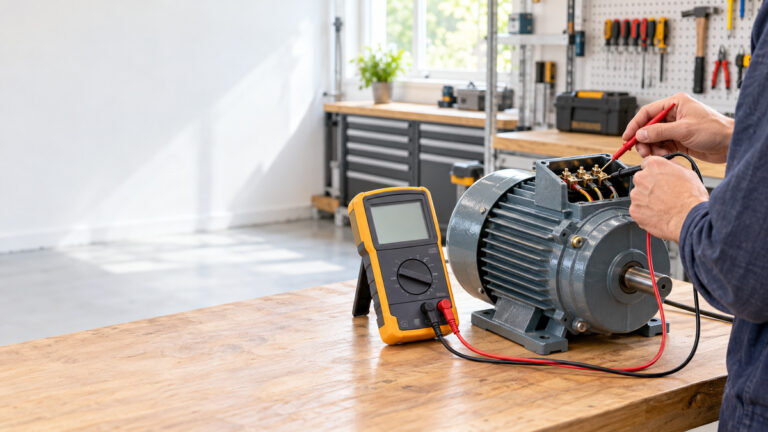
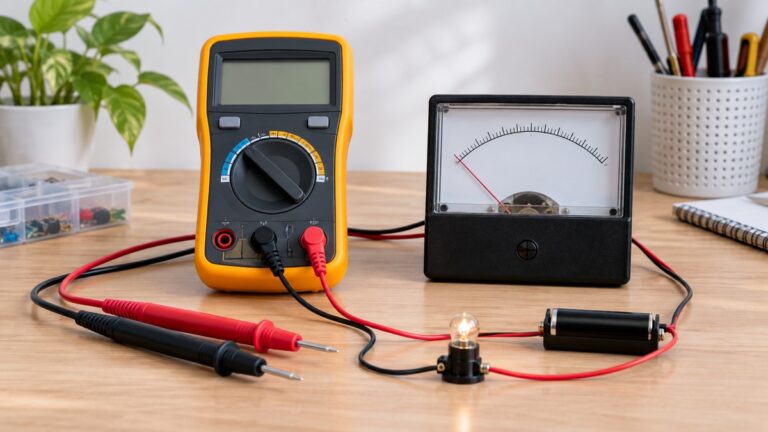
A voltage meter gives you a number. Unlike a simple tester that only signals whether voltage is present, it shows how many volts a circuit, battery or outlet carries. Most models here also measure current and resistance. This guide compares five voltage meter picks, explains which features change your buying decision, and shows how to match the CAT rating to your circuit. Work on mains circuits can kill, and the meter’s CAT rating must suit the circuit you plan to measure. Panel and service work belongs to a licensed electrician. If you are new to measuring, read the rating section first.
Quick answer
For household voltage checks at outlets, fuses and batteries, choose the first pick. It is a digital multimeter whose listing states CAT II 600 V, and it lists DC voltage up to 600V and AC voltage up to 600V. If you need to measure current without breaking the circuit, choose a clamp meter. The third, fourth and fifth picks each state a CAT III 600V rating, but their listings differ on the details. The second pick does not state a CAT rating, so do not use it on household mains. A multimeter needs you to connect leads, while a clamp meter needs only its jaw around one conductor.
How to choose a voltage meter
1. What you measure. A voltmeter or multimeter connects with test leads and reads voltage, and most of the models here also read resistance and continuity. For a plain explanation of the tool, see what a voltage meter does. A clamp meter reads current by clamping around one conductor, so you do not have to break the circuit. Many clamp meters cannot measure small DC currents, and the listings here do not state a minimum DC current. Read each listing for the model’s actual capability before you rely on it.
2. CAT rating and voltage rating. A CAT rating is the IEC classification of the measurement environment. Category II is for measurements on circuits directly connected to the low-voltage installation. Category IV is for measurements performed at the source of the high-voltage installation. Choose a rating that suits your circuit. If the listing does not state a CAT rating, do not treat the meter as safe for household mains.
3. Auto-ranging or manual ranging. The first pick uses manual range selection, so you turn the dial to a range before you measure. Several clamp meters here state automatic ranging, which picks the range for you. Auto-ranging saves steps, but it does not replace a correct rating.
4. True RMS and counts. In simplified terms, a true RMS meter measures the heating effect of a waveform, while a meter without true RMS assumes a clean sine wave. Distorted waveforms can therefore read wrong on a meter without true RMS. The fifth pick’s listing says TRMS. Counts describe display resolution. The first pick and the second pick list 2000 counts, and as a common rule of thumb that display tops out at 1999. The clamp meters list 6000 counts, which tops out at 5999 on the same rule.
5. Warranty and included parts. The first pick’s listing states a 3 Year Warranty. The second pick’s bullets describe a 2 year guarantee. The clamp meters include test leads or alligator clips, and the fourth pick’s listing mentions 24-hour after-sales service. What comes in the box differs by model, so check the listing.
1. AstroAI Digital Multimeter Tester 2000 Counts with DC AC Voltmeter and Ohm Volt Amp Meter; Measures (Best overall)
Specs from the listing (checked 2026-10-11):
- Environmental Conditions: CAT II 600 V; CAT Ill 300 V
- Range Selection: Manual
- Power: 2 x 1.5 V AAA Batteries
- Warranty Description: 3 Year Warranty by AstroAI
- Item Weight: 0.15 kg
Pros
- Listing states a 3 Year Warranty
- Two test leads and a user manual are included
- DC voltage ranges start at 200mV
Cons
- Range selection is manual
- Bullets conflict with specs on counts and sampling speed
Best for: Outlet, fuse and battery voltage checks with a multimeter
Skip if: You need a clamp or auto-ranging
View on Amazon (affiliate link)
2. Digital Multimeter Voltmeter Battery Voltage Multi Tester Continuity Ohm Volt Amp DC AC Current (Multimeter with 2-year guarantee)
Specs from the listing (checked 2026-10-11):
- Specification Met: Safety Standards Met
- Item Weight: 166 g
- Item Dimensions: 5.51 x 2.56 x 1.18 inches
- Included Components: multimter
Pros
- Bullets describe overload protection on all ranges
- Backlit 2.7 inch LCD display
- Two year guarantee stated in bullets
Cons
- Specification field does not state a CAT rating
- No range values given in the listing
Best for: Low-voltage bench and automotive checks
Skip if: You plan to measure household mains
View on Amazon (affiliate link)
3. Clamp Meter, 6000 Counts, Auto Ranging, Measures High AC/DC Current 600A, 600V AC/DC Voltage (Clamp meter, 600V)
Specs from the listing (checked 2026-10-13):
- Specification Met: Iec-61010-1 Cat III 600v
- Style Name: Digital Clamp Meter
- Included Components: Digital Clamp Meter
- Part Number: 2600D
- Model: K2600B
Pros
- Specification field states Cat III 600v
- Auto ranging selects the range for you
- 1.02-inch jaw fits many wire sizes
Cons
- Model number and set description do not match
- No minimum DC current stated
Best for: Current checks without breaking the circuit
Skip if: You need the model identity clear before buying
View on Amazon (affiliate link)
4. Digital Clamp Meter, 6000 Counts, Measures High AC/DC Current 600A, 600V AC/DC Voltage, Multimeter (Clamp meter, CAT III in bullets)
Specs from the listing (checked 2026-10-13):
- Specification Met: Iec 61010-1
- Item Dimensions: 8.27 x 3.54 x 2.36 inches
- Included Components: Clamp Meters ,User Manual,Battery
- Model: K2026A
Pros
- Bullets name the CAT III 600V overvoltage standard
- Includes two AAA batteries
- Auto-shutdown after 15 minutes of inactivity
Cons
- One bullet says DC/ DC current
- CAT rating appears only in a bullet
Best for: Clamp checks with listed CAT III 600V
Skip if: You need the CAT rating in the specification field
View on Amazon (affiliate link)
5. Digital Clamp Meter, Multimeter TRMS 6000 Counts Amp Volt Meter Auto-ranging Measures AC/DC (TRMS clamp meter)
Specs from the listing (checked 2026-10-13):
- Specification Met: Cat Iii 600v, Pollution Degree 2
- Included Components: 1 Digital Clamp Meter,2 Test Pens,1 Pouch,1 User Manual, 2 Battery
- Power Source: Battery Powered
- Measurement Type: Multimeter
Pros
- Listed as TRMS with 6000 counts
- Package includes two test pens and a pouch
Cons
- No maximum current stated in the listing
- Protective cap must be removed before use
Best for: Distorted-waveform readings with a true RMS meter
Skip if: You need a maximum current figure before buying
View on Amazon (affiliate link)
Pick-by-pick notes
First pick (best overall): digital multimeter with 2000 counts. Its title names a DC and AC voltmeter. The specification fields list DC voltage ranges of 200mV, 2V, 20V, 200V and 600V, plus AC voltage ranges of 200V and 600V. DC current tops out at 10 A in the listing. The listing says it uses 2 x 1.5 V AAA batteries and includes two test leads, a user manual and a 9V battery. The environmental field states CAT II 600 V and CAT III 300 V, and both fuses are listed as 250 V. Two statements do not match. One bullet says the display is a 1999 count and another says sampling is 2 times per second, while the specification fields say 2000 counts and 3 times per second. Rely on neither number. The bullets also say it cannot test all AC current or AC voltage below 100mV. Skip it if you need a clamp or a fast auto-ranging meter.
Second pick: digital multimeter with a 2-year guarantee. Its title lists voltmeter, battery voltage, continuity, ohms, volts, amps, DC and AC current, resistance and diodes, with 2000 counts. Its specification fields give a weight of 166 g and dimensions of 5.51 x 2.56 x 1.18 inches. The bullets describe a 2.7 inch backlit LCD, overload protection on all ranges, a low battery indication, an audible continuity sensor and a fold-out stand. They also say a 9V battery is included and that the guarantee runs 2 years. The specification field reads only Safety Standards Met, so the listing does not state a CAT rating. The included components field also contains a spelling error, which is a reason to check the listing before buying. The listing does not give range values. Skip it if you plan to measure mains.
Third pick: clamp meter with 600A and 600V. Its title names voltage meter, multimeter and amp meter, and lists 6000 counts with auto ranging. The specification field says Iec-61010-1 Cat III 600v. The bullets describe a 1.02-inch jaw opening, a 15 minute auto-shutdown, a backlit display, a flashlight, data hold and max/min readings. It also has a non-contact voltage detection bullet. The listing is inconsistent about its identity: the model is K2600B, the part number is 2600D, and the complete set description names K2026B. Rely on the physical model in your hand, and check the listing before buying. The listing does not state a minimum DC current. Skip it if you need a meter with no model-number questions.
Fourth pick: clamp meter with CAT III 600V in its bullets. Its title names 600A and 600V AC/DC, and its bullets list capacitance from 6nF to 60mF, frequency from 10Hz to 10MHz, duty cycle from 0.1% to 99%, resistance from 600 ohms to 60 megaohms, diode and continuity checks, and thermocouple temperature. The specification field says Iec 61010-1, while a bullet names the CAT III 600V overvoltage standard. It has a 1.02-inch jaw, a 15 minute auto-shutdown and 2 AAA batteries. One bullet says 600A DC/ DC current, which conflicts with the title’s AC/DC. The title is the safer statement, so check the listing for DC current. Skip it if you need the CAT rating in the specification field rather than a bullet.
Fifth pick: TRMS clamp meter with auto-ranging. Its title says TRMS 6000 counts, auto-ranging, AC/DC voltage and AC/DC current. It adds capacitance, NCV, frequency, live wire, resistance, diode, temperature and continuity. The specification field states Cat Iii 600v and Pollution Degree 2. The package lists two test pens, a pouch, a user manual and two batteries. The bullets mention a 1.02-inch jaw, a 15-minute auto power-off, a low battery indication, data hold and a built-in flashlight. A note says to remove the protective cap before using the test leads. The listing does not state a maximum current, so you cannot judge its ceiling from the specs. Skip it if you need a maximum current figure before you buy.
Comparison of the five picks
| Pick | Type | Voltage in listing | Current in listing | CAT in listing | Counts |
|---|---|---|---|---|---|
| First pick | Digital multimeter | DC 200mV to 600V; AC 200V and 600V | DC up to 10A | CAT II 600 V | 2000 |
| Second pick | Digital multimeter | Not stated | Named in title, no range given | Not stated | 2000 |
| Third pick | Clamp meter | 600V AC/DC in title | 600A AC/DC in title | Cat III 600v | 6000 |
| Fourth pick | Clamp meter | 600V DC/AC in title | 600A in title; DC/DC typo in bullet | CAT III 600V in bullet | 6000 |
| Fifth pick | TRMS clamp meter | AC/DC named, no value | Named, no maximum given | Cat Iii 600v | 6000 |
As an example, take a 150 W load on a 12 V supply: current equals power divided by voltage. The steps are: 150 ÷ 12 = 12.5 A. Check that again: 12 × 12.5 = 150, so the result is right. The first pick’s DC current range tops out at 10 A in its listing, and 12.5 A is larger than 10 A. The first pick therefore cannot measure this load. A clamp meter with a 600A listing has room for the reading. As a common rule of thumb, a reading near the bottom of a very large range can be less precise, so check the resolution on the listing. In practice, for DC loads above 10 A, a clamp with a DC current capability is the better fit. For small bench checks, a multimeter is enough.
Comparing the longest listed figures
The second pick lists item dimensions of 5.51 x 2.56 x 1.18 inches, and the fourth pick lists 8.27 x 3.54 x 2.36 inches. The longest listed figure is 8.27 inches for the fourth pick and 5.51 inches for the second. The difference is 8.27 inches minus 5.51 inches, which equals 2.76 inches. Check that size against the space where you will use the meter.
Common mistakes to avoid
- Leads in the wrong socket. The first pick’s bullets warn that test leads not fully inserted, or placed in the wrong socket, can stop a reading. Check the socket before you read the display.
- Clamping more than one conductor. As a common rule of thumb, a clamp reads a single conductor correctly. Clamping a whole cable gives a misleading figure.
- Assuming DC current is covered. Small DC currents may fall below what many clamp meters measure, and the listings here give no minimum DC current.
- Trusting a model number without checking. The third pick’s model, part number and set description do not match, so confirm which unit you hold.
- Choosing by counts alone. A higher count gives finer display steps, but it does not replace a correct CAT rating or a suitable current range.
Safety and care notes
IEC 61010-1 requires that the transient withstand capability of the equipment is made known to the user. Look for that information in the manual, and if it is missing, ask a professional before using the meter on live circuits. Follow the manual for lead connections, range setting and battery replacement. For outlet checks, you can read a step-by-step guide such as the how to use a voltage meter to test an outlet page, and still follow your meter’s manual.
FAQ
Is a multimeter the same as a voltage meter?
A multimeter reads voltage and often current, resistance and continuity, so it is a voltage meter with extra functions. A dedicated voltage meter reads voltage only. Most people buy a multimeter because it covers more tasks with one tool. For more options in this category, see the best digital volt meter guide.
What does CAT III 600V mean for a home?
It describes the measurement environment and voltage the meter is built for. The rating has to suit the circuit you measure, and the listing must state it. A higher number is not automatically the right choice.
Can a clamp meter measure voltage?
Several clamp meters here list AC and DC voltage as well as current. A clamp measures current without breaking the circuit, while voltage is read through the test leads. Check the listing to see which functions each model supports.
Why do the meters show different counts?
Counts describe display resolution. 2000 counts gives fewer display steps than 6000 counts. As a common rule of thumb, a 2000-count display tops out at 1999 and a 6000-count display at 5999.
Can I measure DC current with a clamp?
Only if the listing says so, and some clamp meters cannot measure small DC currents at all. The listings here do not state a minimum DC current, so check each model before you rely on a DC reading.
Do I need true RMS?
If you measure simple sine-wave supplies, a meter without true RMS may be enough. If you measure distorted waveforms from drives or electronics, true RMS reads more accurately.
Should I buy a meter for outlet checks only?
If outlets are your only task, a multimeter with a 600V AC range and a stated CAT rating covers the job. If you also measure current, a clamp with a listed CAT rating adds that function. Choose the one whose listing matches your task.
Bottom line
Choose the first pick if you need a basic multimeter for outlets, fuses and batteries, and its listed CAT II 600 V suits your circuit. Choose a clamp meter if you need current without breaking the circuit. Among the clamps, pick the one whose listing answers your questions most clearly, and check the model number before buying. Skip any meter whose listing does not state a CAT rating. For a car-focused shortlist, see the best digital voltage meter for car guide.
Sources
- Measurement category, Wikipedia: explains the IEC CAT classification and the impulse and energy basis used in the how-to-choose section