Best AC Tester Pen: 4 Non-Contact Voltage Pens Compared
As an Amazon Associate we earn from qualifying purchases. Details
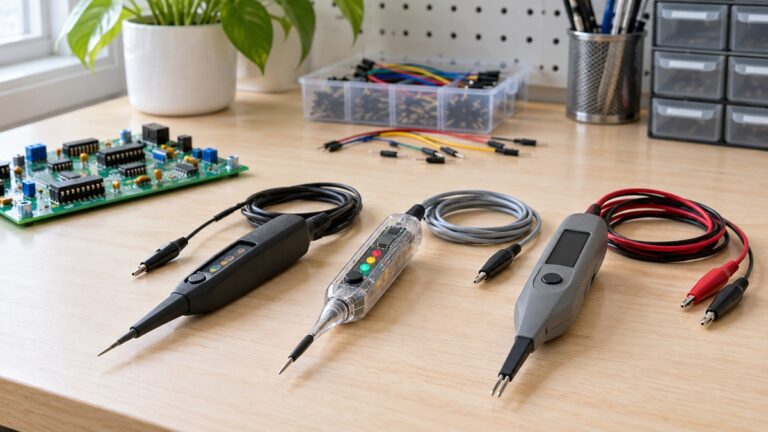
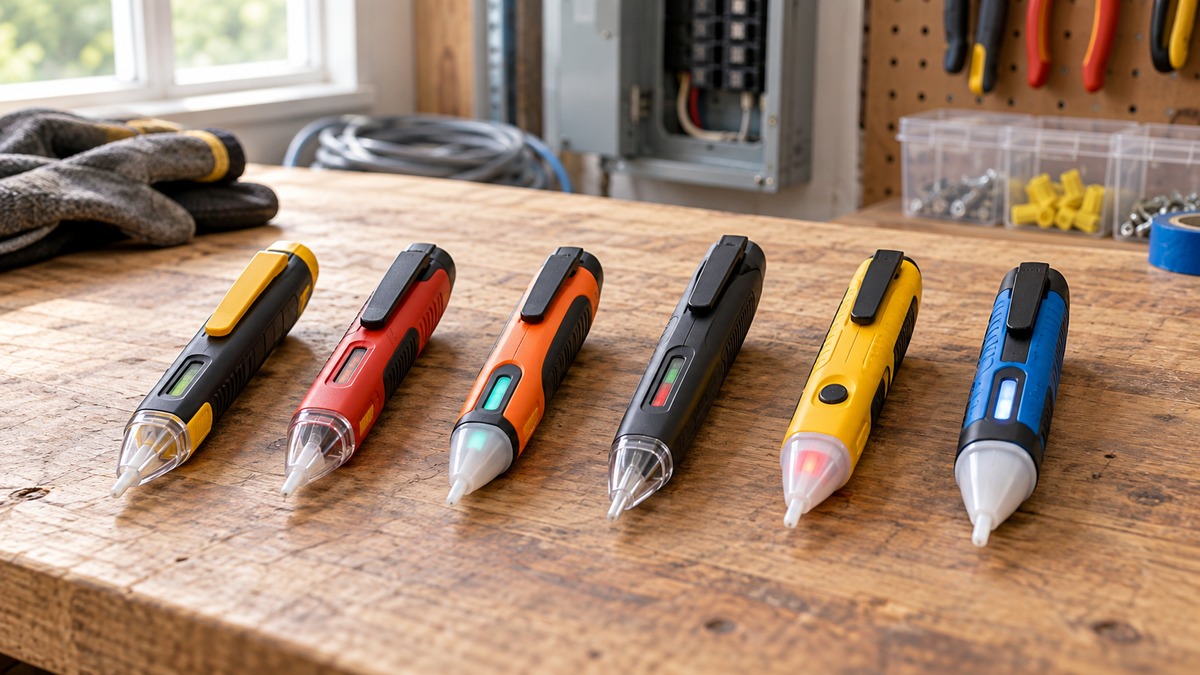
An AC tester pen is a non-contact voltage detector. You hold the tip near a wire, outlet or switch, and it alarms when it senses AC voltage. The listings in this group differ mostly in their lowest detection voltage, their upper limit and their safety rating. We picked four pens that are built for AC detection and that state a voltage range in their listing. Research figures were checked on 11 October 2026, and the two newer pens were checked on 18 October 2026.
Quick answer: for a plain AC check with a wide upper limit, the Klein NCVT1P lists 50 to 1000V AC. For the lowest listed detection floor, 12V AC, look at the yowexa CC3230-A. The ZONV DYB1 also starts at 12V, but it tops out at 300V.
The four pens at a glance
| Pen | Voltage range (as listed) | Alarms and indicators | Size and weight (as listed) |
|---|---|---|---|
| Klein Tools NCVT1P (B099SJ6469) | 50 to 1000V AC | Green LED, flashing red LED, beeper | 5.5 x 0.72 x 1 inches, 22.68 g |
| Fluke 1AC II (B000EJ332O) | 90 to 1000V AC (bullet also gives 200 to 1000V AC) | Red LED at the tip, beeper, audible or silent mode | 10.24 x 7.5 x 1.46 inches, 59 g |
| yowexa CC3230-A (B0GX9PBW8T) | About 12 to 1000V AC on high sensitivity, about 70 to 1000V AC on low | Signal bar, buzzer, LED light | 1.14 x 0.95 x 6.3 inches, 0.06 kg |
| ZONV DYB1 (B0GX1GD9B9) | 12 to 300V AC | Three-level audible and visual alarm, backlit LCD | 0.83 x 6.1 x 0.71 inches, 40 g |
How we chose these four
We kept pens whose listing states an AC detection range and a safety rating, and we picked a spread of ranges so that the set covers low and high voltages. The Klein and Fluke come from the research set, and the yowexa and ZONV are new candidates. The MXCOIRTP MT01 is a similar AC pen with 12V, 48V and 70V to 1000V ranges in its title, but its listing gives no safety rating, so we left it out. The Neoteck PM8908C (12 to 1000V AC) covers the same span as the yowexa, so we kept the yowexa, which has a stated CAT rating. The Neoteck NTK318 is a pen-type multimeter rather than a dedicated AC pen, and the AstroAI, LJPXHHU, TESMEN and FS899L are multimeters too. The WINAMOO and JASTIND test lights are DC automotive tools.
- Voltage range: the detection range the listing states, with conflicts shown side by side.
- Rating: the CAT or safety rating the listing gives, as written.
- Power and size: battery type and dimensions only where the listing gives them.
1. Klein Tools NCVT1P Voltage Tester
The Klein NCVT1P is listed for non-contact AC voltage detection from 50 to 1000V AC in cables, cords, circuit breakers, lighting fixtures, switches, non-tamper-resistant outlets and wires. The listing says a green LED shows the pen is working, and that a red LED flashes with a beep when voltage is detected. It has an auto power-off to save the battery, and the listing gives 6.6 feet (2 m) of drop protection. The specs field gives the rating as CAT IV 1000V, the size as 5.5 x 0.72 x 1 inches, and the weight as 22.68 g. It includes two AAA batteries.
Check the Klein NCVT1P on Amazon
2. Fluke 1AC II VoltAlert
The Fluke 1AC II is listed for a nominal voltage sensing range of 90 V AC to 1000 V AC, and its specs field gives the same figure. A bullet in the same listing gives the range as 90 V to 1000 V AC or 200 V to 1000 V AC, which does not match at the bottom of the range. The listing says the tip glows red and a beeper sounds when voltage is detected. A continuous self-test runs so you know the pen is working, and an audible or silent mode is available. Two AAA alkaline batteries are included, and the listing gives a typical battery life of more than one year. The warranty is two years.
The specs field gives the item dimensions as 10.24 x 7.5 x 1.46 inches. That is far larger than a pocket pen, so check the figure against the box before you buy.
Check the Fluke 1AC II on Amazon
3. yowexa CC3230-A Voltage Tester Pen
The yowexa CC3230-A is battery powered and listed for AC voltage from 12 to 1000 V AC. Its specs field gives a minimum operating voltage of 12 volts and a maximum of 1000 volts, with an upper temperature rating of 40 °C. The bullets say a signal bar and percentage rise with the detected signal, and that the buzzer sounds faster as the signal strengthens. The listing describes two sensitivity modes, high for about 12 to 1000 V AC and low for about 70 to 1000 V AC, and says you should pick the mode before testing and not switch during detection. Auto shutoff comes after about 5 minutes without operation or a detected signal.
The listing says the pen can help tell live from neutral by comparing the signal strength at two points, and that a stronger signal suggests the live wire. The rating is given as CAT III 1000V and CAT IV 600V. The item weighs 0.06 kg and measures 1.14 x 0.95 x 6.3 inches.
Check the yowexa CC3230-A on Amazon
4. ZONV DYB1 Smart Voltage Tester Pen
The ZONV DYB1 is listed for non-contact AC detection from 12 to 300V, and its specs field gives a maximum operating voltage of 300 volts. The safety rating is CAT II 300V, which is a lower category than the Klein or the yowexa. The bullets describe a three-level audible and visual alarm, a backlit LCD that shows real-time voltage values, and a probe made of chrome vanadium steel. The listing also mentions live and neutral identification, breakpoint detection, a continuity check, and an LED flashlight. The listing says the screen turns off after 5 minutes without operation. The pen weighs 40 g and measures 0.83 x 6.1 x 0.71 inches.
Worked example: which pen reaches a 48 volt AC source?
Take a source that reads 48 V AC. The Klein’s listed floor is 50 V, and the Fluke’s is 90 V, so neither range covers 48 V. The yowexa high sensitivity range starts at 12 V and the ZONV starts at 12 V, so both fall inside their listed ranges. Only the yowexa high setting and the ZONV would be expected to alarm at 48 V, based on the listed figures.
Now take a 500 V AC source. The Klein, Fluke and yowexa ranges all reach 500 V, since their tops are 1000 V. The ZONV tops out at 300 V, so for 500 V the ZONV is outside its listed range. For a higher source, skip the ZONV and pick one of the other three.
The worked example depends only on the listed floors and tops. It does not tell you how sensitive each pen is in practice, and the listings do not compare them side by side.
What the listings do not say
None of the listings states that a pen confirms a wire is dead. A non-contact pen gives an alarm when it senses voltage, and the listings do not say how a pen behaves in a metal box, behind a thick wall or near a cable with a shield. The Fluke’s two stated ranges differ at the bottom, and the yowexa’s low setting is listed as about 70 V, which is above the 48 V example. The listings do not give a warranty for the yowexa or the ZONV. Check the rating against the job before you rely on a pen.
Frequently asked questions
What does an AC tester pen actually detect?
A non-contact AC tester pen detects AC voltage near a conductor without touching it. The listings describe alarms and lights, not a measured number, except the ZONV DYB1, which has a backlit LCD that shows real-time voltage values according to its listing.
Which of these pens has the lowest detection floor?
The yowexa CC3230-A and the ZONV DYB1 both list 12 V AC as their lowest detection voltage. The Klein lists 50 V AC, and the Fluke lists 90 V AC as its nominal floor.
Can a pen tell the live wire from the neutral?
The yowexa CC3230-A and the ZONV DYB1 both list live and neutral identification. The yowexa compares signal strength between two points, and the listing says a stronger signal points to the live wire.
Why do the safety ratings differ?
The Klein specs field gives CAT IV 1000V, the yowexa bullet gives CAT III 1000V and CAT IV 600V, and the ZONV title gives CAT II 300V. Match the rating to the category of the circuit you are checking, and do not treat a lower rating as a general rating.
Is a pen enough to confirm a circuit has no voltage?
No listing in this set says a pen confirms that a circuit is dead. Use the pen as a first check, and confirm with a separate tester before you work on a circuit.
Conclusion
For a plain AC check with a wide upper limit, the Klein NCVT1P and the Fluke 1AC II both list tops of 1000 V AC, and the Fluke has the longer warranty. For a low voltage floor of 12 V AC, the yowexa CC3230-A is the pen to look at, and the ZONV DYB1 is the choice if you need live and neutral identification at a CAT II rating. Compare each listed range with the source you test. For related reading, see best NCV tester, best non-contact voltage checker, best pen voltage detector, and how to use a non-contact voltage detector.
Klein NCVT1P on Amazon · Fluke 1AC II on Amazon · yowexa CC3230-A on Amazon · ZONV DYB1 on Amazon