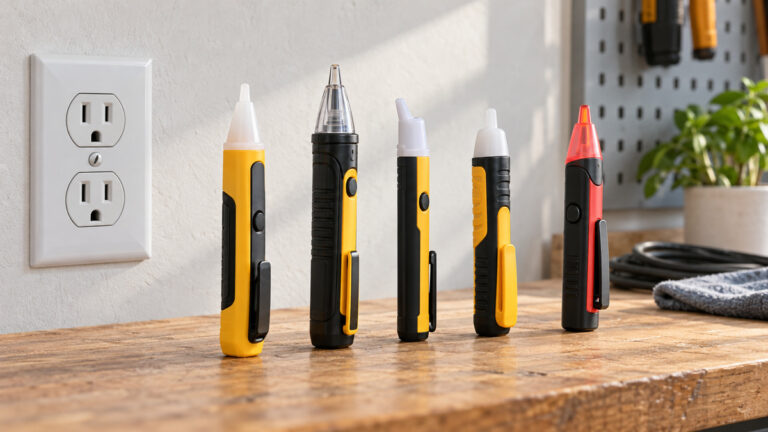
Best Proximity Voltage Detector for Clear AC Alerts
As an Amazon Associate we earn from qualifying purchases. Details
A proximity voltage detector helps you screen for an AC electric field without placing a metal probe on a conductor. Those distinctions matter more than color or a long feature list. Mains electricity can kill, and a non-contact indication does not make live work safe. Match the instrument’s stated rating to the circuit, follow its manual and local rules, and leave panel or service work to a licensed electrician. The aim here is to help you select a detector for your intended checks, not to turn a preliminary indication into permission to touch wiring.
Quick answer
Choose the first pick when you want a broad stated range, included batteries, and a compact pen body. The second pick suits someone who wants two sensitivity ranges plus different light and beep patterns. The third pick adds a signal-strength display instead of only a binary alert. The fourth combines non-contact sensing with a GFCI outlet analyzer. The fifth is the simplest option because its listing describes always-on operation. Before buying, confirm that the current listing states the detection range and CAT rating required for your circuit. A detector is a screening tool; panel or service work still belongs to a licensed electrician.
What matters for a proximity voltage detector
Detection range must fit the intended circuit
The lower threshold varies materially among these detectors. The first and second picks state detection beginning at 12V AC. The fourth states non-contact sensitivity of 50-600V AC, while the fifth states 50-1000V AC. A lower published threshold can matter when your intended signal falls below another detector’s starting point. It does not prove that one pen is universally better.
Read the range as a boundary, not as a direct voltage measurement. These products indicate the presence of an electric field; they do not show a measured voltage value like a contact meter. If you need a numerical reading, choose an instrument intended for that job. Our AC voltage detector guide provides a closely related comparison, while the contactless voltage detector roundup covers more pen-style choices.
Alerts should remain clear in your work area
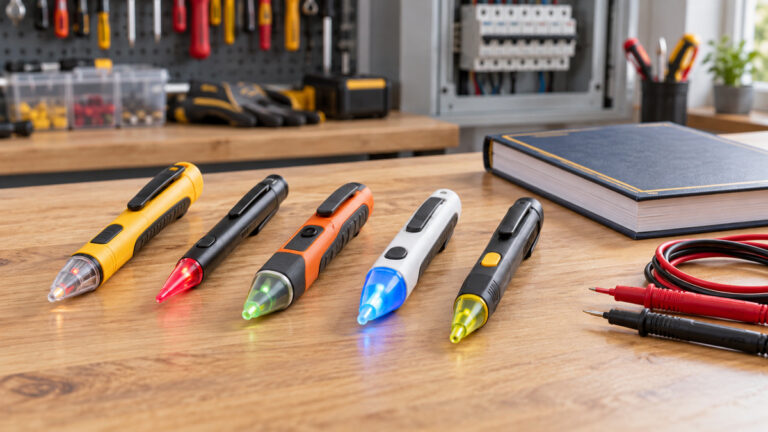
Every selected detector provides a visible and audible response, but the presentation differs. One uses different alarm levels, another changes beep frequency and tip color, and another adds a bar graph. The fourth describes a 360-degree visual indication. The always-on fifth uses a bright LED and audible alert. Choose the feedback you can interpret without moving your attention away from the target.
An adjustable or graded indication can help you approach a suspected source deliberately. It still does not identify an exact voltage. Adjacent energized conductors can affect what a non-contact pen senses, so follow the maker’s operating sequence and confirmation procedure. If an alert is ambiguous, stop and use an appropriate method specified by the instrument manual.
CAT marking is about the measurement environment
Measurement category is an IEC classification for live circuits used in measurement and testing. It accounts for continuous energy and impulse voltages at a location. The fourth pick states CAT III 1000V, and the fifth states CAT IV. The first pick’s bullet states CAT III 600V. The second and third picks do not state a CAT category in their supplied specifications, so do not treat them as suitable for household mains merely because their detection ranges extend to 1000V.
Voltage range and CAT category are not interchangeable. A wide sensing range answers one question, while the category marking addresses the environment and transient exposure stated for the instrument. Check both on the current listing and instrument body. If the required category is unclear, ask a qualified electrician rather than selecting by the largest voltage number.
Controls and self-check behavior affect readiness
The fifth pick has no on/off switch, which removes one control step. The second uses high and low sensitivity modes. The third displays signal strength with an LCD bar graph. The first supplies a straightforward light-and-beep alert. The fourth places two different testers in one housing. Each design changes what you must verify before approaching a suspected conductor.
Follow the detector manual’s readiness check before and after a use. Do not infer correct operation from a quiet tip alone. A depleted battery, an unsuitable range, or an operating mistake can all matter, and only the maker’s instructions define the proper check for a specific model. For a procedural overview, see how to use a non-contact voltage detector.
Size and included functions affect carry and access
The first pick is listed at 6.3 x 0.79 x 0.79 inches and 65 g. The third is 5.7 x 1.14 x 0.93 inches and 1.6 ounces. The fourth is 8.4 x 3.7 x 0.6 inches and 9.07 g, though that weight should be reconfirmed because its combination housing appears physically larger. The fifth is 5.58 x 0.5 x 0.75 inches and 46.2 g.
A slim pocket tool may be easier to carry, but the best shape depends on where the sensing tip must reach. The fourth pick’s GFCI analyzer changes its form and purpose. Built-in flashlights on the first and second choices can illuminate a work area, while the third prioritizes its display. Treat dimensions, lighting, and secondary functions as tie-breakers after range and stated category suitability.
The five proximity voltage detector picks
1. Neoteck Non Contact Voltage Detector 12-1000V AC Voltage Tester (Best overall)
Specs from the listing (checked 2026-10-11):
- Style: AC 12-1000V
- Item Weight: 65 g
- Item Dimensions: 6.3 x 0.79 x 0.79 inches
- Included Components: 2×1.5V AAA batteries
Pros
- The listing states a 12-1000V AC range with audible beeps and LED alerts.
- Its included components identify 2×1.5V AAA batteries.
Cons
- The listing explicitly says it is not suitable for Christmas light testing.
Best for: A compact detector with a broad stated AC range
Skip if: You intend to troubleshoot Christmas lights
View on Amazon (affiliate link)
2. VENLAB Voltage Tester, Non Contact Voltage Detector, Circuit Tester Dual Range Voltage Sniffer (Best adjustable sensitivity)
Specs from the listing (checked 2026-10-11):
- Style: Voltage Tester
- Item Weight: 0.05 kg
- Included Components: 1*Voltage Tester 2*AAA Batteries
- Model: VD-200
Pros
- High and low sensitivity modes cover two stated detection ranges.
- The tip colors and beep frequencies provide differentiated alerts.
Cons
- The supplied specifications do not state a CAT rating.
Best for: Users who want selectable sensitivity
Skip if: Your application requires a confirmed CAT category
View on Amazon (affiliate link)
3. Klein Tools NCVT7 Non-Contact Voltage Tester with LCD Signal Strength Display, 3-Color LED Tip (Best signal display)
Specs from the listing (checked 2026-10-11):
- Style: Non-Contact Voltage Tester
- Item Weight: 1.6 ounces
- Item Dimensions: 5.7 x 1.14 x 0.93 inches
- Model: NCVT7
Pros
- The LCD bar graph indicates relative signal strength.
- The three-color tip and changing audible rate add layered feedback.
Cons
- The supplied fields do not state a CAT category.
Best for: Readers who want a relative signal-strength display
Skip if: You need a detector with a stated CAT marking
View on Amazon (affiliate link)
4. Sperry Instruments VD7504GFI DualCheck 2-in-1 Non-Contact Voltage Detector + GFCI Outlet Circuit (Best two-in-one)
Specs from the listing (checked 2026-10-11):
- Style: Non-Contact Volt Tester & GFCI Tester Combo
- Item Dimensions: 8.4 x 3.7 x 0.6 inches
- Model: VD7504GFI
- Item Type Name: DualCheck 2-in-1 Non-Contact Voltage Detector + GFCI Outlet Circuit Analyzer
Pros
- The housing combines a non-contact detector and GFCI outlet analyzer.
- The listing states CAT III 1000V plus drop and crush ratings.
Cons
- Its combination format is larger than the slim detector-only picks.
Best for: A kit that needs voltage screening and outlet analysis
Skip if: You want only a narrow pen detector
View on Amazon (affiliate link)
5. 3000 Non-Contact Voltage Tester, Always-On AC Voltage Detector 50-1000VAC, CAT IV Certified (Best always-on)
Specs from the listing (checked 2026-10-11):
- Style: Modern, Compact
- Item Weight: 46.2 g
- Item Dimensions: 5.58 x 0.5 x 0.75 inches
- Model: 3000
Pros
- The always-on design has no power button to remember.
- The listing states a CAT IV certification and dual visual-audible alert.
Cons
- Its published detection threshold begins at 50V AC, limiting lower-threshold applications.
Best for: Immediate operation with a stated CAT IV marking
Skip if: You need a published starting threshold below 50V AC
View on Amazon (affiliate link)
First pick: broad range in a compact pen
The first detector lists a 12-1000V AC range and uses audible beeps with LED alerts to distinguish indications. Its specifications give a 65 g weight and dimensions of 6.3 x 0.79 x 0.79 inches. The package also lists 2×1.5V AAA batteries, so the required cells are identified rather than left unstated. A built-in flashlight is described for outlets, switches, lighting fixtures, and circuit breakers.
Its strongest fit is a homeowner who values a low starting threshold and a familiar pen form. The listing also states CAT III600V and notes that it is not suitable for Christmas light testing. That explicit exclusion matters: skip this choice if Christmas-light troubleshooting is your intended task. Anyone comparing it for mains work should verify the marking on the current product and follow the manual rather than relying only on the broad headline range.
Second pick: selectable sensitivity and differentiated alarms
The second detector provides high and low sensitivity settings. Its high mode is listed for 12V-1000V, while low mode is listed for 48V-1000V. The alert changes with the detected condition: the listing describes a red tip and high-frequency beep for high voltage, plus a yellow light and low-frequency beep for low voltage. It also includes a flashlight and a red pointing light.
This is the better match when selectable sensitivity and differentiated feedback are central to the decision. The listed weight is 0.05 kg, and the included components specify the tester with 2 AAA batteries. However, the supplied specifications do not state a CAT rating. Skip it when your application requires a confirmed measurement category unless the current listing and tool marking provide one that fits the circuit.
Third pick: visible signal-strength trend
The third option detects 12-1000V AC and adds an LCD bar graph. More bars illuminate as the detector approaches a source or the signal grows stronger. Its audible alert changes rate along with the graph, and its three-color tip uses blue for low signal strength, red for high strength, and green when no voltage is detected. That layered feedback separates it from simple light-and-beep pens.
The housing is listed at 5.7 x 1.14 x 0.93 inches and weighs 1.6 ounces. A slim pocket clip supports carry between checks. It best fits a reader who wants more context about relative signal strength without claiming a numerical voltage measurement. The listing does not state a CAT category in the supplied fields. Skip it if a verified category marking is mandatory and cannot be confirmed on the current product page.
Fourth pick: combined detector and outlet analyzer
The fourth selection combines a non-contact voltage detector on one end with a GFCI outlet circuit analyzer on the other. Its sensing bullet states 50-600V AC and 50-60Hz. The alert is both audible and visible around 360 degrees. Its housing uses impact-resistant polycarbonate with over-molded rubber grips, making it a functionally different choice from a detector-only pen.
The listing states a 10 ft drop rating, 250 lb crush rating, and CAT III 1000V. These figures make it the most explicitly specified pick for someone who also needs outlet-analysis functionality. It is not the right choice when a narrow, detector-only pen is the priority. The listed 8.4 x 3.7 x 0.6 inches also reflects the combination design, so check whether that format suits the places you plan to access.
Fifth pick: always-on operation
The fifth detector is listed for 50-1000VAC and has no on/off switch. Its purpose is immediate readiness when removed from a pocket. The product description specifies a bright LED and audible beep, plus a non-flammable high-impact polycarbonate body. It also states CAT IV certification, making the stated category a central reason to consider this model.
At 5.58 x 0.5 x 0.75 inches and 46.2 g, it is the narrowest listed body among these five. Choose it if always-on operation and the stated category outweigh the desire for adjustable sensitivity or an LCD. Skip it if you need a lower published starting threshold than 50V AC. Always verify the present marking and manual because a category label does not remove the hazards of live electrical work.
| Pick | Listed detection range | Distinctive feedback | Stated category | Main reason to choose |
|---|---|---|---|---|
| First | 12-1000V AC | Beeps and LED | CAT III600V | Compact body and included batteries |
| Second | 12V-1000V or 48V-1000V | Two sensitivity modes and changing alerts | Not stated | Selectable sensitivity |
| Third | 12-1000V AC | LCD bars, changing beep, three-color tip | Not stated | Relative signal-strength display |
| Fourth | 50-600V AC | 360-degree visual and audible alert | CAT III 1000V | GFCI analyzer on the other end |
| Fifth | 50-1000VAC | Bright LED and audible beep | CAT IV | Always-on operation |
The table shows why the largest upper number does not settle the choice. The second and third picks reach down to 12V, yet neither supplied specification states a CAT category. The fourth starts at 50V and ends at 600V, but it combines two functions and carries a stated category. Decide first where the detector will be used, then compare the declared range, category, and alert format.
Three buying scenarios
For occasional outlet and switch screening, the first pick offers a wide stated range, clear alerts, and included cells. Its compact dimensions suit a pocket or small tool pouch. Respect the stated Christmas-light exclusion and confirm that the category marking matches your environment.
For distinguishing relative signal strength, the third pick is more informative. Its bar graph, beep-rate change, and three-color tip provide layered feedback. That does not make it a voltmeter, and its unstated CAT category remains a meaningful limitation.
For a maintenance kit that also needs a GFCI outlet analyzer, the fourth pick reduces the number of separate devices carried. Its 50-600V AC sensing range is narrower than several alternatives. The combination tool earns its place through the second function and explicit physical ratings, not through the widest range.
Screening the five detectors by starting range
Three of the five detectors list a starting threshold of 12V AC (the first, second and third picks), and the other two begin at 50V AC (the fourth and fifth).
First calculation: 3 detectors + 2 detectors = 5 detectors. Verification: 5 detectors – 2 detectors = 3 detectors.
Second calculation: 3 ÷ 5 × 100 = 60%. Check the result another way: 5 × 60% = 3 detectors.
Third calculation: 2 ÷ 5 × 100 = 40%. Recheck: 5 × 40% = 2 detectors.
The two shares must cover all five detectors. Confirmation: 60% + 40% = 100%. Reverse check: 100% – 60% = 40%.
So a task that needs detection from 12V AC rules out the fourth and fifth detectors, which begin at 50V AC. That arithmetic is only a shortlist filter. It does not establish whether any detector is suitable for a real circuit; the manual, category marking, and a qualified person’s assessment still control that decision.
Mistakes that undermine the choice
Do not treat a non-contact alert as a voltage measurement. These pens indicate an electric field, while a measured value requires a suitable instrument and procedure. Selecting a pen because its upper range is 1000V ignores how and where it will be used.
Do not substitute voltage range for CAT category. The classification considers the installation environment and impulse exposure. A product with no stated category should not be assumed suitable for household mains.
Do not buy a secondary function you will not use. The fourth pick’s outlet analyzer is meaningful for one workflow but adds a different form factor. A detector-only pen can be the clearer choice when access and pocket carry matter more.
Do not overlook exclusions and missing statements. The first listing excludes Christmas-light testing, and several picks omit a category in the supplied specifications. Missing information is a reason to verify the current listing, not permission to fill in a favorable assumption.
Do not proceed into a panel because the detector appears quiet. Mains circuits can kill, and service work belongs to a licensed electrician. Follow the instrument manual and local electrical rules for every readiness check and use.
FAQ
Does a proximity voltage detector show the actual voltage?
No selected pen presents a numerical voltage measurement. Their listings describe LEDs, beeps, colors, bars, or changing alarm rates that indicate detection. The third pick’s LCD shows relative signal strength through a bar graph, not an exact voltage value. If your decision depends on a measured value, use a properly rated measuring instrument and the procedure in its manual.
Which pick has the lowest stated starting range?
The first, second, and third choices each list detection beginning at 12V AC. The second can also switch to a 48V-1000V low-sensitivity range. A lower threshold is relevant only when it matches your intended signal and environment. It does not override the need to confirm the instrument’s category marking and follow its manual.
Which detector gives the most detailed alert?
The third pick supplies the most layered indication among these choices. Its LCD bar graph changes with signal strength or proximity, its beep rate follows the graph, and its tip uses three colors. Those cues can help interpret a changing field, but they are not a substitute for an actual voltage measurement or an approved safety procedure.
Which option includes a GFCI outlet analyzer?
The fourth pick places a GFCI outlet circuit analyzer on the opposite end from its non-contact detector. Its sensing specification states 50-600V AC and 50-60Hz. Choose that model when both functions belong in the same kit. Skip it when you want the narrowest detector-only body or need a lower stated sensing threshold.
Are batteries included with every detector?
The first pick lists 2×1.5V AAA batteries, and the second lists 2 AAA batteries among its included components. The supplied details for the remaining three selections do not identify included cells. Check the current product listing before ordering if immediate use matters, and follow the manual’s battery and readiness-check instructions.
Which detector has no power switch?
The fifth pick is described as always on, with no on/off button to press. That can reduce one setup action when taking it from a pocket. Its listed 50-1000VAC range begins higher than the 12V AC threshold stated for several alternatives, so readiness should not be confused with suitability for every intended signal.
Can a quiet detector prove a conductor is safe to touch?
No. A quiet indication does not authorize contact with wiring. Confirm the detector’s correct operation using the sequence in its manual, match its stated category to the environment, and obey local rules. Mains work can be fatal, so panel and service tasks should be handled by a licensed electrician rather than inferred from one non-contact check.
Bottom line
Choose the first pick for a compact 12-1000V AC pen with included batteries, the third for relative signal-strength feedback, or the fourth when a GFCI analyzer is genuinely useful. The fifth best suits someone prioritizing always-on operation and its stated CAT IV marking. Confirm the current range and category before purchase, and leave panel or service work to a licensed electrician.
Sources
- Measurement category: explains that CAT categories classify live measurement circuits by installation environment and impulse exposure.