Siglent SDM3055 Digital Multimeter: Specs and Buying Checks
As an Amazon Associate we earn from qualifying purchases.
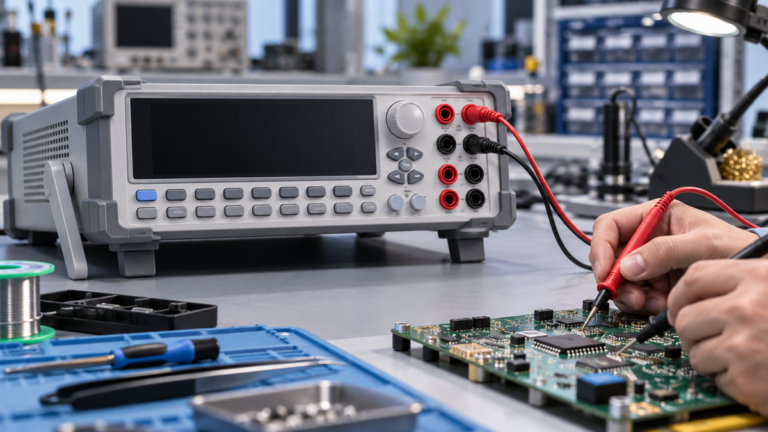
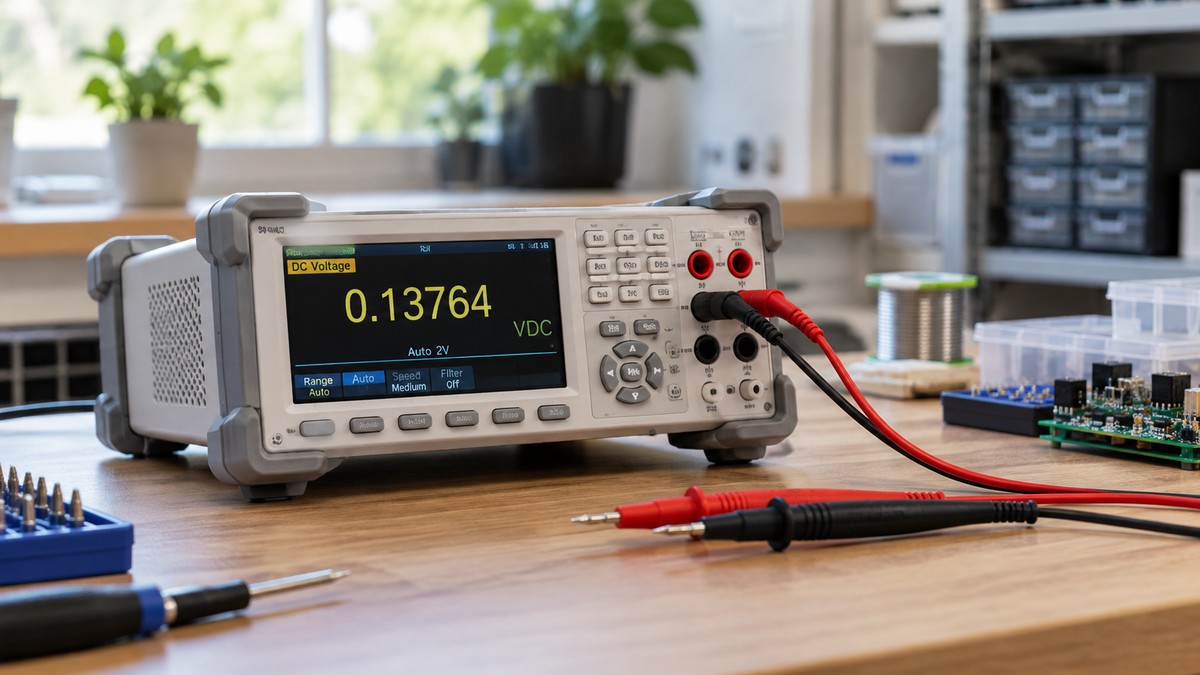
The Siglent SDM3055 is a 5½-digit benchtop digital multimeter with a dual display and True-RMS AC measurement. Siglent’s datasheet gives its resolution as 240,000 counts and its measurement speed as up to 150 readings per second. Its user manual rates the input for IEC Measurement Category II at up to 600 VAC. That rating is for circuits at outlet level, not for a building’s distribution panel. This guide explains those statements and what to check before you buy.
Quick answer
- Siglent’s datasheet states a 5½-digit resolution of 240,000 counts and a speed of up to 150 readings per second.
- The datasheet lists DC voltage from 200 mV to 1000 V and True-RMS AC voltage from 200 mV to 750 V.
- The user manual states IEC Measurement Category II, with the HI and LO inputs rated for mains up to 600 VAC.
- Standard interfaces are USB Host and LAN. USB-GPIB is an optional accessory.
- Check the rated category and the fuse ratings before you connect it to any circuit, and do not use it on the building’s panel or service supply.
What the SDM3055 measures
The datasheet lists the basic measurement functions as DC voltage, DC current, True-RMS AC voltage, True-RMS AC current, two-wire and four-wire resistance, capacitance, continuity, diode test, frequency, period, and temperature for thermocouple and RTD sensors. It also lists math functions, including maximum, minimum, average, standard deviation, dBm and dB, relative measurement, pass/fail, histogram and trend chart.
The datasheet lists frequency measurement from 20 Hz to 1 MHz. For AC voltage and AC current, the measurement is True-RMS, which the datasheet states directly. True-RMS matters when a waveform is not a clean sine wave, because an averaging meter can misread distorted signals. Check the function list in the manual for the exact range and mode you plan to use.
Resolution and speed
The datasheet describes the display as 5½ digits, with 240,000 counts. A count is one step on the display, so 240,000 counts is the number of distinct readings the display can show on a range. Resolution and accuracy are different things. Accuracy is given as a percentage of reading plus a percentage of range for each function, and it depends on the function and range. The datasheet gives these tables for each function, and you should read them before you rely on a reading.
Speed is stated as up to 150 readings per second. This article does not list rates for each function or range, so do not assume that rate applies to every measurement you make.
Display and dual-display operation
The datasheet describes a 4.3-inch TFT-LCD with a 480 by 272 resolution and dual-display operation. It also lists a built-in help system, a Chinese and English menu, and file management using a USB drive or local storage. Dual display lets you watch two measurements at once, which is useful for comparing a voltage and a current, or two readings during a setup.
Safety rating: what the manual states
The user manual states that the SDM3055 provides over-voltage protection for line-voltage mains connections when the HI and LO terminals are connected under IEC Measurement Category II conditions and the maximum line voltage is 600 VAC. It defines CAT I as 1000 V peak in the HI-LO terminal and CAT II as inputs connected to mains up to 600 VAC under Category II overvoltage.
The manual also says that Category II covers devices plugged into a branch outlet, such as small appliances and test equipment. It says the HI and LO terminals cannot be connected to permanently installed devices such as main circuit-breaker panels, sub-panel boxes and permanently wired motors. Those circuits can exceed the protection limits. The manual further states that the meter can withstand transient over-voltage up to 2500 Vpk, and that it should not be used where transients may exceed that level.
These statements mean the SDM3055 is a benchtop instrument for outlet-level and bench work. It does not replace a CAT III or CAT IV rated tool for building distribution or service-entrance work. Work on panels and service equipment belongs to a licensed electrician.
Fuses and input protection
The datasheet lists a rear-panel accessible 10 A, 250 V fast-melt fuse and an internal 12 A, 250 V slow-melt fuse. The manual repeats these protections. If a fuse blows, replace it only with the type and rating the manual specifies. A fuse with the wrong rating can leave the meter unprotected, and a fuse you cannot identify is a reason to stop and check the manual before you measure again.
Interfaces and remote control
The datasheet lists USB Host and LAN as standard interfaces. The USB-GPIB adapter is an optional accessory, so GPIB is not part of the base configuration. The datasheet says the meter supports remote control through SCPI commands and that it is compatible with commands used by other mainstream multimeters. It also lists the EasyDMM PC software. If you plan to automate measurements, confirm the interface and the software you need before you buy.
Variant: the SDM3055-SC
The selection guide lists an SDM3055-SC with a scanner card, the SC1016, for the SDM3055-SC model. The scanner card is not part of the base SDM3055. If you need multi-channel switching, check that the variant you buy includes it.
How we chose the sources
This article uses three Siglent documents: the SDM3055 datasheet (E_04A), the SDM3055 user manual (EN03B), and the Siglent all-products selection guide dated April 2026. We opened each document on 2026-10-27 and confirmed its text can be read. We quote only the figures and statements in those documents. We did not use retailers, resellers or third-party manual archives for any specification in this article.
Who the SDM3055 suits
The datasheet lists research and development laboratories, repair and maintenance, calibration laboratories, and automatic production test among the application fields. It fits bench work where you need high resolution, dual display, True-RMS AC, and remote control. It is not a handheld tool for a homeowner checking a light fixture, and it is not a tool for work inside a building’s distribution panel. For another bench meter to compare against, see our guide to the Keysight 34461A.
If you want a smaller meter for field work, a handheld digital multimeter with a CAT rating that matches the circuit is the better fit. Our guide to the functions and types of digital multimeters covers that category in plain terms.
Buying checklist
- Confirm the functions you need appear in the datasheet function list, and check the accuracy table for each one.
- Check the Category II rating in the manual and match it to the circuits you will measure.
- Confirm the fuse ratings and keep the manual’s replacement instructions with the meter.
- Decide whether you need LAN or USB remote control, and whether you need the optional USB-GPIB adapter.
- Check whether you need the SC variant for scanner-card switching.
Mistakes to avoid
- Do not read 240,000 counts as an accuracy claim. Accuracy depends on the function, the range and the tolerance tables.
- Do not assume the 150 readings per second rate applies to every function and range. The datasheet states it as an upper figure.
- Do not use the SDM3055 on permanently installed mains equipment. The manual names main breaker panels and sub-panel boxes as circuits that can exceed its protection limits.
- Do not replace a blown fuse with a different rating because it is the only one on hand.
FAQ
Is the SDM3055 a handheld multimeter?
No. The datasheet describes a benchtop instrument with a 4.3-inch display, dual display and remote interfaces. A handheld meter is a different product class.
What does the SDM3055’s 240,000-count resolution mean?
It means the display can show 240,000 distinct steps on a range, according to the datasheet. It does not mean the meter is accurate to that many digits. The accuracy tables for each function set the real tolerance.
What CAT rating does the SDM3055 have?
The user manual states IEC Measurement Category II, with the HI and LO inputs rated for mains connections up to 600 VAC under Category II conditions. Check the manual for the exact conditions before you connect it to any circuit.
Does the SDM3055 measure True-RMS AC?
Yes. The datasheet lists True-RMS AC voltage from 200 mV to 750 V and True-RMS AC current from 20 mA to 10 A.
Which interfaces does it have?
The datasheet lists USB Host and LAN as standard. USB-GPIB is an optional accessory.
What we could not verify
The sources we opened do not give a price, a shipping time or current availability, and this article does not state them. The datasheet’s accuracy tables are long, so this article quotes the function list and the headline figures only. For a purchase decision, read the accuracy table for each function and range you need. The selection guide is a catalogue, so its figures should match the datasheet, and where they differ you should follow the datasheet.
Bottom line
The Siglent SDM3055 is a 5½-digit benchtop multimeter with True-RMS AC, dual display and USB and LAN remote control. Its user manual rates it for Category II use at outlet level, up to 600 VAC. Buy it for bench and laboratory work that matches those ratings. For panel or service-entrance work, use a tool with the right rating and a licensed electrician.
Sources
- Siglent, SDM3055 Digital Multimeter Datasheet, E_04A, https://siglentna.com/download/2554 (opened 2026-10-27)
- Siglent, SDM3055 Series Digital Multimeter User Manual, EN03B, https://shop-us.siglent.com/wp-content/uploads/2025/11/SDM3055_Usermanual-EN03B.pdf (opened 2026-10-27)
- Siglent, All Products Selection Guide, April 2026, https://shop-us.siglent.com/wp-content/uploads/2026/06/Siglent-all-products-selection-guide-2026-04.pdf (opened 2026-10-27)
As an Amazon Associate we earn from qualifying purchases.