Fluke 8845A Explained: Specs, Uses and What to Check
As an Amazon Associate we earn from qualifying purchases.
The Fluke 8845A is a 6.5-digit precision bench multimeter that shares its main specification sheet with the 8846A. This explainer covers the functions the 8845A has and lacks, its published ohms range and safety rating, and the checks to make before buying. It draws on the same three Fluke documents used for the 8846A, and the text notes where a figure applies to one model only.
Quick answer
- The Fluke 8845A is a 6.5-digit precision bench multimeter. It shares its main specification sheet with the 8846A.
- The 8845A does not measure capacitance or temperature, and it has no USB memory port. Fluke’s documents list both as 8846A-only features.
- Fluke publishes a safety rating of CAT I 1000 V and CAT II 600 V for the 8845A and 8846A.
- The published ohms range for the 8845A is 100 Ω to 100 MΩ, according to Fluke’s Spanish product page. The shared specification sheet gives a wider range for both models, so check the range in the manual.
- Fluke’s two documents disagree on the warranty length. Confirm the term for your region before buying.
Where the 8845A fits
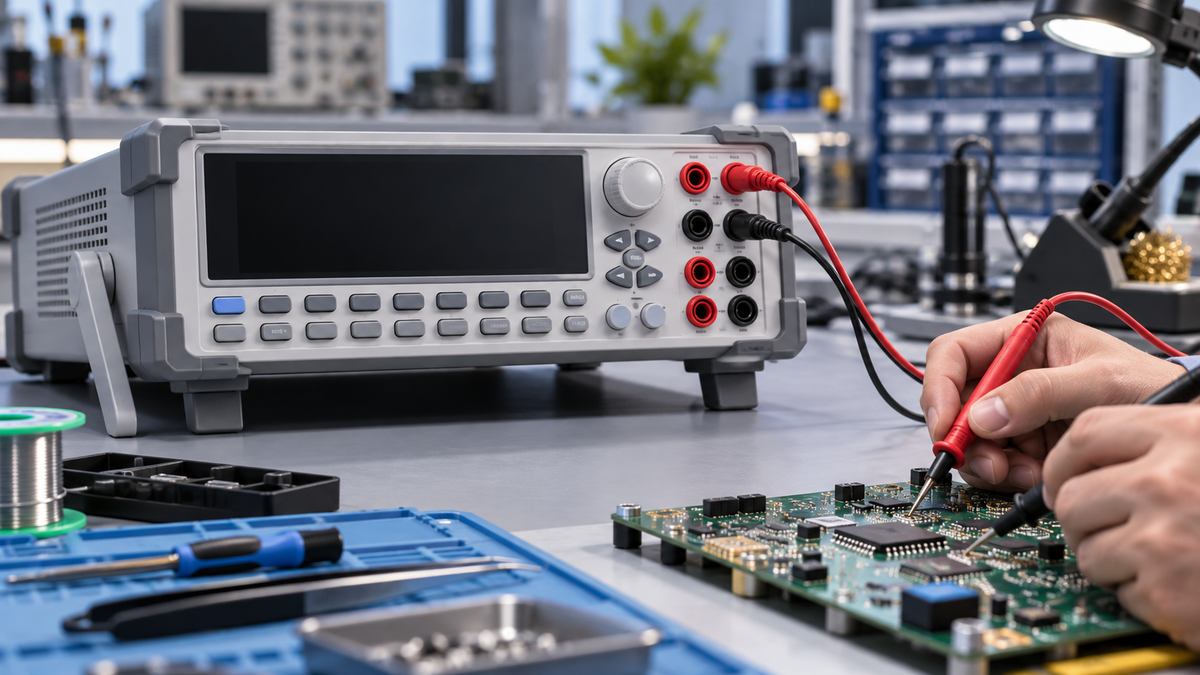
The 8845A is a benchtop digital multimeter for volts, ohms, amps, frequency and period. Fluke describes it for manufacturing test, research and development, and service work. It is built to sit on a bench, run from the mains and connect to a computer or a test system.
Its name refers to the display: six full digits plus a leading digit that can only be 0 or 1. That gives more decimal places than a handheld meter. The extra digits are only useful when the accuracy of the meter at that range supports them, so read the accuracy table before you rely on the last digit.
What the 8845A has, and what it does not
Fluke’s extended specification lists these features for the 8845A and 8846A together:
- 6.5-digit resolution
- A current range of 100 µA to 10 A, with resolution down to 100 pA
- Frequency and period measurement
- A graphical display with trend plot, histogram and statistics
- Fluke 45 and Agilent 34401A command emulation
- RS-232C, IEEE 488.2 and LAN interfaces
- A limit test, dB and dBm, and MX+B math functions
The 8845A differs from the 8846A in three places that Fluke’s documents state clearly:
- No capacitance or temperature. Fluke’s list of features says the 8846A also measures capacitance and temperature. The 8845A does not appear in that line.
- No USB memory port. The 8846A has a front-panel USB port for a memory module, which Fluke lists at up to 2 gigabytes. The 8845A stores readings internally only.
- Internal memory only. Fluke lists the 8845A’s memory as 10,000 measurements, internal only.
If your work needs capacitance, temperature or large data logs written to a memory stick, the 8845A is the wrong model. If you only measure volts, amps, ohms and frequency and you can store results on a PC through the interfaces, the 8845A covers those functions.
Ohms range: check the model
Fluke’s documents disagree on the resistance range. The shared extended specification lists ohms ranges from 10 Ω to 1 GΩ for both models, with resolution down to 10 µΩ. Fluke’s Spanish product page gives a model-specific table. For the 8845A, that table lists a range of 100 Ω to 100 MΩ and a maximum resolution of 100 µΩ. For the 8846A, the same table lists 10 Ω to 1 GΩ and 10 µΩ.
The model-specific table is the safer reference for the 8845A. Confirm the range in the 8845A manual before you rely on a high-resistance measurement.
Reading the accuracy table
The extended specification includes accuracy tables for each function. The DC voltage table for the 8845A lists accuracy as a percentage of reading plus a percentage of range. Its first column shows, for example, 0.0015 + 0.0004 on the 10 V range and 0.002 + 0.0006 on the 1 V and 100 V ranges. Each figure applies only under the conditions stated in the table, and the specification lists more than one period and column.
To estimate an error, multiply the first figure by the reading and the second by the full-scale value of the range, then add the two results. A reading of 5 V on the 10 V range, at 0.0015 + 0.0004, has an error of about 0.0015 % of 5 V plus 0.0004 % of 10 V. That is a small number, but it holds only under the conditions in the table.
The specification says accuracy applies after at least one hour of warm-up with Auto Zero enabled. It also says 24-hour specifications are relative to calibration standards. Use the period that matches your calibration schedule.
Safety rating and category
Fluke publishes a safety rating of CAT I 1000 V and CAT II 600 V for the 8845A. The extended specification says the meter is designed to comply with IEC 61010-1, UL 61010-1A1 and CAN/CSA-C22.2 No. 61010-1. The Spanish product page gives the same rating.
A CAT II rating covers circuits connected directly to an appliance or outlet. A CAT III rating covers fixed building wiring such as a panel and its feeder circuits. The 8845A’s published rating does not include CAT III work. Do not use it on a panel, a service entrance or any fixed installation.
The manual supplement lists the current-input fuses. F1 is an 11 A, 1000 V fast-blow fuse with Fluke part number 943121. F2 is a 440 mA, 1000 V fast-blow fuse. Replace a blown fuse only with one of the listed rating.
A separate Fluke safety sheet in the set we opened lists CAT III 1000 V and CAT IV 600 V for a related model. It does not identify the 8845A, and it is not the rating for this meter. Use the manual for the exact model you buy.
Operating conditions
The extended specification lists an operating temperature of 0 °C to 55 °C, and a storage range of −40 °C to 70 °C. The operating altitude limit is 2,000 meters. The meter’s power section covers 100 V, 120 V, 220 V and 240 V settings, and it senses a line frequency between 47 Hz and 440 Hz at power-up.
The listed dimensions are 88 mm high, 217 mm wide and 297 mm deep. The published weight is 3.6 kg (8.0 lb). The display is a vacuum fluorescent dot-matrix display, according to the specification.
What to check before you buy
- Confirm you do not need capacitance or temperature. If you do, look at the 8846A.
- Check the resistance range you need against the 8845A model-specific table, not the shared table.
- Read the accuracy table for the range and the period you plan to use.
- Decide how you will store data. The 8845A keeps 10,000 measurements internally, and it has no USB memory port. Use one of its computer interfaces if you need more.
- Confirm the warranty term. Fluke’s extended specification says one year, and its Spanish product page says three years.
- Check the safety rating in the manual before using the meter on any circuit.
Mistakes to avoid
Do not assume the 8845A and 8846A are the same meter. The shared specification sheet covers both, but the features and the ohms table differ.
Do not use the 8845A on fixed building wiring. Its published rating is CAT I and CAT II. Panel and service work belongs to a licensed electrician.
Do not swap in a fuse with a different rating. The supplement lists the correct fuses.
FAQ
Does the 8845A measure capacitance?
Fluke’s features list places capacitance on the 8846A. The 8845A is not listed for capacitance in the sources we opened.
What is the 8845A’s ohms range?
Fluke’s Spanish product page lists 100 Ω to 100 MΩ for the 8845A. The shared extended specification lists a wider range for both models, so check the manual.
What CAT rating does the 8845A have?
CAT I 1000 V and CAT II 600 V, per Fluke’s extended specification and Spanish product page.
Does the 8845A have a USB port?
Fluke lists a USB memory port on the 8846A only. The 8845A is listed with RS-232C, IEEE 488.2 and LAN interfaces.
How many readings can the 8845A store?
Fluke lists 10,000 measurements, internal only.
Bottom line
Choose the 8845A if you need a 6.5-digit bench meter for volts, amps, ohms and frequency, and you do not need capacitance, temperature or a USB memory port. Read the model-specific ohms range and the accuracy table for your range before you buy, and use the rating in the manual for the work you plan to do.
How we chose
This article covers one model in one post, because a reader who searches for the model needs its published figures and its buying checks together. We read the manufacturer’s own documents first. Where the original was not reachable to us, we opened a copy hosted elsewhere and say so in the source list. We did not use reseller listings, forums or used-equipment pages as a source for any figure. Every number quoted is one printed in a document we opened, with its revision or date where the document gives one.
What we could not verify
The shared specification sheet covers both models, so some figures are not specific to the 8845A. Where a figure is model-specific, the source is named.
The sources do not give a full 8845A user manual in English. The 8x safety sheet does not name the 8845A.
Fluke’s documents disagree on the warranty term. The text shows both.
Sources
- Fluke, “8845A/8846A Digital Multimeters, Extended Specifications,” 2 pages. Opened and read, hosted at https://xdevs.com/doc/Fluke/8846A/2748044_6200_ENG_B_W.PDF
- Fluke, “Multímetros de precisión de 6,5 dígitos 8845A y 8846A,” product page, Spanish-language Fluke site. Opened and read, https://www.fluke.com/es-es/producto/medidas-de-precision/instrumentos-de-banco/fluke-8845a-8846a
- Fluke, “8845A/8846A Manual Supplement,” Issue 6, Revision 3, 3/11 (current-input fuse table and safety correction). Opened and read, hosted at https://xdevs.com/doc/Fluke/8846A/884xa___umeng0306.pdf
Related guides: Best Digital Multimeters, How to Read Multimeter Symbols and Dial Positions, Best Digital Multimeter for Voltage.