Fluke 110
As an Amazon Associate we earn from qualifying purchases.
The Fluke 110 is a handheld true-rms digital multimeter with 6,000 counts, a 33-segment bar graph, and a stated safety rating of IEC 61010-2-033, CAT III 600 V. Fluke’s product pages list its AC and DC voltage ranges, resistance ranges, continuity beeper and battery. They also show that the 110 is marked discontinued on at least one regional page. This guide explains what those specifications mean, how to use the meter within its rating, and what to check before you buy a unit.
Quick answer
- The Fluke 110 measures AC and DC voltage up to 600 V, resistance up to 40 MegOhm, and continuity, using 6,000 counts.
- Its stated safety rating is CAT III 600 V under IEC 61010-2-033. Do not use it above that category or voltage.
- Fluke’s pages we opened do not list a current measurement function for the 110. Use a separate clamp or meter for current.
- One Fluke regional page marks the 110 as discontinued and names the Fluke 114 as its replacement. Check availability before you buy.
What the Fluke 110 is for
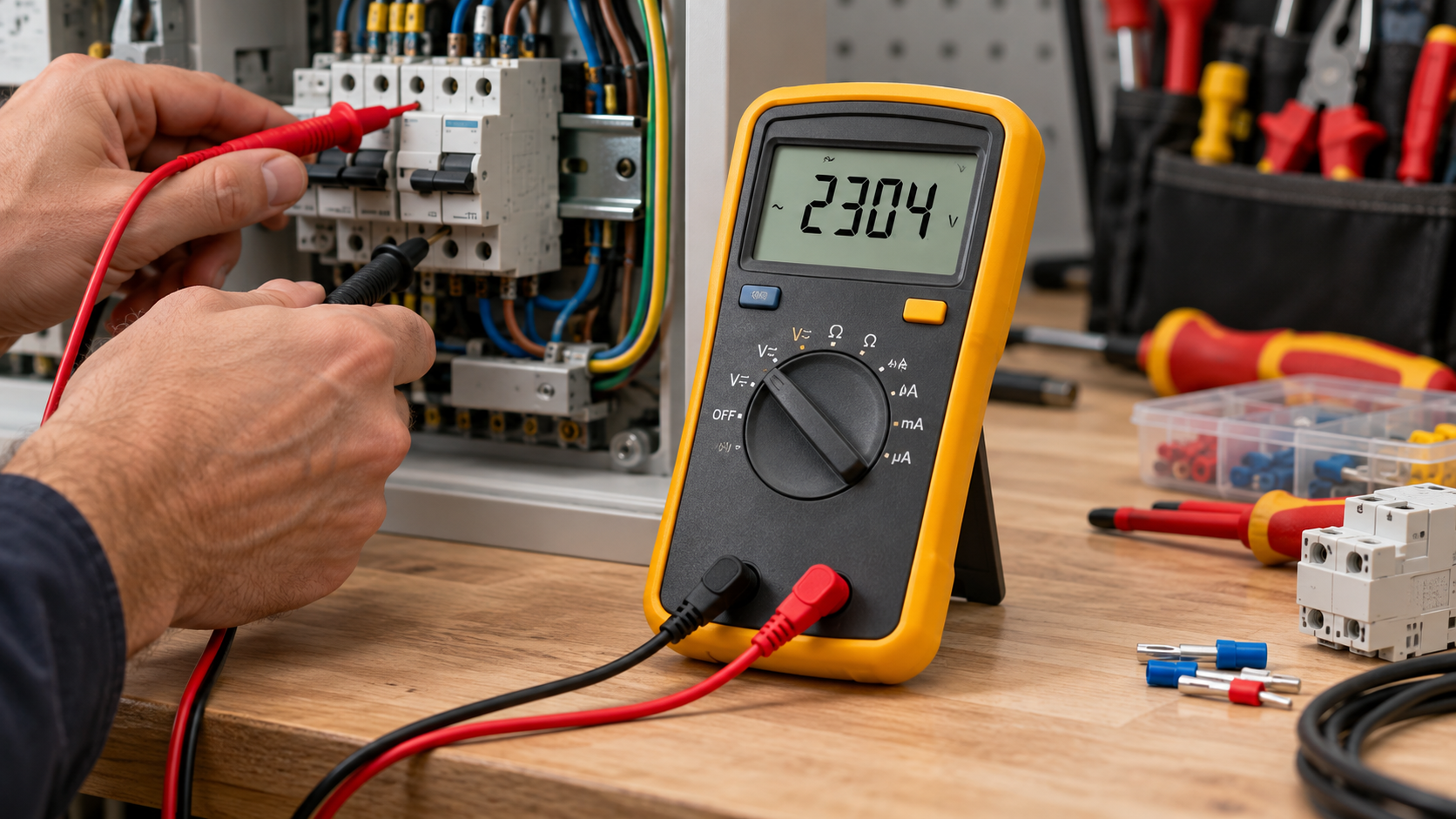
The 110 is a general-purpose handheld meter for common electrical and electronic checks: confirming a supply voltage, testing a switch or fuse for continuity, measuring a resistor or a sensor, and checking a battery voltage. Its true-rms AC voltage reading is intended for non-linear signals, which means it reads distorted waveforms more accurately than an average-responding meter does. That is the main reason to choose true rms over a basic meter.
The 110 is a voltage-focused tool. Its listing does not present it as a clamp meter, a current tester or a bench instrument. If your work depends on current, choose a meter or clamp with a current function and a stated rating.
What the Fluke pages state
The table uses only the two Fluke product pages we opened on 2026-10-27. Where a page is silent, the cell says so.
| Item | What the Fluke pages state |
|---|---|
| Safety standards | IEC 61010-1, pollution degree 2; IEC 61010-2-033, CAT III 600 V. |
| Maximum voltage | 600 V between any terminal and earth ground. |
| True rms | True-rms AC voltage, for non-linear signals. |
| Display | 6,000 counts, updating 4 times per second. Bar graph of 33 segments, updating 32 times per second. |
| DC millivolts | 600.0 mV range, 0.1 mV resolution, accuracy 0.5% + 2. |
| DC volts | 6.000 V, 60.00 V and 600.0 V ranges. Accuracy 0.5% + 2. |
| AC volts (true rms) | 6.000 V, 60.00 V and 600.0 V ranges. Accuracy 1.0% + 3 from DC to 500 Hz, and 2.0% + 3 from 500 Hz to 1 kHz. All AC ranges are specified from 1% to 100% of range. |
| Resistance | 600.0 Ohm, 6.000 kOhm, 60.00 kOhm, 600.0 kOhm, 6.000 MOhm and 40.00 MOhm ranges. |
| Continuity | 600 Ohm range. The beeper sounds below 20 Ohm and is off above 250 Ohm. The page says it detects opens or shorts of 500 microseconds or longer. |
| Battery | One 9 V alkaline battery, IEC 6LR61. About 400 hours typical without backlight. |
| Accuracy conditions | Specified for one year after calibration, at 18 to 28 degrees C. |
| Current measurement | Not listed on the Fluke pages we opened. The regional page names a separately sold i1010 AC/DC current clamp. |
| Capacitance and diode test | Not listed on the Fluke pages we opened. |
| Fuse rating | Not listed on the pages we opened. |
| Included accessories | Not listed on the English page. The regional page shows accessories sold separately. |
How to use the Fluke 110 within its rating
Fluke’s safety guide says to choose a meter rated for the highest category you might encounter, to pick a voltage rating that matches or exceeds the job, and to find the rating printed near the input jacks. The guide also says a damaged meter or damaged probes should never be used. For the 110, that means the CAT III 600 V rating is the ceiling for every measurement you make with it.
- Read the rating label first. Confirm CAT III 600 V on the meter and on the leads. A meter is only as good as its least-rated accessory.
- Check the meter before the measurement. Test the meter on a known source before you rely on it. Inspect the leads for cracks and exposed metal.
- Set the function before the probes touch the circuit. Select AC or DC volts, resistance or continuity before you connect the leads. Never turn the dial to resistance on a live circuit.
- Keep the leads in the correct jacks. Voltage and resistance use the voltage jacks. The 110 has no current function on the pages we opened, so do not look for current on the dial.
- Stop at the rating. Do not measure above 600 V, and do not use the 110 on a system whose category is higher than CAT III. Use a meter with a higher rating for those jobs.
- Keep panel and service work with a licensed electrician. A meter does not make live panel work safe for a beginner.
Things to check before you buy
- Availability. One Fluke regional page marks the 110 as discontinued and suggests the Fluke 114 as a replacement. The English page we opened does not show that label. Confirm with the seller whether the unit is current.
- Current needs. If you need amps, add a separate clamp or choose a meter that lists a current function. The i1010 clamp is sold separately, according to the regional page.
- Battery and backlight. The page gives 400 hours without backlight. Check that you have a spare 9 V alkaline battery in your kit.
- Leads. The regional page lists several lead and probe options sold separately. Check that the leads you buy carry the same CAT rating as the meter.
- Use case. The 110 suits household and light electronics checks within CAT III 600 V. It is not a substitute for a higher-rated meter on distribution equipment.
Common mistakes with a 110
- Assuming it measures current. The pages we opened do not list a current function on the 110.
- Using it above its rating. A CAT III 600 V meter is not rated for CAT IV work or for voltage above 600 V.
- Trusting a resistance reading on a live circuit. Resistance measurement needs a de-energized circuit.
- Ignoring the beeper threshold. The continuity beeper sounds below 20 Ohm, so a reading above that may still be a weak connection.
- Using damaged probes. The Fluke guide is direct on this point: a damaged probe is a hazard.
FAQ
Is the Fluke 110 true rms?
Yes. The Fluke page lists true-rms AC voltage for accurate measurements on non-linear signals. The pages we opened do not list true rms for every function on the meter, so confirm the function you need.
What is the Fluke 110 safety rating?
The pages list IEC 61010-2-033, CAT III 600 V, with pollution degree 2. That is the category and voltage ceiling for the meter.
Can the Fluke 110 measure amps?
Not on the Fluke pages we opened. A current clamp is sold separately on the regional page. Check the function list before you buy if amps are part of your work.
How long does the battery last?
The page gives about 400 hours typical without backlight, using one 9 V alkaline battery.
Can it check a capacitor or diode?
The Fluke pages we opened do not list a capacitance or diode test for the 110, so this guide does not claim one.
Is it still sold new?
One Fluke regional page shows a discontinued label and names the Fluke 114 as a replacement. Ask the seller to confirm the model status before you buy.
How we chose
This explainer covers one model. It does not rank the 110 against other meters. The facts come from the two Fluke pages and the Fluke safety guide we opened on 2026-10-27. Where a page is silent, the text says so.
What we could not verify
- A fuse rating for the 110. The pages we opened do not list one.
- Capacitance and diode functions. The pages we opened do not list them.
- The full list of included accessories. The English page does not show them, and the regional page lists only items sold separately.
- Warranty length. The pages we opened do not state a warranty term.
Bottom line
The Fluke 110 is a voltage and resistance meter rated CAT III 600 V. Use it within that rating, check the availability of the unit, and add a separate current tool if you need amps.
Related guides
- Best multimeter for DIY, for home checks that fit a CAT III 600 V meter.
- Best true RMS multimeters, to compare true-rms features across models.
- How to use a multimeter step by step, for the setup steps before any measurement.
Sources
- Fluke Corporation, “Fluke 110 True-rms Digital Multimeter.” https://fluke.com/en/product/electrical-testing/digital-multimeters/110 (opened 2026-10-27)
- Fluke Corporation, “Fluke 110 True-rms Digital Multimeter,” regional page. https://www.fluke.com/en-vn/product/electrical-testing/digital-multimeters/110 (opened 2026-10-27)
- Fluke Corporation, “Guide to digital multimeter safety.” https://fluke.com/en-us/learn/blog/safety/multimeter-guide (opened 2026-10-27)