Best Battery Tester for AA and AAA Batteries
As an Amazon Associate we earn from qualifying purchases. Details
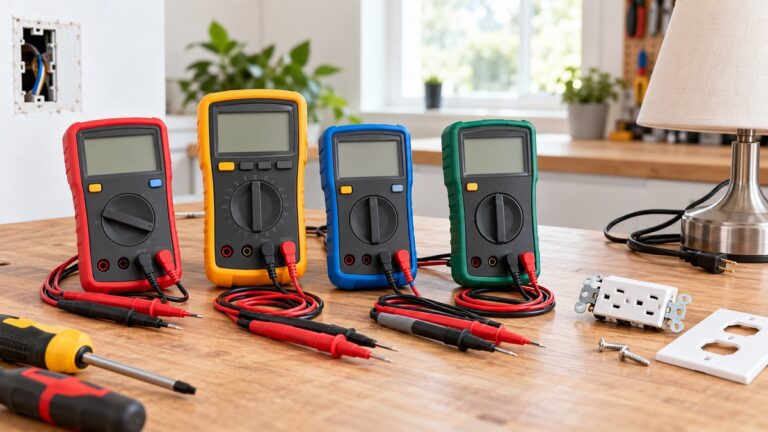
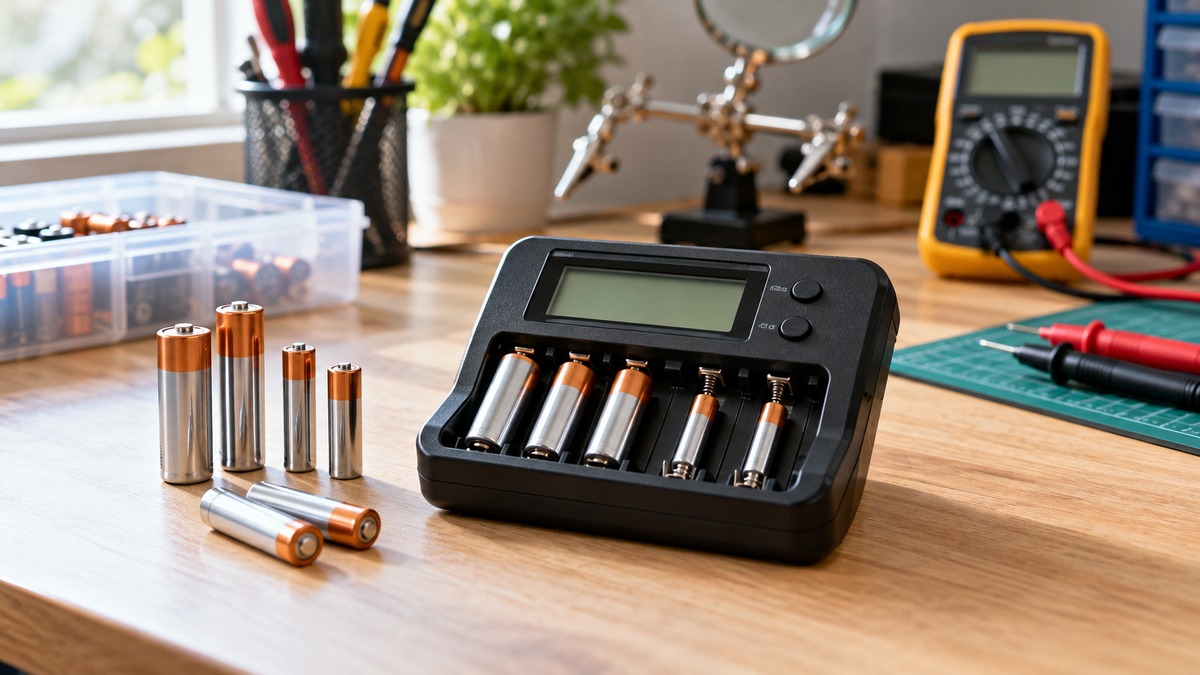
The best battery tester for AA and AAA batteries is the one whose listing names the exact cell you own and states how it shows the result. This guide compares six listings that name AA and AAA cells, uses only the facts those listings state, and says plainly what they leave out. Work on mains circuits can kill. The CAT rating of any meter has to suit the circuit it touches, and panel or service work belongs to a licensed electrician. A battery tester reads one cell at a time, so none of the six is a substitute for a meter rated for household mains.
Quick answer
- The KKEANIC SL-049 listing names the most cell types: 19 in its compatible-device line.
- The DLYFULL B1L listing gives a 70g weight and a Good, Low and Replace color display.
- The DLYPOW B1T listing is the one with a magnetic tip and a classic analog display.
- None of the six listings states a CAT rating, so none is a mains tool.
- Keep rechargeable cells away from any tester whose listing rules them out, such as the DLYFULL B2.
Electrical safety before you buy
Work on mains circuits can kill, and that is why the CAT rating matters. A CAT rating tells you which kinds of circuit a meter is built for, and it has to match the circuit you are working near. A battery tester is a different class of tool from a meter for outlets, breakers or service wiring. It reads one small cell. Panel and service work belongs to a licensed electrician, and nothing in this guide is a method for working on live wiring.
The Cornell Legal Information Institute text of 29 CFR 1910.333 says that “Safety-related work practices shall be employed to prevent electric shock” when work is done near or on circuits that are or may be energized. The rule is written for workplaces, but the same idea holds at home: the tool and the method have to match the hazard.
For the six products here, the listing does not state a CAT rating. Where a listing is silent on that point, this guide says so. Do not use any of these testers on household mains, on outlets or on a service panel.
What the listings say about cell types
The table uses only the cell names that each listing spells out in its title, bullets or specification fields. A blank cell means the listing does not name that type. A blank is not proof that the tester fails on that cell. It means the listing gives no support for it.
| Listing | AA | AAA | C | D | 9V | N | Button cells | Rechargeable |
|---|---|---|---|---|---|---|---|---|
| DLYFULL B2 | Named | Named | Named | Named | Named | Named | “a wide variety of button cell batteries” | Listing says do not test |
| KKEANIC SL-049 | Named | Named | Named | Named | Named | Named | CR1616, CR1632, CR2016, CR2025, CR2032, CR2450, CR3032, LR44, LR43, LR41 | 1.2V AA, AAA, AAAA |
| DLYFULL B1L | Named | Named | Named | Named | Named | Not named | “button-cell batteries” | Not named |
| DLYPOW B1T | Named | Named | Named | Named | Named | Not named | “button cell batteries” | Not named |
| TEKCOPLUS BCTK-64 | Named | Named | Named | Named | Named | Named | Title only | Not named |
| Shutao 2-pack | Named | Named | Named | Named | Named | Named | Title only | Not named |
Counting the names gives a clear comparison. The KKEANIC compatible-device line names 19 cell types, not counting its 1.2V rechargeable entries. The DLYFULL B2 bullet names 11: AA, AAA, C, CR123A, D, 9V, N, CR2, CRV3, 2CR5 and CR-P2. Eight names appear on both lists, so 8 + 11 = 19 for KKEANIC and 8 + 3 = 11 for the B2. KKEANIC adds 11 names the B2 bullet does not give, including AAAA and the coin-cell and LR-series codes. The B2 adds 3 names the KKEANIC line does not give: CRV3, 2CR5 and CR-P2.
The practical lesson is to read the list against your own drawer, not to count the names and stop. A tester with fewer names is still the right choice if every cell you own is on its list.
Reading the result
Each display shows a state, not a voltage. The DLYFULL B1L names Good in green, Low in yellow and Replace in red. The KKEANIC bullet describes a colored power indicator bar that displays Good, Weak or Poor status. The Shutao pack uses a three-color indicator with a bar graph. The TEKCOPLUS listing describes an LCD bar graph. The DLYPOW B1T uses a classic analog display, and its listing does not describe the scale.
The Purdue Extension 4-H sheet explains why a reading needs two points: “Voltage potential can be measured and is the difference between two points, for example between the positive and negative ends of a battery.” A small tester reads across the two ends of a cell, so the display always answers a question about those two ends.
Two things follow. First, compare the state on the display with the state the listing names, and do not turn it into a number. Second, because none of the listings gives the voltage behind each state, a single reading cannot be checked against a spec sheet in this guide. For the basics of how a voltage tester reads a battery, see how voltage testers work.
The six picks
Six listings meet the cell-name test and state enough facts to write about. Each pick has its own section below. The cards after this paragraph repeat the pros, cons and skip condition from the listing data.
1. Battery Tester for AA AAA C D 9V, Button Cell & Household Batteries (DLYFULL B2: LCD bars and 11 named cell types)
Pros
- The bullet names 11 cell types, including AA, AAA, C, D, 9V and N.
- The listing states an 18-month warranty.
- The Included Components field lists one AAA alkaline battery.
Cons
- The listing does not state a CAT rating or a voltage range.
- The listing says not to power it with or test rechargeable batteries.
Best for: A reader who wants one LCD tester for common cylindrical cells, 9V blocks and coin cells.
Skip if: Most of your cells are rechargeable, or you need a tester that names rechargeable cells as a test target.
View on Amazon (affiliate link)
2. Battery Tester for AA AAA C D 9V & Household Batteries Battery Checker (KKEANIC SL-049: 19 named cell types and real-load checks)
Pros
- The compatible-device line names 19 cell types, including CR1616, CR2032 and LR44.
- The listing says it tests 1.2V rechargeable AA, AAA and AAAA cells.
- A bullet gives a discharge resistor for each cell family, such as 20 ohms for AA and AAA.
Cons
- The listing says it needs one AAA battery for operation, and that battery is not included.
- The listing does not state a CAT rating.
Best for: A drawer with coin cells, AA and AAA cells and rechargeable 1.2V cells.
Skip if: You do not want to buy an AAA battery to run the tester, or you need a rated meter for mains work.
View on Amazon (affiliate link)
3. Battery Tester for AA AAA C D 9V, 1.5V Button & Household Batteries Checker (DLYFULL B1L: 70g tester with Good, Low and Replace colors)
Pros
- The listing gives a weight of 70g.
- The bullets name a green Good, yellow Low and red Replace display.
Cons
- The compatible list does not name N cells.
- The listing gives no voltage range or accuracy figure.
Best for: A light color check on AA, AAA, C, D, 9V and button cells.
Skip if: You need a numeric voltage readout or you test N cells.
View on Amazon (affiliate link)
4. Dlypow Magnetic Battery Tester for AAA AA C D 9V, Buttons, Batteries Checker (DLYPOW B1T: magnetic tip and classic analog display)
Pros
- The bullets say a built-in magnetic tip grabs and holds the battery.
- The listing gives dimensions of 4.33 x 2.32 x 0.98 inches.
- The bullets describe a classic analog display.
Cons
- The Power Source field reads Internal Power Source and names no battery type.
- The listing gives no weight and no voltage range.
Best for: A reader who wants the cell held in place while reading a needle.
Skip if: You want a digital number, or you need the weight before buying.
View on Amazon (affiliate link)
5. Battery Tester Universal Battery Checker with LCD Display Digital Multi Purpose Small Battery (TEKCOPLUS BCTK-64: larger LCD bar graph, 0°C to 40°C range)
Pros
- The compatible line names seven cell types: C, AA, AAA, D, N, 9V and 1.5V.
- A bullet gives an operating range of 0°C to 40°C.
- The listing says it runs on the batteries under test, with no external power source.
Cons
- Two bullets repeat the same LCD sentence.
- The listing gives no warranty term and no CAT rating.
Best for: A reader who wants a larger LCD bar display.
Skip if: A pocket-size tool matters more to you than display size.
View on Amazon (affiliate link)
6. 2Pcs Universal Battery Tester Digital LCD Display Multi-Purpose Battery Checker Capacity Analyzer (Shutao 2-piece pack: adjustable slider and three-color result)
Pros
- The listing is a two-piece pack.
- The bullets say the design suits toolboxes, drawers or on-the-go use.
- The bullets say it is self-powered, with no external power needed.
Cons
- Unit Count reads 2 Count, but Number of Items reads 1.
- The listing gives no dimensions, weight or warranty.
Best for: Two testers for different places, such as a drawer and a toolbox.
Skip if: You need the item count settled before buying, or you need a stated size.
View on Amazon (affiliate link)
DLYFULL B2
The DLYFULL B2 suits a reader who wants one LCD tester for a wide set of cylindrical cells, 9V blocks and coin cells. Its bullet names 11 cell types, including AA, AAA, C, D, 9V, N and CR123A. The Included Components field lists one B2 battery tester, one AAA alkaline battery and a welcome guide.
The listing gives an 18-month warranty, a weight of 115 g and dimensions of 5.2 x 3.46 x 0.94 inches. Its bullets describe a crisp LCD screen and a bar display that shows whether a battery is in poor, weak or good condition. The listing gives no voltage range, no accuracy figure and no CAT rating, so the bar state is the only result it describes.
The listing also says the tester should not be powered by rechargeable batteries and should not be used to test them. Keep rechargeable AA and AAA cells away from it. Skip the B2 if most of your cells are rechargeable, or if you need a tester that names rechargeable cells as a test target.
KKEANIC SL-049
The KKEANIC SL-049 has the widest named cell list in this set. Its compatible-device line names 19 types, from AAAA, AA and C through D, N and 9V to CR1616, CR2032, LR44 and CR123A. It separately names 1.2V rechargeable AA, AAA and AAAA cells. A reader with a mixed drawer of coin cells and rechargeable cells will find that list useful.
The listing describes real-load testing and gives a discharge resistor for each cell family. For AA, AAA, AAAA, C and D it lists 20 ohms, about 75 mA. For 1.2V rechargeable cells it lists 30 ohms, about 40 mA. For LR44 and CR2032 it lists 1 kilo-ohm, about 1.5 mA and about 3 mA. The listing also states a 1-year warranty.
The limits are clear in the text. The listing says the tester needs one AAA battery for operation and that the battery is not included. It does not state a CAT rating. One bullet that would give the lithium and temperature limits is cut off in the text this guide has, so this guide does not use it. Skip the SL-049 if you do not want to buy an AAA battery to run the tester, or if you need a rated meter for any mains work.
DLYFULL B1L
The DLYFULL B1L is the light option in this set. Its listing gives a weight of 70g and describes a compact size. It says there is no need for a built-in power supply, because you align the battery terminals and read the result. The bullets name 1.5V AAA, AA, C and D alkaline cells, 9V batteries and button-cell batteries.
The listing labels its three display states Good, Low and Replace, and it gives each one a color. That is the decision a reader needs at a glance: whether a cell still has charge worth keeping or should be replaced. The listing gives no numeric reading for any of the three states.
The listing states an 18-month warranty. It does not name a rechargeable cell type, and it gives no voltage range or accuracy figure. Its compatible list also omits N cells, which four of the other listings name. Skip the B1L if you need a numeric voltage readout, or if you test N cells.
DLYPOW B1T
The DLYPOW B1T is the analog option. Its bullets say a built-in magnetic tip grabs and holds the battery in the ideal position, and that the reading appears on a classic analog display. The listing names AAA, AA, C, D, 9V and button cells, and its dimensions are 4.33 x 2.32 x 0.98 inches.
A reader who prefers a needle to a digital figure, or who wants the cell held in place while reading it, will find this layout fits. The bullets describe a one-step process, so there is little to set up before a check.
The listing has two gaps. Its Power Source field reads “Internal Power Source” and names no battery type, and the bullets do not explain what that means in use. The listing gives no weight, no voltage range and no CAT rating. Skip the B1T if you want a digital number, or if you need the battery type or the weight before you buy.
TEKCOPLUS BCTK-64
The TEKCOPLUS BCTK-64 is the largest tester of the six, which may suit a reader who wants a bigger LCD bar graph. Its listed size is 5.75 x 4.21 x 0.47 inches, and its weight is 0.05 kg. Among the picks that give dimensions, it is the largest in both length and width.
The compatible line names C, AA, AAA, D, N, 9V and 1.5V cells, and the title adds 6F22 and button cells. The listing says the tester runs on the batteries under test and needs no external power source. It gives an operating range of 0°C to 40°C and says the body is made from ABS and stainless steel.
The gaps are real. Two bullets repeat the same LCD sentence word for word, so the listing reads as copied. It gives no warranty term, no voltage range and no CAT rating. Skip it if a pocket-size tool matters more to you than a large display.
Shutao 2-piece pack
The Shutao listing is a two-piece pack, and its bullets suggest use in more than one place. One bullet says the design suits toolboxes, drawers and on-the-go use, so one tester could stay in a drawer and one in a toolbox. The bullets name C, AA, AAA, D, N and 9V cells, and the title adds button cell batteries.
The tester is self-powered, with no external power needed, and an adjustable slider fits different battery sizes. The bullets describe a three-color result indicator and an easy-to-read bar graph display. The title calls it a digital LCD display.
The gaps are the count and the specifications. The listing’s Unit Count reads 2 Count, while its Number of Items reads 1. It gives no dimensions, weight or warranty. Skip the Shutao pack if you need the count settled before you buy, or if you need a stated size.
Checklist before you buy
Write down the cells you own, by name, before you compare listings. A cell name that is missing from a listing is a question to answer, not a gap to fill with a guess.
- Match each cell to a named type in the table. Coin cells need a listing that names their code.
- Check the rechargeable rule. The B2 says not to test rechargeable batteries, and only the SL-049 names rechargeable AA, AAA and AAAA cells as a test target.
- Check the power need. The SL-049 needs an AAA battery for operation, and the listing says that battery is not included.
- Look for a CAT rating. None of the six states one, so none of these picks is a mains tool.
- Inspect each cell before you place it in a tester, and set aside any cell that shows damage, as covered below.
- For a separate non-contact check of a wire or outlet, see how to use a non contact voltage detector. That is a different tool and a different job from reading a cell.
Damaged cells
The Western Michigan University environmental health page on lithium-ion cells gives a short set of rules that are useful for any cell you suspect is damaged. It says “Inspect batteries for damage before use and promptly dispose of damaged ones.” It also says “If leaking material is present, do not touch it.” For a damaged cell with exposed terminals, the same page says “Tape exposed terminals to prevent short circuits.”
That page is written for lithium-ion and LiPo cells in a university setting. Read it as a general habit, not as a disposal rule for alkaline AA or AAA cells. The sources opened for this guide do not give a disposal route for those cells, so check your local rules before you throw one away.
Mistakes to avoid
- Reading a color or bar state as a voltage. None of the six listings gives the voltage behind a state.
- Putting a rechargeable cell into the DLYFULL B2, whose listing says not to test rechargeable batteries.
- Assuming the SL-049 runs on its own. Its listing says a separate AAA battery is needed and is not included.
- Using a battery tester on an outlet, a breaker or service wiring. None of the six is listed for mains, and panel work belongs to a licensed electrician.
- Trusting the Shutao count. The listing gives 2 in one field and 1 in another.
- Quoting a lithium or temperature limit from the SL-049 bullets. That bullet is cut off in the text this guide has.
How we chose
The scan checked 32 search results and kept 12 listings from 9 brands. This guide reads those listings as they were captured on 2026-10-23. Five of the 12 carry a scan flag named tool_only_suspect, which the scan did not clear, so they are left out. Those five come from TFJAYTOO, AKIELO, two UMLIFE listings and YFUSET. One more DLYFULL listing, model 742354369388, is left out because its bullets repeat the DLYFULL B2 bullets word for word and its compatible-device field names a radio. That leaves six listings.
Three criteria decided which listings were kept. The listing names AA or AAA cells. The facts used come from specification fields or from complete bullets, so a bullet cut off mid-sentence is not used. The listing does not contradict itself on a point a buyer would check, or, where it does, the conflict is reported in the pick. The six kept listings also cover three display types: an LCD bar readout, a color state and an analog needle.
This selection does not rank the six. The listings are placed by cell coverage and display type, not by any measured result or by sales data.
What we could not verify
- A CAT rating for any of the six. None of the listings states one.
- A voltage range, accuracy figure or threshold for each display state on the DLYFULL B2, DLYFULL B1L, DLYPOW B1T, TEKCOPLUS and Shutao listings.
- Whether the SL-049 supports lithium cells, and what its temperature range is. The bullet that would say so is cut off.
- A weight for the DLYPOW B1T and the Shutao pack, and dimensions for the DLYFULL B1L and the Shutao pack.
- A warranty term for the DLYPOW B1T, the TEKCOPLUS and the Shutao pack.
- Whether any of these displays matches a published standard. The sources opened for this guide do not give thresholds for these display states.
- Real-world accuracy. The sources opened for this guide do not cover battery tester accuracy, and no listing reports an accuracy result.
FAQ
Do these testers read AA and AAA batteries?
Yes. All six listings name AA and AAA cells. Use the table as the check: find the cell you own by name before you buy.
Can I test rechargeable batteries with them?
Only the KKEANIC SL-049 names rechargeable cells as a test target, and it names 1.2V AA, AAA and AAAA cells. The DLYFULL B2 says not to test rechargeable batteries. The other four listings do not name rechargeable cells at all.
Is a battery tester safe for household outlets?
No. None of the six listings states a CAT rating, and none is listed for mains work. Work on mains circuits can kill. Panel and service work belongs to a licensed electrician, and an outlet check is a separate job that needs a different tool.
What does a color or bar reading tell me?
It tells you which state the display shows. The Purdue Extension 4-H sheet says that “Voltage potential can be measured and is the difference between two points,” so every reading depends on the two ends of the cell. None of the six listings gives the voltage behind a state, so one reading cannot be turned into an exact number here.
What should I do with a cell that looks damaged?
Set it aside and dispose of it promptly. The Western Michigan University guidance says “Inspect batteries for damage before use and promptly dispose of damaged ones.” That page is written for lithium-ion cells, so check your local rules for alkaline cells.
Do I need to buy a battery to run the tester?
It depends on the listing. The SL-049 needs one AAA battery for operation, and the listing says it is not included. The DLYFULL B2 includes one AAA alkaline battery and says it is battery powered. The DLYFULL B1L says it needs no built-in power supply, and the TEKCOPLUS and Shutao listings say they run on the cell under test with no external power. The DLYPOW B1T names only an internal power source.
Bottom line
For the widest named list of cells, the KKEANIC SL-049 is the listing to read first, and you must add the AAA battery it needs. For a light color readout, the DLYFULL B1L fits. For a needle and a magnetic tip, the DLYPOW B1T fits. Whichever you choose, a battery tester reads a cell. It does not make mains work safe, and none of these listings says it is rated for mains.
Sources
- https://extension.purdue.edu/4-H/_docs/projects/electric/All-Levels-Voltage-Meter-Basics.pdf
- https://wmich.edu/ehs/lithium-ion-battery-safety-guidance
- https://www.law.cornell.edu/cfr/text/29/1910.333