How to Choose a Multimeter for Checking Guitar Pickups
As an Amazon Associate we earn from qualifying purchases.
How to choose a multimeter for checking guitar pickups comes down to three functions: an ohms range that reads a few thousand ohms clearly, a zero or relative (REL) mode, and a continuity beep. Pickup makers and guitar repair guides treat the check as a resistance measurement on the coil, so those functions matter more than voltage or current ranges. The sources we opened do not name one range or one model that every pickup needs.
Electrical safety first
Work on mains circuits can kill. Before you measure anything, check that the meter’s CAT rating suits the circuit you are testing, and read the rating from the listing or the manufacturer’s manual. Panel and service work belongs to a qualified electrician. A pickup check is a low-voltage bench job, and this guide covers only that. Do not use a pickup test as a reason to open a guitar amplifier, a power supply or any wall-powered device. The sources we opened on shock hazards are general, and they do not describe a pickup test.
Quick answer
- Use a meter with an ohms (Ω) setting, a zero or REL mode, and a continuity beep.
- On a four-conductor humbucker, check the full pickup first, then each coil separately.
- Read the CAT rating and accuracy from the listing. If the listing does not state a CAT rating, say so.
The guitar pickup sources we opened agree on the basic steps. Seymour Duncan describes checking a pickup’s resistance with the meter set to ohms, using the guitar’s output jack or the pickup’s lead wires. The same article notes that “resistance is never exact” and that a reading is expected to fall near the pickup’s rating. If a single pickup reads far from its rating, the article suggests digging deeper into the coil and its wiring.
What a pickup check needs from a multimeter
Pickup checks use four functions. Each one maps to a step in the sources, so use this list when you compare listings.
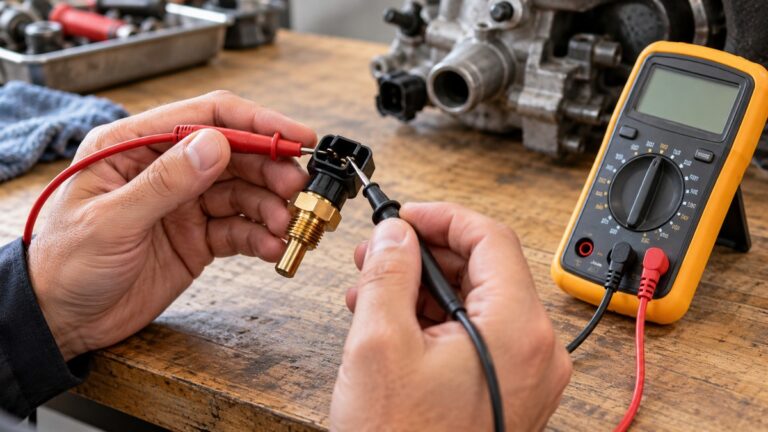
- Ohms (Ω) mode. A pickup coil is a resistance of a few thousand ohms, and the Seymour Duncan article tells the reader to set the meter to the Ohm setting before touching the probes.
- Zero or relative (REL) mode. Fluke describes REL as a mode that automatically subtracts test lead resistance, which it gives as typically 0.2 Ω to 0.5 Ω. The Fluke page calls this mode zero or delta on some meters. Check the listing for the name your meter uses.
- Continuity beep. Fluke states that a digital multimeter beeps when it detects a complete path. Seymour Duncan uses the continuity setting to check a guitar’s ground connection, so the beep function matters for a wiring check as well as for a coil check.
- Auto-ranging or a manual range. Fluke says that a digital meter in resistance mode can switch to the best range automatically when leads touch a component, and that a manual range can be set with the Range button. Either option can read a pickup. Read the display annunciator (K or M) when you use a fixed range.
The sources we opened do not give a required display resolution, count figure or accuracy spec for pickup work. The listing does not state a resistance accuracy for every meter, so compare the stated accuracy figure yourself on each listing. Do not treat a single number as a pass or fail line for a pickup.
Why the reading varies
Pickup makers usually list a resistance value for each model, but that figure is not an exact target. Seymour Duncan explains that manufacturers often publish an average DC resistance, and that magnet wire is made to a range of diameters. In the example given, 42-gauge wire has a bare copper diameter that can differ across a minimum, nominal and maximum value. That spread changes the resistance even when the number of turns is the same. A pickup can therefore read noticeably away from its catalog figure and still be healthy.
The same article gives a practical guide for a healthy result. For a four-conductor humbucker, each coil should read roughly half of the full pickup’s listed rating. If one coil or both read well off that mark, the article says the pickup is probably broken. If the total reading is correct but the output is still wrong, the article points to checking the wiring. The sources we opened do not say how far a reading may move before a pickup counts as faulty, so this guide does not give a percentage.
A University of Illinois physics project measured the DC resistance of a guitar pickup with a benchtop digital multimeter, and paired that reading with inductance and impedance measurements taken on separate instruments. That project shows that DC resistance is one measurement among several. It does not show that a handheld meter can measure inductance, so do not assume a basic meter can do it. The listing does not state an inductance function unless the page says so.
How we chose
This guide works from the method steps in the sources, not from product features. We opened ten pages that cover pickup resistance checks, meter resistance and continuity functions, and CAT ratings. Each claim in the body is tied to one of those pages. We did not rank meters, and we did not name any model as a recommendation. The criteria are the four functions above, the stated CAT rating, and the stated accuracy on the listing. We chose these because the sources describe these functions as the ones used for coil, wiring and continuity checks.
What we could not verify
The sources we opened do not give a typical resistance range for every pickup type, so this guide does not list one. They do not state a pass or fail percentage for a coil reading. They do not say whether a given handheld meter reads resistance to a required number of decimal places. The sources do not say which meter model suits guitar work, and they do not state a CAT rating for any meter. Where a listing does not state a CAT rating, write that the listing does not state one. Never call a meter safe for household mains because it is marketed for guitar work.
Buying checklist
- Confirm that the meter has an ohms mode and a continuity beep on the same dial or on a clearly labelled button.
- Check that the listing says whether the meter has a zero or REL function, and what it calls it.
- Read the stated resistance accuracy and the stated count or resolution. If the listing does not state them, write down that it does not.
- Read the CAT rating from the listing or the manual. If the listing does not state a CAT rating, say so in your notes.
- Confirm whether the listing names a fuse rating and the input jacks. The sources we opened do not say a pickup test needs a fuse rating, but the same meter may be used on other jobs.
Step by step: a pickup check with the right meter
The steps below follow the Seymour Duncan article and the Fluke resistance guidance. They describe a low-voltage bench check, and they assume the instrument is not plugged into an amplifier when you measure the coil.
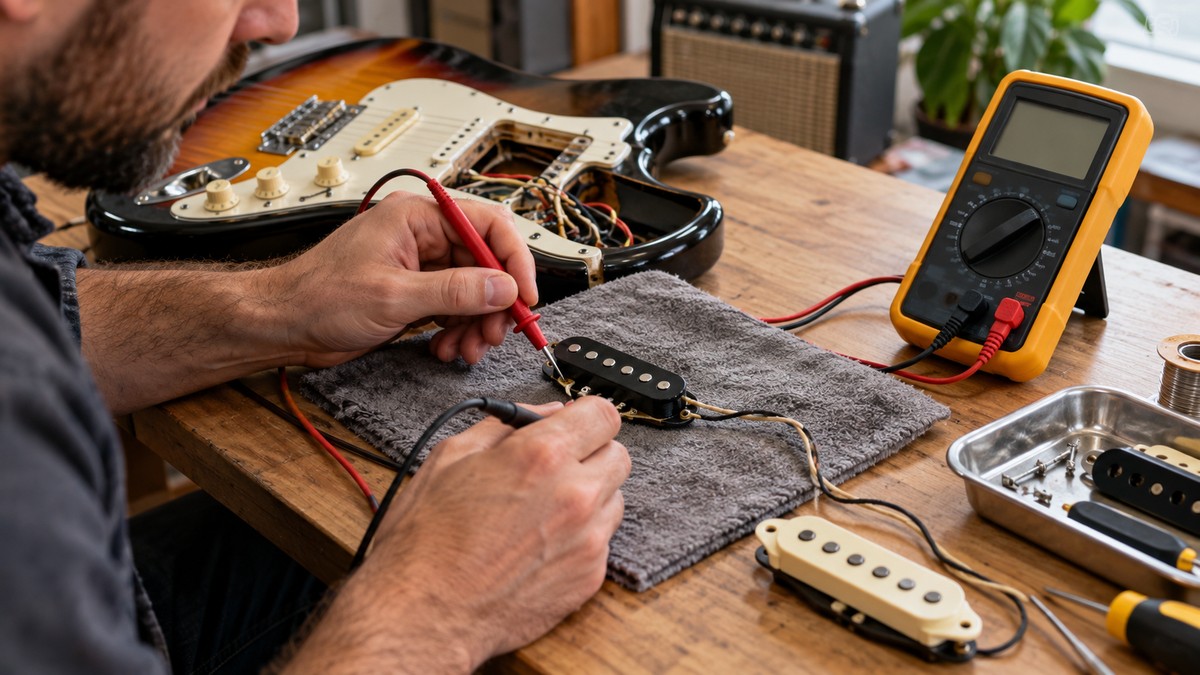
- Set the meter to ohms. Choose the Ohm (Ω) setting. If the meter has a fixed range, pick one that covers a few thousand ohms and read the annunciator on the display.
- Insert the leads. Fluke says to insert the black lead into COM and the red lead into the VΩ jack.
- Zero the leads if the meter has REL. Touch the probe tips together. Fluke says the display should show 0 Ω, and that lead resistance is typically 0.2 Ω to 0.5 Ω. Use the relative mode to subtract it.
- Remove the rest of the guitar’s electronics from the reading. Seymour Duncan says a measurement from the lead wires gives a more accurate reading because it leaves out the rest of the guitar’s electronics. Fluke makes the same point for any component: it is best to measure it removed from the circuit, because parallel paths change the reading.
- Measure the coil. For a single-conductor pickup, touch one probe to each lead, excluding the ground wire. For a four-conductor humbucker, the article gives separate steps for the full pickup and for each coil.
- Compare the reading. Use the listed rating as a guide, not a pass line. For a split humbucker, each coil should read roughly half the full listed rating.
- Check ground with continuity. Set the meter to the continuity setting, touch one probe to a string and the other to the output jack’s ground. Seymour Duncan says a good ground gives a clear beep.
Keep the meter’s probes away from metal tips while you read the coil, because Fluke says the human body becomes a parallel resistance path that lowers the reading. Touching the bare probe tips is a common cause of a reading that looks low.
Reading the results
A reading near the listed rating means the coil is probably intact. A reading that is close to the listed rating but far from the expected value for one coil can point to a wiring or winding problem, and Seymour Duncan says to check each coil separately before deciding. A reading that shows OL (overload) on the display means the meter sees a resistance above the selected range or no closed circuit. The sources we opened do not say what OL means in every case, so treat it as a sign that the coil or its connection needs a closer look.
A beep in continuity mode means the meter found a complete path. Fluke says no beep means the circuit is open. For a pickup, that can point to a broken wire or a loose connection. The sources we opened do not say how to tell a loose connection from a broken winding, so check the connections first, then the coil.
Common mistakes
- Measuring while the pickup is still wired into the guitar. Other parts of the circuit can change the reading, as Fluke and Seymour Duncan both note.
- Trusting the listed rating too far. The Seymour Duncan article and the wire-tolerance example show that a healthy pickup can read off its catalog figure.
- Touching the probe tips. Fluke warns that body contact adds a parallel path and lowers the reading.
- Skipping the continuity check. A pickup can read correctly while the ground path is broken, which the continuity steps are meant to catch.
- Buying on the basis of a claim the listing does not make. If the listing does not state an inductance function, a CAT rating or an accuracy figure, the meter does not have that function as far as the listing shows.
FAQ
Can a basic multimeter check a guitar pickup?
Yes, the Seymour Duncan article and the University of Illinois project both measure coil DC resistance with a multimeter. The sources do not say that a basic meter can measure inductance, so do not assume it can.
What reading should a pickup give?
The Seymour Duncan article says pickups usually list a resistance and that a reading should be near that rating. The sources we opened do not give a percentage tolerance, so the listed figure is a guide only.
Why does a humbucker read half the rating on each coil?
The article says that, for a four-conductor humbucker, each coil should read roughly half of the full pickup’s listed rating. It does not explain the winding design beyond that statement.
Do I need a zero or REL mode?
Fluke describes REL as a way to subtract test lead resistance, which it gives as typically 0.2 Ω to 0.5 Ω. A pickup reading is in the thousands of ohms, so the sources do not say the function is required for every pickup check.
What does a continuity beep tell me?
Fluke says the meter beeps when it detects a complete path. Seymour Duncan uses the beep to check a guitar’s ground. No beep points to an open path.
Which CAT rating does a pickup test need?
The sources we opened tie CAT ratings to the installation the meter is used on. They do not state a CAT rating that a pickup test needs, so read the rating from the listing and use the highest category your work might reach.
Bottom line
Choose a multimeter for guitar pickups by its ohms function, its zero or REL mode and its continuity beep. Check the stated accuracy and CAT rating on the listing, and compare each coil reading with the listed rating rather than a fixed pass line.
Related guides
Sources
- https://www.seymourduncan.com/?p=63382 (opened 2026-10-21)
- https://www.seymourduncan.com/blog/latest-updates/how-a-multi-meter-can-help-your-guitar (opened 2026-10-21)
- https://www.seymourduncan.com/?p=5373 (opened 2026-10-21)
- https://courses.physics.illinois.edu/phys406/sp2017/406emi_guitar_pickup_results.html (opened 2026-10-21)
- https://www.fluke.com/en-us/learn/blog/digital-multimeters/how-to-measure-resistance (opened 2026-10-21)
- https://www.fluke.com/en-au/learn/blog/digital-multimeters/how-to-test-for-continuity (opened 2026-10-21)
- https://www.fluke.com/en-us/learn/blog/safety/multimeter-guide (opened 2026-10-21)
- https://www.triplett.com/blogs/news/understanding-cat-ratings-in-electrical-test-instruments (opened 2026-10-21)
- https://tester.co.uk/advice/what-are-cat-ratings (opened 2026-10-21)
- https://www.unca.edu/ehs/electrical-safety/ (opened 2026-10-21)