What Is Accuracy on a Multimeter
As an Amazon Associate we earn from qualifying purchases.
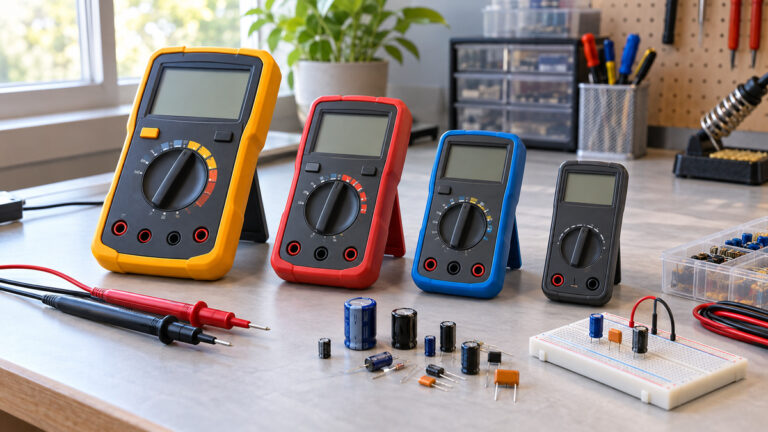
What is accuracy on a multimeter? It is the largest error the maker allows between the displayed reading and the true value, under stated conditions. Makers usually write it as a percentage of the reading plus a number of counts, such as ±(0.5% + 2), or as a percentage of the reading plus a percentage of the range. This page explains how to read that figure, how it differs from resolution, and what one named bench meter’s datasheet gives. It starts with electrical safety, because an accuracy figure says nothing about whether a meter is safe on mains.
Quick answer
- A spec such as ±(0.5% + 2) is a percentage of the displayed reading plus a fixed number of counts.
- One count is a step of the least significant digit on the range in use, so its size changes with the range.
- Resolution sets the display step, while accuracy sets the window around the true value.
- Mains work is governed by the CAT rating from the listing or manual, never by the accuracy figure.
Electrical safety first
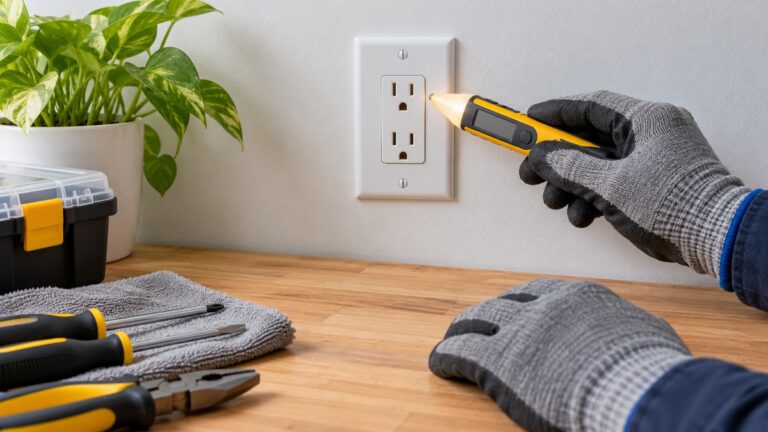
Work on mains circuits can kill. OSHA’s publication on controlling electrical hazards lists current levels with their effects, and at 50 to 150 milliamperes it says death is possible. Fluke’s safety guide explains the mechanism: shock occurs when the human body becomes part of an electrical circuit. OSHA’s construction rule goes further and says electric lines and equipment are treated as energized until they have been de-energized.
Before you measure anything, check that the meter’s CAT rating suits the circuit you are working on, and read the rating from the listing or the manufacturer’s manual. Fluke’s guide asks for a CAT II, CAT III or CAT IV rating matched to the highest category you could meet. The table gives its examples.
| Category | Fluke’s example (safety guide) |
|---|---|
| CAT II | Single-phase receptacle connected loads |
| CAT III | Three-phase distribution, including single-phase commercial lighting |
| CAT IV | Three-phase at utility connection, any outdoor conductors |
The Keysight 34401A datasheet we opened does not state a CAT rating, so this page gives none for that model. Nothing here asks you to measure mains, an outlet, a fuse box or a service panel.
Panel and service work belongs to a licensed electrician. The OSHA general industry rule we opened limits work on energized circuit parts to qualified persons, and it does not mention licensing, so the licensing point is this site’s advice rather than a sourced rule. Accuracy and safety are separate specs, and a small percentage never makes a meter safe for household mains.
What the accuracy number means
Fluke says accuracy “refers to the largest allowable error that occurs under specific operating conditions,” and Electronics Notes calls it “effectively the uncertainty surrounding the measurement.” Both descriptions place the figure on the reading’s distance from the true value.
A figure in a manual describes the model, not your own unit. Fluke’s FAQ says the quoted specification “covers every meter of that model,” and that establishing one meter’s accuracy would take “calibration as an individual device.” The same FAQ says the figure is valid from 18°C to 28°C, with a further correction outside that range.
Bench models carry conditions too. The Keysight 34401A datasheet assumes a one-hour warm-up, and its figures are relative to calibration standards. Tektronix separates absolute accuracy, which also counts the uncertainty of the calibrating standard, from relative accuracy, which takes that standard at face value. The sources we opened do not say which convention a given meter uses.
Precision, the ability to repeat a reading, is a separate idea, and a meter can be precise without being accurate. Fluke’s blog gives only a line-wide range for handheld models: basic DC accuracy “ranges from 0.5% to 0.025%.”
How to read a spec such as ±(0.5% + 2)
A spec in this form has two parts. The first is a percentage of the reading, which is the number on the display. The second is a fixed number of counts. Fluke’s FAQ says a count “refers to the least significant digit on the meter on that range,” so the size of one count depends on the range you select. The percentage term grows with the reading, and the counts term does not.
Our own arithmetic for ±(0.5% + 2) runs as follows. On a range whose last digit is 0.1 V, a 100.0 V reading gets 0.5 V from the percentage and 0.2 V from two counts, so the window is ±0.7 V, from 99.3 V to 100.7 V. The 0.1 V step is our own assumption, because the sources do not name a meter with this spec.
Fluke’s blog runs ±(2%+2) on 100.0 V and says the reading “can be from 97.8 V to 102.2 V.” The B&K Precision note gives ±0.5% plus 10 counts on a 2.0000 V reading as a window of 1.9890 V to 2.0110 V, with the counts added to the last digit.
Low readings and the counts term
The counts term matters most at low readings. Fluke’s example uses ±(1% + 2 counts) on a 6000-count meter. One percent of 5 mV is 0.05 mV, below the 0.1 mV step, so the counts set the window. The table uses Fluke’s own figures for four inputs.
| Input | Percentage term (1%) | Counts term (2 counts) | Window | Range in Fluke’s example |
|---|---|---|---|---|
| 5 mV | 0.05 mV, below the 0.1 mV step | ±0.2 mV | 4.8 mV to 5.2 mV | 0.0 mV to 600.0 mV |
| 200 mV | 2.0 mV | ±0.2 mV | 197.8 mV to 202.2 mV | 0.0 mV to 600.0 mV |
| 50 V | 0.50 V | ±0.02 V | 49.48 V to 50.52 V | 0.00 V to 60.00 V |
| 450 V | 4.5 V | ±0.2 V | 445.3 V to 454.7 V | 0.0 V to 600.0 V |
The counts term dominates at 5 mV, while at 450 V the percentage term does most of the work. Fluke’s blog also notes that it is now more common to classify digital multimeters by total counts than by digits, so check the counts on the range you will use.
Why accuracy is not the same as resolution
Fluke’s blog describes resolution as the “smallest increment a tool can detect and display.” Electronics Notes says accuracy and resolution are “often confused,” and Tektronix defines resolution as “the smallest portion of the signal that can be observed,” adding that accuracy has no bearing on that smallest signal.
A display can show finer steps than its window allows. In Fluke’s 5 mV example the steps are 0.1 mV, but the window is ±0.2 mV, which is two steps either side. The last displayed digit is therefore not a fact about the input.
The B&K note says resolution sets how many digits are shown, while the counts are “just values added to the number being displayed.” A display with more digits does not change the window the spec allows.
A university-hosted Agilent application note on the 34410A bench meter shows the noise side of the same point. On the 10 V range its readings vary by about 15 µV rms, which makes the one-microvolt digit useless in that case. More counts do not guarantee better accuracy: Tektronix notes that a meter can have resolution and sensitivity without accuracy.
A named meter: the Keysight 34401A datasheet
The Keysight 34401A datasheet we opened sits in the manufacturer’s archived-datasheet folder. Its accuracy table is a percentage of reading plus a percentage of range, in columns for 24 hour at 23 ± 1 °C, 90 day and 1 year at 23 ± 5 °C, and a temperature coefficient. The front page quotes “0.0015% basic 24-hr dcV accuracy” and “Basic accuracy: 0.0035% DC, 0.06% AC,” but the sources we opened do not say which table row those summary figures come from.
| DC voltage range | 24 hour | 90 day | 1 year | Temperature coefficient |
|---|---|---|---|---|
| 100.0000 mV | 0.0030 + 0.0030 | 0.0040 + 0.0035 | 0.0050 + 0.0035 | 0.0005 + 0.0005 |
| 1.000000 V | 0.0020 + 0.0006 | 0.0030 + 0.0007 | 0.0040 + 0.0007 | 0.0005 + 0.0001 |
| 10.00000 V | 0.0015 + 0.0004 | 0.0020 + 0.0005 | 0.0035 + 0.0005 | 0.0005 + 0.0001 |
| 100.0000 V | 0.0020 + 0.0006 | 0.0035 + 0.0006 | 0.0045 + 0.0006 | 0.0005 + 0.0001 |
| 1000.000 V | 0.0020 + 0.0006 | 0.0035 + 0.0010 | 0.0045 + 0.0010 | 0.0005 + 0.0001 |
Our own arithmetic for the 10.00000 V row at 24 hours: a reading of 5.00000 V carries 0.0015% of 5 V, which is 75 µV, plus 0.0004% of the 10 V range, which is 40 µV. The window is ±115 µV, so the reading sits between 4.999885 V and 5.000115 V. This assumes the 23 ± 1 °C column and the one-hour warm-up.
The datasheet’s footnotes change some figures for low-level inputs, and this page does not reproduce them. A University of Minnesota-hosted Agilent note on the 34410A shows how an integration setting adds error: below 100 PLC on the 10 V range it adds 0.0003% of range, and its worked 5 V example totals ±145 µV.
How we chose
We began with manufacturer pages and datasheets on accuracy and resolution from Fluke, Keysight and Tektronix, then added an education-hosted application note and OSHA rules for the safety section. We opened each URL on the source list with curl on 2026-10-22, saved the body, stripped the markup, and checked every quoted phrase against it. A phrase that did not match was rewritten as a paraphrase.
Several pages were left out. A radio-electronics.com address returned the same Electronics Notes page, a Keysight education blog returned HTTP 403, a third-party copy of a Keysight datasheet did not extract, and a second Fluke FAQ page repeats the first. Retailer listings supply no figure here, and search results were used only to find URLs. Each figure either comes from a listed source or is labelled as our own arithmetic.
What we could not verify
The sources we opened do not give a current accuracy figure for the Keysight 34401A, whose datasheet sits in an archived folder. Check the manufacturer’s current page before you rely on any number in it.
No source we opened gives an accuracy figure for a named Fluke handheld meter. The blog gives only a line-wide range, and the FAQ examples use a generic 6000-count meter.
The sources do not say which accuracy convention a given meter uses, give a calibration interval for any model, or give the correction factor for temperatures outside the stated window.
No CAT rating appears for any meter named on this page, and none of the sources describes a home method for establishing one unit’s accuracy.
Common mistakes
- Reading the display step as the accuracy. A 0.1 mV step can sit inside a window of ±0.2 mV, as Fluke’s 5 mV example shows.
- Treating counts as a percentage. Fluke’s FAQ defines a count as a step of the least significant digit on the range in use.
- Assuming the percentage is taken on full scale. Fluke says its industrial-range meters express accuracy as a percentage of the reading.
- Ignoring the temperature window. Outside 18°C to 28°C a further correction applies, so a room-temperature figure is not the whole story.
- Comparing two brands by one number. Each maker picks its own format, so compare the same format under the same conditions.
- Expecting more digits to mean a better window. Extra digits sharpen the display, but the window still comes from the spec.
Checklist for a listing or manual
Use the manual or datasheet for the exact model, not the brand’s general line. Before you compare two specs, check:
- the accuracy format, and whether each term is a percentage of the reading, of the range, or a count figure;
- the range each figure applies to, and the counts on that range;
- the temperature window and any warm-up time the datasheet states;
- the CAT rating, which must come from the listing or the manual;
- whether the figure is a headline summary or a row in a table.
For model comparisons, see our hand-held multimeter picks and the auto-ranging meter roundup. For the wider question of what separates a well-built meter from a weak one, the guide to what makes a multimeter high quality covers ratings, accuracy and calibration.
Frequently asked questions
Is accuracy the same as resolution?
No. Resolution is the smallest step a meter can display, and accuracy is how far a reading can sit from the true value. A fine step does not make a reading accurate.
What does the counts figure in an accuracy spec mean?
It is a number of steps of the least significant digit on the range in use. Fluke’s FAQ works an example at 120 V on a 6000-count meter, which uses the 600.0 V range with a 0.1 V last digit. One percent of 120 V is 1.2 V, three counts add 0.3 V, and the total is 1.5 V.
Does ±(0.5% + 2) make a meter safe for mains work?
No. The spec sets a window on a reading and says nothing about mains safety. CAT ratings and the safety rules at the top of this page govern mains work, and this page gives no mains procedure. Take the CAT rating from the listing or the manufacturer’s manual, and if it is not stated, say so rather than assume one.
Why does accuracy change between ranges?
Each range has its own full scale and count size, so the spec is set per range. The Keysight table gives different figures for five DC voltage ranges, and the 10 V row is not the same as the 1 V row.
Does a higher count always mean a better meter?
No. Higher counts give finer steps, but they do not change the window the spec allows. Electronics Notes and Fluke both treat counts as a measure of resolution, which is why the accuracy line has to be read separately.
Bottom line
Read the percentage of reading first, the counts second and the conditions third, and keep the display step separate from the window.
Sources
- Fluke, “Why Digital Multimeter Accuracy and Precision Matter”, https://www.fluke.com/en/learn/blog/digital-multimeters/accuracy-precision
- Fluke, “FAQ – Instrument Accuracy of display value” (KA-01125), https://my.fluke.com/en-US/article/KA-01125
- Fluke, “Digital Multimeter FAQ”, https://www.fluke.com/vi-vn/support/digital-multimeter-frequently-asked-questions
- B&K Precision, “How to Read Accuracy Specifications”, https://www.bkprecision.com/knowledge/technical-notes/5/how-to-read-accuracy-specifications
- Electronics Notes, “Understanding Digital Multimeter DMM Accuracy, Resolution & Counts”, https://www.electronics-notes.com/articles/test-methods/meters/dmm-digital-multimeter-accuracy-resolution.php
- Tektronix, “What is the Difference Between Accuracy, Resolution, and Sensitivity?”, https://www.tek.com.cn/blog/what-difference-between-accuracy-resolution-and-sensitivity
- Keysight, 34401A Digital Multimeter datasheet (archived), https://www.keysight.com/us/en/assets/7018-06774/data-sheets-archived/5968-0162.pdf
- Agilent Technologies, “Understanding Reading Accuracy and Resolution in a 6½-Digit DMM” (hosted by the University of Minnesota), https://groups.spa.umn.edu/zudovlab/manuals/measurement/34410A_accuracy.pdf
- OSHA, “1910.333 – Selection and use of work practices”, https://www.osha.gov/laws-regs/regulations/standardnumber/1910/1910.333
- OSHA, “1926.960 – Working on or near exposed energized parts”, https://www.osha.gov/laws-regs/regulations/standardnumber/1926/1926.960
- OSHA, “Controlling Electrical Hazards” (OSHA 3075), https://www.osha.gov/sites/default/files/publications/OSHA3075.pdf
- Fluke, “Guide to digital multimeter safety”, https://www.fluke.com/ja-jp/learn/blog/safety/multimeter-guide