How to Test a Coolant Temperature Sensor With a Multimeter
As an Amazon Associate we earn from qualifying purchases.
How to test a coolant temperature sensor with a multimeter comes down to one reading: the resistance across the sensor’s two terminals, taken with the ignition off, the connector unplugged, and the engine cold. Compare that number with a temperature-versus-resistance table. The sources we opened give such a table for one Saab model only, so for your own vehicle you need the service information that names your engine and sensor.
Electrical and battery safety first
Battery handling comes first. Mazda’s owner’s manual says hydrogen gas from a lead-acid battery could ignite and cause the battery to explode. The Purdue Herrick battery safety slides add that hydrogen is explosive at 4 to 74 percent by volume of air, and that you cannot see or taste it.
- Keep flames and sparks away from the battery. Mazda’s manual gives this rule for lead-acid cells. Purdue and OSHA apply the same rule to battery charging areas.
- Keep metal tools away from both terminals. Mazda’s manual warns against letting a metal tool touch the positive or negative terminal when you work near a lead-acid battery.
- Keep the positive terminal away from the vehicle body. Mazda’s manual says removing the positive terminal first can let it touch the body and generate sparks.
- Wear eye protection and gloves. Mazda’s manual says battery fluid contains sulfuric acid that could cause blindness if splashed into the eyes.
- Keep an ABC dry chemical fire extinguisher in or near the work area. Purdue advises one in charging areas or readily available when you service a battery.
- If you disconnect the battery terminals, remove the negative terminal first. Mazda’s manual gives the same order for the same reason: removing the positive terminal first can let it contact the body and spark.
The Saab test sequence does not list disconnecting the battery. It starts with the ignition off and the connector unplugged. If you disconnect the battery for other work, follow the negative-first order above.
Work on mains circuits can kill. OSHA’s electrical page says working with electricity can be dangerous and that workers are more vulnerable to the danger of electrocution. GAMBICA’s overvoltage guide describes potentially lethal short circuit currents on the mains supply system, and it says test equipment for mains circuits carries a CAT rating that shows where it can be used.
Before you measure anything, check that the meter’s CAT rating suits the circuit you are testing, and read the rating from the listing or the manufacturer’s manual. This guide names no meter, so it gives no CAT rating. If the listing or manual does not state a CAT rating, do not use that meter on mains.
Panel and service work belongs to a licensed electrician. OSHA’s electrical work rule says circuits must meet its requirements before they can be treated as de-energized, and it assigns the testing of de-energized circuits to a qualified person who uses test equipment.
The sensor circuit in this guide is low voltage. The Saab 1998 9-5 page says the control module supplies the sensor with 5V. Even so, switch off the ignition, unplug the sensor, and keep the probes off any live circuit. Fluke’s resistance guide says to turn off power to the circuit before taking a resistance reading. Fluke’s safety guide adds that shock occurs when the human body becomes part of an electrical circuit.
This guide does not cover airbag systems or high-voltage hybrid or EV systems, and it gives no steps for them.
Quick answer
- Test with the ignition off, the connector unplugged, and the engine cold. This is the state this guide covers.
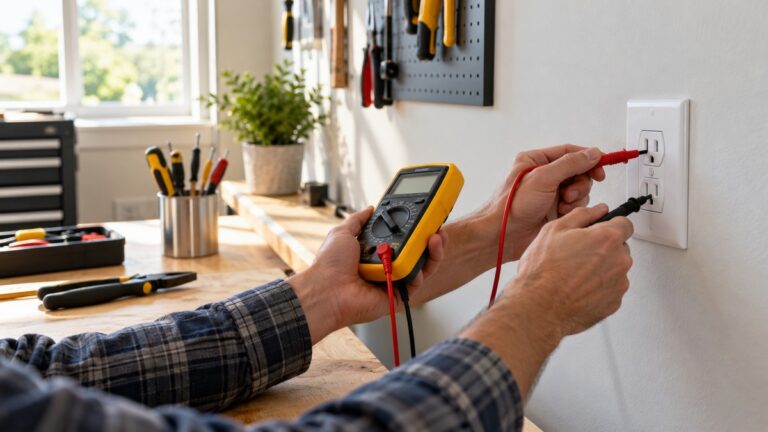
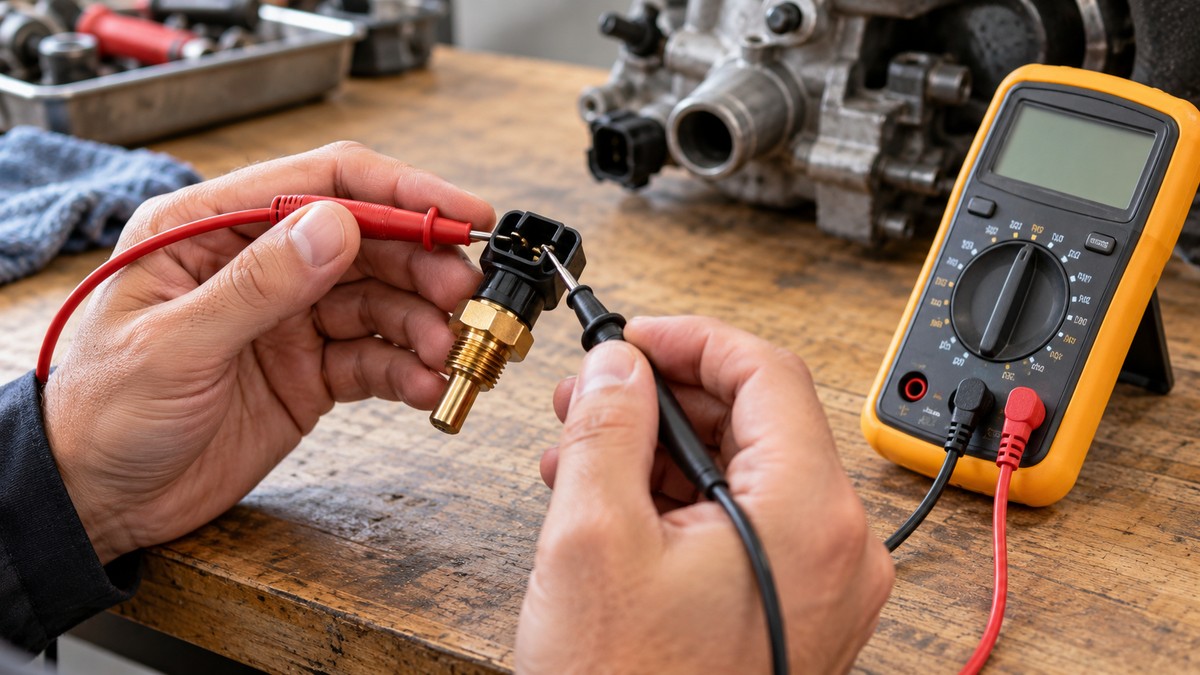
- Set the meter to ohms, then read across the sensor’s two terminals without touching the metal parts of the leads.
- Compare the reading with a temperature table for your own vehicle. The only vehicle table opened for this guide belongs to one Saab model.
What you need
- A multimeter with a resistance (ohms) setting. Fluke says resistance is measured using analog or digital multimeters. For a list of meters with this setting, see our roundup of resistance meters.
- The vehicle’s own service information, with the coolant temperature sensor’s temperature-versus-resistance table. Saab’s test text refers to such a table by name, and the 2011 9-4x page we opened does not reproduce it.
- Access to the sensor connector and its two terminals, with the ignition off.
How to test the sensor
Step 1: Confirm the engine is cold and the ignition is off
This guide covers a cold engine only. The Saab test sequence begins with the ignition off. The sources we opened do not say how long an engine must sit before its coolant sensor reads ambient temperature, so check your service manual for any waiting time. This guide does not describe work on a hot or pressurized cooling system.
Step 2: Unplug the sensor connector
Saab’s component test begins: “Ignition OFF, disconnect the harness connector at the B34 engine coolant temperature (ECT) sensor.” B34 is the label in that model’s service text, and your vehicle will use its own label. While the connector is apart, inspect the sensor terminals. Saab’s 2011 9-5 page tells readers to inspect the terminals for corrosion and for engine coolant leaking through the sensor. It adds that leaking coolant creates a high-resistance short to ground.
Step 3: Set the meter to ohms and connect the leads
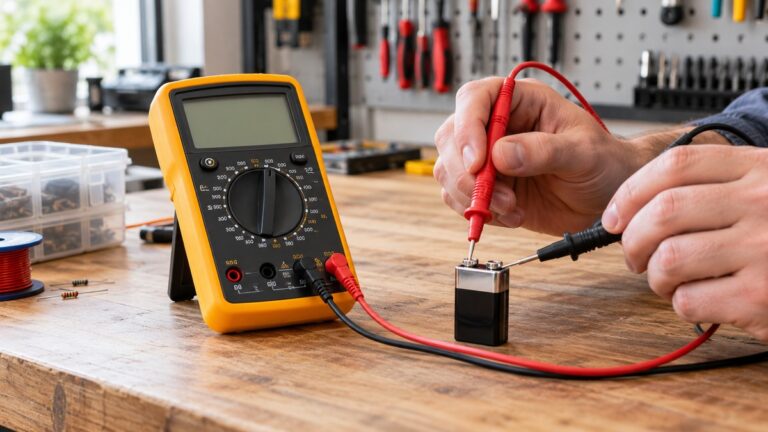
Fluke’s resistance guide says to turn the dial to resistance, or ohms. It also says to put the black lead in the COM jack and the red lead in the jack marked for volts and ohms. Test leads add a small resistance of their own. Fluke gives a typical figure of 0.2 to 0.5 ohms, and a relative mode can subtract that offset. If the ohms setting is new to you, read our continuity tester guide before you start.
Step 4: Measure across the two terminals
Fluke says to connect the test leads across the component being tested and to make sure the contact is good. Keep your fingers off the metal tips of the leads. Fluke explains that the human body becomes a parallel resistance path, and it advises avoiding contact with the metal parts of the leads to prevent errors. Dirt, solder flux and oil can also change a reading, and so can other components wired in parallel with the part under test.
Step 5: Compare the reading with the table
Saab’s component test says to compare the readings with its temperature-versus-resistance table and to verify that the resistance is within 5 % of the specification. If the reading is outside that range, the same page says to replace the sensor. That rule is Saab’s, for that model. Check the tolerance in your own vehicle’s service information before you act on it.
Reading the results
The Saab 1999 9-3 page for the B204i engine gives a temperature-versus-resistance table. The page describes a sensor mounted in the intake manifold that reports engine (coolant) temperature. The source prints decimal commas and lists both Celsius and Fahrenheit, plus a voltage column. The table below shows the Celsius values with the resistance ranges as printed, converted to decimal points.
| Coolant temperature (°C) | Resistance stated by Saab (kΩ) |
|---|---|
| -30 | 20 to 30 |
| -10 | 8.3 to 10.6 |
| 0 | 5.2 to 6.4 |
| 20 | 2.3 to 2.7 |
| 40 | 1.0 to 1.3 |
| 60 | 0.56 to 0.67 |
| 80 | 0.30 to 0.36 |
| 90 | 0.20 to 0.24 |
The voltage column gives approximate values for the signal that the control module reads on pin 45. An ohmmeter reads resistance, so your meter will not show those voltages.
Resistance falls as temperature rises in this table: about 2.3 to 2.7 kΩ at 20 °C and 0.30 to 0.36 kΩ at 80 °C. Saab’s 1998 9-5 page says its coolant temperature sensor is of NTC type. For a generic view of how far an NTC resistance can change, Vishay’s conversion table for NTC thermistors lists, for Curve 1, a ratio of 3.266 at 0 °C and 0.2488 at 60 °C. Each ratio is taken against the resistance at 25 °C. That table describes one thermistor curve, not a car sensor, so it is not a specification for your vehicle.
Common mistakes
- Testing with the connector still plugged in. Saab’s sequence unplugs the sensor first, and Fluke notes that parallel components can change a resistance reading.
- Using a test lamp. Saab warns: “Do NOT use a test lamp to test the continuity of the circuit.” The same page says damage to the control module may occur due to excessive current draw.
- Skipping the terminals. Saab’s 2011 9-5 page includes an inspection of the sensor terminals for corrosion and leaking coolant.
- Ignoring the test leads. Their resistance is a small offset, and touching the metal tips adds a body path.
- Using a table from another vehicle. Each Saab table covers only the model named on its page.
How we chose
The test sequence comes from Saab’s workshop text for two models: unplug the sensor with the ignition off, compare the reading with the temperature table, and apply the 5 % tolerance named on the page. Fluke’s pages supply the basic meter steps and the mains and CAT statements. The Mazda manual, the Purdue slides and three OSHA pages supply the battery and electrical safety statements. The Vishay table is used only as a generic reference. The Saab 1999 9-3 table is the only coolant-sensor table we opened from a manufacturer’s service text, so it is the only one shown. The Saab pages are copies of Saab’s workshop information on saabwisonline.com, which is not Saab’s own domain, and they cover Saab models only.
Every source was opened with curl on 2026-10-21, its text was saved, and each quoted sentence was checked against that text before use. Search snippets and generic how-to pages were not used as evidence. Pages that returned 403, 404 or 503 were left out.
What we could not verify
- A table for your vehicle. The Saab tables cover specific models. The 2011 9-4x page refers to its temperature table by name, but the page we opened does not reproduce it.
- A waiting time for a cold engine. The sources we opened do not say how long an engine must sit.
- Open and short readings. The sources we opened do not give ohm values for an open or shorted coolant sensor, so this guide does not say what an infinite or zero reading means.
- The terminal count for every sensor. The Saab pages describe their own sensors, and the sources do not say how many terminals other coolant sensors have.
- Reconnection steps and clearing trouble codes. The sources we opened do not describe either.
- The thermometer method. The Saab 9-4x page describes heating or cooling the sensor off the vehicle with a thermometer. The sources we opened do not confirm that method, and this guide does not use it.
- A meter rating. The sources do not name a meter for this guide, so no CAT rating is given for any model.
Frequently asked questions
Do I need to disconnect the battery to test the sensor?
Saab’s test sequence lists only the ignition and the connector. It does not list the battery. If you disconnect the battery for other work, Mazda’s manual says to remove the negative terminal first.
Can I test the sensor on a hot engine?
Not with this guide. It covers a cold engine. Saab’s page describes testing the sensor off the vehicle with a thermometer, and this guide does not cover that method.
What resistance should a coolant sensor read?
It depends on the vehicle. One Saab 1999 9-3 table lists about 2.3 to 2.7 kΩ at 20 °C. Use the table from your own vehicle’s service information, because the sources we opened do not give one for other cars.
Why does the reading change with temperature?
Saab’s 1998 9-5 page says the sensor is of NTC type. Its resistance falls as its temperature rises, and the Saab 1999 9-3 table shows that drop between 20 °C and 80 °C. The 1998 page adds that the control module supplies the sensor with 5V through an integral 1.0 kOhm resistor, and that the voltage across that resistor is proportional to coolant temperature.
Does a CAT rating matter for this test?
The sensor circuit is low voltage, but a CAT rating still matters for any meter used on mains. A CAT rating only tells you where a meter may be used, so check it before any mains work.
What if my reading is outside the table?
On Saab’s 2011 9-4x page, a reading outside 5 % of the specification means replacing the sensor. That rule belongs to that model. For your vehicle, follow the tolerance in its service information.
Sources
- Fluke, How to measure resistance: https://www.fluke.com/en-us/learn/blog/digital-multimeters/how-to-measure-resistance
- Fluke, Guide to Digital Multimeter Safety: https://www.fluke.com/en-us/learn/blog/safety/multimeter-guide
- OSHA, Electrical: https://www.osha.gov/electrical
- OSHA, 29 CFR 1910.333: https://www.osha.gov/laws-regs/regulations/standardnumber/1910/1910.333
- OSHA, 29 CFR 1910.178: https://www.osha.gov/laws-regs/regulations/standardnumber/1910/1910.178
- GAMBICA, Guide to Overvoltage Categories and Measurement Categories: https://www.gambica.org.uk/static/d96bb734-348d-478e-b0cba3b50fc35940/Guide-to-Overvoltage-Categories-and-Measurement-Categories.pdf
- Mazda, CX-50 owner’s manual, Inspecting lead-acid battery: https://www.mazdausa.com/static/manuals/2026/cx-50/contents/69060500.html
- Purdue Herrick Laboratories, Battery Safety slides: https://engineering.purdue.edu/Herrick/about/information/Safety/Batterysafety.pdf
- Saab Workshop Information System Online, DTC P0116 for 9-4x 2011: https://saabwisonline.com/9-4x/2011/2-engine/engine-management-and-fuel-system-v6/fault-diagnosis-diagnostic-trouble-codes/dtc-p0116-lf1-lfw
- Saab Workshop Information System Online, DTC P0116 for 9-5 2011: https://saabwisonline.com/9-5-9650/2011/2-engine/engine-management-and-fuel-system-2-0-l-petrol/fault-diagnosis-diagnostic-trouble-codes/dtc-p0116
- Saab Workshop Information System Online, Coolant temperature for 9-3 1999: https://saabwisonline.com/9-3-9400/1999/2-engine/motronic-2-10-3-b204i/technical-description/coolant-temperature
- Saab Workshop Information System Online, Engine coolant temperature sensor for 9-5 1998: https://saabwisonline.com/9-5-9600/1998/2-engine/trionic-4-cyl-obdii/technical-description/engine-coolant-temperature-sensor
- Vishay Dale, NTC Thermistors, Resistance/Temperature Conversion (Doc 33011): https://www.vishay.com/docs/33011/convtabs.pdf