How to Test a Car Ground Wire With a Multimeter
As an Amazon Associate we earn from qualifying purchases.
How to test a car ground wire with a multimeter comes down to two checks. With the battery disconnected, you check continuity across the wire to see whether it is broken. With the battery connected and the circuit operating, you check voltage drop across the ground path to see whether it carries current well. The sources we opened describe both checks, but none gives a resistance limit for a car ground wire.
Electrical safety
Work on mains circuits can kill. Before you measure anything, check that the meter’s CAT rating suits the circuit you are testing, and read the rating from the listing or the manufacturer’s manual. Panel and service work belongs to a licensed electrician. The sources we opened do not state a CAT rating for any meter, so this guide gives none. A meter used on a 12V car circuit is not thereby suitable for household mains.
This guide covers 12V car ground wires only. The sources we opened do not cover airbag circuits or high-voltage hybrid and electric vehicle systems, so this guide gives no steps for them. Use the vehicle’s service information for those systems.
Battery handling before you disconnect
A lead-acid battery gives off hydrogen gas while it charges or when its fluid is added, and its fluid is sulfuric acid. Follow these rules before you touch a battery terminal.
- Remove the negative cable first. The Mazda manual, the NIOSH summary and Bulletin #314 all give this order.
- Reconnect the negative cable last. Bulletin #314 states this order, and it mirrors the removal order in the other two sources.
- Keep sparks, flames and smoking away from the battery. The Mazda manual warns that hydrogen can ignite and make the battery explode. Bulletin #314 describes a spark near escaping hydrogen gas that led to an explosion. The NIOSH summary warns that short circuits can cause burns or explosions and says not to allow smoking in the charging area.
- Keep metal tools off the battery and off both terminals, and use insulated tools. The Mazda manual warns against metal tools touching either terminal. Bulletin #314 says to insulate all tools and to keep tools and metallic objects off the battery. The NIOSH summary says to use insulated tools and to keep conductive objects off the top of the battery.
- Treat battery fluid as a hazard. The NIOSH summary calls sulfuric acid poisonous and corrosive. The Mazda manual warns it can cause blindness if it splashes into the eyes, and Bulletin #314 warns against getting electrolyte in your eyes or on your skin.
Keep terminals and connections clean, tight, and coated with petroleum jelly or terminal grease, as the Mazda manual advises. Mazda and Bulletin #314 both say to keep the top of the battery clean and dry.
Quick answer
- Disconnect the battery, then remove the negative cable first.
- With the circuit de-energized, check continuity across the ground wire. A beep means a complete path, and no beep means an open path.
- With the circuit operating, Fluke gives 0.10 V at a ground as a maximum when the manual lists no value.
- The sources give no resistance limit for a car ground wire, so use the vehicle’s own specification whenever you have one.
Preparation
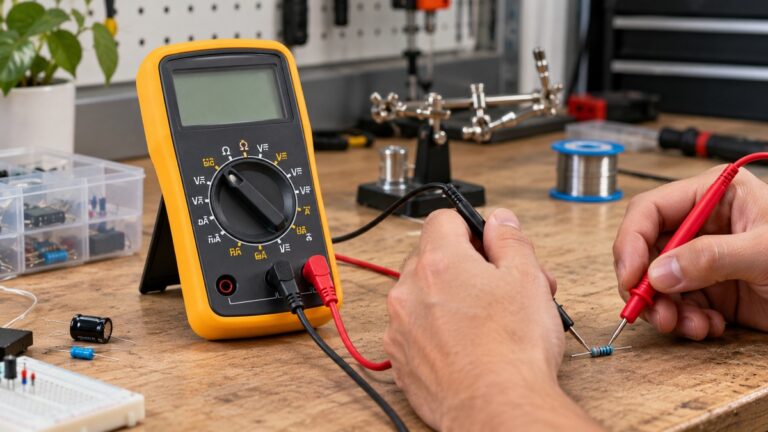
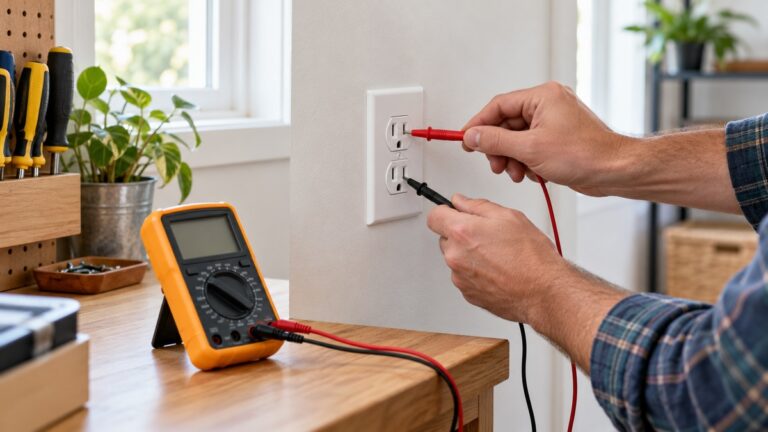
You need a digital multimeter with a continuity mode and the wrench you normally use for the battery clamp. Fluke’s continuity guide says continuity mode is suitable for testing switches, fuses, electrical connections and conductors. It also says the mode is often combined with resistance (Ω), so check the dial labels on your meter. The guide says to plug the black lead into the COM jack and the red lead into the VΩ jack. If you are new to this mode, see the continuity tester basics.
Why car ground wires fail
Fluke’s voltage drop article notes that most devices do not have separate ground wires. They are grounded to the engine or body, and rust, grease, vibration and careless repairs often restrict the path from the engine or body back to the battery. Many components share a common ground, so one bad ground can affect several components at once. Fluke also says visual inspection misses most voltage drop cases, because the corrosion inside a connection cannot be seen. The article argues that checking grounds early saves time: some shop manuals place ground checks last, but Fluke says checking ground circuits first is much quicker. As Fluke puts it, “A free-flowing ground side is as important as a free-flowing hot side.” Fluke lists dimming headlights, slow cranking, malfunctioning sensors and intermittent component failures as common signs of voltage drop. It also says that excessive resistance from corroded connections, frayed wires or poor grounding can generate heat. Delphi makes a similar point about fuel pumps: a bad connection or ground can make a pump underperform, producing the same test results as a bad pump.
Step 1: check continuity with the battery disconnected
- Disconnect the negative battery cable first, following the battery rules above.
- Isolate the ground wire by disconnecting one end. Fluke’s continuity guide says to ensure the component is isolated from other components in the circuit, so the meter reads the wire alone.
- Turn the dial to continuity mode.
- With the circuit de-energized, connect the test leads across the two ends of the wire. Fluke says the position of the leads is arbitrary, so either lead can go on either end.
- Listen for the beep. The meter beeps when it detects a complete path. No beep means the path is open. On a 400.0 Ω range, Fluke says a meter typically beeps when the resistance is 40 Ω or less. The beep threshold depends on the range and the meter, so check your meter’s manual.
- Remove the leads in reverse order, red first and then black.
- Reconnect the negative battery cable last.
Step 2: check voltage drop with the circuit operating
Use this check only after the battery is reconnected and the circuit can operate. Fluke says voltage drop cannot be measured unless current flows through the circuit. Delphi describes a ground-side method, which is the one below.
- Set the meter to DC volts on the 20 V range, or to DC on a meter with auto-ranging.
- Touch the positive lead to the ground terminal of the load’s connector.
- Touch the negative lead to the battery negative terminal.
- Switch the ignition on and operate the circuit.
- Read the meter and compare the reading with a limit, as explained below.
Fluke’s quick ground test uses a different pair of points. It connects the meter between the engine and the negative battery terminal, and it describes cranking the engine for a few seconds after safely disarming the ignition. For a body ground, Fluke connects the meter between the negative battery terminal and the firewall, then starts the engine and switches on the major accessories.
Where you clip the meter matters. Fluke says a vehicle passing the body ground test does not mean a meter can be clipped anywhere. It also says the meter itself can act as a substitute ground on a circuit with bad grounds, depending on its impedance. To reach battery negative from the rear of a vehicle, Fluke suggests a 20- or 30-foot jumper wire with an alligator clip on each end.
Reading the results
- A beep in continuity mode shows a complete path. No beep shows an open path. Fluke says a broken ground wire totally blocks current flow. The load then sits on a ground side that reads system voltage.
- For voltage drop, Fluke gives 0.10 V at a ground as a maximum when the manual lists no value. Delphi’s example for a fuel pump ground supply sets the limit at less than 0.2 V DC. These figures come from different circuits, so use the vehicle’s own specification when you have one.
- Fluke’s worked example applies Ohm’s law, V = I × R. Ten amperes through 0.5 ohms gives a 5-volt drop, so even a small added resistance matters when current is high.
- A continuity beep alone does not show that the ground is healthy under load. Fluke says that after an open circuit is fixed, the circuit must carry current and be checked again before you can know it is healthy.
- The sources do not give a resistance limit for a car ground wire, so there is no number to compare a continuity reading against.
Common mistakes
- Measuring continuity with the battery still connected. Fluke’s continuity method starts with the circuit de-energized.
- Reversing the cable order. Follow the order in the battery rules above.
- Reading voltage drop with the circuit off. Fluke says the circuit must carry current before voltage drop can be measured.
- Using a test light for voltage drop. Fluke says test lights are not accurate enough to diagnose voltage drop and can damage most computer circuits.
- Using a low-impedance meter on a low-current circuit. Fluke says such a meter may load the circuit so much that it gives an incorrect reading or no reading at all. Fluke also says most professional-grade meters have 10-megohm input impedance.
- Clipping the meter to a poor ground. Fluke says a meter that is not well grounded can send a technician around a circuit for hours.
- Letting a metal tool touch a battery terminal or sit on the battery. The Mazda manual, Bulletin #314 and the NIOSH summary each warn against this.
Frequently asked questions
Do I need to disconnect the battery to test a car ground wire?
For a continuity check, yes. Fluke’s continuity method starts with the circuit de-energized, and the sources give the order of disconnecting the negative cable first. The voltage drop check is the exception, because it needs the circuit operating.
Does a continuity beep prove the ground is good?
No. A beep shows a complete path with the circuit off, and the beep depends on the meter’s range. Fluke says a circuit cannot be judged healthy until current flows through it and it is checked again, so run the voltage drop check as well.
What voltage drop reading is too high?
Fluke gives 0.10 V at a ground as a maximum when the manual lists no value. Delphi’s fuel pump example sets the limit at less than 0.2 V DC. Use the vehicle’s specification first.
Can I use a test light instead of a meter?
Fluke describes test lights as too coarse for this check, and warns that they can damage most computer circuits. Use a digital multimeter for voltage drop.
Does the engine need to run for a ground check?
Fluke’s engine ground test has you crank the engine for a few seconds after safely disarming the ignition, and its body ground test has the engine started with major accessories on. The sources we opened do not say that every ground needs the engine running. Follow the vehicle’s service information for each circuit.
Is battery handling covered fully here?
No. The sources we opened cover cable order, sparks and flames, metal tools and battery fluid, and nothing more. Bulletin #314 tells readers to consult the battery supplier for more information on safety, maintenance and charging, so follow the supplier’s instructions as well.
Bottom line
Disconnect the battery and remove the negative cable first. Check continuity across the ground wire with the circuit de-energized, then confirm with a voltage drop reading while the circuit runs, and use the vehicle’s own specification whenever you have one. For a broader view of continuity testers, see continuity testers compared.
How we chose
We kept only the steps and limits that a page we opened states in plain words. The pages are a meter maker’s guides (Fluke), a parts maker’s how-to (Delphi), a vehicle manufacturer’s service manual page (Mazda), a trade magazine’s summary of NIOSH guidance, and a battery safety bulletin. We opened ten pages on 2026-10-21. Six are cited here. Three returned a block or error page, and one was a regional copy of a page already cited. We did not use forum posts, search snippets or any page we could not open. Each quoted sentence was matched against the text of its page.
What we could not verify
The sources we opened do not give a resistance limit for a car ground wire, so this guide does not state one. They give no OEM value for any make, model or ground point, so check the vehicle’s service information for its own specification. The sources we opened state no CAT rating for any meter. The NIOSH wording comes through a trade magazine article, and the NIOSH page itself was not reached. The battery bulletin we opened names no publisher and is dated April 15, 2013. None of the pages compares a battery-off continuity reading with a live voltage drop reading on the same wire, so this guide does not claim the two readings match. The sources do not cover airbag circuits or high-voltage hybrid and electric systems.
Sources
- https://www.fluke.com/en-au/learn/blog/automotive/electrical-automotive-troubleshooting
- https://www.delphiautoparts.com/en-gb/mom/how-to/article/how-to-perform-a-voltage-drop-test
- https://www.fluke.com/en-ca/learn/blog/digital-multimeters/how-to-test-for-continuity
- https://www.mazdausa.com/static/manuals/2026/cx-50/contents/69060500.html
- https://www.safetyandhealthmagazine.com/charging-safely-2/
- https://psopk.com/source/sustainability/hse/hse_library/battery_maintenance.pdf