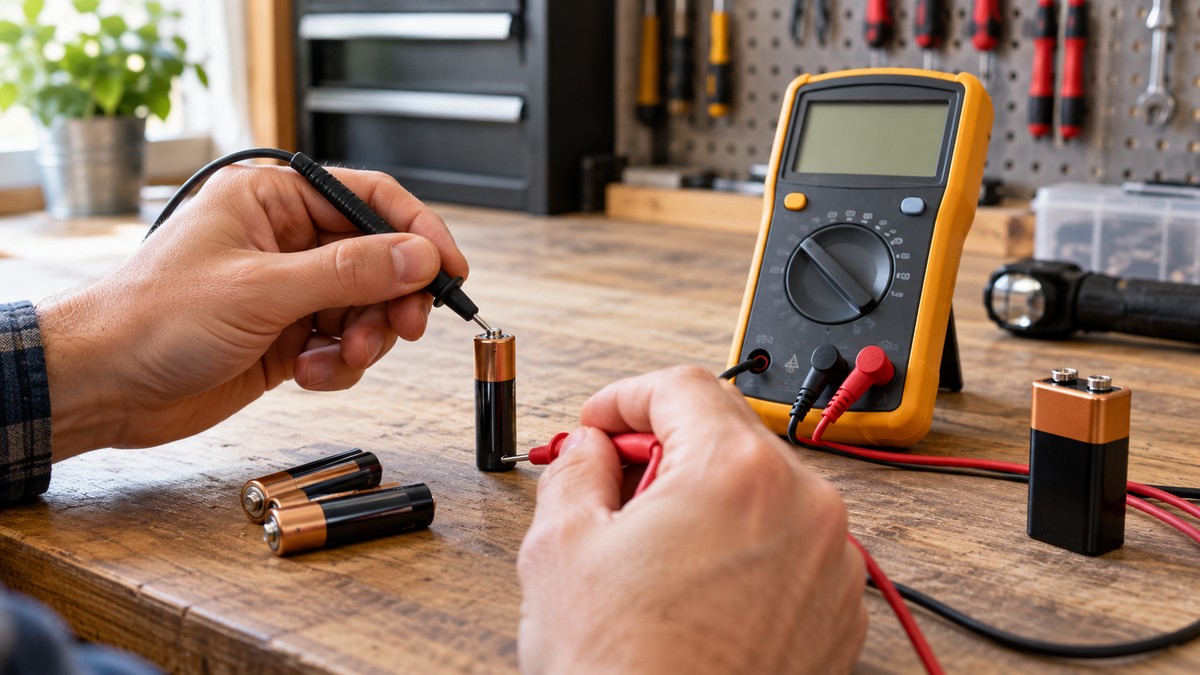
How to Test AA and 9V Batteries With a Multimeter
As an Amazon Associate we earn from qualifying purchases.
How to test AA and 9V batteries with a multimeter comes down to one DC voltage reading per battery. Set the meter to DC volts, touch the red lead to the positive terminal and the black lead to the negative terminal, then compare the reading with the nominal voltage on the manufacturer’s datasheet. That figure is 1.5 V for an alkaline AA cell and 9.0 V for an alkaline 9V battery. The sources we opened do not turn a reading into a percentage of charge. This guide does not cover coin cells, 12V car batteries or lithium packs.
Electrical safety comes first
Work on mains circuits can kill. Electric shock happens when the human body becomes part of an electrical circuit, and the Fluke safety guide notes that working with electricity always carries a risk. A Portland State University safety page, citing Bureau of Labor Statistics data, reports 159 occupational fatalities from exposure to electricity in 2018.
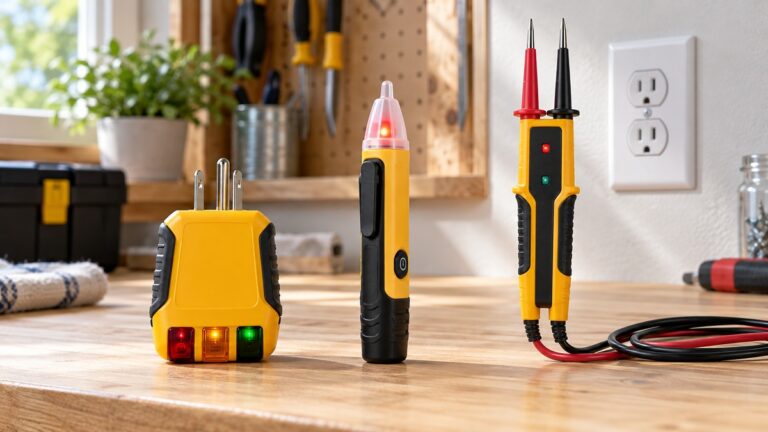
Before you measure anything, check that the meter’s CAT rating suits the circuit you are testing, and read the rating from the listing or the manufacturer’s manual. The CAT rating is usually displayed near the input jacks. The Fluke guide advises choosing a meter rated for the highest category you could potentially use it in.
The battery work in this guide is low-voltage bench work. It does not cover live mains, outlets, panels or service wiring. Panel and service work belongs to a licensed electrician or another person trained as a qualified person. OSHA defines qualified persons as those who have training in avoiding the electrical hazards of working on or near exposed energized parts. Its rules also require live parts to be de-energized before an employee works on or near them, unless the employer can show that de-energizing adds hazards or is not feasible.
Quick answer
- Use the meter’s DC volts setting. Put the red lead in the V/Ω jack and the black lead in COM.
- The datasheets we opened list 1.5 V nominal for an alkaline AA cell and 9.0 V nominal for an alkaline 9V battery.
- Never bridge the two terminals with a wire, a coin, a key, foil or a meter lead. A short circuit can overheat a battery.
Before you start
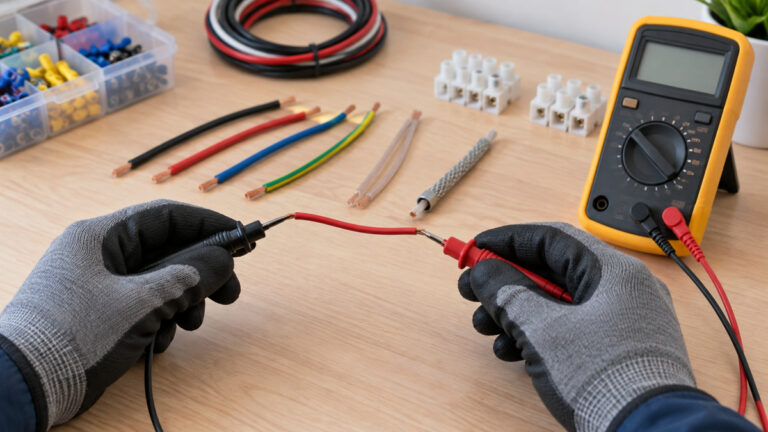
Gather a digital multimeter, one fresh alkaline AA cell and one alkaline 9V battery. Check the meter and its leads first. The Fluke guide says never use a damaged meter or damaged test probes, so look for cracked insulation or exposed metal before you connect anything. The same guide says to verify that the meter works on a known voltage source or a proving unit, and its advice is: “Never just assume it is.”
Keep loose batteries away from steel wool, aluminum foil and keys. The Kinston Fire and Rescue handout and the Tyngsborough sheet both give this warning for 9V batteries. For a broader look at meters that read battery voltage, see our roundup of battery voltage testers.
Set the meter and connect the leads
- Insert the black lead into the COM jack and the red lead into the V/Ω jack. The Fluke battery voltage page gives the same pairing: “Red lead in V/Ω, black lead in COM.”
- Turn the dial to DC volts. The Fluke page says to “Set the dial to VDC (DC volts).”
- Choose the range. The Fluke 12 manual says the input range “determines the highest value the meter will measure.” In autorange, “the meter selects the range automatically.” The Fluke 12 manual says the meter “defaults to autorange when you turn it on.” The Wavetek 34XR manual says to “Use autorange for all initial measurements.” On a manual-range meter, the UT33D manual advises starting at the maximum range and reducing it until the readings are usable. That manual lists DC voltage ranges of 200 mV, 2000 mV, 20 V, 200 V and 500 V. By our own arithmetic, the lowest range on that list that covers a 1.5 V cell is 2000 mV, and for a 9.0 V battery it is 20 V. For auto-ranging models, see our guide to auto-ranging digital multimeters.
- Touch the red lead to the positive (+) battery terminal and the black lead to the negative (−) terminal. The Fluke page gives this polarity.
- Read the display. If it shows OL, the input is above the range. The Wavetek manual says an overload should be immediately corrected by selecting a higher range.
Test an AA cell
Both the Ansmann datasheet and the Energizer datasheet list an alkaline AA cell at 1.5 V nominal. The Ansmann sheet also gives an off-load voltage of 1.57 to 1.62 V. A fresh cell should therefore read close to 1.5 V, and a reading at the upper end of the Ansmann off-load range is consistent with that sheet. The same sheet gives a shelf life of up to 5 years under proper storage conditions. The sources we opened do not give off-load readings for an older cell, so a cell near the end of its shelf life has no reading target in these sources.
Test a 9V battery
The Panasonic 6LR61 sheet lists a nominal voltage of 9.0 for an alkaline 9V battery, and the Farnell 6LR61 sheet gives the same nominal figure. Set the meter to DC volts as above, and compare the reading with the 9.0 V nominal figure.
The two posts on a 9V battery sit close together. The Kinston handout says that a metal object touching both posts can cause a short circuit. Our own reasoning from that warning: a probe tip is metal, so the two tips must not touch each other while both are on the posts.
Short-circuit warning
Do not short battery terminals. Illinois State University’s environmental health and safety page says all batteries should have both terminals covered with clear tape “to prevent short-circuiting and fires.” The same page says not to leave battery terminals exposed, and warns that metal containers can cause short circuits if batteries shift or touch.
The Lincolnshire County Council advisory defines a short circuit as connecting one terminal of the battery directly to the other, and says many batteries will overheat and vent gases if short-circuited. It notes that AA cells were once assumed to be very safe because of their limited current, but newer battery technology can deliver much greater currents. It reports burns to pupils from metal connection boxes during short circuits with high-powered AA cells. It adds that alkaline cells, particularly the high-capacity types, can produce much higher currents that cause overheating. The same advisory says to avoid rechargeable batteries for circuit work, because they can produce very high current when short-circuited.
For 9V batteries, the Kinston, Whitpain Township, Tyngsborough and Colorado Springs fire safety sheets share one warning. A metal object across the two posts can make enough heat to start a fire. The Kinston sheet adds that weak batteries may have enough charge to cause a fire. Keep 9V batteries in their original packaging until you use them.
Reading the results
The table lists every figure the sources give for these two cells. Each figure describes a datasheet cell or a test condition, not the battery on your bench. For DC voltmeter picks, see our guide to DC volt meters.
| Battery | Figure in the sources | What the source says it is | Source |
|---|---|---|---|
| Alkaline AA | 1.5 V | Nominal voltage | Ansmann; Energizer |
| Alkaline AA | 1.57 to 1.62 V | Off-load voltage | Ansmann |
| Alkaline AA | 0.8 V | End voltage for the rated capacity test | Ansmann; Energizer |
| Alkaline 9V | 9.0 V | Nominal voltage | Panasonic; Farnell |
| Alkaline 9V | 5.4 V per battery | Recommended cut-off voltage | Panasonic |
The Panasonic cut-off figure is a recommendation printed on the datasheet. The sources we opened do not explain how it applies to a no-load reading from a multimeter. The Ansmann and Energizer 0.8 V figure belongs to a capacity test, not to a dead-or-alive rule.
After the test
Remove the leads without letting the tips touch. For a 9V battery, cover both posts before you throw it away. The Kinston sheet says to “cover the positive and negative posts with masking, duct, or electrical tape before getting rid of batteries”, and that 9-volt batteries should not be thrown away with trash. The same sheet says to check with your city or town for the best way to get rid of batteries.
Common mistakes
- Putting the red lead in the wrong jack. The Fluke page names the correct jacks for battery voltage.
- Leaving an overload on the display. The Wavetek manual says to move to a higher range.
- Using a range that is far too high. The Fluke 12 manual says a range that is too high shows fewer digits of resolution.
- Letting the probe tips touch while both are on a 9V battery’s posts.
- Reading a low number as proof that a cell is dead, or a near-nominal number as proof that it is good. The sources do not say either.
- Using a damaged lead or probe. The Fluke guide says never use damaged test probes.
How we chose
This guide covers one bench method: a DC voltage reading across one alkaline AA cell and one alkaline 9V battery. We chose a DC voltage reading because the sources we opened describe that method for batteries, and because both datasheets publish a nominal voltage to compare against. We grouped the sources by job. Meter manuals and the Fluke pages cover setup and ranging. Battery datasheets cover the expected figures. Fire, university and OSHA pages cover the hazards and the qualified-person rule.
Every page in the source list was opened with curl on 2026-10-21, and each quoted sentence was checked against the text of the fetched page. We left out coin and button cells, 12V car batteries and lithium packs, which fall outside this scope. The four local fire safety sheets use nearly the same wording, so we count them as one warning rather than four independent proofs.
What we could not verify
The sources we opened do not say what a voltage reading means as a percentage of charge. They give no dead-or-alive threshold for AA or 9V cells. The 0.8 V and 5.4 V figures are a test end point and a recommended cut-off, not a verdict on one battery.
The sources do not say how a no-load voltage reading predicts performance under load, so this guide does not cover load testing. The UT33D manual states a CAT rating for its own model, but this guide does not name a meter, and none of the sources gives a rating that applies to a general meter. The sources cover alkaline cells, and the pages we opened give no nominal figures for rechargeable AA cells, so this guide does not cover them.
Frequently asked questions
Should I use the AC volts setting for a battery?
No. The Fluke page says to set the dial to DC volts for battery voltage.
What voltage should a new AA alkaline cell read?
The Ansmann datasheet lists a nominal voltage of 1.5 V and an off-load voltage of 1.57 to 1.62 V. The Energizer datasheet lists 1.5 V nominal. The sources we opened do not say what a reading outside that range means.
Does a 9V battery read 9 volts when it is fresh?
The Panasonic and Farnell 6LR61 sheets list 9.0 V as the nominal voltage. The sources we opened do not give a fresh-cell range for 9V readings, so the 9.0 V figure is the only target these sources give.
What reading means a battery is dead?
The sources we opened do not give a dead-battery reading. Ansmann and Energizer use 0.8 V as the end voltage in their capacity ratings, and the Panasonic 9V sheet lists a recommended cut-off of 5.4 V per battery. Neither figure is a verdict on one battery.
Is it safe to touch both 9V posts with the probes?
No. The Kinston handout warns that a metal object touching both posts can cause a short circuit and enough heat to start a fire. Our own reasoning from that warning: a probe tip is metal, so keep the two tips apart while both are on the posts.
Does a voltage reading show how a battery performs under load?
The sources we opened do not say. This guide does not include a load test, and a no-load voltage reading does not answer that question by itself.
Sources
- https://fluke.com/en-in/learn/blog/digital-multimeters/how-to-test-a-battery-with-a-multimeter (opened 2026-10-21)
- https://xdevs.com/doc/Fluke/FLUKE%2012%20User.pdf (opened 2026-10-21)
- https://xdevs.com/doc/Wavetek/34xr_manual.pdf (opened 2026-10-21)
- https://etekcity.com/cdn/shop/files/HOHIHT03E-MSR-R500_UT33D_-Digital-Multimeter-Manual-US-A4—WEB.pdf (opened 2026-10-21)
- https://www.farnell.com/datasheets/86310.pdf (opened 2026-10-21)
- https://static.rapidonline.com/pdf/1333035_da_en_01.pdf (opened 2026-10-21)
- https://mediap.industry.panasonic.eu/assets/imported/industrial.panasonic.com/cdbs/www-data/pdf2/AAC4000/AAC4000C16.pdf (opened 2026-10-21)
- https://www.farnell.com/datasheets/1971880.pdf (opened 2026-10-21)
- https://ehs.illinoisstate.edu/health/management/universal-waste/batteries/ (opened 2026-10-21)
- https://professionals.lincolnshire.gov.uk/downloads/file/933/hsb18-high-powered-aa-batteries (opened 2026-10-21)
- https://kinstonnc.gov/DocumentCenter/View/3438/9VoltBatterySafety (opened 2026-10-21)
- https://whitpaintownship.org/DocumentCenter/View/4494/9-Volt-Battery-Safety (opened 2026-10-21)
- https://tyngsboroughma.gov/316/Battery-Safety (opened 2026-10-21)
- https://coloradosprings.gov/fire-department/page/9-volt-battery-fire-safety (opened 2026-10-21)
- https://www.osha.gov/laws-regs/regulations/standardnumber/1910/1910.331 (opened 2026-10-21)
- https://www.osha.gov/laws-regs/regulations/standardnumber/1910/1910.333 (opened 2026-10-21)
- https://www.fluke.com/en-us/learn/blog/safety/multimeter-guide (opened 2026-10-21)
- https://assets.testequity.com/te1/Documents/ARTICLE_LIBRARY/Fluke%20-%20How%20robust%20is%20your%20handheld%20multimeter.pdf (opened 2026-10-21)
- https://www.pdx.edu/environmental-health-safety/electrical-safety (opened 2026-10-21)