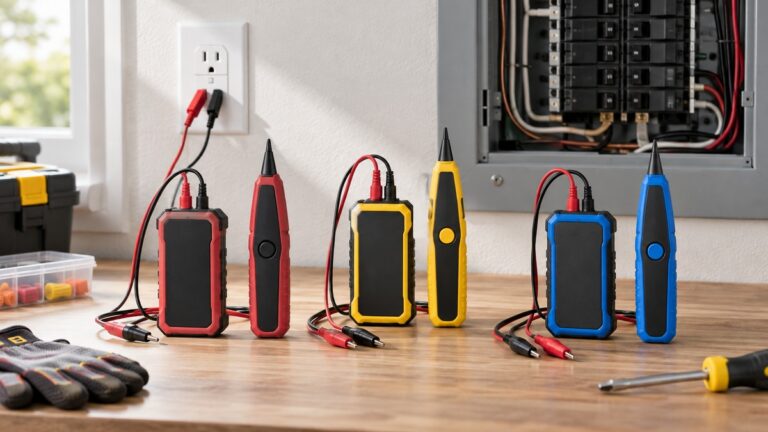
Proster Multimeter Guide: 7 Meters and Pens by Function
As an Amazon Associate we earn from qualifying purchases. Details
Someone typing proster multimeter usually wants a meter that fits one electrical task, not a list of everything the brand sells. Proster makes TRMS multimeters with magnetic backs, clamp meters, non-contact voltage pens and a compact component tester, and several of its listings share most of their bullet text. This guide sorts the seven Proster records that fit a multimeter, clamp or voltage-tester use by function, sets out the ranges and counts each listing states, and flags every place where a title, a bullet and a specification block disagree.
Quick answer
- For a meter that stays put on a panel or a steel frame, the T28B record has the most functions in one body: a 6000-count display, a magnetic back, a temperature probe and a flashlight. Its 20A figure appears only in the title and highlight.
- For AC current on one conductor, the CM2000C states AC current up to 600A in its bullets and has a 28mm jaw. The CM2018 lists AC and DC current up to 800A in its bullets, and the PDM-6000NCV kit gives 800A only in its title.
- For finding live and neutral conductors at an outlet or breaker, the TOPPST224 pen switches between 12V to 1000V and 48V to 1000V AC. It is a voltage detector and gives alarms, not numeric readings.
- For small surface-mount parts, the TS-800 tweezer meter reads resistance, capacitance, diodes and DC voltage up to 10V. It is not a mains tool.
Proster records grouped by function
The seven records below cover four uses. Each entry uses only what its listing states, and each conflict is named.
TRMS multimeters with a magnetic back
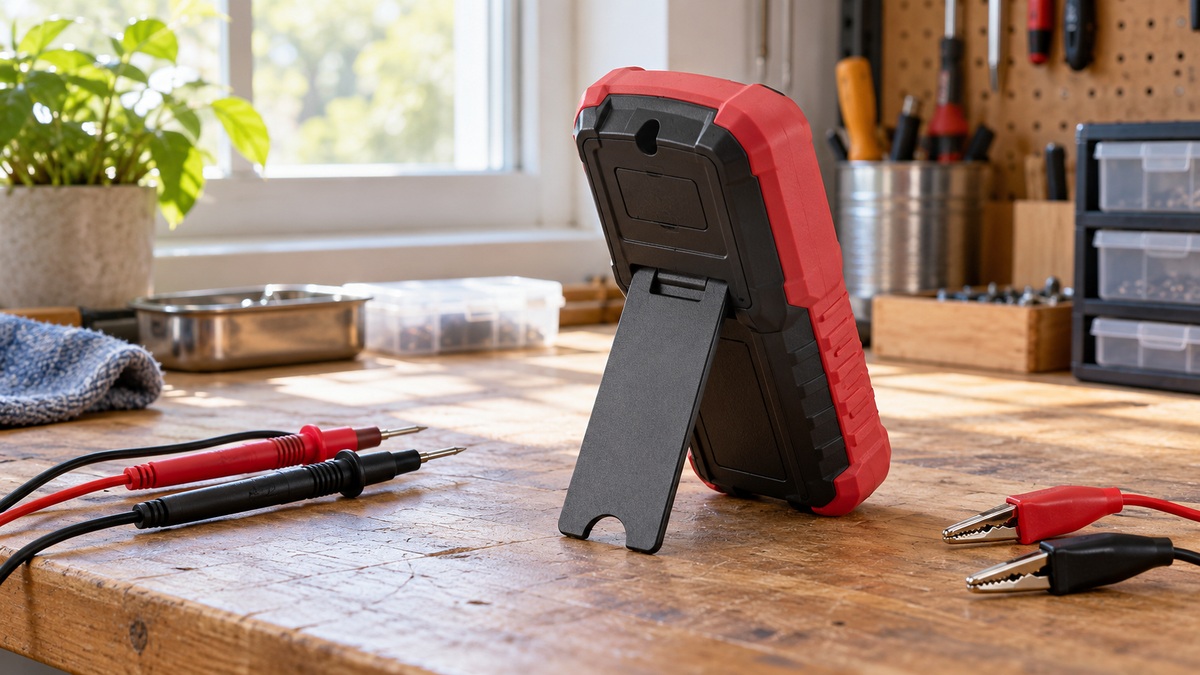
The T28B record, model T28B, is a 6000-count TRMS meter. Its bullets list AC and DC voltage, AC and DC current, resistance, capacitance, frequency, duty ratio, temperature, NCV, diode, transistor and continuity. The magnetic back lets the meter attach to a ferrous surface such as a breaker panel or a machine frame, and the fold-out kickstand leaves both hands free for the probes. The temperature probe is rated in the bullets from -20 to 1000 degrees C, and the package includes two spare fuses, alligator clips, a screwdriver and a holster. Its title and highlight give 20A for current, but the bullets never repeat that figure, so the 20A rating rests on the title.
Clamp meters
The CM2018 record, model CM2018, is the clamp in this group with the widest current figures in its bullets. It states AC and DC current up to 800A at ±1.5% accuracy, a 28mm jaw, auto-ranging with NCV, and two special modes. The LoZ mode is described as a way to remove ghost or stray voltages, and the LPF mode is described for variable frequency drive signals on motors and transformers. The bullets warn that only one conductor can be measured at a time, and that two or more conductors clamped together give an incorrect reading. Its backlight turns orange when voltage passes 80V or current passes 3A, which the listing presents as a warning rather than a limit.
The CM2000C record, model CM2000C, is a 2000-count clamp multimeter whose title adds TRMS. Its bullets state AC current up to 600A, AC and DC voltage up to 600V, resistance from 200Ω to 20MΩ, a light alarm for AC voltage from 90V to 1000V or a live wire, and an overload display that shows OL. It includes a K-type thermocouple rated from -40 to 1000 degrees C. The bullets describe current for AC only, so no DC current is claimed for this record.
The PDM-6000NCV kit, model PDM-6000NCV, is a 6000-count TRMS clamp with an 800A figure in its title. Its bullets describe AC and DC voltage, current, resistance, capacitance, frequency up to 10MHz, diode and continuity testing, and a non-contact AC voltage detector. The bullets list the test leads, the K-type thermocouple, alligator clips, two AAA batteries and a storage pouch, while its specification block names only the clamp meter.
The kit record, listed as a multimeter set with model PST088c-PST224, combines a TRMS clamp meter and a voltage pen in one package. The item highlight describes the clamp at 800A AC and DC with auto-range and NCV, and the pen with adjustable sensitivity. The bullets for this set repeat the clamp and pen descriptions in one block, so some sentences describe two separate tools at once.
Non-contact voltage pen
The TOPPST224 pen, model TOPPST224, is listed as a voltmeter. Its bullets say the default AC detection range is 48V to 1000V and that a short press of the S button switches it to 12V to 1000V. It has three sensitivity levels, an audible and visual alarm, an LED torch and automatic power-off. Its specification block gives a two-year manufacturer warranty, while a bullet gives 18 months of after-sale service, so the warranty length should be confirmed on the listing.
Component tweezer meter
The TS-800 record, model TS-800, is a tweezer-style SMD meter. Its specification block gives resistance from 600Ω to 60MΩ, capacitance from 6nF to 60mF, DC voltage up to 10V with 0.01V resolution, a diode reading with a 3.2V open voltage, and a continuity buzzer. Its measurement-type field lists current, resistance and voltage, but no current range appears anywhere in the listing. The bullets describe a 6000-count LCD, a lithium battery with Type-C charging, and 36V DC overload protection on every function.
Ranges, counts and a conversion
The table uses only what each listing prints. A blank cell means the listing does not give that figure.
| Record (listing model) | Measurement type | Voltage stated | Current stated | Count or display |
|---|---|---|---|---|
| T28B | Multimeter (title) | not stated in bullets | 20A (title and highlight) | 6000 count |
| CM2018 | Multimeter | 80V warning point (bullet) | AC and DC up to 800A | 6000 count (title) |
| PDM-6000NCV kit | Multimeter | not stated | 800A (title) | 6000 count |
| CM2000C | Multimeter | AC and DC up to 600V (bullet) | AC up to 600A (bullet) | 2000 count (title) |
| TOPPST224 pen | Voltmeter | 12V to 1000V or 48V to 1000V AC | not applicable | not applicable |
| TS-800 tweezer meter | Current, Resistance, Voltage | DC up to 10V | listed in type field only | 6000 count LCD |
Two calculations follow. The first compares display counts: a 2000-count display splits a range into at most 2000 steps, and a 6000-count display into at most 6000, so 6000 / 2000 = 3. The 6000-count records therefore have three times the steps across a range as the 2000-count CM2000C. That says nothing about accuracy, which only the CM2018 and the TS-800 state in their bullets or specification block. The second is a unit conversion for the PDM-6000NCV body. Its specification block gives 7.28 x 2.56 x 1.26 inches, and 7.28 x 25.4 = 184.91 mm, 2.56 x 25.4 = 65.02 mm and 1.26 x 25.4 = 32.00 mm. Those match the millimeter figures in its bullets, which give 185mm by 65mm by 32mm.
How we chose
The seven records come from the Proster pool. We kept a record when its listing names a multimeter, a clamp meter or a voltage tester, and when its title, bullets and specification block describe the same main measurement. We also wanted a stated range, count or safety figure in the listing.
Two Proster records were set aside. One is an automotive wire tracker with a transmitter and a receiver, which the listing describes as a DC 6V to 24V tool for finding shorts and open circuits. It traces wires rather than measuring them, so it sits outside a meter roundup. The other is an LCR meter. Its listed measurements are inductance, capacitance, resistance and diode forward drop, and its listing names no voltage or current function. A reader who needs one of these can open the listing directly.
No Proster listing in this group states a CAT measurement category. The specification blocks name UL 61010-1 and IEC 61010-2-030 for several records, which are standards references, but they do not give a category for the listed meter, so this guide does not assign one.
Where the listings disagree
- The TS-800 specification block gives an item weight of 0.4 kg, while a weight line in the same listing says approximately 36g.
- The PDM-6000NCV specification block gives an item weight of 0.37 kg, while its bullets say about 200g including the battery.
- The T28B’s 20A current figure appears in the title and highlight but not in the bullets.
- The PDM-6000NCV’s 800A figure appears in the title, while the bullets describe current without a range.
- The TOPPST224 specification block gives a two-year manufacturer warranty, while a bullet gives 18 months of after-sale service.
- The TS-800 measurement-type field lists current, but the listing states no current range.
- The PST088c-PST224 kit bullets combine the clamp and the pen into one run of text, so the boundary between the two tools is unclear.
How to choose by job
Start with the reading you need. For a panel or steel-frame meter that reads voltage, current, resistance and temperature in one body, the T28B has the broadest function list here. For AC current on a single conductor in a motor or a panel, the CM2000C states the AC current range in its bullets, and the CM2018 adds the widest current figures and the LoZ and LPF modes. If you want one clamp and one voltage pen for the price of a single set, the PST088c-PST224 kit packages both, but read its bullets with care. For finding live and neutral conductors without a numeric reading, the TOPPST224 is the pen to compare. For surface-mount parts on a board, the TS-800 is the record to read first. If the job needs DC current, start with the CM2018, because its bullets state DC current up to 800A, while the CM2000C bullets claim AC current only. Compare each specification block against its bullets before you decide, since the two often describe the same tool in different words.
For a wider look at the voltage detector category, the pen voltage detector picks show the same kind of tool across makers. The true RMS clamp meter picks cover TRMS clamps more broadly, and the auto-ranging multimeter picks describe the meter category that the T28B belongs to.
1. Proster TRMS Multimeter – 6000 Counts 20A NCV Magnetic with Temp (TRMS multimeter with magnetic back and temperature probe)
Specs from the listing (checked ):
- Unit Count: 6000 Count
- Specification Met: CE, RoHS
- Included Components: Test Probe, Temperature Probe, Manual, Alligator Clip, 3 AAA battery, 2 Fuses
Pros
- Bullets list AC and DC voltage, AC and DC current, frequency, duty ratio and temperature.
- Bullets say the back is magnetic, so the meter can hang on a ferrous surface.
Cons
- The 20A figure appears in the title and highlight, not in the bullets.
- Bullets give no range for voltage or resistance.
Best for: Electricians and facility staff who want a hands-free meter that also reads temperature.
Skip if: Skip it if you need stated ranges in the bullets, since this record gives none for voltage or resistance.
View on Amazon (affiliate link)
2. Proster Digital Clamp Meter 6000Count 800A AC/DC Current LPF LOZ Multimeter (800A AC/DC clamp meter with LoZ and LPF modes)
Specs from the listing (checked ):
- Model: CM2018
- Specification Met: Ul 61010-1, Iec 61010-2-030, Ce Marked
- Included Components: Clamp Meter, K-Type Thermocouple, Test Leads
Pros
- Bullets state AC and DC current up to 800A with ±1.5% accuracy.
- LoZ and LPF modes are described for ghost voltages and variable frequency drives.
Cons
- Bullets warn that clamping two or more conductors at once gives a wrong reading.
- Bullets give only an 80V warning point, not a voltage range.
Best for: Technicians measuring current on motors, drives and vehicle circuits one conductor at a time.
Skip if: Skip it if you need a stated voltage range, since the listing gives only the 80V alarm point.
View on Amazon (affiliate link)
3. Proster 6000 Count Clamp Meter 800A Amp Tester TRMS NCV Multimeter Kit (6000-count TRMS clamp kit with K-type thermocouple)
Specs from the listing (checked ):
- Item Dimensions: 7.28 x 2.56 x 1.26 inches
- Item Weight: 0.37 kg
Pros
- Bullets give a 185mm by 65mm by 32mm body that matches the inch figures in the specification block.
- Bullets list a continuity buzzer, diode test and frequency testing up to 10MHz.
Cons
- The item-weight field says 0.37 kg while a bullet says about 200g.
- The specification block names only the clamp meter, although the bullets list leads and a pouch.
Best for: Users who want a clamp with a K-type thermocouple and a continuity buzzer in one kit.
Skip if: Skip it if weight matters, since the two listed weights differ by 170 g.
View on Amazon (affiliate link)
4. Proster Clamp Meter 2000 Counts TRMS, AC Current Clamp Multimeter (2000-count clamp multimeter with clamp light and K-type probe)
Specs from the listing (checked ):
- Model: CM2000C
- Specification Met: CE, UL
Pros
- Bullets state AC current up to 600A and AC and DC voltage up to 600V.
- The clamp head has a light, and the backlit LCD shows OL on overload.
Cons
- TRMS appears in the title only, not in the bullets.
- Auto power-off is set at about 15 minutes, with no stated option to change it.
Best for: Maintenance staff checking AC current on one conductor in dim panels and motors.
Skip if: Skip it if you need DC current, since this record's bullets state AC current only.
View on Amazon (affiliate link)
5. Proster Electrical Test Tool – TRMS Clamp Meter 6000&NCV Voltage Tester Pen (Clamp meter and voltage pen kit with adjustable sensitivity)
Specs from the listing (checked ):
- Included Components: Multimeter Set
- Specification Met: Ul 61010-1, Iec 61010-2-030
Pros
- The item highlight lists the clamp at 800A AC and DC with auto-range and NCV.
- Bullets say the pen switches between 12V to 1000V and 48V to 1000V AC ranges.
Cons
- Bullets run the clamp and pen descriptions into one block of text.
- The specification block lists the kit without a range for either tool.
Best for: Users who want a clamp and a voltage pen bought as one set.
Skip if: Skip it if you need to know exactly which tool is in the box, since the bullets blur the two.
View on Amazon (affiliate link)
6. Proster Non-Contact Voltage Tester Pen Adjustable 12-1000V/48-1000V (Non-contact voltage pen with adjustable 12V to 1000V sensitivity)
Specs from the listing (checked ):
- Measurement Type: Voltmeter
- Specification Met: CE
Pros
- Bullets describe 48V to 1000V by default and 12V to 1000V after a short press of the S button.
- Bullets list audible and visual alarms, an LED torch and automatic power-off.
Cons
- The specification block gives a two-year warranty, while a bullet gives 18 months.
- It reads AC voltage only and has no current or resistance function.
Best for: Homeowners and electricians finding live and neutral conductors at outlets and breakers.
Skip if: Skip it if you need numeric readings, since this pen gives alarms rather than values.
View on Amazon (affiliate link)
7. Proster SMD Tweezer Meter for Resistance Capacitance Diode 6000 Counts LCD (SMD tweezer meter with DC voltage to 10V and buzzer continuity)
Specs from the listing (checked ):
- Resistance: 600Ω–60MΩ; ±(0.8%+5) at 600Ω; ±(0.8%+3) at 6kΩ–6MΩ; ±(2.0%+10) at 60MΩ
- Capacitance: 6nF–60mF; ±(3.5%+20) at 6nF–6mF; ±(5.0%+3) at 60mF
- DC Voltage: 10V; ±(1.0%+5); 0.01V resolution
- Continuity: 2.0V open voltage with buzzer
Pros
- Specification block gives resistance from 600Ω to 60MΩ and capacitance from 6nF to 60mF.
- Bullets say the tips clamp onto 0402 and 0603 parts and the meter switches range by itself.
Cons
- DC voltage is stated only up to 10V, and no AC voltage range appears.
- The item-weight field says 0.4 kg while a weight line says approximately 36g.
Best for: Electronics repair workers testing small surface-mount parts on a board.
Skip if: Skip it if you need mains or outlet voltage checks, since the stated voltage range is 10V DC only.
View on Amazon (affiliate link)
Safety notes for clamp and pen use
The OSHA electrical overview says electricity has long been recognized as a serious workplace hazard, and that OSHA’s electrical standards are designed to protect employees from electric shock, electrocution, fires and explosions. OSHA’s work-practices rule says a qualified person uses test equipment to test the circuit elements and electrical parts of equipment, and that live parts must be de-energized before a worker works on or near them.
The Purdue extension sheet says voltage is the difference between two points, and that the same measuring principles apply to DC battery work and AC house wiring. It also says that working with live circuits can be very hazardous without proper tools and safeguards, and that a user should move cautiously while probing circuits.
For Proster clamps and pens, the listings themselves add a few limits. A clamp should be placed around one conductor at a time, as the CM2018 and CM2000C bullets state, and a pen’s alarm is not a measurement. The CM2018 backlight warning at 80V and the pen’s alarm levels are warnings written by the maker, not ratings of what the meter can safely be used on, so they do not mark the limit of safe use. Mains work, panel work and vehicle electrical work should be left to a qualified person, and the manual that comes with the meter should be followed before any connection is made.
What we could not verify
- Accuracy. The CM2018 bullets state ±1.5% for current, and the TS-800 specification block states accuracy figures for resistance and DC voltage. The documents we opened do not cover Proster’s accuracy, so those figures remain the listings’ claims.
- The 20A figure on the T28B and the 800A figure on the PDM-6000NCV, which rest on the title alone.
- The CM2000C’s DC current, which its bullets do not state.
- The TOPPST224 warranty length, which the listing gives two ways.
- The TS-800 current range, which the listing names as a type but does not give.
- Whether the box contents differ between the kit and the single-unit listings.
- Whether the magnetic back holds on painted or uneven metal. The T28B listing refers to ferrous metal surfaces and gives no load rating for the back.
FAQ
Which Proster record suits a steel-frame or panel job?
The T28B has the most functions in one body, with a magnetic back, a 6000-count display and a temperature probe. Read the 20A figure as a title claim, because the bullets do not repeat it, and check the listing before counting on that range.
Can a Proster clamp meter read DC current?
It depends on the record. The CM2018 bullets state AC and DC current up to 800A. The CM2000C bullets state AC current only, so a DC current job needs the CM2018 or a listing that states DC current in its bullets.
Is the TOPPST224 pen a meter?
No. It is a non-contact voltage detector with three sensitivity levels, an alarm and a torch. It gives alarms rather than numeric values, and its stated ranges are 12V to 1000V and 48V to 1000V AC.
Does the TS-800 replace a multimeter?
Not for mains work. Its stated DC voltage range is 10V, and its bullets focus on surface-mount parts, resistance, capacitance and diodes. A general multimeter is still the tool for household and vehicle voltage checks.
Are the Proster clamp meters rated CAT III or CAT IV?
None of the Proster listings in this group gives a CAT category. Several specification blocks name UL 61010-1 and IEC 61010-2-030, which are standards references, but the listings do not state the category of the meter itself. Check the manual and the markings on the meter before using it on mains work, and leave mains and panel work to a qualified person.
What should I check on a Proster listing before buying?
Look for a stated range or count in the bullets, not only in the title. Compare the specification block’s weight and warranty fields with the bullets, and confirm whether the listing describes one tool or a set. Where a title names a current figure that the bullets never repeat, treat the figure as unverified until the listing confirms it.
Bottom line
Choose the Proster record by the function you need, then confirm each range in the bullets rather than the title. Where a specification block and the bullets disagree, check the listing before buying, and leave mains, panel and vehicle electrical work to a qualified person.
Sources
- Electrical (OSHA overview): electrical hazard and standards context for the safety section.
- 29 CFR 1910.333, Selection and use of work practices (OSHA): qualified person test equipment and de-energizing wording.
- Voltage Meter Basics (Purdue University Cooperative Extension, 4-H project sheet, PDF): voltage as a difference between two points and the hazard of live circuits.