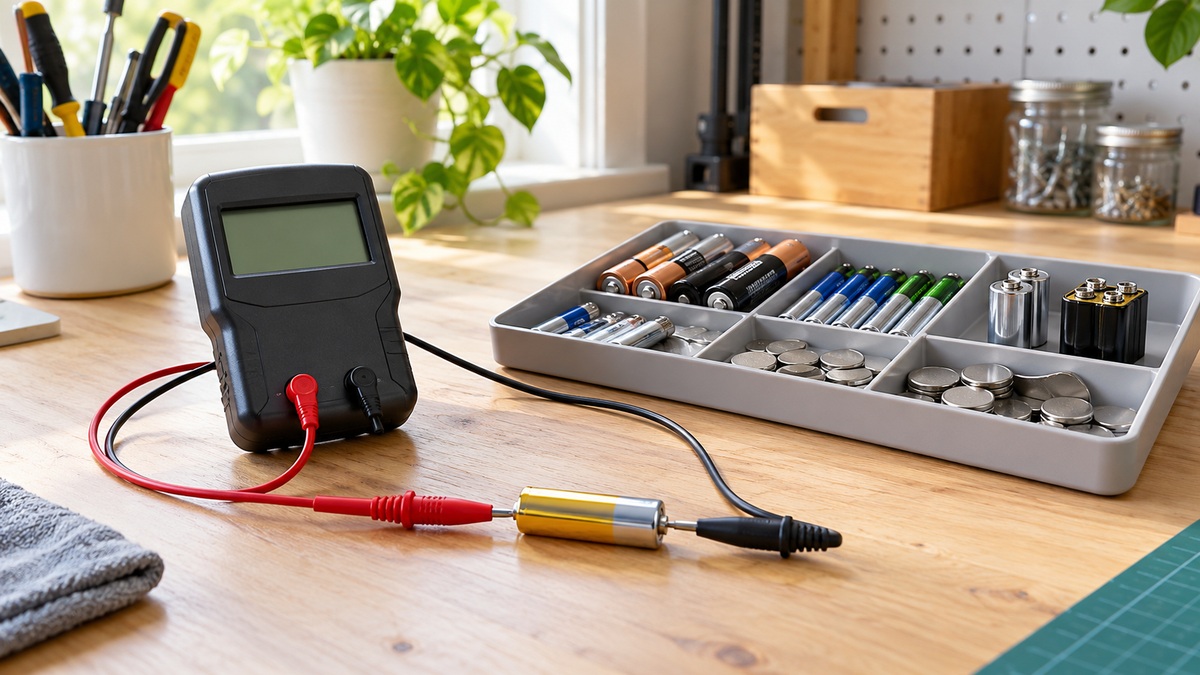
Battery Tester for Small Batteries: Cell Types and Readings
As an Amazon Associate we earn from qualifying purchases. Details
Updated 20 October 2026
Author: Ken
A battery tester for small batteries is only useful if it reads the cell you actually own. Of the twelve listings in our research set for this query, two are battery testers that name small cells. The DLYFULL tester names AA, AAA, C, D, 9V and button cells. The FNIRSI HRM-10 names AA and AAA cells and says it suits all kinds of batteries. The other ten are vehicle meters, a lead-acid load tester, a circuit tracer, a moisture and outlet kit, an earth resistance tester and a general multimeter. This guide shows how each of the two covers small cells, how to read its result, and what the listings leave out.
Quick answer
- Choose the DLYFULL listing if your cells are mostly AA, AAA, C, D, 9V or coin cells and you want a quick condition read. Its listing names the most cell types.
- Choose the FNIRSI HRM-10 listing if you want numbers. Its listing says it measures voltage and internal resistance at the same time, but it names only AA and AAA cells.
- Do not test a cell that shows swelling, leakage, corrosion or excess heat. The EPA tip sheet lists these as signs of damage.
- The listings do not say which reading counts as weak on either tester, so one reading does not tell you whether a cell is worth keeping.
What a small-cell tester has to handle
Small devices use different cell shapes. One gadget may take AA or AAA cells, another a 9V block, and a key fob or watch a coin cell. A tester that covers only one shape leaves the others unchecked, so the cell list in each listing is the first thing to read. The reading comes second. For the basics of how a voltage tester reads a battery, see how voltage testers work.
The EPA tip sheet is about damaged and defective batteries, not about testers. It still gives a useful frame. It defines small format batteries by weight: “single-use batteries weighing less than 4.4 pounds and rechargeable batteries weighing less than 11 pounds.” Its figure caption also places button cells in the same group: “Corrosion indicates damage in small format batteries such as button cell batteries.” For a tester, that means a coin cell needs the same look for damage as an AA cell before it goes into any slot or clip.
Cell names in each listing
The table counts only what each listing spells out. A cell the listing does not name is not ruled out, but the listing gives you no support for it.
| Cell name | DLYFULL listing | FNIRSI listing |
|---|---|---|
| AA | Named | Named (highlights) |
| AAA | Named | Named (highlights) |
| C | Named | Not named |
| D | Named | Not named |
| 9V | Named | Not named |
| N | Named | Not named |
| CR123A | Named | Not named |
| CR2032 (coin cell) | Named (highlights) | Not named |
| CR2, CRV3, 2CR5, CR-P2 | Named | Not named |
| Button cells in general | “a wide variety of button cell batteries” | Covered only by “all kinds of batteries” |
Counting distinct names, the DLYFULL listing spells out 12 cell names and the FNIRSI listing spells out 2. The difference is 12 – 2 = 10 names that only the DLYFULL listing spells out. Those ten are C, D, 9V, N, CR123A, CR2032, CR2, CRV3, 2CR5 and CR-P2.
The two listings that fit
Both cards draw only on the title, bullets and specification lines in the research record.
1. Dlyfull Battery Tester for AA AAA C D 9V 1.5V/3V Button, Batteries Checker (Cell list: widest named coverage)
Specs from the listing (checked ):
- Measurement Type: Voltmeter
- Item Highlight: LCD Display Universal Battery Checker for CR2032 CR123A CR2 CRV3 2CR5 CRP2, 1x AAA Batteries Included
- Specification Met: CE, FCC, RoHS
- Number of Items: 1
Pros
- The listing names 12 distinct cell names across its title, highlights and bullets
- The listing describes a simple bar display for poor, weak and good states
- The listing includes one AAA battery and an 18-month warranty
Cons
- The listing gives no voltage figures behind the poor, weak and good states
- The listing says the tester should not be powered by or used to test rechargeable batteries
Best for: A quick condition read on AA, AAA, C, D, 9V or coin cells that are not rechargeable
Skip if: You need a voltage or resistance number, or you mainly test rechargeable cells
View on Amazon (affiliate link)
2. FNIRSI HRM-10 Precision Voltage Internal Resistance Battery Tester (Numbers: voltage and internal resistance)
Specs from the listing (checked ):
- Measurement Type: Ohmmeter, Voltmeter
- Included Components: Date cable and kelvin clip test line
- Specification Met: CE, RoHS
- Item Highlight: 100V 200Ω, for All Types of Batteries, Car Battery Tester, Voltage Meter, AAA AA Battery, Digital Household Battery Analyzer
Pros
- The listing says it measures voltage and internal resistance at the same time
- The listing gives a voltage range up to 100 V and a resistance range up to 200 ohms
- The listing says the Kelvin four-wire connection is meant to avoid wire and contact resistance
Cons
- The listing names only AA and AAA cells, so C, D, 9V and coin cells are not named
- The listing gives no minimum voltage and no accuracy figure
Best for: Readers who want voltage and resistance numbers for AA or AAA cells and can use separate Kelvin test lines
Skip if: You need a pocket checker with a bar display, or a named fit for coin cells or 9V blocks
View on Amazon (affiliate link)
What the readings can and cannot tell you
The DLYFULL listing says the tester shows “whether the battery is in poor, weak, or good condition of voltage” on a bar display. It does not give the voltage behind those three states. So a bar result tells you which state the tester shows, and the listing does not say how far apart the states sit.
The FNIRSI listing says it tests “internal resistance and voltage value at the same time,” and that “The measured value can be used to determine whether the battery quality has decreased.” It gives a voltage range of “up to 100 V” and a resistance range of up to 200 ohms. Those are ceilings. The listing gives no lower limit.
A simple division shows why a high ceiling says little about a small cell. The DLYFULL title lists 1.5V/3V, so 100 V ÷ 1.5 V = 66.7 and 100 V ÷ 3 V = 33.3. The FNIRSI ceiling is about 67 times the 1.5 V figure and about 33 times the 3 V figure. That shows the range is wide. It does not show how the tester reads at the bottom of the scale, and the listing does not say.
The Purdue Extension sheet explains why a reading needs a reference point. It says voltage potential “can be measured and is the difference between two points, for example between the positive and negative ends of a battery.” It also warns that “Voltage and resistance readings will not be useful until also understanding voltage potential and loads/resistance in a circuit.” A small-cell tester reads across the two ends of a cell, but the number still needs a reference. Neither listing gives a reference for each cell type. The only voltage reference in either listing is the 1.5V/3V in the DLYFULL title.
How to run each tester on a cell
These steps follow the two listings. The safety steps come from the EPA and WMU guidance named in the safety section below.
- Inspect the cell first. The EPA tip sheet says signs of battery damage “may include bulging or swelling, odors, excess heat, smoke, discoloration, corrosion, damaged wires, leaking and odd noises.” If you see any of them, stop and go to the disposal step.
- Match the cell to the listing. For DLYFULL, check the cell against the names in the table above. For FNIRSI, if the cell is not AA or AAA, ask the seller which cells the tester is meant for, because the listing names only those two sizes.
- Leave rechargeable cells out of the DLYFULL check. The listing says the tester should not be powered by rechargeable batteries and should not be used to test them. For FNIRSI, the listing does not name rechargeable cells, so confirm before you use it on one.
- Run the DLYFULL check by placing the cell as the listing describes and reading the bars. The listing mentions a welcome guide in the box. The research record does not quote it, so read that guide before you rely on the slot layout.
- Run the FNIRSI check with the Kelvin test lines. The listing says the Kelvin four-wire connection is meant “to avoid wire and contact resistance and improve measurement accuracy.” Adjust the voltage and resistance range by hand when needed, as the listing allows, then read both values. The listing does not show how the clips attach to a small cell.
- Keep records only if you need them. The FNIRSI listing says it “supports historical records and export data tables.” The DLYFULL listing does not mention records.
- Handle any damaged cell as waste. Do not put it in curbside trash. The EPA tip sheet asks readers to check with their state, county and local agency for additional requirements.
Safety notes for small cells
The EPA tip sheet says that “All battery chemistries, including lithium, alkaline and lead-acid, can pose health and safety risks when they are damaged or defective.” The risks it lists include “a higher likelihood of catching fire (especially for lithium batteries), leakage of toxic substances and injury to handlers from chemical burns or electric shock.” It also says that “damaged and defective lithium batteries pose greater health and safety risks than other chemistries.” So a damaged alkaline AA is still a hazard to handle, but a damaged lithium coin cell carries the higher risk.
Western Michigan University’s guidance for its lithium-ion and LiPo cells gives the same kind of rule in plain terms: “Inspect batteries for damage before use and promptly dispose of damaged ones.” It adds that “If leaking material is present, do not touch it,” and that “Avoid mishandling such as burning, disassembling, or puncturing” is part of safe use. For a damaged lithium-ion cell waiting for disposal, WMU also says to “Tape exposed terminals to prevent short circuits.” That guidance is written for lithium-ion cells in a university setting, so apply it to any lithium cell you find, not as a general rule for every AA.
The Purdue Extension sheet adds a general caution for meters: “Working with live electrical circuits can be very hazardous without proper tools and safeguards.” It also says “Move cautiously while probing circuits.” Those lines apply when a meter moves from a single cell into a circuit.
The FNIRSI listing sets its own limits. The device “must not be used with a DC voltage higher than 100V,” and “Do not apply AC voltage under any circumstances.” That rule means the tester is not for AC wiring.
Listings without a card
Ten listed items were not used. None is a battery tester for small cells, so none earns a card. Each entry gives the reason.
- OLIKIUS waterproof voltmeter (DC 4.5-150V). The title gives a range from 4.5 V to 150 V and lists vehicles, golf carts and e-bikes. Its stated range starts at 4.5 V, above a 1.5 V cell. Its model field reads CR2025, but no bullet says it tests coin cells. For vehicle packs, see our battery voltage tester guide.
- MOTOPOWER MP0514A 12V car battery tester. The title names a car battery and charging-system analyzer. The research record has a title but no bullets or specifications, so there is nothing else to quote.
- CRLITSIY AG004 load tester. Its title lists 6 V, 8 V, 12 V, 16 V and 24 V batteries, and its bullets describe lead-acid types, including flooded, gel, maintenance-free and sealed batteries. It names no small cell, and it says not to use the tester “for more than 10 seconds.”
- DROK 180038 battery monitor. A vehicle voltage and temperature display for 12 V and 24 V systems.
- FIRSTOOL EM415Pro circuit tracer. Built for DC systems from 6 to 42 volts, such as cars, trucks and boats. The 9V battery in the box powers the transmitter and receiver. The listing does not say the tool tests batteries.
- Smgda analog multimeter. A general analog multimeter with test leads and one AA battery included. It is not a tester for other cells.
- MESTEK 3-piece electrical kit. A pinless wood moisture meter, a GFCI outlet tester and a non-contact voltage tester. The listing names no cell test.
- SUNAPEX BT-1 battery voltage tester. Its title gives a 5V-60V range, and its bullets name motorcycle, golf cart and off-grid solar batteries. A 1.5 V cell is below the stated 5 V minimum, and the bullets say the tool reads DC voltage only, not CCA, load or alternator output. For how a voltage tester reads a battery, see how voltage testers work.
- EVKIFEY 3-in-1 car voltmeter. A plug-in voltmeter for 12 V and 24 V vehicles, with a USB port and a temperature probe.
- DUOYI earth resistance tester. A ground and soil resistance tester with AC and DC voltage tests. It is not a cell tester.
How we chose
We read each of the twelve records against three tests.
- The listing names a small cell (AA, AAA, C, D, 9V, N, or a coin or button cell) in its title, highlights or bullets.
- The listing describes a battery check, either a condition read or a voltage and resistance readout. A USB, wire, moisture, ground or general meter function does not count.
- The listing gives enough text to quote: a title, bullets or specification lines.
Two records pass all three tests: DLYFULL and FNIRSI. The other ten fail at least one. We did not add a product from outside the research record, and we did not remove one from it. The set holds only two small-cell battery testers, so this is a short roundup. Two honest cards are better than a list padded with a car tester or a USB meter.
What we could not verify
- Accuracy. Neither listing gives an accuracy figure for its readings. The FNIRSI listing uses the word accuracy in a general sentence only.
- The voltage behind the DLYFULL states of poor, weak and good.
- The lowest voltage the FNIRSI reads, and its display resolution. The listing gives only the upper limit of 100 V.
- How the FNIRSI Kelvin clips attach to AA, AAA or coin cells. The listing names the test line, not the cell contact method.
- Whether the FNIRSI covers rechargeable cells. The listing says “all kinds of batteries,” but it does not name rechargeable cells.
- What the “Date cable” in the FNIRSI component line is. The listing reads “Date cable and kelvin clip test line,” so ask the seller what the cable is before you buy.
- A warranty for the FNIRSI. The research record has no warranty line. The DLYFULL listing states an 18-month warranty.
- How long the AAA battery included with the DLYFULL lasts. The listing does not say.
- Whether a visual check finds every defect. The EPA tip sheet says some defects “may not be visible upon inspection,” so a clean-looking cell is not proof of a good one.
- Whether either tester matches a laboratory method. Neither listing names one.
FAQ
Can a battery tester for small batteries check a rechargeable AA cell?
The DLYFULL listing says its tester should not be powered by rechargeable batteries and should not be used to test them. The FNIRSI listing names AA and AAA cells and says it suits all kinds of batteries, but it does not say whether rechargeable cells are covered. Ask the seller before you test one.
Does the DLYFULL tester cover a CR2032 coin cell?
According to its listing, yes: the highlights name CR2032 among the cells the checker is built for. A coin cell with corrosion is a damaged cell. The EPA caption says corrosion indicates damage in button cell batteries, so inspect the cell before you place it in the tester.
Which listing should I pick if I only need AA and AAA cells?
Both listings name AA and AAA. Pick DLYFULL for a quick condition read on its bars. Pick FNIRSI if you want voltage and resistance numbers and can work with Kelvin test lines. Neither listing gives a voltage that counts as a pass or a fail.
Can a damaged or leaking battery be tested safely?
Do not test a cell that is leaking, swollen, corroded or hot. The EPA tip sheet says all battery chemistries “can pose health and safety risks when they are damaged or defective.” WMU’s lithium-ion guidance says that if leaking material is present, “do not touch it.” The EPA tip sheet, written for collection sites, says to store damaged cells individually, bagged in non-flammable materials. Keep them out of curbside trash, and follow local rules.
Can a regular multimeter do the same job?
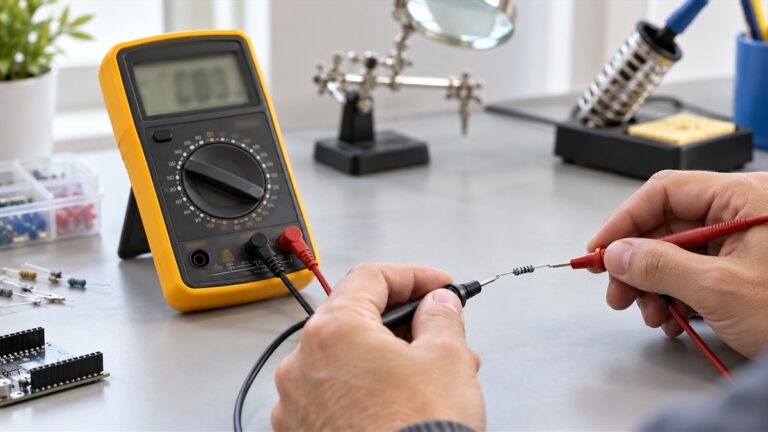
Partly. The Purdue Extension sheet describes measuring voltage across a battery by setting the meter to DC voltage, touching the red lead to the positive end and the black lead to the negative end. Its example reads “approximately 3 volts” on a first-year circuit board. A multimeter can read that voltage. The two listings here add a cell list on DLYFULL or a resistance readout on FNIRSI. Neither listing compares itself with a multimeter, so choose by what you need to read. For multimeter basics, see best hand held digital multimeter.
Bottom line
Start with the cell list. If the cell you own is named in one of these two listings, that listing fits. If it is not named, ask the seller before you buy or test it. Choose DLYFULL for a quick condition read and FNIRSI for voltage and resistance numbers. Stop at any cell that leaks, swells or corrodes, and dispose of it under local rules.
Sources
- Collecting Household Small Format Damaged and Defective Batteries (U.S. EPA tip sheet, June 2026): the small-format weight definition, the damage signs, the defect visibility limit, the button cell caption, the storage and disposal lines
- Lithium-ion Battery Safety Guidance (Western Michigan University, Environmental Health and Safety): the inspection rule, the leaking material rule, the terminal taping rule and the handling warning for lithium-ion cells
- Voltage Meter Basics (Purdue University Cooperative Extension, 4-H project sheet): the voltage definition, the DC probe method, the reference point for readings and the live-circuit caution