Checking Gfci Outlet
As an Amazon Associate we earn from qualifying purchases. Details
Safety first: a GFCI outlet sits on a mains circuit, and mains can kill. Before you press any button or touch the receptacle, confirm with a voltage tester rated for the circuit that the outlet is live, and follow the outlet’s own label. If the lamp stays on when you press TEST, the GFCI will not reset, or it trips with nothing plugged in, stop and call a licensed electrician. Someone searching “checking GFCI outlet” usually wants to know whether the outlet still protects, often after a trip, a new installation or a home inspection. This page gives the test steps, what a plug-in check can and cannot show, and when to stop.
Quick answer
Plug a lamp into the GFCI, press RESET, press TEST and the lamp should go off. Press RESET again and the lamp should come back on. Texas Co-op Power recommends this check every month and after every power surge. If the lamp does not go off at TEST, the GFCI has failed the check, and an electrician should look at it.
The lamp test, step by step
These are the steps from Texas Co-op Power, a utility source we opened on 2026-10-17:
- Push the RESET button on the GFCI receptacle to prepare it for testing.
- Plug a lamp into the GFCI and turn it on. The bulb should light.
- Push the TEST button. The lamp should turn itself off.
- Push RESET again. The lamp should turn back on.
Some manufacturers print their own procedure on the outlet or the cover plate. If the label and these steps differ, follow the label and keep the outlet’s own instructions with the device.
What a plug-in or non-contact tool can show
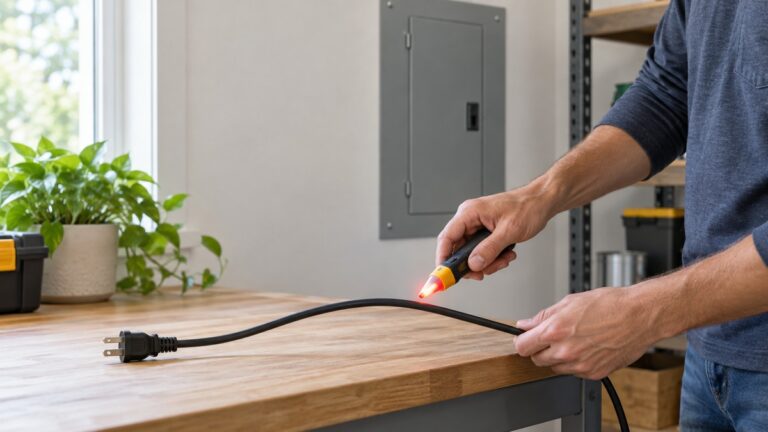
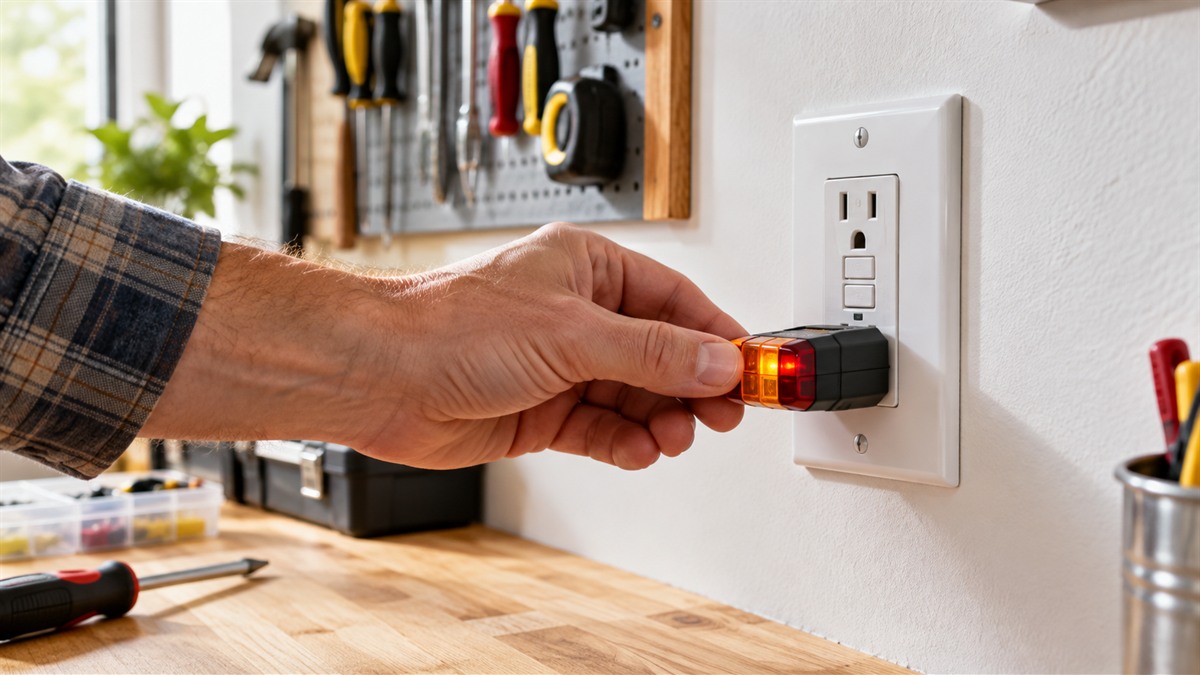
A non-contact voltage detector tells you that AC voltage is present near a conductor. It does not test whether a GFCI trips, and it does not give a voltage reading in volts. The lamp test is the GFCI check. A detector is a first step before you handle the outlet.
Two detectors worth checking before you touch the outlet
The research for this keyword contains no GFCI tester listing with specifications we could verify, so this page does not recommend a GFCI tester. The two listings below are AC voltage detectors from the same research file. Specifications come from the listings, checked on 2026-10-11.
At a glance: the 2 detectors, by their own spec fields
| Pick | Detection range | CAT rating | Flag |
|---|---|---|---|
| Klein Tools NCVT1P (best for a pocket check at lower voltages) | 50 V to 1000 V AC | CAT IV 1000V (per the specification field) | No numeric voltage reading, LED and beep only |
| Fluke 1AC II VoltAlert (best for a self-testing detector with a beeper) | 90 V to 1000 V AC nominal (one bullet separately says 200 V to 1000 V AC) | CAT IV, per the title | Starts at 90 V, not a low-voltage detector; two conflicting range figures in the listing; no numeric reading |
Specs are from each product’s Amazon listing, checked 2026-10-11. Both detectors’ ranges include 120 V, the nominal voltage of a standard US household outlet. The Fluke listing’s two differing low-end figures (90 V vs. 200 V) are worth confirming on the current listing.
1. Klein Tools NCVT1P: best for a pocket check at lower voltages
Specs (from the listing, checked 2026-10-11): non-contact AC detection from 50 V to 1000 V; flashing red LED and beeping alert; green LED shows the tester is working; auto power-off; 6.6 feet (2 meters) drop protection; a 5.5-inch pen with two AAA batteries rated 1.5 volts each. The specification field reads “Cat Iv 1000v.”
Pros: the listing states a CAT rating; detects down to 50 V. Cons: it is a detector, not a meter, and gives no reading in volts.
Best for: a quick presence check before you touch an outlet or wire. Its listed range includes 120 V, the nominal voltage of a standard US household outlet. Skip if: you need a numeric voltage reading.
View on Amazon (affiliate link)
2. Fluke 1AC II VoltAlert: best for a self-testing detector with a beeper
Specs (from the listing, checked 2026-10-11): nominal detection from 90 V to 1000 V AC; one bullet also gives 200 V to 1000 V AC; red LED tip and beeper; continuous self-test; audible or silent mode; two AAA alkaline batteries included; 2-year warranty. The title states a CAT IV rating.
Pros: continuous self-test; CAT IV stated in the title. Cons: the listed range starts at 90 V, so it is not a low-voltage detector; it gives no reading in volts.
Best for: someone who wants a detector that tests itself and beeps. Skip if: you need detection below 90 V or a numeric reading.
View on Amazon (affiliate link)
Mistakes to avoid
- Testing a damaged outlet. Do not test an outlet with a scorched face, loose wiring, or a cracked cover. Turn off the breaker and call an electrician.
- Skipping the voltage check. A GFCI test assumes the outlet is in service. Confirm that with a rated tool first.
- Pressing TEST again and again. A second press does not change the result. If the first test fails, stop.
- Using a detector as proof. A detector that stays silent does not prove the circuit is dead. Confirm with a rated voltage tester.
When to stop and call an electrician
Texas Co-op Power says that if the lamp does not turn off at TEST, the GFCI needs a licensed electrician. Our own rules add these stop points, which are not from that source: the GFCI does not reset, it trips with nothing plugged in, or the outlet is warm, buzzing or smells of burning.
Worked example
For example, suppose the lamp goes off at TEST and comes back on at RESET. The outlet passed the lamp test, so the device responded as the utility’s steps describe. Now suppose the lamp stays on at TEST. The GFCI failed the check. Do not press RESET and TEST over and over to see whether it changes. Stop, and have an electrician evaluate it.
Related guides
- Receptacle tester covers plug-in receptacle testers.
- GFCI open ground covers open-ground checks on GFCI outlets.
- Test electrical outlet with multimeter covers the outlet check with a multimeter.
FAQ
What should a GFCI outlet do when I press TEST?
It should cut power to the outlet, and the lamp should go off. Press RESET to restore power, and the lamp should come back on.
How often should I test a GFCI?
Texas Co-op Power recommends testing every month and after every power surge.
Does a voltage detector test a GFCI?
No. A detector shows that AC voltage is present near a conductor. It does not test whether the GFCI trips. Use the lamp test for that.
What if the GFCI will not reset?
Stop, do not keep pressing the buttons, and call a licensed electrician. This page does not offer a fix for a GFCI that will not reset.
Sources
The lamp test steps and the monthly test recommendation come from Texas Co-op Power’s GFCI guide: Texas Co-op Power, how to test GFCIs monthly.
Conclusion
Check the outlet with a rated voltage tester, run the lamp test once a month, and stop at the first failure. If the lamp stays on at TEST, the GFCI will not reset, or the outlet is hot or damaged, call a licensed electrician. Confirm the CAT rating and current price on each listing before you buy.