Best Earth Leakage Testers: Picks and How to Choose
As an Amazon Associate we earn from qualifying purchases. Details
An earth leakage tester checks whether a leakage protector trips at the intended current and within the intended time. A leakage protector interrupts a circuit when the current in the line and neutral conductors is unequal, which indicates current leaking to ground or to an unintended path. This guide compares the two leakage protector testers in this roundup, what their listings say about trip current and operating time, and what to confirm before you order. The guide also explains the leakage concept, so a trip reading means something to you before you buy.
Quick answer
For bench checks of leakage protectors, the touch-screen tester with a 5 to 1000 mA initiating range and 0 to 999 ms timing is the more flexible option. The second tester uses ten fixed current grades from 15 to 500 mA with a 0 to 999 ms timer, which suits set-point checks. No CAT category appears in either listing, so read the manual for categories before you connect either unit to live equipment. Skip both if you need a clamp for leakage current on an energized cable, since that is a different tool.
What matters for this keyword
Trip current range
Leakage protectors have a rated trip current, and a tester applies a controlled test current to see when the device operates. The touch-screen listing gives an initiating range from 5 to 1000 mA. The fixed-grade listing gives ten selectable steps from 15 to 500 mA. A wider range covers more devices, while fixed grades are simpler to select when your procedure names a grade. Match the range or the grade to your procedure, not to the biggest number on the page. For a clamp-style leakage reading, see the leakage current clamp guide.
Operating time
Time is the second half of the check. Both listings give a timing range of 0 to 999 ms. Timing shows how quickly a device operates once the test current flows, so keep the time reading next to the current used. A trip that looks fine in current but slow in time still needs attention. For ground resistance tools that also run timed checks, see the earth ground resistance tester guide.
Voltage ranges and limits
One listing gives an AC voltage range up to 600V and a separate note about relay switch tests below 250V. The other lists AC 0 to 750V and DC 0 to 1000V. Those figures apply to the tester’s measurement modes. Read each one as a separate limit, and check the manual before connecting the leads.
Construction and display
The touch-screen listing gives a weight of 2 kg and a 7-inch display. The fixed-grade listing gives a 4-bit LCD and 500 groups of stored data. Its power source field reads “Eletric”, which appears to be a typo, so confirm how the unit is powered before you buy.
Why the protector matters
Leakage is the gradual transfer of electrical energy across a boundary normally viewed as insulating. Unwanted leakage current can cause damage, fires or electrocution. OSHA lists lack of ground-fault protection among the most frequent causes of electrical injuries. A leakage tester checks whether the protective device responds as designed, which is why its trip current and time both matter. For a ground resistance meter, see the earth tester meter guide.
The picks
Each card below shows the specs the listing gives, followed by pros and cons from the same listing. The paragraphs here give the short version for each pick.
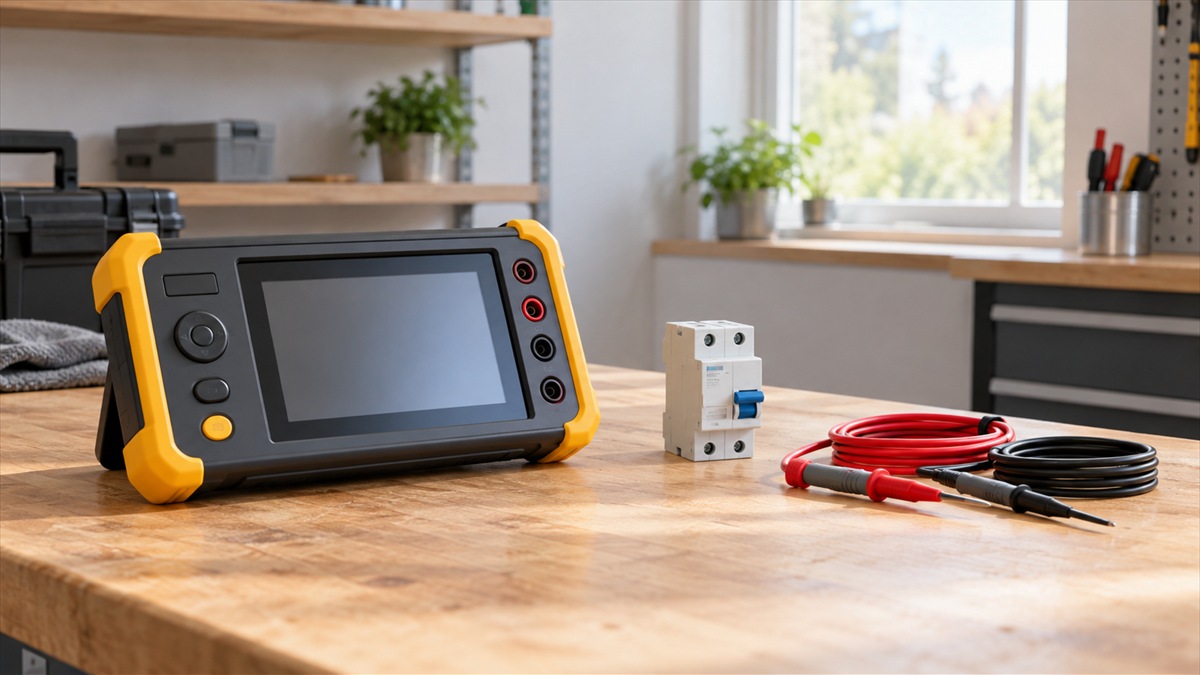
Best for a touch-screen bench check. The first entry is a leakage protector tester with a 7-inch color touch screen, a 5 to 1000 mA leakage initiating range and 0 to 999 ms timing. Its bullets also list AC voltage up to 600V. It suits a fixed bench where you want a wide current range on one screen.
Best for fixed current grades. The second entry offers ten selectable grades from 15 to 500 mA and a 0 to 999 ms timer, plus storage for 500 groups of data. Its bullets list AC up to 750V and DC up to 1000V for measurement. It suits set-point checks where you choose each grade by hand and record the result.
1. Leakage Protector Tester Earth Leakage Circuit Breaker Detector Leakage Protector Device with Color (Best for a touch-screen bench check)
Specs from the listing (checked 2026-10-16):
- Power Source: Battery Powered
- Item Weight: 2 kg
- Item Dimensions: 8.46 x 7.01 x 3.27 inches
- Color: Black
Pros
- Leakage initiating current range of 5 to 1000 mA for leakage protectors
- Operating time range of 0 to 999 ms named in the bullets
- Color touch screen 7 inches in size, with AC voltage up to 600V
Cons
- Listed weight is 2 kg, which is heavy for a field bag
- One bullet gives a 600V line range and a separate 250V limit for relay switch tests, so check which applies
Best for: Users who want a touch-screen tester for leakage protector trip checks at a fixed bench.
Skip if: Skip it if you need a small pocket tool, since the listed weight is 2 kg.
View on Amazon (affiliate link)
2. Leakage Switch Tester Leakage Protection Switch Tester with Current Gear 15 30 50 75 100 150 200 (Best for fixed current grades)
Specs from the listing (checked 2026-10-16):
- Power Source: Eletric
- Style: Leakage Switch Tester
- Model: 2025012116
- Included Components: Leakage Switch Tester
Pros
- Ten selectable current grades from 15 mA to 500 mA
- AC voltage up to 750V and DC up to 1000V listed in the bullets
- Stores 500 groups of data on a 4-bit LCD
Cons
- Accuracy is listed as plus or minus 5% of reading plus 5 digits, so small readings carry proportionally more error
- Power source is listed as Eletric, which reads as a typo, so confirm how the unit is powered
Best for: Users who need a set of standard current grades to check leakage protector operating current and time.
Skip if: Skip it if you need a touch screen, since the listing describes a 4-bit LCD and no touch input.
View on Amazon (affiliate link)
How to choose
Choose the tool that matches the grades your procedure uses and the voltage limits your work requires.
- Choose the touch-screen tester when you want a wider initiating range and a color display on a bench.
- Choose the grade-based tester when your procedure calls for fixed trip grades and stored records.
- Skip both if you need a clamp that reads leakage current on an energized cable.
Before you order, confirm the voltage limits, the trip grades your procedure needs and the power source. If a field conflicts with the title, ask the seller before you buy.
Safety note. A leakage tester applies a current designed to trip the protective device, so follow the manual and local electrical rules before you start. Repeated trips are a warning sign. Stop, and call a licensed electrician to find the cause instead of resetting the device again. Panel or service work belongs to a licensed electrician.
Worked example: a bench pass
- Checks per protector: 3 x 2 = 6 checks.
- Total checks: 8 x 6 = 48 checks.
- Time for all checks: 48 x 15 = 720 seconds.
- In minutes: 720 divided by 60 = 12 minutes.
One bench pass takes about 12 minutes before setup. Repeat the pass after any change to the devices, and keep the same current steps each time so the records compare.
Common mistakes
- Picking a tester by its largest current figure instead of the grades your procedure uses.
- Ignoring the voltage limit noted for relay switch tests.
- Trusting a power source field that reads oddly until the seller confirms it.
- Treating a repeated trip as a nuisance rather than a sign to call a licensed electrician.
- Skipping the manual for the timing setup before the first check.
FAQ
What does an earth leakage tester do?
It checks whether a leakage protector trips at the intended current and within the intended time. The tester applies a controlled test current and reports the result.
What is a residual-current device?
A residual-current device, also called a ground fault circuit interrupter, interrupts a circuit when the current in the line and neutral conductors is unequal. That imbalance indicates current leaking to ground.
Is an earth leakage tester the same as a clamp leakage meter?
No. A clamp measures current without breaking the circuit, and many clamps cannot read small DC currents. A leakage protector tester checks how a protective device trips, which is a different job.
What current range should I pick?
Choose a range that covers the trip current your procedure calls for. The touch-screen listing gives 5 to 1000 mA, and the grade-based listing gives 15 to 500 mA.
Why do the voltage limits differ?
The bullets name different voltage ranges for different functions, such as AC and DC measurement. Read each range as a separate limit, and check the manual before you connect the leads.
Can I test a live breaker with these?
Follow the manual and local electrical rules. Testing a live protective device should be done by a trained person, and panel or service work belongs to a licensed electrician.
What does a repeated trip mean?
A repeated trip is a warning sign. Stop, and call a licensed electrician to find the cause. Do not keep resetting the device.
Bottom line
For a touch-screen bench check with a wide current range, the first listing suits the job. For set-point checks with fixed grades and stored records, the second listing fits better. Confirm the voltage limits and power source before you order, and leave panel or service work to a licensed electrician.
Sources
- Residual-current device (Wikipedia): what an RCD interrupts and why current imbalance indicates leakage
- Leakage (electronics) (Wikipedia)): leakage definition and its risks
- OSHA electrical safety: most frequent causes of electrical injuries, including ground-fault protection
- Current clamp (Wikipedia): clamps read AC typically, while Hall effect types measure both AC and DC