Best GFCI Socket Tester: Six Plug-In Picks Compared
As an Amazon Associate we earn from qualifying purchases. Details
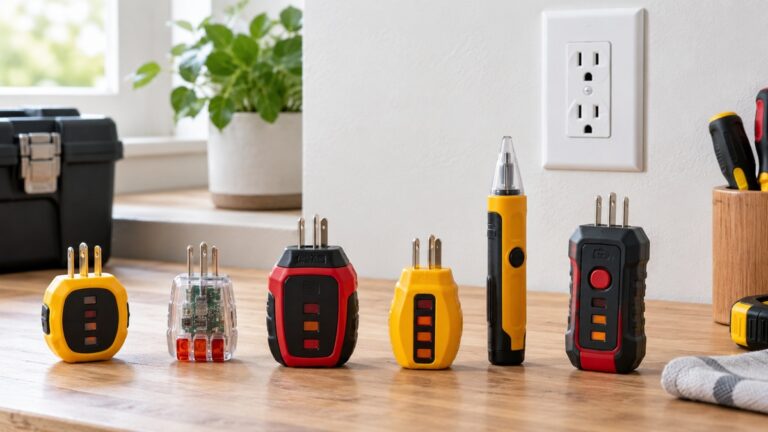
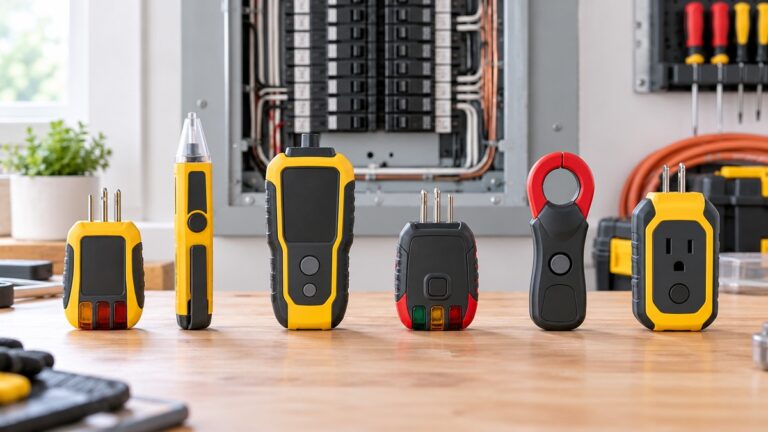
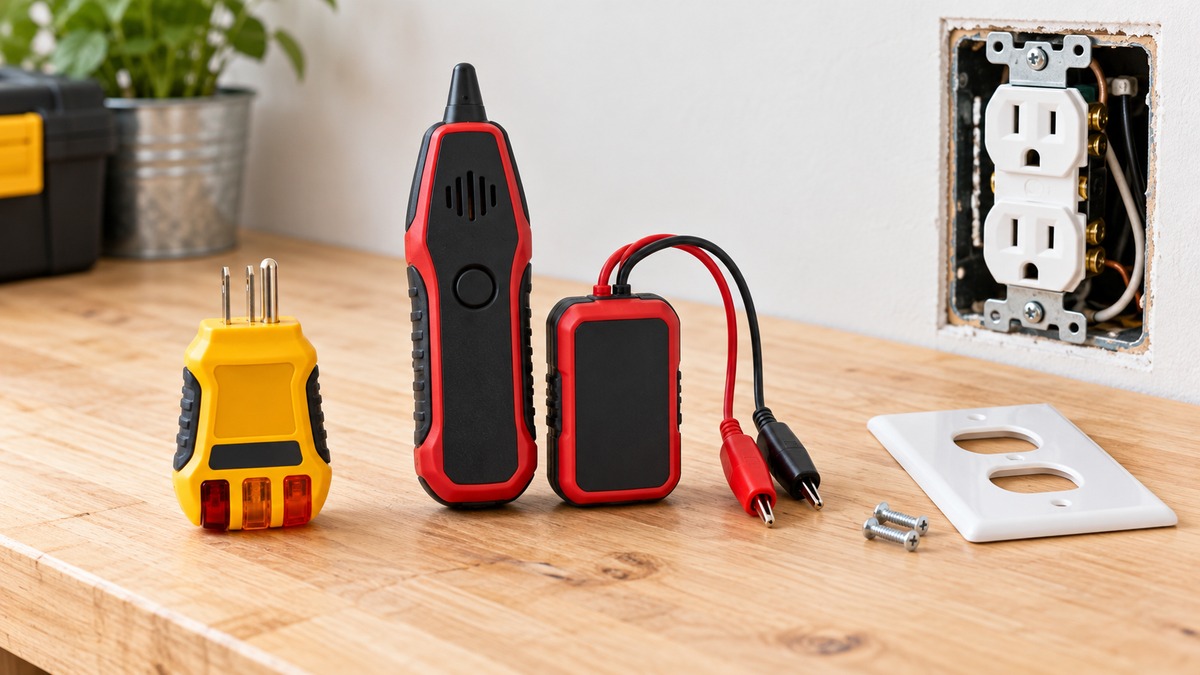
A GFCI socket tester is a plug-in device that checks a receptacle for common wiring faults and, on GFCI outlets, verifies that the protective device trips. You plug it in, read the indicator or screen, and press the test button where the tester has one. Work on mains circuits can kill, so treat every outlet as live until you have checked it. Follow the tester manual at each step, and leave panel or service work to a licensed electrician. This guide compares six plug-in picks by wiring checks, GFCI test method, readout style and rating, so you can match a tester to the outlets you actually use.
Quick answer
Choose a plug-in GFCI tester that names the wiring faults you need to find and has a clear test method for GFCI outlets. If you need a number, look for a voltage readout. Check the rating against your receptacle type, because the picks here list ratings from 125V to 300V. The Klein RT210 is hand powered and works on GFCI and standard outlets. The Goldeep is battery powered and adds auto-hold and a voltage readout. For a color LCD, the YOJOCK tester shows green for a good outlet and orange for a wiring problem.
What matters for a GFCI socket tester
Four features change which tester fits your outlets. Compare them in this order.
Wiring fault detection
Most plug-in testers flag the common faults: open ground, open neutral, open hot, missing live and reversed wiring. The color LCD tester and the Goldeep each describe six common faults. The seven-fault LCD tester lists seven, including open ground, open neutral, missing live and live and ground reversed. Read which faults the tester names, because a longer list helps you narrow the problem faster.
GFCI test method
The GFCI test is a separate check from the wiring check. The KPS CC810US has a dedicated test button for GFCI operation. The seven-fault LCD tester asks you to press and hold its built-in button for 2 seconds. The Goldeep GFCI test needs correct wiring and an installed breaker. The color LCD tester warns that its GFCI function should not be used on regular receptacles. Learn the method before you press anything.
Readout style
Readouts differ across these picks. The YOJOCK tester has a color LCD, the Goldeep has a backlit LCD that shows voltage, the KPS CC810US uses LED indicators with audible alerts, and the Westinghouse uses neon lights. The Klein RT210 bullets describe wiring detection and say nothing about a voltage readout. Choose the readout that matches the answer you need.
Ratings and voltage range
Ratings differ across the group. The Klein RT210 lists Cat Ii 300v, the color LCD tester lists CAT.II 300V with CE, the KPS CC810US lists a CAT II 125V safety rating, the seven-fault LCD tester lists Cat II and Cat III 300V, and the Westinghouse lists UL 1436 Category II. A 125V rating is lower than the 300V ratings in this group, so check the rating against the receptacle type you test. A rating is a stated limit, not a promise of accuracy.
How to choose
Use these rules, then compare the picks below.
- Choose the Klein RT210 for a hand-powered tester that checks GFCI and standard outlets with no battery to replace.
- Choose the YOJOCK color LCD tester for a GFCI button and an input range of 90-250V.
- Choose the Goldeep for a battery tester with auto-hold and a timed shutdown.
- Choose the KPS CC810US if a dedicated GFCI test button and LED plus audible alerts matter most.
- Choose the seven-fault LCD tester for a seven-fault readout and a two-second GFCI test, if your outlets fall within the stated operating range.
- Choose the Westinghouse for a plug-in tester with neon status lights, a two-year warranty and a UL 1436 Category II listing.
At a glance: the 6 picks, by their own spec fields
| Pick | Power source | CAT rating | Flag |
|---|---|---|---|
| Klein Tools RT210 (best hand-powered) | Hand powered | CAT II 300V | No voltage readout, wiring checks only |
| YOJOCK-TPGFCI-LCD (best color LCD readout) | Corded electric (how it draws power is not explained) | CAT II 300V, CE | Has a GFCI test button that can affect household wiring on regular receptacles |
| Goldeep (best battery tester with auto-hold) | Battery powered | Not stated | GFCI test deliberately creates 6-9 mA of leakage to the ground wire; needs correct wiring and an installed breaker |
| KPS CC810US (best compact GFCI button tester) | Not stated | CAT II 125V — lower than other picks | Product dimensions field reads 10 x 10 x 10 inches, which does not match a 2.89-ounce tool — likely a listing error |
| Seven-fault readout GFCI tester | Battery powered | CAT II 300V, CAT III 300V, 110-250V AC | Title says 110-250V AC, bullets describe 120V outlets — confirm which range applies; rated 0°C to 40°C only |
| Westinghouse GFCI125V10 (best plug-in with status lights) | Not stated | UL 1436 Category II, Pollution Degree 2 | No voltage readout — neon status lights only |
Specs are from each product’s Amazon listing, checked 2026-10-11 through 2026-10-16. The KPS CC810US dimension conflict and the seven-fault tester’s two differing voltage-range figures are worth confirming on the current listing before ordering.
1. Klein Tools RT210 Outlet Tester, Receptacle Tester for GFCI / Standard North American AC Electrical (Best hand-powered GFCI tester)
Specs from the listing (checked 2026-10-11):
- Power Source: Hand Powered
- Specification Met: Cat Ii 300v
- Included Components: GFCI Outlet Tester
- Item Weight: 1.9 ounces
Pros
- Its bullets say it works on GFCI outlets and verifies the ground fault protective device.
- Its bullets give 110/125V AC at 50/60Hz for 3-wire outlets.
- Its Specification Met field lists Cat Ii 300v.
Cons
- Its bullets describe wiring-problem detection and say nothing about a voltage readout.
- Its included components list only the GFCI outlet tester, with no manual or instructions.
Best for: Electricians and homeowners who need a simple GFCI and wiring check on 3-wire outlets.
Skip if: Skip it if you need a voltage readout, since its bullets describe wiring checks only.
View on Amazon (affiliate link)
2. Outlet Tester Electrical GFCI Receptacle Detector with LCD Display, 90-250V Power Socket Tester (Best color LCD readout)
Specs from the listing (checked 2026-10-16):
- Power Source: Corded Electric
- Item Weight: 0.1 kg
- Specification Met: Cat.ii 300v, Ce
- Model: YOJOCK-TPGFCI-LCD
Pros
- Its color LCD shows green for a good outlet and orange for wiring problems, per the bullets.
- Its bullets describe six common wiring issues it can flag.
- Its bullets list CAT.II 300V and CE certification with a one-year guarantee.
Cons
- Its bullets warn that the GFCI button may affect the household wiring on regular receptacles.
- Its Power Source field reads Corded Electric, but the bullets do not explain how the tester draws power.
Best for: Homeowners and inspectors who want a color LCD readout across a wide input range.
Skip if: Skip it if you want a tester with no GFCI button, since this one has one.
View on Amazon (affiliate link)
3. Goldeep GFCI Outlet Tester Socket Tester Plug Checker for Grounding-Green (Best battery tester with auto-hold)
Specs from the listing (checked 2026-10-16):
- Power Source: Battery Powered
- Item Weight: 2.88 ounces
- Included Components: GFCI Outlet Tester*1、battery*2、User Manual*1
- Item Dimensions: 4.09 x 2.05 x 1.3 inches
Pros
- Its auto-hold keeps the reading for about 10 seconds after you unplug the tester, per the bullets.
- It shuts itself off after about 3 minutes unmeasured, according to its bullets.
- Its LCD shows real-time voltage along with a wiring status.
Cons
- Its GFCI test needs correct wiring and an installed breaker, per the bullets.
- Its GFCI test deliberately creates 6mA~9mA of leakage to the ground wire, according to its bullets.
Best for: Electricians and renters who want a battery-powered tester with auto-hold and an LCD voltage readout.
Skip if: Skip it if you need a tester that runs without batteries, since its power source is battery powered.
View on Amazon (affiliate link)
4. KPS CC810US Socket Tester. GFCI Receptacle & Wiring Diagnostic Tool (Best compact GFCI button tester)
Specs from the listing (checked 2026-10-16):
- Item Weight: 2.89 ounces
- Product Dimensions: 10 x 10 x 10 inches
- Model: CC810US
- Manufacturer: KPS USA INC
Pros
- Its dedicated test button verifies GFCI outlet operation, per the bullets.
- It gives LED indicators and audible alerts for wiring conditions.
- Its bullets state a CAT II 125V safety rating for American-style receptacles.
Cons
- Its Product Dimensions field reads 10 x 10 x 10 inches, which does not fit a tool that weighs 2.89 ounces.
- Its only rating is CAT II 125V, a lower rating than some other picks carry.
Best for: Electricians and maintenance teams who want a compact tester for American receptacles.
Skip if: Skip it if you need a rating above 125V or cannot confirm the real size on the listing.
View on Amazon (affiliate link)
5. GFCI Outlet Tester with LCD Display, Standard 3-Prong Receptacle, Voltage Socket Checker, Circuit (Best seven-fault readout)
Specs from the listing (checked 2026-10-16):
- Power Source: Battery Powered
- Specification Met: Cat II 300v, Cat III 300v, 110-250v Ac
- Warranty Description: 2 Year Manufacturer
- Included Components: GFCI Outlet Tester x 1pcs
Pros
- Its bullets describe a two-second press of the built-in button to test the GFCI breaker.
- Its specs list Cat II 300v and Cat III 300v, with a 2 Year Manufacturer warranty.
- The package includes the tester, two AAA batteries and a user manual, according to its bullets.
Cons
- Its title gives 110-250V AC, but its bullets describe 120V outlets, so confirm which range applies.
- Its bullets state 0°C to 40°C operation and 20% to 70% RH, which may limit cold or damp jobs.
Best for: Renters and homeowners who want a battery tester with a seven-fault readout and a two-second GFCI test.
Skip if: Skip it if your work falls outside 0°C to 40°C, since its bullets state that operating range.
View on Amazon (affiliate link)
6. Westinghouse Plug-in GFCI Receptacle & Outlet Tester, 3-Prong Electrical Socket Voltage Tester (Best plug-in tester with status lights)
Specs from the listing (checked 2026-10-16):
- Specification Met: FCC, UL
- Style: Plug-in
- Part Number: GFCI125V10
- Included Components: Outlet Tester for North American AC Outlets – GFCI & Standard Receptacle Tester
Pros
- Neon lights show outlet status, according to the bullets.
- Its bullets say it complies with UL 1436 for measurement Category II, Pollution Degree 2.
- Its bullets describe a 2-year warranty and 24/7 customer service.
Cons
- Its bullets name only Category II, with no higher category stated.
- Its specs list no power source field, so check the manual for how it runs.
Best for: Electricians and DIY users who want a plug-in tester with neon status lights and a two-year warranty.
Skip if: Skip it if you need a voltage readout, since its bullets describe neon status lights and wiring checks.
View on Amazon (affiliate link)
The six picks, one at a time
The Klein RT210 is hand powered, so its specs name no battery. Its bullets describe detection of common wiring problems in standard and GFCI receptacles. It also says it works on GFCI outlets and verifies the protective device. The bullets give 110/125V AC at 50/60Hz for 3-wire outlets. Its Specification Met field lists Cat Ii 300v, and its bullets say it is built to withstand a 6.6-foot drop. The bullets state an operating range from 0-degree to 40-degree Celsius. Its bullets say nothing about a voltage readout, so do not expect one. Skip it if you need a voltage number.
The YOJOCK tester has a color LCD. Its bullets say green means a correct outlet and orange means a wiring problem. The bullets describe six common wiring issues and a one-click GFCI test. The test caution says to use the GFCI function only on GFCI receptacles, since it may affect the household wiring on regular receptacles. Its specs list a Corded Electric power source, and its title gives a 90-250V input range. Its safety entry lists CAT.II 300V and CE, with a one-year guarantee. Skip it if you want a tester with no GFCI button.
The Goldeep runs on battery power, according to its specs. Its bullets describe an LCD that shows real-time voltage together with the wiring status. Its auto-hold keeps the reading for about 10 seconds after you unplug the tester. It shuts down after about 3 minutes unmeasured, and pressing any key re-times that shutdown, according to its bullets. Its GFCI test presses a TES key to create 6mA~9mA of leakage to the ground wire, which trips the breaker within about 3 seconds. Its item weight is 2.88 ounces, and it includes a battery pair and a user manual. Skip it if you need a tester that runs without batteries.
The KPS CC810US is a compact tester with a dedicated GFCI test button. Its bullets describe LED indicators and audible alerts that show wiring conditions quickly. It is built for American receptacles and carries a CAT II 125V safety rating, according to its bullets. Its item weight is 2.89 ounces, and its ergonomic body fits in a tool bag. Its Product Dimensions field reads 10 x 10 x 10 inches, which does not fit a tool that weighs 2.89 ounces. Check the listing for the real size before you order. Skip it if you need a rating above 125V.
The seven-fault LCD tester runs on batteries and lists seven common wiring faults on an LCD. Its bullets describe a two-second press of the built-in button to test the GFCI breaker. Its specs list Cat II 300v and Cat III 300v, and its warranty field reads 2 Year Manufacturer. The package includes the tester, two AAA batteries and a user manual. Its title gives a 110-250V AC range, but its bullets describe 120V outlets, so confirm which range applies to your receptacle. The bullets state 0°C to 40°C operation and 20% to 70% RH. Skip it if your work falls outside that temperature range.
The Westinghouse is a plug-in tester with neon lights that show outlet status. Its bullets say it works on standard 3-wire and GFCI protected 120 Volt AC outlets at 60Hz. It complies with UL 1436 for measurement Category II, Pollution Degree 2. Its bullets describe a 6.5 Feet (2 Meter) drop resistance and a 2-year warranty with 24/7 customer service. The bullets name only Category II, with no higher category stated. The specification fields do not name a power source, so read the manual for how it runs. Skip it if you need a voltage readout.
When a socket tester is not enough
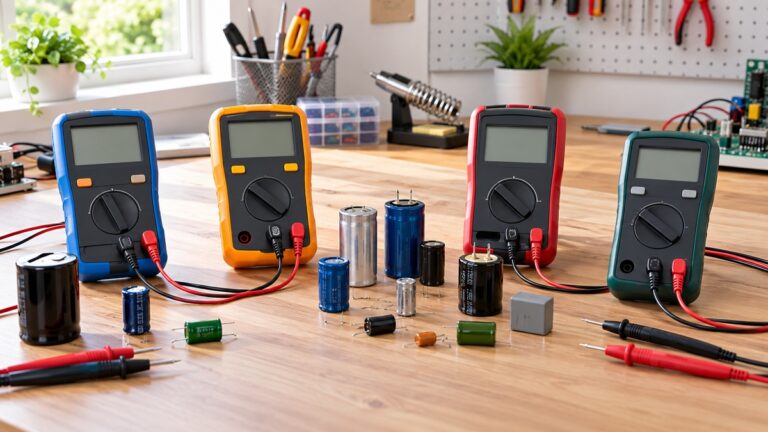
A plug-in tester checks wiring patterns and, on GFCI outlets, the trip function. It does not replace a meter when you need values, and it does not replace a licensed electrician when a fault needs repair. A test light checks whether electricity is present and is simpler than a measuring instrument. A multimeter gives values you can compare with a manual. Use the tool that answers your question. If you are comparing a simpler wall-mounted check, the best wall socket tester guide covers that category.
A residual-current device, also called a ground fault circuit interrupter, interrupts a circuit when the current in the line and neutral conductors is unequal. A GFCI test confirms that this protection responds. Reset the device only as its own instructions describe.
OSHA lists the most frequent causes of electrical injuries as contact with power lines, lack of ground-fault protection, a path to ground that is missing or discontinuous, equipment not used as prescribed, and improper use of extension and flexible cords. OSHA also says listed equipment should be installed and used in accordance with the instructions included in the listing. Follow the tester’s listing and manual exactly.
Reading results without guessing
Read the indicator or screen, then match it to the fault list in your manual. Do not assume the receptacle is the problem until you have checked the connection and the device it feeds. If a GFCI test does not trip the device, stop using the outlet and call a licensed electrician. If you are not trained for live work, stop after the wiring check and call a licensed electrician rather than opening the box.
A six-outlet room check
Suppose a room has 6 receptacles, 2 of them GFCI. You run the wiring check on all 6 receptacles, then run the GFCI test on the 2 GFCI receptacles only. 6 receptacles plus 2 GFCI tests equals 8 actions in total. If one GFCI test does not trip, add a licensed electrician visit to the list, which makes the plan one step longer.
Mistakes to avoid
Running the GFCI function on regular receptacles. The YOJOCK tester bullets warn about that use, so reserve the function for GFCI outlets.
Treating a wiring check as a voltage check. The Klein RT210 and the KPS CC810US describe wiring detection without a voltage readout, so pair them with a meter when you need a number.
Ignoring the temperature range. The seven-fault LCD tester states 0°C to 40°C and 20% to 70% RH, so check that range before a cold or humid job.
Assuming all ratings are the same. The 125V rating on one pick is lower than the 300V ratings on others, so match the rating to the receptacle.
Skipping the manual. Each tester names its own fault list and button steps, and the manual is the reference for them.
FAQ
What does a GFCI socket tester check?
It checks common wiring faults in the receptacle. On GFCI outlets, it can also confirm that the protective device trips when you use its test function. Some picks add a voltage readout.
Can I use the tester’s GFCI test on any outlet?
Use it on GFCI outlets only. The second pick’s bullets warn that the function may affect the wiring on regular receptacles, so follow the manual before you press the button.
Do I need a battery-powered tester?
Not always. The first pick is hand powered, and the sixth pick’s specs show no power source. Battery picks add features such as auto-hold and timed shutdown in some listings.
What does a 300V rating mean?
It is the voltage rating the listing gives, paired with a measurement category. Match the rating to your receptacle type, and check the manual for the full meaning.
What is the difference between a GFCI tester and a multimeter?
A GFCI tester checks wiring patterns and a GFCI trip. A multimeter gives voltage and other values you can compare with a manual. Use both for different questions.
Why does the temperature range matter?
A tester used outside its stated range may not perform as its bullets describe. The fifth pick states 0°C to 40°C, so an unheated garage may fall outside it.
Who should run the GFCI test?
Only someone trained for live work should run it. If you are not trained, stop after the wiring check and call a licensed electrician.
Bottom line
Choose the tester whose fault list matches your job and whose GFCI test works on your receptacle type. For a hand-powered tool, choose the Klein RT210. For a color screen, choose the YOJOCK tester. For battery use with a voltage readout, choose the Goldeep. For neon status lights with a two-year warranty, choose the Westinghouse. Keep mains work with a licensed electrician, and read the tester manual before every use. For related outlet checks, see the best receptacle tester guide and the best 3-prong outlet tester guide.
Sources
- Residual-current device, Wikipedia: an RCD, also called a GFCI, interrupts a circuit when line and neutral currents are unequal.
- Test light, Wikipedia: a test light checks for the presence of electricity and is simpler than a multimeter.
- OSHA electrical safety: the most frequent causes of electrical injuries, and safe work practices.
- OSHA 29 CFR 1910.303(b)(2): listed equipment should be installed and used in accordance with the listing instructions.