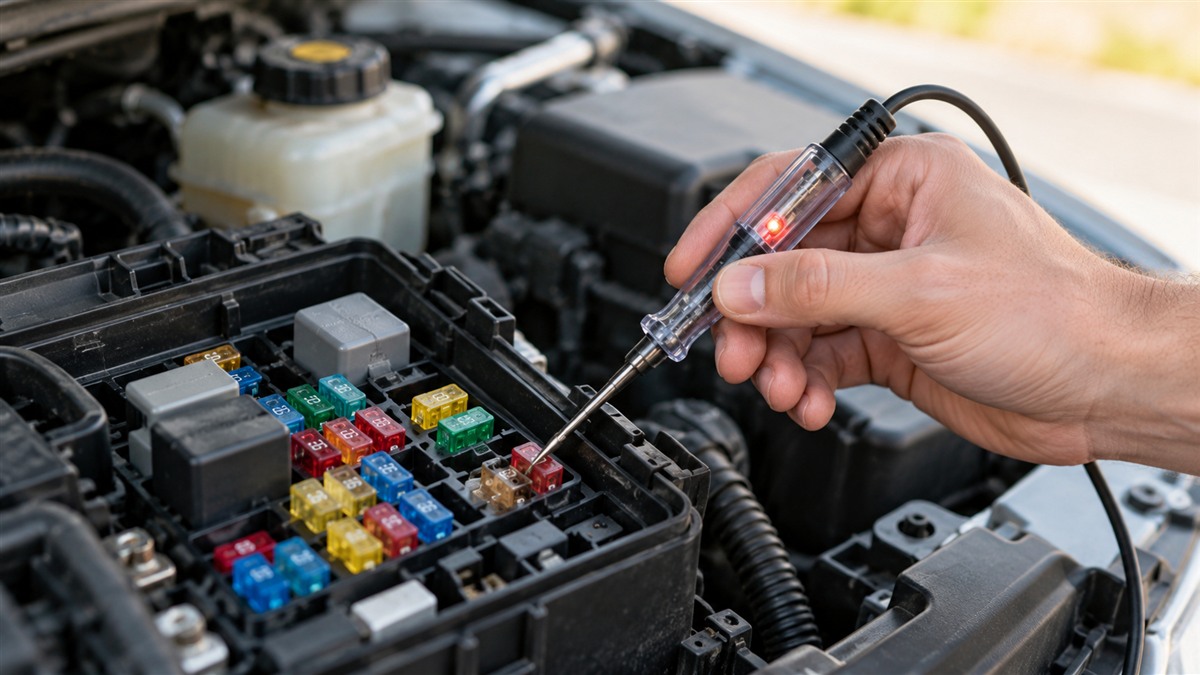
Best 12v Power Probe Car Circuit Tester: What to Check Before You Buy
As an Amazon Associate we earn from qualifying purchases. Details
This page covers 12-volt car circuit testers, with a focus on the pen-style and probe-style tools in the listing set. It sets out what each listing states about voltage range, polarity, leads and size, and it marks any figure the listing leaves out. Use it to decide which kind of tester matches the check you need before you compare products.
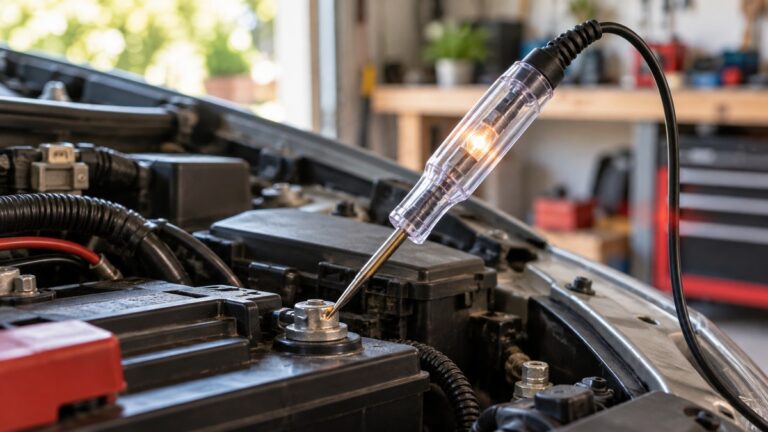
If you are looking for a 12v power probe car circuit tester, start with one question: do you need a light-style check that a wire has power, or a number on a display? A probe-style tester answers the first question quickly. A digital voltage pen answers the second. For a wider view, see what a circuit tester is used for.
Quick answer
The answer depends on what you need to see. A light-style probe shows whether a circuit has power. A digital voltage pen gives a reading on its display. The closest match among the options covered here is a battery-powered digital voltage test pen, and the listing does not describe it as a power probe. Choose it for a basic DC voltage and polarity check on a car circuit. Skip it if you need a stated CAT rating for mains work. Read the listing and the manufacturer’s manual before you use any tool on a vehicle. Use the checklist below before you commit to any purchase.
What matters for this keyword
Five criteria change with this keyword, so rank them by the job in front of you.
Voltage range on a car system
Most car electrical systems run on direct current (DC), so the DC range of a tool matters more than its AC range for this keyword. The listing gives a range of 3-120V DC. That range includes typical car battery voltages, but the listing does not state the accuracy of the reading anywhere in that range.
Polarity
Polarity tells you which point is positive and which is negative. The listing describes one method: touch the pen tip to one pole and clamp the alligator clip to the other. The display then shows a plus or minus sign. Confirm the sign before you connect anything, because reversing the two points gives the opposite sign.
Leads, clips and probe protection
The listing includes a spring wire with a probe protection shell and an alligator clip. The shell helps keep the tip from accidental contact when you carry the tool. It does not make the tool safe at every voltage. Inspect the tip, the wire and the clip before each use, and replace any part that is cracked or loose.
CAT rating and insulation
Read the CAT rating first, because it decides where a tool may be used. Measurement category is a classification by the International Electrotechnical Commission (IEC) of live circuits used in measurement. It takes into account the total continuous energy available at a point in the circuit and the occurrence of impulse voltages. Category II is for measurements on circuits directly connected to the low-voltage installation. Category IV is for measurements at the source of a high-voltage installation. The listing does not state a CAT rating for this pen, so it is not a tool the listing presents for mains work. IEC 61010-1 requires that the transient withstand capability of a meter be made known to the user, so ask the manufacturer for that figure before any use beyond car circuits.
Car battery and vehicle system limits
Disconnect and handle car batteries with care, and follow the vehicle manual for the order of steps. Keep metal tools away from the battery terminals. This guide does not cover airbag systems or high-voltage hybrid and electric vehicle systems. Follow the vehicle maker’s service information for those. If you are unsure whether a circuit is safe to check, stop and ask a qualified automotive technician before you continue.
Fuses and circuit breakers
A fuse is a sacrificial device. Once it operates, it is an open circuit and must be replaced. A circuit breaker can be reset, manually or automatically. A voltage check tells you whether power is present at a point, but it does not tell you why a fuse blew. Replace a fuse only with one that has the rating given in the vehicle manual, because fuses carry specific current and voltage ratings. If a fuse blows again after replacement, stop and have the circuit inspected by a qualified technician instead of trying a different rating.
What the listing states and what it leaves out
Reading a listing is the fastest way to separate what the seller has stated from what you would have to assume. For this pen, the listing states a 3-120V DC range, a battery-powered design, a polarity method with a plus or minus sign on the display, a spring wire with a probe protection shell, an alligator clip, and a measurement type of automotive fuse testing. It also gives a weight of 2.4 ounces and dimensions of 8 inches by 1 inch by 2.3 inches, which helps you judge how much room the pen takes in a tool bag.
The listing leaves several points open. It does not state a CAT rating, an accuracy figure, a response time or a warranty. It also does not say whether a battery is included, and it does not name a manual among its included components. When a point is missing, treat it as unknown. Do not assume a similar product covers it.
How to choose
- Choose a digital voltage pen if you need a readout with polarity on a DC car circuit and no work on mains.
- Choose a light-style probe if you only need to know that a wire has power and you do not need a number.
- Choose a meter with a stated CAT rating if you work on circuits connected to building wiring. For a general overview of voltage checks, see the best circuit tester guide.
Whatever you choose, check the listing for the voltage range, the polarity method, the CAT rating, the lead and clip design, and whether a battery is included. Write down anything the listing does not state, and ask the seller or manufacturer for it. The best 12v voltage tester guide and the best voltage tester for car guide cover neighbouring tool types.
If you check a car circuit only now and then, a basic voltage pen can cover the job, provided you accept the limits described in this guide. If you work on vehicles every week, look for a tool whose listing states its CAT rating, its accuracy and its battery arrangement. Expect to ask the seller for any detail the listing leaves out.
Before you buy: a checklist
- Voltage range: does it cover the system you plan to check? This pen states 3-120V DC.
- Polarity method: is the sign shown on the display, and is the method described in the listing?
- CAT rating: is it stated, and does it match the circuit you plan to test? This pen does not state one.
- Battery: is a battery included, and what kind does it need? The listing does not say.
- Leads and clips: is the probe protected, and does the alligator clip grip firmly?
- Manual: is a manual included or available from the maker? The included components do not name one.
Products that fit this
At a glance: the tester’s own listing fields
| Specification | Listed value | Flag |
|---|---|---|
| Voltage range | 3-120V DC | — |
| Display | Digital, bidirectional polarity (+ or – sign) | — |
| Weight / dimensions | 2.4 ounces; 8 x 1 x 2.3 in | — |
| Included | Test pen, spring wire with probe protection shell, alligator clip | — |
| Measurement type field | “Automotive Fuse Testing” | No accuracy figure stated |
| CAT rating | Not stated | Not presented for mains work |
Specs are from the product’s Amazon listing, checked 2026-10-13. This is a basic DC voltage and polarity pen, not a power probe or light-style circuit probe — confirm it suits your intended use before buying.
1. Automotive Digital Voltage Tester Pen, 3-120V DC Circuit Tester with LED Display, Bidirectional (Best for a basic DC voltage and polarity check)
Specs from the listing (checked 2026-10-13):
- Power Source: Battery Powered
- Measurement Type: Automotive Fuse Testing
- Item Weight: 2.4 ounces
- Included Components: Digital Voltmeter Test Pen, Spring Wire With Probe Protection Shell, Clamp
- Item Dimensions: 8 x 1 x 2.3 inches
Pros
- The listing gives a voltage range of 3-120V DC and a digital display.
- The listing describes polarity detection: pen tip on one pole, alligator clip on the other, with a plus or minus sign on the display.
- The listing includes a spring wire with a probe protection shell and an alligator clip.
Cons
- The listing does not state a CAT rating, so it is not a tool the listing presents for mains work.
- The listing does not describe it as a power probe or as a light-style circuit probe.
- The listing gives its measurement type as automotive fuse testing and does not state an accuracy figure.
Best for: Car owners and hobbyists who need a basic DC voltage and polarity reading with a digital display.
Skip if: Skip it if you need a stated CAT rating for mains work, or a light-style power probe.
View on Amazon (affiliate link)
The card above lists this pick’s specs, pros and cons. Use it only for the job described in the quick answer.
Worked example: checking a set of circuits
Those are a power check, a polarity check, a recheck after a fuse change, and a final check. If each check takes about 2 minutes, then 24 x 2 = 48 minutes. Check the arithmetic again: six circuits with four checks each is 24 checks, and 24 checks at two minutes each is 48 minutes. The listing does not state a response time, so treat the two minutes as your own estimate and time your own checks. Run the doubled case the same way: twelve circuits with four checks each is 12 x 4 = 48 checks, and 48 checks at two minutes each is 48 x 2 = 96 minutes.
Common mistakes
- Reading only the title. The title names a test light, a digital voltage tester and a circuit tester, but the specs list automotive fuse testing as the measurement type. Read both before you decide.
- Reading the polarity sign before checking which lead sits on which point.
- Choosing by voltage range alone. The range shows the readings a tool can display, not the category of circuit it is designed for, so check the CAT rating as well.
- Using a voltage pen in place of a current tool. A current clamp has jaws that open around a conductor to measure current without contact. This pen is a voltage tool, so it does not replace a clamp for current.
- Assuming the whole 3-120V range has the same accuracy. The listing does not state accuracy for any part of that range.
- Replacing a fuse with one of a different rating than the vehicle manual gives. A fuse with the wrong rating may not protect the circuit it is meant to protect.
- Treating any pen as a mains tester because it reads voltage. A reading is not a rating, and the listing must state the rating for mains use.
- Assuming a general tool covers airbag or high-voltage hybrid and electric vehicle systems. Those systems are outside this guide.
FAQ
Is the pick in this guide a power probe?
No. The listing describes it as a digital voltage test pen with a 3-120V DC range and polarity detection. It does not describe it as a power probe, so check the listing for the features you need.
Can I use a voltage pen on household mains?
Not on the strength of this listing. The listing does not state a CAT rating, and the CAT section above explains why that matters. Panel and service work belongs to a licensed electrician.
How do I read polarity on this type of pen?
The listing says to touch the pen tip to one pole and clamp the alligator clip to the other. The display then shows a plus or minus sign for polarity.
What does CAT II mean?
Category II is a measurement category for circuits directly connected to the low-voltage installation. Category IV is for the source of a high-voltage installation. The IEC categories also take into account the energy available and impulse voltages.
Does the listing say a battery is included?
The listing says the tool is battery powered. It does not say whether a battery is included, so check the listing before you buy.
Which one should I check first, a fuse or a breaker?
Check the protective device your circuit uses, as the vehicle manual describes it. A blown fuse must be replaced with the rating the manual gives. A tripped breaker can be reset.
Is a voltage tester the same as a multimeter?
No. A multimeter measures voltage, resistance and current, and digital ones have numeric displays. A voltage tester or test light checks for the presence of electricity and is simpler. Many car checks need only the presence check.
Should I work on a car battery myself?
Handle car batteries carefully and follow the vehicle manual. This guide does not cover airbag systems or high-voltage hybrid and electric vehicle systems, so use the maker’s service information for those.
Bottom line
Choose the digital voltage pen only for a basic DC voltage and polarity check on a car circuit. Choose a light-style probe if you only need a presence check. Choose a meter with a stated CAT rating for any work on building wiring. Before any purchase, read the CAT rating, the lead design and the battery details on the listing, and follow the maker’s manual.
Sources
- Test light: a test light checks whether electricity is present, and non-contact types can detect voltage on insulated conductors.
- Measurement category: how IEC categories classify live circuits by energy and impulse voltage.
- OSHA electrical safety: the most frequent causes of electrical injuries and ways to reduce the risk.