TOPTES Wood Moisture Meter Review
Start here: what this meter is for
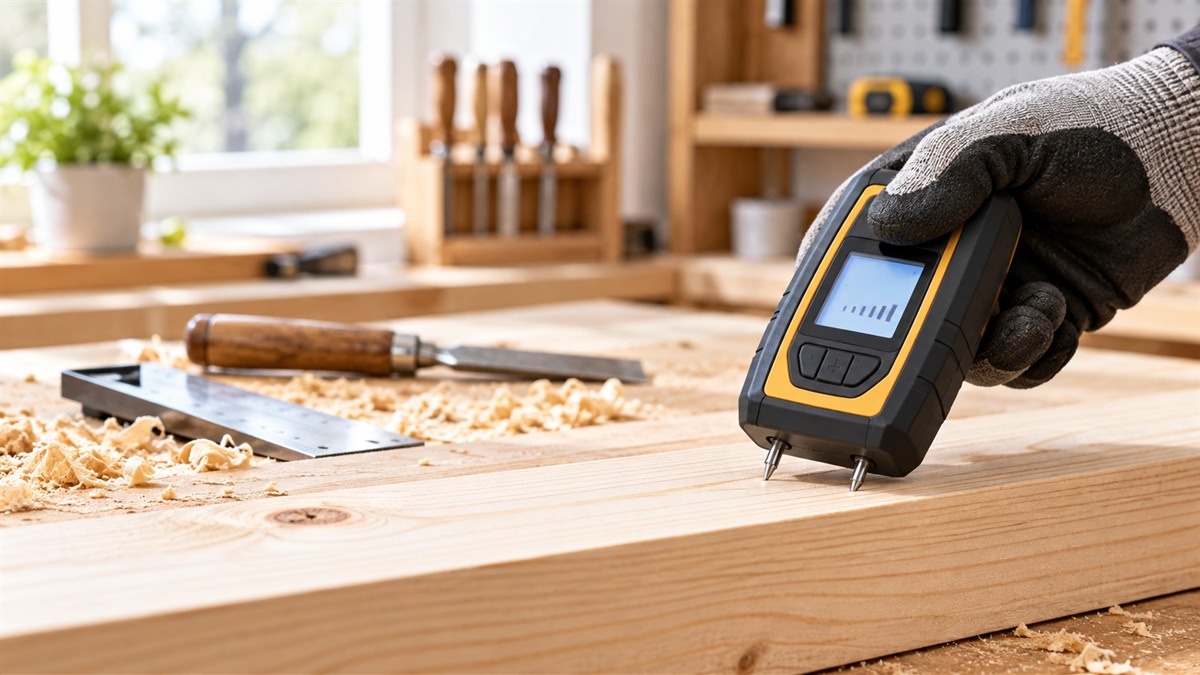
The TOPTES TS-630 is a handheld, pin-type moisture meter in orange, with a 2.25-inch LCD and a tricolor backlight. It is built for checking moisture in wood and some building materials, and the listing names woodworking, water damage restoration, building construction and home renovation as intended uses. If you are checking a board before a cut, a wall before a repair, or a log before you stack it, this meter gives you a percentage reading for the material setting you choose.
See the TOPTES TS-630 on Amazon
Reading the material modes
The meter has seven listed modes, and each one covers a different material and a different percentage range. Choosing the right mode matters more than the number itself.
| Mode | Listed use | Listed range |
| — | — | — |
| A | Beech, spruce, larch, birch, cherry, walnut | 8.8% to 54.8% |
| B | Oak, pine, maple, ash, Douglas fir, eucalyptus | 6.8% to 47.9% |
| C | Cement mortar layer and concrete | 0.9% to 22.1% |
| D | Anhydrous gypsum mortar layer (drywall) | 0.0% to 11.0% |
| E | Cement mortar | 0.7% to 8.6% |
| F | Lime mortar and gypsum | 0.6% to 9.9% |
| G | Brick | 0.0% to 16.5% |
Spruce and larch sit in the hardwood mode, while oak and maple sit in the softwood mode. The reason is that the listing’s own groupings do not match standard wood classes. Check the mode chart in the manual before you choose a setting for a species that matters to your job.
The title also mentions firewood. Firewood is not a named material in the mode list, so choose the wood mode closest to your species and treat the reading as a comparison, not an absolute value.
Who should buy it
- Woodworkers who want to check stock before glue-up or finishing.
- Homeowners checking a wood floor, framing or trim after a leak.
- Anyone doing a basic dampness check on drywall, mortar or brick before painting or repairing.
- Buyers who want a simple handheld tool with a backlight, an auto shut-off and a carry pouch to store it in.
Who should look elsewhere
- Anyone who needs a pinless meter that will not leave pin holes in finished surfaces. This meter uses test pins.
- Anyone who needs a scale they can trust across many species without checking the manual. The mode groupings need a careful read.
- Anyone who needs a documented accuracy figure in percent. The listing does not give one, as discussed below.
Real jobs this meter fits
- Before a cut or glue-up. Check a board’s moisture against its mode so you know whether it is ready to work.
- After a water event. Check framing and subfloor near the affected area to see whether the wood is still wet.
- Before painting drywall or mortar. The drywall and mortar modes have much lower ranges, so pick the mode that matches the surface.
- Marking a survey area. Take several readings across a wall or floor and compare them, rather than relying on one spot.
Choosing a mode for each job
Mode selection decides whether a reading means anything. Use the table below to pick the listed mode closest to your job, then check the exact species or material against the group the listing names. The groups come from the listing, and they are the ones to follow when you set the meter.
| Job | Listed mode | Materials the listing names for that mode |
| — | — | — |
| Hardwood stock for a furniture project | Mode A | Beech, spruce, larch, birch, cherry, walnut |
| Pine trim or softwood lumber | Mode B | Oak, pine, maple, ash, Douglas fir, eucalyptus |
| Concrete slab | Mode C | Cement mortar layer and concrete |
| Drywall before painting | Mode D | Anhydrous gypsum mortar layer |
| Cement mortar joint | Mode E | Cement mortar |
| Lime mortar or gypsum plaster | Mode F | Lime mortar and gypsum |
| Brick wall | Mode G | Brick |
Because the wood groups do not follow the usual hardwood and softwood split, a species you care about may sit in a mode you did not expect. If your species is not clearly in the group, check the mode chart in the manual before you trust the percentage.
Reading the percentage without an accuracy figure
The listing gives a range for each mode, but it does not give an accuracy figure in percent. Treat each reading as a comparison point rather than a calibrated value. Three habits make the numbers more useful:
- Take several readings across the same board, wall or slab, and note where each one falls within the mode’s range.
- Keep the mode fixed while you compare readings. Changing modes changes the scale, so a number from one mode cannot be compared with a number from another.
- Compare a suspect area with a known reference area in the same material. The listing does not define what counts as dry, so your reference area is the only baseline you have.
Pinless category example: fields to compare
Category examples show what changes when a meter uses a pinless design. The rows below describe the other products and not the TOPTES meter.
| Field | TOPTES TS-630 (this review) | General Tools MMD7NP (category example) | Pinless wall meter (category example) |
| — | — | — | — |
| Design | Pin-type, with a pair of test pins | Pinless | Pinless |
| Power | Three AAA batteries | 9-volt alkaline battery | Battery powered; cell type listed as Other Than Listed |
| Depth | — | Up to 3/4 inch (19 mm) | Maximum sensing depth of 0.75 inch |
| Scale | Seven material modes with ranges in percent | 0 to 53% softwood, 0 to 35% hardwood | — |
| Feedback | — | Audible alert, 3-color LED bar graph, out-of-range alarm | — |
| Weight | 148 g | 4 ounces | 7 ounces |
| Warranty | 3 years | — | — |
The table makes one point clear. The TOPTES meter is the only one of the three with a documented warranty, and it is the only one that pairs pins with a set of mode ranges in percent. The pinless examples list more feedback features, but their scales and depths belong to those models.
Battery, storage, and shut-off
The meter takes three AAA batteries, and the listing names three in the box. The special feature field names auto shut off. The listing does not give the time before shut-off, so check the manual if you need that number.
The carry pouch is part of the box, so the meter has a place to live between jobs. Keep the pins inside the pouch so they are not bent in a tool bag. The listing names a spare pair of pins, which is useful if a pin is damaged during a survey.
A survey routine for a water-damage check
A water-damage check is a survey, not a single reading. A simple routine keeps the results comparable:
- Sketch the room or wall and mark a grid of test points, so you can repeat the same spots later.
- Set the mode that matches each material on the grid, such as Mode B for a wood subfloor and Mode D for drywall.
- Read each point, and write the mode and the percentage beside the point on your sketch.
- Read a known dry area in the same material, and treat it as the baseline.
- Repeat the grid after the area has dried or been checked again, and compare the two sets of numbers.
The routine relies on the mode groups and the percentages the listing gives. It does not depend on an accuracy figure the listing does not state.
Pins versus pinless: what to weigh
This meter uses test pins, which are pushed into the material. A category example, the General Tools MMD7NP, is a pinless model. Its listing describes a reading depth of up to 3/4 inch, scales of 0 to 53% for softwood and 0 to 35% for hardwood, and a no-pin design that will not mar walls. The pinless approach suits finished surfaces. The pin approach suits raw, unfinished wood, where a small pin mark does not matter. Those specifications belong to the General Tools model and are not features of the TOPTES meter.
Buying checks before you order
- Confirm the species or material you will check is covered by one of the seven modes.
- Decide whether pin marks are acceptable on the surface you will test.
- Check the mode groupings against the manual for any species that matters to your job.
- Plan for AAA batteries. The box includes three.
- Note that the box includes a storage bag, a manual, a spare pair of pins and a mini wrench.
What is in the box and what it covers
The listing names the following contents: one TS-630 moisture meter, three AAA batteries, one user manual, one carry pouch, one pair of test pins and one mini wrench. The meter is listed at 148 grams, made of ABS plastic. The warranty is listed as three years.
The box-contents line is used here, and whether the wrench ships with the meter should be checked on arrival.
Limitations and open points
- Accuracy. The only accuracy figure is in grams, which does not fit a moisture reading.
- Readout accuracy in grams. This review does not use that figure.
- Weight capacity. That figure does not describe a handheld moisture meter’s use, so it is not used here.
- Backlight. The tricolor backlight appears in the title. The feature bullets do not describe it separately.
Questions buyers ask
Can I use it on concrete? Yes, the listing includes a concrete mode and a cement mortar mode. Use the mode that matches your surface, not the wood mode.
Follow the manual for any setup or reset steps.
Is it good for firewood? The title names firewood, but firewood is not a named mode. Use the wood mode closest to your species and treat the reading as a comparison.
How much does the meter weigh? The item weight is 148 g. The listing also gives the meter’s material as ABS plastic.
What is the warranty? The listing gives a 3-year warranty.
Measure the meter before you choose a storage spot.
The listing does name three AAA batteries in the box.
Does the meter turn off on its own? The special feature field names auto shut off.
Does the box include spare pins? Yes. The listing names one pair of replacement pins in its included components, and one pair of test pins in the box contents. Keep the spare set for a damaged pin.
Final verdict
The TOPTES TS-630 is a practical handheld pin-type meter for checking moisture in wood and building materials. Its seven modes cover a broad range of uses, its box includes spare pins and a storage bag, and its three-year warranty is a plus. Check the mode groupings against the manual before you rely on a species setting, and confirm the accuracy and box contents when the meter arrives.