Best Network Cable Testers and Tracing Kits: RJ45, RJ11 and PoE
# Best Network Cable Testers and Tracing Kits: RJ45, RJ11 and PoE
Every product detail in this guide comes from the supplied product data for each item. Manufacturer claims are marked as claims. The set includes a crimp kit with a tester built in, and two tone-tracing kits that are built to find a cable rather than test its wiring. Each is covered in its own entry so you can see what it does.
You crimp a new cable, plug it into the switch, and the link light refuses to come on. A cable tester is the tool that tells you why. It checks whether each wire reaches the right pin, whether any pair is crossed or open, and in some models whether power is arriving over the cable. The eleven products in this guide range from simple continuity checkers to kits that measure length, test PoE and reach into a fiber line.
Start here: who these testers suit, and who should skip them
These testers suit a homeowner who runs new network drops, a DIY installer who terminates cables, an IT technician who needs to check patch cords, or an electrician who traces a cable through a wall. Most of the handheld units here work with RJ45 and RJ11 connectors, and several handle PoE, which is the power-over-ethernet that cameras and access points use.
They are a poor fit if you need a tool that reads a live circuit. The AMPCOM notes say not to use the tester on live circuits, and that rule applies to every tool in this set. They also do not suit you if you need a full certification report for a commercial installation. The Fluke kit gives a wire map, length and PoE verification, but the data does not describe a certification report.
Match the tester to the job
Pick the tool from the job, not from the title.
- Checking a patch cord or a finished cable: a handheld continuity tester, such as the AMPCOM (B0CH1472JQ), the NOYAFA NF-468CS (B0C5MF7BC6) or the Mcbazel (B0FDGMLVKV). Each one shows opens, shorts and miswires on LED lights.
- Reading a wire map in a backlit display: the Klein Tools LAN Scout Jr (B0925826M2), which shows the pin-to-pin wiremap on an LCD.
- Checking PoE on a camera or access point run: the NOYAFA NF-8518 (B0FYNQG2H5), the NOYAFA NF-8209 (B08334R9KP), the NF-468CS, the Brileine (B0FLJQD8TQ) and the Fluke LinkIQ kit (B091FXSL4P). Each one lists some form of PoE test.
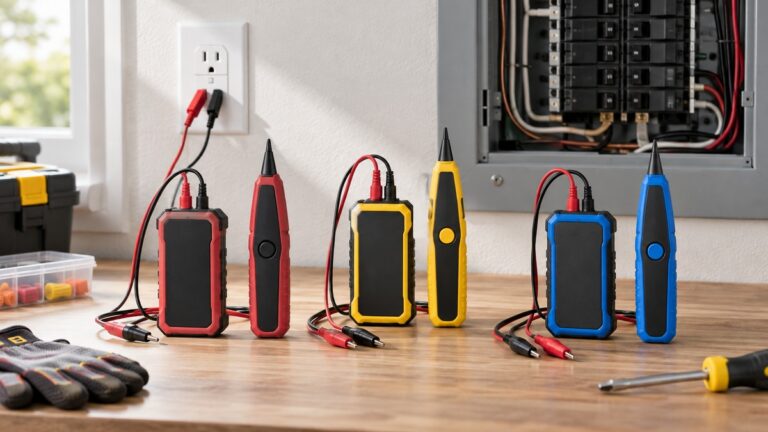
- Tracing a cable through a wall or a bundle: the NOYAFA NF-8209 with its NCV pen, and the GOTMEET tracing kit (B0H4GQTJSQ), which the maker describes as a transmitter and receiver for locating cables.
- Measuring length and checking the network: the Fluke LinkIQ kit, which displays cable length and distance to an open or short, and the NOYAFA NF-8209, which measures length from 2.5 to 200 meters.
- Building new terminations: the YWNEGWE crimp kit (B09JYTBDXN), which comes with a pass-through crimp tool, connectors and a tester.
- Home telephone and network lines: the YOJOCK tester (B0FJ2H6KLV), which covers RJ45 and RJ11 with a remote unit.
How to choose: five checks that matter more than the brand
1. Cable type first. Check which connectors the tester handles. Most in this set handle RJ45 for Ethernet and RJ11 for telephone. The AMPCOM tester adds RJ12. The YOJOCK and Mcbazel testers list CAT5 through CAT7 and UTP and STP shielded cable. Confirm that your cable type appears on the page.
2. PoE support. If you run cameras, access points or phones over the cable, you need a PoE test. The NF-8518 and the NF-8209 both describe PoE testing with a stated voltage range. The NF-468CS describes a 60-volt powered test. The Fluke kit tests PoE classes 1 to 8 and performs a load test from the switch. The Brileine tester says it detects PoE.
3. Remote unit and distance. A remote unit lets one person test a cable from both ends. Several kits in this set have one. The Brileine remote is described for testing over 300 meters. The NF-468CS maker gives a maximum test distance of 1000 meters. Length and distance figures depend on the test method, so check the page for the figure that applies to your job.
4. Tone and tracing. A tracer finds a cable among others in a bundle or a wall. The NF-8209 includes a transmitter and receiver, plus an NCV pen. The GOTMEET kit includes a transmitter, a receiver and adapter cables. The Klein Tools tone generator needs a probe sold separately.
5. Power and batteries. Batteries vary. The AMPCOM battery type is not stated in the listing. The YOJOCK includes two AAA batteries. The Mcbazel and YWNEGWE testers use a 9-volt battery that is not included. The NOYAFA NF-8518 and NF-468CS have built-in rechargeable batteries, and the NF-8209 kit includes a rechargeable transmitter and a 9-volt battery for the receiver.
Safety before you test
Read the safety notes before you test any cable. The AMPCOM page gives five notes that are a sound baseline for every tool here.
- Do not use the tester on live circuits. The AMPCOM note says the voltage levels can pose a shock hazard.
- Observe safety precautions above 60 volts DC or 30 volts AC rms. That is the AMPCOM figure, and it is a reminder to check any cable before you connect a tester.
- Do not ground yourself when taking measurements. The AMPCOM note says never to ground yourself.
- Do not operate the instrument in an explosive atmosphere. The AMPCOM note applies to every tester in this set.
- Keep the tester dry. The AMPCOM note says to protect the product from rain and moisture.
Some kits include a visual fault locator and an optical power meter. The NF-8518 lists a 650-nanometer visual fault locator, and the NF-8209 lists an NCV pen for non-contact AC detection. Never look into a fiber end or an optical connector while a light source is on. That is general fiber safety, not a figure from the data, but it applies to any visual fault locator.
Comparison table
| Product | ASIN | Type | Connectors | PoE | Power | Included |
|—|—|—|—|—|—|—|
| AMPCOM RJ45 LAN and TEL tester | B0CH1472JQ | Handheld continuity | RJ45, RJ11, RJ12 | Yes, PoE pins | Battery type not stated | Tester, carrying bag |
| Fluke LinkIQ kit | B091FXSL4P | Professional kit | Ethernet, PoE | PoE class 1 to 8 | Battery powered | Kit, probe, software features |
| NOYAFA NF-8518 | B0FYNQG2H5 | Multifunction, fiber and copper | USB Type-C charging, Cat 6 | 60 VDC PoE test | Built-in lithium, 1500 mAh | Tester kit |
| YWNEGWE crimp kit | B09JYTBDXN | Crimp tool with tester | 8P8C, CAT5e, CAT6, CAT6a | Not stated | 9-volt, not included | Crimper, connectors, covers, stripper, tester |
| YOJOCK HT812A | B0FJ2H6KLV | Tester with remote | RJ45, RJ11 | Not stated | Two AAA included | Tester, batteries, manual |
| NOYAFA NF-468CS | B0C5MF7BC6 | Handheld tester with remote | RJ45, RJ11, RJ12 | Powered test, 60 V | Lithium, rechargeable | Not stated in the listing |
| Klein Tools LAN Scout Jr | B0925826M2 | Backlit wiremap tester | RJ45 | Not stated | Battery type not stated | Tester; probe sold separately |
| Brileine tester | B0FLJQD8TQ | Tester with remote | RJ11, RJ12, RJ45 | Yes | Not stated | Main and remote units |
| Mcbazel tester | B0FDGMLVKV | Tester with remote | RJ45, RJ11 | Not stated | 9-volt, not included | Two units |
| GOTMEET tracing kit | B0H4GQTJSQ | Tracer and tester kit | RJ45 and RJ11 adapters | Not stated | Battery type not stated | Transmitter, receiver, adapters, clip lead, pouch |
| NOYAFA NF-8209 | B08334R9KP | Tracer, PoE and length kit | RJ45, shielded 9-pin | DC 5 to 60 V | Rechargeable transmitter, 9-volt receiver | Transmitter, receiver, adapter, cables, bag, battery, cable |
The 11 products, one by one
1. AMPCOM Network Cable Tester RJ45 for LAN and TEL Continuity, Black
This is a handheld continuity tester for RJ45, RJ11, RJ12 and PoE cables. It has a fast mode and a slow mode, with a remote unit to test from the other end. The maker says it finds opens, shorts and incorrect wiring, and the light patterns are set out clearly in the data. An RJ45 UTP cable lights 1 to 8, an RJ45 STP cable lights 1 to G, an RJ12 cable lights 1 to 6, and an RJ11 cable lights 1 to 4 or 1 to 2. A PoE check lights 1, 2, 3 or 6. Fast mode takes 3 to 4 seconds and slow mode takes 5 seconds.
The item weighs 125 grams and is built in high-impact ABS. The page lists TIA and EIA-568A and 568B as specifications met. The working range is 0 to 40 degrees Celsius and 10 to 70 percent relative humidity. The measurement type field reads ohmmeter, and the page’s light patterns describe a continuity check, so do not expect a wiremap display from this unit. The battery type is not stated in the listing, and the warranty is not stated in the data.
Best for: a quick check of a patch cord or a newly crimped cable.
Skip if: you need a backlit wiremap, a length reading or fiber testing.
2. Fluke Networks LIQ-KIT LinkIQ Cable and Network Tester Kit
This is a professional kit from Fluke Networks. It is battery powered and weighs 4.9 pounds. The maker lists cable performance testing up to 10GBASE-T through frequency-based measurements. The item dimensions are 17.13 by 20 by 6.1 inches. The network features include IPv4 and IPv6 ping, and nearest-switch diagnostics that show the switch’s IP address, name, port or VLAN number and advertised data rates.
The PoE function is Ethernet Alliance certified. It detects the PoE class from 1 to 8 and the power available, and it performs a load test of the PoE from the connected switch. The kit displays cable length, wire map, and the distance to an open or short. Results can be managed and printed from LinkWare PC software, and an IntelliTone probe is included to help locate cables.
The included-components field reads “See images with included components”. The listing does not spell out the full parts list in the data, so check the images or the box. The warranty is the manufacturer warranty.
Best for: an installer or IT technician who needs length, wire map, PoE verification and switch diagnostics in one set.
Skip if: you only need a continuity check on patch cords, since this kit covers far more than that.
3. NOYAFA NF-8518 Network Cable Tester, Optical Power Meter and VFL
This is a multifunction tester that covers copper and fiber. The maker lists nine core functions, including continuity testing, cable scanning, port flashing, length measurement, PoE power supply testing, an optical power meter and non-contact voltage testing. The optical power meter covers the wavelengths 850, 1300, 1310, 1490, 1550 and 1625 nanometers, with a range from minus 70 to plus 10 dBm and support for FC, SC and ST connectors. The visual fault locator is listed at 650 nanometers.
The PoE function detects the polarity, voltage and status of a PoE switch port, and the maker says it can switch between 10, 100 and 1000 megabit modes automatically. The stated maximum voltage for that test is 60 volts DC. The tester has a built-in 1500 milliamp-hour lithium battery, which the maker says lasts up to 10 hours, and it charges by USB Type-C. The backlight timeout and automatic shutdown can be set.
Not confirmed: the maximum voltage field reads 3.7 volts DC, which matches the battery rather than the PoE test. The PoE test is described at 60 volts DC, so treat the 3.7-volt field as the battery figure and not as the tester’s input limit.
The item count field reads 5, but the data does not list the accessories in the kit.
Best for: a technician who tests copper and fiber, and needs a PoE port check in one device.
Skip if: you only need a copper continuity check, or you cannot follow the fiber safety rules above.
4. RJ45 Crimp Tool Kit Pass Thru Ethernet Crimper for Cat5e, Cat6, Cat6a and 8P8C Modular Connectors, with Tester
This is a crimp kit with a tester built in, and it is aimed at making new cables. The contents are one RJ45 pass-through crimp tool, 20 CAT6 pass-through connectors, 20 connector covers, one wire stripper and one network cable tester. The 9-volt battery for the tester is not included. The maker describes the crimper as suitable for CAT5e, CAT6 and CAT6a 8-position modular plugs, including shielded ones, but not AMP connectors.
The tool has a heavy-duty steel body with a black oxide finish, an ergonomic grip and replaceable blades. The maker also describes a scanning function that can find a working wire behind a wall, and says the tool suits telephone lines, alarm cables, computer cables, intercom lines and thermostat wiring. These are the maker’s claims. The item weighs 0.57 kilograms.
Not confirmed: the product dimensions field reads 2.3 by 2.4 inches, while the size field reads 5.3 by 2.4 inches. Measure the tool before you plan a bench or storage space.
Best for: a DIY installer who terminates pass-through connectors and wants a tester for the finished cable.
Skip if: you only need a tester, since this kit is built around the crimp tool.
5. Network Ethernet Cable Tester for LAN RJ45 RJ11, Ethernet Wire Tester Tool, HT812A
This is a handheld tester with a remote unit, for RJ45 cables from CAT5 through CAT7 and for RJ11 telephone lines. It runs on two AAA batteries, which the kit includes. The maker says it detects continuity, short circuits, open wires, miswiring and cable shielding status. The fast and slow modes show the wire order on both the master and the remote units, and the LED lights make it easy to spot open pairs or misaligned pins.
The master and remote units separate for long-distance testing, so one person can test both ends of a cable. The housing is ABS and the unit is pocket-sized. A single button runs the test. The G light shows whether the cable is shielded (FTP or STP) or unshielded (UTP). The maker says the tester is safe for telephone lines with typical voltages under 48 to 72 volts. The specifications met are CE and RoHS.
Best for: home and office cable checks, including telephone lines, where you need a remote unit and batteries in the box.
Skip if: you need a PoE check, since the data does not list one for this unit.
6. YILTION NF-468CS Network Cable Tester, Telephone and Continuity Tester, Ethernet Cable Mapper
This is a handheld tester with a host and a remote unit. The title names the brand YILTION, but the brand field reads NOYAFA and the manufacturer field reads NF-468CS. Not confirmed: the three names disagree, so check the box and the label before you contact support.
The maker lists cable types RJ45 CAT5, CAT5e, CAT6 and CAT6a, plus RJ11 and RJ12 telephone lines in the 6P2C, 6P4C and 6P6C formats. It also lists a PoE test for router-to-wire and POE switch checks, which the maker describes as a 60-volt powered test. The quick test shows open circuit, crossover, straight-through and short circuit. The maker says the tester can detect the crimp condition of a plug, and that it reads shielded cables (UTP and STP) as well.
The maker gives a maximum test distance of 1000 meters for the host and remote combination. The unit charges a lithium battery and has an auto-shutdown function. The included-components field reads “NO”, which is not a parts list, so treat the contents as not stated in the data. The specifications met are CE, FCC, ISO 9001 and RoHS.
Best for: checking crimped cables and PoE switch ports with a rechargeable unit.
Skip if: you need a confirmed brand or a clear parts list, since the data does not give either.
7. Klein Tools VDV526-200 LAN Scout Jr Cable Tester Ethernet Cable Tester Kit
This is a wiremap tester from Klein Tools with a large backlit LCD. It tests RJ45 terminated cables and patch cords, and it reads pin-to-pin wiremap results on the screen, even in low light. It detects open, short, miswire, split-pair and cross-over faults, and it tests the shield. The interface has three buttons and simple test responses.
The tone generator sends a signal to a single wire, a pair or all eight conductors. The data notes that the tone function requires the probe, catalog number VDV500-123, which is sold separately. The auto power-off turns the unit off after 10 minutes in test mode and 60 minutes in tone mode.
The item weighs 4.32 ounces and measures 5.23 by 2.5 by 1 inch. The battery type is not stated in the listing.
Best for: an installer who wants a backlit wiremap and a clear fault display.
Skip if: you need tone tracing without buying the probe, since the probe is sold separately.
8. Brileine Network Cable Tester and Ethernet Tester with POE Detection
This is a handheld tester with main and remote units, for RJ11, RJ12 and RJ45 cables. The maker says it scans wiring automatically and checks for continuity, open, short and crossover faults. The LEDs are sequenced, and the fast and slow test modes let you choose a pace. The maker says it detects live PoE connections, and that the remote unit allows testing over 300 meters. These are the maker’s claims.
The unit has a removable bright orange silicone sleeve for shock protection and high visibility. The kit includes main and remote units and a manual. The maker offers 18 months of product support, which is a claim the page states.
The size field gives 1.5 by 0.8 by 4.2 inches. The data does not say whether that describes one unit or both, so check the box before you plan storage. The weight and battery type are not stated in the listing.
Best for: a compact tester for home or small office cabling that needs a PoE check and a remote.
Skip if: you need a length reading or a wiremap display, since the data does not describe either.
9. Mcbazel Ethernet Cable Tester, RJ45 RJ11 Network Tester Tool for CAT5 to CAT7, Black
This is a portable tester with a detachable master and remote unit. It tests RJ45 and RJ11 interfaces, and the maker lists CAT5, CAT5e, CAT6, CAT6a and CAT7 cable, with UTP and STP shielded types. The LED array runs from 1 to 8 and G, and the slow mode (S) slows the LED sequence so it is easier to see. The note on the page says the G light shows green when a shielded cable is detected. The text on the unshielded case is cut off in the data, so check the manual for that case.
The units are made of shock-resistant ABS and slide apart so you can test cable already run through walls or ceilings. The product runs on a standard 9-volt battery that is not included. The item weighs 130 grams, and the kit has two units. The maker says the unit switches on with one button and gives results without setup.
Best for: installed cable in walls or ceilings, where the remote needs to reach the other room.
Skip if: you need a PoE test, since the data does not list one for this unit.
10. Network Cable Tester, RJ11 RJ45 Ethernet Tester for CAT5 CAT6
Despite the title, this kit is built around tracing. It includes a transmitter and a receiver, an RJ45 adapter cable, an RJ11 adapter cable, an alligator clip test lead and a carrying pouch. The maker says it traces the target cable among bundled network, telephone and electrical wires without damaging the insulation. The kit also tests continuity, wire mapping, open and short circuits, and crossed wires.
The receiver has an adjustable volume, a built-in flashlight for dark spaces and a low-battery reminder. The transmitter and receiver can be used together or on their own for telephone line polarity and signal checks. The item weighs 280 grams and measures 7.09 by 2.76 by 1.18 inches. The battery type is not stated in the listing.
Best for: finding a particular cable in a bundle, and checking a telephone line’s polarity.
Skip if: you need a PoE check or a wire-map display, since the data describes neither for this kit.
11. NOYAFA NF-8209 Network Cable Tester with PoE, NCV and Length Test
This is a tracing and testing kit. The transmitter and receiver use digital decoding with normal, anti-interference and PoE modes. The maker says it traces live cable up to 600 meters, and it includes an NCV pen for non-contact AC detection. The remote adapter pairs with the receiver to test RJ45 cables, both shielded and unshielded, for shorts, opens, miswiring and normal connections. The kit supports eight-pin network cable and nine-pin shielded cable.
The length function measures each twisted pair of CAT5 or CAT6 cable from 2.5 to 200 meters and displays the result in meters, feet or yards. The PoE function tests DC voltage from 5 to 60 volts for standard and non-standard PoE, identifies IEEE 802.3af and 802.3at, and shows the power method, voltage and polarity. The port flash and link test works at 10, 100 and 1000 megabits.
The kit includes a transmitter, receiver, remote adapter, cable set, tool bag, a 9-volt battery and a Type-C cable. The transmitter uses a 3.7-volt, 950 milliamp-hour rechargeable battery. The receiver uses a 9-volt battery, and the unit has an LED light. The item weighs 420 grams.
Best for: a technician who needs tracing, PoE, length and port tests in one kit.
Skip if: you only need a continuity check, since this kit is larger and heavier than a handheld.
Reading the results: what the lights and modes mean
Most of the testers in this set show results on LEDs, so the pattern tells you what is wrong. The AMPCOM page gives the clearest set of patterns, and the other makers follow the same logic.
For an RJ45 UTP cable, the AMPCOM page lists lights 1 to 8 as the pattern. For a shielded cable, the RJ45 STP pattern runs from 1 to G. If the lights you see do not match the pattern for your cable type, the page’s list of faults (opens, shorts and incorrect wiring) tells you what to check next.
For telephone lines, the AMPCOM page lists RJ12 as lights 1 to 6 and RJ11 as 1 to 4 or 1 to 2, depending on the format. For PoE, the page lists 1, 2, 3 or 6 lights.
Use slow mode when you need to watch the sequence. The AMPCOM page gives fast mode as 3 to 4 seconds and slow mode as 5 seconds for a full cycle. The Mcbazel slow mode is marked S, and the YOJOCK fast and slow modes show wire order on both units.
Testers that go beyond continuity
Continuity is the first check. Several kits in this set go further.
PoE checks tell you whether power is arriving at the cable. The NF-8518 and the NF-8209 both give a voltage range for the powered test, and both identify the PoE type. The Fluke kit goes further, testing the PoE class and running a load test from the switch.
Length and distance checks tell you where a fault is. The Fluke kit displays length and the distance to an open or short. The NF-8209 measures each twisted pair from 2.5 to 200 meters.
Fiber and optical checks apply to the NF-8518 only. Its optical power meter covers six wavelengths, and its visual fault locator is listed at 650 nanometers. Use it only if your network includes fiber.
Tone and tracing tools find a cable in a bundle. The GOTMEET kit and the NF-8209 are the two tracing kits in the set. The Klein tone generator requires its probe, sold separately.
Care, batteries and storage
Store the tester in a dry, safe place when it is not in use. The AMPCOM page gives that instruction directly, and it applies to every tester here.
Check the battery before a job. The AMPCOM page says to check that the battery has enough power, and its low-battery note says the LED indicator will not light when ON is pressed.
Charge the rechargeable units through their own cable. The NF-8518 charges through USB Type-C, and the NF-8209 kit includes a Type-C cable for its transmitter.
Handle the connectors gently. The AMPCOM page says to avoid applying excessive force or bending the connectors, and the page also says to handle the tester and cables with care.
Keep the crimp tool’s blades sharp. The YWNEGWE page says the blades are replaceable and describes them as sharp, so swap them when they stop cutting cleanly.
Before you buy: a checklist
- Confirm the connectors your cable uses: RJ45, RJ11, RJ12 or a shielded cable.
- Decide whether you need PoE. If so, check that the tester lists a PoE test.
- Decide whether you need a remote unit to test from both ends.
- Decide whether you need a wiremap display, a length reading or a tracer.
- Check the battery type and whether a battery is included. Several listings do not state the battery type, and two say the 9-volt battery is not included.
- Read the safety notes on the page before you test any cable that may be live.
- Note any figure marked as not confirmed, and check it on delivery.
Frequently asked questions
Can I use these testers on a live power circuit? No. The AMPCOM page says not to use the tester on live circuits, and the safety notes above apply to every product in the set.
Which tester covers PoE? The AMPCOM, NF-8518, NF-8209, NF-468CS and Brileine testers all describe a PoE check. The Fluke kit goes further and tests the PoE class and runs a load test.
Which tester measures cable length? The Fluke kit displays length and the distance to an open or short. The NF-8209 measures length from 2.5 to 200 meters on each twisted pair.
Do I need a fiber tester? Only if your network has fiber. The NF-8518 is the only product in the set with an optical power meter and a visual fault locator.
What does the tone probe do? It sends a tone along a cable so a receiver can find that cable in a bundle. The Klein tone function requires its probe, which is sold separately.
Is the crimp kit a tester? It is a crimp kit with a tester included. The 9-volt battery for the tester is not in the box.
What does “Not confirmed” mean here? It marks a figure or label that conflicts with another figure on the same page. The reason is given once, in the product entry, so you know what to check on delivery.
Links on this page are affiliate links, which means a purchase through them can support the site at no extra cost to you.