Best 12V Automotive Short Finders
As an Amazon Associate we earn from qualifying purchases. Details
# Best 12V Automotive Short Finders
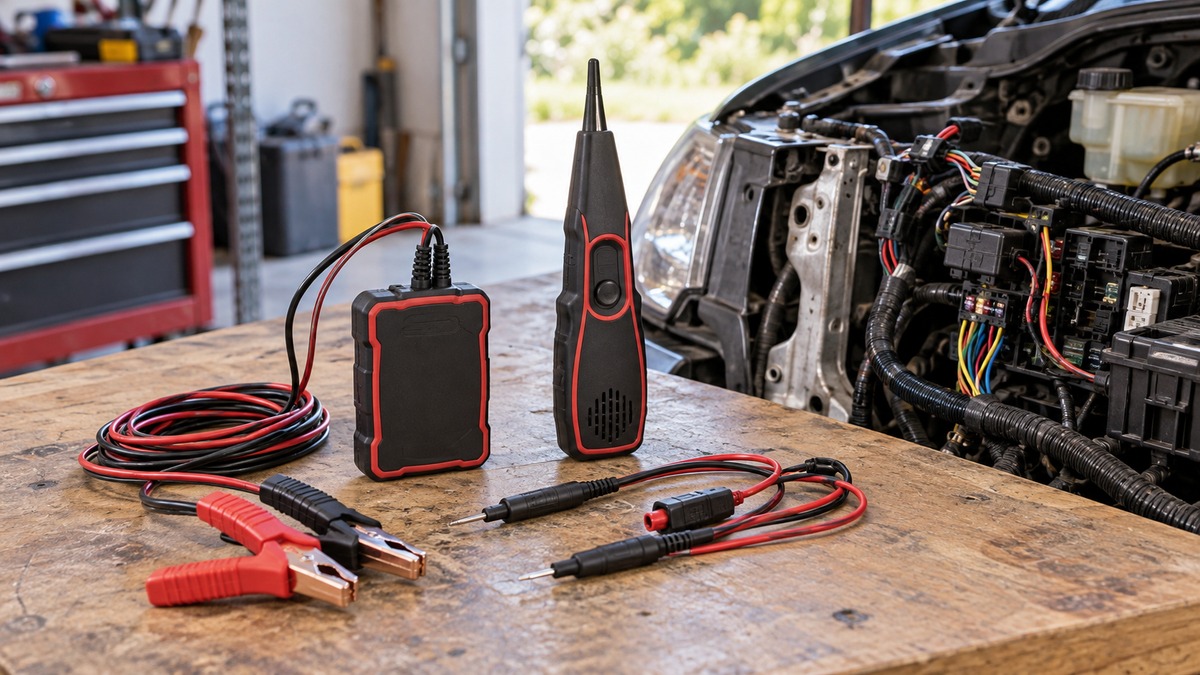
A short finder is a diagnostic tool for a live low-voltage circuit. A transmitter is connected to the wire or harness under test, and a receiver is moved along the wiring to find where a signal stops, grows, or changes. Some tools are built to find an open circuit (a break in the wire), some to find a short (an unintended connection to another part of the circuit), and some also include a continuity check for a single wire. Most of the tools in this roundup are described for 12-volt automotive systems, which fall inside the DC voltage range these listings give.
Product details come from published specifications and listing text only.
Who This Roundup Is For
the product descriptions describe these tools for car, truck, RV, trailer, motorcycle, and boat electrical work, for both professional technicians and home mechanics. Based on those descriptions, this roundup is most relevant to:
- Owners who want to trace a blown fuse, a broken wire, or a short in a DC vehicle circuit.
- Readers who want a dedicated tracer with a flexible receiver probe for reaching behind a dashboard or into an engine bay.
- Readers who prefer a tool with a continuity mode for checking a single wire.
- Readers who want a multi-function tester that also covers other automotive checks.
It is less suited to readers who need a tool for household AC wiring. Several listings say these tools are for DC vehicle systems only. The Girnfac and Ansbell listings say explicitly that the tool must not be used on household AC or AC power.
Decision Criteria
Six points separate these tools.
- Tool type. A dedicated tracer, or a multi-function tester that includes an oscilloscope, a multimeter, and other tests.
- Voltage range. Most listings give 6 to 42 volts DC. The VDIAGTOOL is the exception, since its title and its bullets give different ranges.
- Probe. Whether The listing describes a flexible probe and its length, since reach matters in tight spaces.
- Indication. Whether the tool signals an open or a short with lights, sound, an alarm, or a combination.
- Modes. Whether the tool has a short or open mode, a continuity mode, or both.
- Power and contents. Whether the tool needs batteries, whether they are included, and what the kit contains.
The table below sets out the fields each listing gives. A “not stated” cell means does not give that information for that listing.
Comparison at a Glance
| # | Brand | Voltage range (listing) | Probe | Indication | Modes listed | Power and included items |
|---|---|---|---|---|---|---|
| 1 | UT-LNTELA | 6–42V DC | 7-inch flexible probe | Audible receiver feedback | Tracing | Battery power (type not stated); receiver and transmitter |
| 2 | AWBLIN | 6–42V DC | Not stated | Green and red lights, beeping | Open, short, continuity | Two 9V batteries; transmitter, receiver, manual |
| 3 | CrysGuard | 6–42V DC | 7-inch flexible receiver probe | Tracing with receiver | Tracing, continuity | Two 9V batteries; test leads, clips, tape, case, manual |
| 4 | VDIAGTOOL | 9–30V in title; 0.1–100V DC in bullets | Wire piercing probe included | LED screen and audible tone | Multi-function (oscilloscope, multimeter, injector, relay and fuse tests) | Vehicle battery or cigarette lighter; probe kit with leads, fuses, relay cable |
| 5 | Solderstick | 6V–42V DC | Flexible receiver (length not stated) | Audible signal, adjustable sensitivity | Tracing | Transmitter, receiver, test leads |
| 6 | ATOBLIN | 6–42V DC | Not stated | Green and red lights, sound | Open, short, continuity | Two 9V batteries; transmitter, receiver, manual |
| 7 | Girnfac | 6–42V DC | 6.74-inch flexible probe | LED indicator on transmitter | Tracing | Power source conflicts; storage bag included |
| 8 | OBDKCAN | 6–42V DC | 7-inch flexible probe | Red and green LEDs, buzzer | Tone and continuity | Two 9V batteries, not included |
| 9 | LYIYEYAN | 6–42V DC | 7-inch coiled steel probe | Alarm and tone | Open detection, tracing | Model listed generically; battery not stated |
| 10 | Ansbell | 6–42V DC | Coiled steel bendable probe | LED bars and audible tone | Open, short, continuity | Battery included (type not stated); manual |
The table is a summary of listing fields. It does not rank the tools. The product sections below explain the conflicts that the table cannot show.
Product Coverage
1. UT-LNTELA EM415Pro Automotive Wire Tracer
The UT-LNTELA listing is for a black wire tracer and voltage detector with a transmitter and a receiver. It is described for a DC range of 6 to 42 volts and includes a 7-inch flexible probe. The included parts are one receiver and one transmitter. The specification fields show battery power and an item size of 10.04 by 4.92 by 1.38 inches.
The bullets describe tracing open wires and short circuits through a transmitter signal with audible receiver feedback. They describe a non-contact method, which the product information presents as a way to trace wires without piercing insulation. The bullets say the tool can follow wires behind panels, under carpets, and through harnesses, and that the bendable probe reaches spaces around dashboards, fuse boxes, and connectors. These are manufacturer statements, not independently verified results.
The specification field includes a “Specification Met: UL” entry. Treat that as a listing field, not a test report, since does not include supporting documents.
The battery type is not stated, so check the battery requirement before you buy. The product information names this as a DC-only tracer, and it suits a reader who wants a transmitter, a receiver, and a flexible probe in one set.
Who it suits. A reader who wants a DC-only tracer with a 7-inch flexible probe and does not need a continuity mode or a multi-function tester. It is a weaker fit for a reader who needs a battery type stated on the product information.
View the UT-LNTELA tracer on Amazon: UT-LNTELA EM415Pro automotive wire tracer.
2. AWBLIN Wire Tracer, Automotive Short and Open Finder
The AWBLIN listing describes a red tracer kit with a transmitter and receiver for DC systems between 6 and 42 volts. Its bullets describe three modes. In the open-circuit check, the transmitter is set downward and a green light flashes to show an open. In the short-circuit check, a red light flashes to show a short. In the continuity mode, the transmitter is switched upward to the CONT setting, and a green light means the wire is in good condition.
The receiver has three sensitivity levels. The bullets say that in areas without an open circuit, the receiver’s signal light is full and the tool beeps rapidly, and that the signal and sound change at the breakpoints. includes no test results for any of these modes.
The specification fields list two 9V batteries, a transmitter, a receiver, and a user manual. The item weighs 0.34 kilograms. The product information does not state the length of the probe , so check that before buying if reach matters for your work.
Who it suits. A reader who wants open, short, and continuity modes in one tracer and who is comfortable with 9V batteries. It is a weaker fit for a reader who needs the probe length stated before ordering.
View the AWBLIN tracer on Amazon: AWBLIN wire tracer automotive short and open finder.
3. CrysGuard EM415PRO Automotive Circuit Tracer Kit
The CrysGuard listing is for a black kit described as a professional compact diagnostic tool for DC 6-to-42-volt systems in cars, motorcycles, trailers, RVs, and boats. The bullets describe a transmitter, a receiver probe, test leads, alligator clips, two 9V batteries, insulation tape, and a carrying case. The receiver probe is described as flexible and 7 inches long.
The bullets describe a continuity mode, a non-invasive tracing method, and a “CONT” mode for checking continuity. The product information says the kit lets you check wires and cables in seconds. These are manufacturer descriptions and includes no test of them.
The specification fields name CE, RoHS, and UL as met specifications. These are entries on the product information. does not include the documents behind them, so treat them as seller statements.
The main practical advantage of this listing is the number of accessories it describes. The bullets list test leads, clips, batteries, tape, and a case, which makes it the most complete kit in the roundup by its own description.
Who it suits. A reader who wants a complete kit with test leads, clips, batteries, and a carrying case in one listing, and who is comfortable with the 9V batteries it requires. It is a weaker fit for a reader who wants a multi-function tester rather than a dedicated tracer.
View the CrysGuard kit on Amazon: CrysGuard EM415PRO automotive circuit tracer kit.
4. VDIAGTOOL V500 Pro Automotive Circuit Tester
The VDIAGTOOL is the only multi-function listing in this roundup. Its title describes a 9–30 volt electrical open and short finder. Its bullets describe an oscilloscope, a digital multimeter, an injector tester, relay and fuse tests, a test light, a 0–5 volt adjustable supply, and a 90-degree rotating screen with an LED flashlight.
The two ranges conflict. The title gives 9 to 30 volts, while the bullets give a DC voltage range of 0.1 to 100 volts and list resistance from 10 ohms to 200 kilohms, diode, current from 2 milliamps to 25 amps, and frequency. The product information does not explain which range applies to open and short tracing, so do not assume the title’s range covers the same function as the bullets’ ranges.
The tool is powered by the vehicle battery or a cigarette lighter, according to the product information. The packing list includes probe tips, a wire piercing probe, test leads, fuses, a relay test cable, and a USB-C data cable. The specification fields list the measurement types as circuit short and open tests, resistance, fuel injector, fuse and relay tests, trailer light tests, and oscilloscope.
The tracing features are described in the bullets, but does not say how the tracing function compares with a dedicated tracer. Because the VDIAGTOOL covers more than tracing, it is not a like-for-like comparison with the other nine tools.
Who it suits. A reader who wants an oscilloscope, a multimeter, an injector test, and relay or fuse tests in one tool, and who expects to use tracing as one function among several. It is a weaker fit for a reader who needs only a simple wire tracer, or who needs one consistent voltage range.
View the VDIAGTOOL tester on Amazon: VDIAGTOOL V500 Pro automotive circuit tester.
5. Solderstick TrueTrace Automotive Circuit Tester
The Solderstick listing, titled TrueTrace Auto Circuit Tester, describes a compact automotive wire tracer and short and open finder for DC systems from 6 to 42 volts. Its bullets describe a transmitter and receiver, adjustable sensitivity, audible signal guidance, and a flexible receiver that bends around tight spaces.
The listing says the tool suits cars, trucks, SUVs, motorcycles, RVs, trailers, and marine electrical systems. It lists test leads and user-friendly controls among the included parts. The specification fields are short, and the listing does not give a probe length in inches.
The bullets use language such as “reduces troubleshooting time” and “more efficient.” These are manufacturer statements, not measured results.
Who it suits. A reader who wants an adjustable-sensitivity tracer with a flexible receiver for DC systems, and who does not need a probe length or a battery type stated on the product information. It is a weaker fit for a reader who needs those specifications before ordering.
View the Solderstick tester on Amazon: Solderstick TrueTrace automotive circuit tester.
6. ATOBLIN AT-681 Automotive Wire Tracer
The ATOBLIN listing describes a blue wire tracer for DC systems from 6 to 42 volts. It has a transmitter and receiver, sound and light indication, and a continuity mode. The bullets say the transmitter can be set to a short or open mode, with a green light for an open and a red light for a short.
The bullets describe a low-battery alert on both the transmitter and the receiver. The product information says that a low battery can affect the test results, and that the alert is there to warn of it. No independent test data is available of that claim.
The package/listing includes an important usage note. Connect a DC power supply before tracing, so the wiring is powered. Connect the transmitter first, then turn on power to the car circuit. The vehicle does not need to be started, since only powered wiring is required. If the tool gives no response after you adjust its three sensitivity settings and hold it close to the wiring, The product information says the wiring may not be powered.
The ATOBLIN specification fields likewise list two 9V batteries, a transmitter, a receiver, and a user manual. The compatibility field lists vehicles with DC electrical systems at 6 to 42 volts. does not give a probe length.
Who it suits. A reader who wants a continuity mode, a low-battery alert, and open and short modes in one DC tracer. It is a weaker fit for a reader who needs a probe length or who will not be able to power the circuit before tracing.
View the ATOBLIN tracer on Amazon: ATOBLIN AT-681 automotive wire tracer.
7. Girnfac EM415Pro Automotive Wire Tracker
The Girnfac listing is for a black tracker described for DC 6-to-42-volt systems in cars, trucks, RVs, and boats. The bullets describe a 6.74-inch flexible probe that can be bent, a compact body, and a storage bag. The tool is described as non-contact, with a transmitter and an LED indicator. The listing says the tool is for vehicle DC systems and is not for household AC circuits or ignition systems.
The specification fields list the power source as corded electric. The bullets do not describe a power cord or a battery type. This is a conflict on the product information, and it matters, because you need to know whether the tool needs a battery, a cord, or neither. Confirm the power source with the seller before ordering.
The item dimensions are 7.73 by 1.76 by 1.76 inches, and the weight is 10.24 ounces. The product information names its model as EM415Pro Automotive Wire Tracker.
The bullets describe the tool as compact and easy to use with one hand, and say it can locate short circuits, open circuits, and break points. includes no test of those claims.
Who it suits. A reader who wants a compact DC tracer with a 6.74-inch flexible probe and who will confirm the power source before buying. It is a weaker fit for a reader who needs a stated battery type or a clear power arrangement.
View the Girnfac tracker on Amazon: Girnfac EM415Pro automotive wire tracker.
8. OBDKCAN EM415PRO Automotive Electrical Open and Short Finder
The OBDKCAN listing describes an EM415PRO-model open and short finder with a tone mode and a continuity mode. The transmitter has red and green LED indicators, and the receiver has a built-in buzzer and a 7-inch flexible probe. The probe can be bent to reach wires in crowded places, according to the product information.
The product information gives a DC range of 6 to 42 volts and a working temperature range of minus 60 to 60 degrees Celsius. The bullets say the tool is internally protected against power surges and overloads. That is a manufacturer statement, not an independently verified result.
The bullets say the tool needs two 9V batteries, one each for the receiver and transmitter, and that the batteries are not included. Buy them separately, and check their type against the product information.
The package/listing includes an important caution about signal strength. It says the signal may be affected by propagation, resistance, shielding, and circuit complexity. It recommends checking the wiring and completing signal checks step by step, so that you can find the exact fault point.
The product information gives the receiver as 8.14 by 1.57 by 0.78 inches and the transmitter as 2.55 by 2.2 by 0.74 inches. The red and black test leads are 61 centimeters long. A storage pouch is included.
Who it suits. A reader who wants a tone and continuity tracer with a 7-inch flexible probe and who will supply their own 9V batteries. It is a weaker fit for a reader who expects batteries in the box.
View the OBDKCAN tracer on Amazon: OBDKCAN EM415PRO automotive electrical open and short finder.
9. LYIYEYAN Electrical Short Open Finder
The LYIYEYAN listing describes an electrical short and open finder for DC 6-to-42-volt systems in cars, trucks, tractors, boats, and RVs. The bullets describe a transmitter connected in series with the circuit, a 7-inch coiled-steel flexible probe, and an alarm that sounds when an open is detected.
The listing suggests a method for intermittent problems. Bend the wires or connectors while listening to the receiver, and watch for a change in tone. The bullets give examples of where the tool can find a fault, including where a fuse has blown, on a connector, in series with an open wire, and at a light bulb socket.
The specification fields list the model as “Circuit Breaker Finder,” with two items and one pack, and a weight of 0.27 kilograms. The model field is a generic name rather than a model code. Confirm the exact model with the seller before ordering, since the product information does not give a code to check.
The listing The listing does not state the battery type or whether batteries are included. The included components field lists only the circuit breaker finder.
Who it suits. A reader who wants an alarm-based open finder with a flexible probe for DC systems and who can confirm the model and power requirement with the seller. It is a weaker fit for a reader who needs a model code or a stated battery type.
View the LYIYEYAN finder on Amazon: LYIYEYAN electrical short open finder.
10. Ansbell Automotive Wire Tracer, Short and Open Finder
The Ansbell listing describes an orange wire tracer and short and open finder for DC 6-to-42-volt vehicle and low-voltage systems. The bullets describe LED bars and audible tone feedback. A green open indicator and a red short indicator are described, along with three sensitivity levels and a bendable coiled-steel probe.
The three sensitivity levels are Level 1 Low, Level 2 Medium, and Level 3 High. The bullets say that if the receiver has trouble detecting a signal, the instructions recommend switching to Level 3 and checking again. The transmitter has a continuity mode, with two clips for checking a wire’s continuity. A green light indicates continuity, and no green light indicates a fault.
The listing says the tool is for DC circuits only and must not be connected to circuits above 42 volts DC or to AC power. It lists the included parts as a tester, a battery, and a user manual. The battery type is not stated , and the item dimensions are 7.91 by 1.81 by 1.06 inches.
The measurement type is listed as ammeter, which does not describe the tracing function in the bullets. Read the listing’s description of the tool before buying, and check whether the ammeter entry is a field error or a feature you need.
Who it suits. A reader who wants LED bars, an audible tone, three sensitivity levels, and a continuity mode in one DC tracer, and who will confirm the battery type and the measurement entry. It is a weaker fit for a reader who needs those details stated clearly before ordering.
View the Ansbell tracer on Amazon: Ansbell automotive wire tracer, short and open finder.
Test Modes Compared
the product descriptions describe three kinds of test. Read the mode you need against the product information before choosing.
Open-circuit checks look for a break in a wire. The AWBLIN and ATOBLIN listings describe a green light for an open. The OBDKCAN describes red and green LEDs. The Ansbell describes green LED bars for an open, and the LYIYEYAN describes an audible alarm when an open is detected.
Short-circuit checks look for an unintended connection. The AWBLIN and ATOBLIN describe a red light for a short. The Ansbell describes red LED bars for a short. The VDIAGTOOL describes open and short tracing in its bullets, but does not say how that function compares with a dedicated tracer.
Continuity checks confirm that a single wire passes current between its ends. The AWBLIN, ATOBLIN, CrysGuard, OBDKCAN, and Ansbell listings describe a continuity or CONT mode, with two clips attached to both ends of the wire. A green light or sound indicates continuity in each case.
Several listings describe tracing as a separate feature. The UT-LNTELA, Solderstick, Girnfac, and LYIYEYAN listings describe tracing along a wire with a receiver and probe, without naming a separate continuity mode.
Probes and Reach
The probe is the part of the tool that reaches the wire, so its length and flexibility matter. the product descriptions give the following.
- The UT-LNTELA, CrysGuard, OBDKCAN, and LYIYEYAN listings give a 7-inch probe.
- The Girnfac listing gives a 6.74-inch probe.
- The AWBLIN, ATOBLIN, and Solderstick listings do not state the probe length.
- The Ansbell listing describes a bendable coiled-steel probe but does not give a length.
- The VDIAGTOOL lists a wire piercing probe among its included parts, along with probe tips.
Bendable probes are described in most listings as useful for tight spaces behind dashboards, around fuse boxes, and in engine bays. does not test how well each probe bends or how it holds its position in use. If reach matters, measure the space you need to reach and compare it with the probe length.
Power, Batteries and Included Items
Power is one of the most practical differences in this roundup.
The AWBLIN, CrysGuard, ATOBLIN, and OBDKCAN listings describe 9V batteries. The AWBLIN, CrysGuard, and ATOBLIN listings say the batteries are included. The OBDKCAN listing says the batteries are not included.
The Ansbell listing includes a battery, but does not state its type. The UT-LNTELA listing says battery power and does not state the type either. The LYIYEYAN listing The listing The listing does not state the battery type or whether batteries are included.
The Girnfac specification field says corded electric, while its bullets describe neither a cord nor a battery. The VDIAGTOOL is powered by the vehicle battery or a cigarette lighter.
Before ordering, confirm the battery type, whether the batteries are included, and the power source. These details change the total cost and the number of tools you need to keep charged or powered.
Using a Short Finder Safely
the product descriptions give several usage notes, and they apply to all of these tools.
First, use the tool only on DC systems within the listed range. The Girnfac and Ansbell listings say the tools must not be used on household AC wiring. The Girnfac listing also excludes ignition systems. The Ansbell listing says the tool must never be connected to circuits above 42 volts DC or to AC power.
Second, make sure the circuit is powered before you trace it. The ATOBLIN listing says to connect a DC power supply before tracing, so the wiring is energized. It also says to connect the transmitter first, and that the vehicle does not need to be started. If you get no response, The product information says the wiring may not be powered.
Third, expect signals to vary with the circuit. The OBDKCAN and LYIYEYAN listings say signal strength can be affected by resistance, shielding, and circuit complexity. Check the wiring step by step rather than relying on a single reading.
Fourth, follow the listing’s sensitivity advice. The Ansbell listing recommends switching to the highest sensitivity level if the receiver has trouble detecting a signal. Other listings describe three sensitivity levels or adjustable sensitivity, so check the instructions for how to change them.
Matching a Tool to the Job
the product descriptions describe several kinds of job. Each one points to different features, so it helps to match the job to the tool before comparing details.
A blown fuse or a dead section of wire. The LYIYEYAN listing gives a concrete example of what its method is meant to find: a blown fuse, a fault on a connector, an open wire in series, or a light bulb socket. Its transmitter is described as connected in series with the circuit, and its alarm sounds when an open is detected. The Ansbell and AWBLIN listings describe a similar open check using lights and sound. For this job, a tool with a clear open indication and a stated powered-circuit requirement fits best.
An intermittent fault. The LYIYEYAN listing describes a specific method for problems that come and go: bend the wires or connectors while listening for a change in the receiver tone. does not describe an equivalent procedure for the other tools, so if intermittent faults are your main concern, that method is the one to check in the product information before you buy.
A short to a nearby circuit. The AWBLIN, ATOBLIN, and Ansbell listings describe a red light or red LED bars for a short. The OBDKCAN describes a red LED on the transmitter for a short and a buzzer on the receiver. the product descriptions describe the short check in different ways, some as a selectable mode and some as an indicator that shows red during a short, so confirm how the tool you choose signals a short.
A single wire that must carry current. The continuity mode is the job for this case. Attach the two clips to both ends of the wire, then look for the green light described in the AWBLIN, ATOBLIN, CrysGuard, OBDKCAN, and Ansbell listings. the product descriptions describe a green light as good continuity and no green light as a fault. does not describe how long a wire can be before the check becomes less reliable, so check any long run against the listing’s instructions.
Wiring hidden behind a dashboard, panel, or engine bay. Reach is the main constraint here. The UT-LNTELA, CrysGuard, OBDKCAN, and LYIYEYAN listings give a 7-inch probe, and the Girnfac listing gives 6.74 inches. The Solderstick and Ansbell listings describe bendable probes without a length. The VDIAGTOOL’s bullets describe a 90-degree rotating screen and an LED flashlight for tight engine bays and under-dash work, which is a manufacturer-stated claim rather than a measured result.
Boats, trailers, and RVs. Several listings name these as intended uses, including the CrysGuard, Girnfac, Solderstick, LYIYEYAN, and VDIAGTOOL listings. The VDIAGTOOL lists trailer light tests among its measurement types. These uses are the seller’s descriptions, and does not describe how any tool performs in a marine or trailer environment.
A Working Sequence from the product descriptions
the product descriptions describe a similar sequence of steps. Following the order they describe keeps the tests consistent.
- Confirm that the circuit is DC and within the listed range, and that it is not AC or above 42 volts DC.
- Make sure the circuit is powered. The ATOBLIN listing says a DC supply should be connected before tracing, and that the vehicle does not need to be started.
- Connect the transmitter. The ATOBLIN listing says to connect the transmitter first, then turn on power to the circuit. The LYIYEYAN listing describes connecting the transmitter in series with the circuit.
- Set the mode you need: open or short detection, tone, or continuity.
- Set the sensitivity. The Ansbell listing describes three levels and recommends switching to Level 3 if the receiver has trouble detecting a signal.
- Move the receiver along the wire from the transmitter toward the load, as the Ansbell listing describes, and watch the lights and tone.
- If you get no response, check that the wiring is powered and try a higher sensitivity setting before concluding that the wire is faulty. The ATOBLIN listing describes this same check.
The sequence is a general description from the product descriptions. It is not a guaranteed procedure for every vehicle, and does not include test results that compare the steps across tools.
Reading Listing Conflicts
Several listings in this roundup conflict with themselves, and the conflicts are the most useful thing to check before you buy. Three types appear most often.
Voltage ranges. The VDIAGTOOL title gives 9 to 30 volts, while its bullets give 0.1 to 100 volts DC for the voltage function. The title range may describe the tool’s intended automotive use, and the bullet range describes a measurement function. Ask the seller which range applies to open and short tracing before you rely on the tool for that purpose.
Power and battery entries. The Girnfac entry names corded electric as its power source, yet the bullets mention neither a cord nor a battery. The Ansbell listing includes a battery, but its type is not stated. The OBDKCAN listing says two 9V batteries are required and are not included. A listing that names a battery type gives you more to plan around than one that does not.
Model and measurement entries. The LYIYEYAN model is a generic name rather than a model code. The Ansbell measurement type is listed as ammeter, which does not match the tracing function in its bullets. These entries do not prove the tool is defective, but they do make it harder to confirm that you are buying the tool you read about.
When a listing conflicts with itself, the safest step is to ask the seller for the missing or corrected detail, then compare the answer with the product in hand. The conflicts in these listings are a reason to check before you buy, not evidence that any tool will fail.
Buyer Checklist
Before you choose a tool from this roundup, work through these points.
- Confirm that the tool is DC-only and that your circuit falls within the listing’s stated range. Compare the span of each listing against the 6 to 42 volt range most of them state.
- Decide whether you need a dedicated tracer or a multi-function tester. The VDIAGTOOL is the only multi-function listing in this roundup.
- Choose the modes you need: open, short, continuity, or tone. Check the product information for each.
- Confirm the probe length if reach matters. Several listings do not give it.
- Confirm the battery type and whether batteries are included. Several listings give two 9V batteries, and others do not state the battery type.
- Confirm the power source. The Girnfac listing conflicts between “corded electric” and its bullets.
- Check the model number, since the LYIYEYAN listing gives a generic name rather than a model code.
- Read the measurement entry on the Ansbell listing, which says ammeter.
- Look at the included items, such as test leads, clips, a case, or a storage pouch, and compare them with what you need.
- Treat the “accurate” and “reduces troubleshooting time” statements in the product descriptions as claims.
Build a shortlist without comparing everything at once
The fastest way to choose a 12v short finder is to eliminate mismatches before comparing extras. First set the non-negotiables—fit, operating format, and the feature that solves your main problem. Next remove every product that lacks a required measurement. Only then compare convenience features.
- EM415Pro Automotive Wire Tracer Circuit Breaker Finder: keep it on the shortlist only when its stated format solves your main use case and its dimensions fit.
- AWBLIN Wire Tracer Automotive Short & Open Finder Circuit Breaker Finder: keep it on the shortlist only when its stated format solves your main use case and its dimensions fit.
- Automotive Circuit Tracer & Wire Tracker 6-42V DC Wire Short Finder: keep it on the shortlist only when its stated format solves your main use case and its dimensions fit.
- VDIAGTOOL V500 Pro Automotive Circuit Tester: keep it on the shortlist only when its stated format solves your main use case and its dimensions fit.
Decision tree by use case
- Fit comes first. Use the dimensions and compatibility notes in the product sections; do not assume that similar-looking products fit the same space.
- Choose the operating format. Decide whether you value reach, compact storage, capacity, adjustability, or simpler upkeep most.
- Check the recurring drawback. Weight, cleaning effort, installation steps, and replacement parts can matter more over time than a long feature list.
- Use extras as the tie-breaker. Accessories and secondary functions should decide only between products that already meet the first three tests.
Who should postpone the purchase
Wait when the available specifications do not answer a fit or compatibility question that could make the product unusable. Measuring first is better than choosing the option with the longest description.
Worked example: a 12-volt check against the range
The listings describe a DC range of 6 to 42 volts. A 12-volt automotive circuit sits 6 volts above the bottom of that range and 30 volts below the top, so it falls inside the stated span. Confirm the circuit voltage against the listing before you choose a tool, because a value outside the span would call for a different product.
Limitations and Caveats
the product descriptions contain several conflicts. The VDIAGTOOL’s title and bullets give different voltage ranges. The Girnfac’s power source is listed as corded electric but is not described elsewhere. The Ansbell’s measurement type is listed as ammeter. The LYIYEYAN’s model is a generic name. The CrysGuard lists CE, RoHS, and UL entries, and the AWBLIN and ATOBLIN specification fields do not state a probe length.
Claims about accuracy, sensitivity, low-battery alerts, surge protection, and time savings come from the manufacturers or sellers. Treat them as stated claims rather than verified facts.
Signal behavior depends on the circuit. the product descriptions note that resistance, shielding, and circuit complexity can affect the signal, so a tool that works well on one circuit may give a weaker signal on another.
As an Amazon Associate, this site earns from qualifying purchases.
Conclusion
The ten tools in this roundup share a basic purpose. They signal a break, a short, or continuity in DC vehicle wiring, using a transmitter and a receiver. They differ in their modes, probes, indicators, power needs, and included parts, and several listings conflict on details that matter.
Start by deciding whether you need a dedicated tracer or a multi-function tester. If you need a tracer with clear open and short modes, look at the AWBLIN, ATOBLIN, CrysGuard, OBDKCAN, and Ansbell listings. If you need a multi-function tester, the VDIAGTOOL is the only listing in this group that covers that range. Then confirm the probe length, the battery type, the power source, and the model, since those are the details most often missing from the product descriptions. If those details fit your work, the tool that matches your modes and your power setup is the right place to start.
Frequently asked questions
Are these tools suited to household AC wiring? No. The roundup is aimed at DC vehicle circuits, and several listings say these tools are for DC systems. Readers who need a tool for household AC wiring should look elsewhere.
What voltage range do most of these tools cover? The usual stated span is 6 to 42 volts DC. The VDIAGTOOL title gives 9 to 30 volts while its bullets give 0.1 to 100 volts DC, so check the listing you are considering.
What should I confirm about power before ordering? Check the battery type, whether batteries are included, and the power source, because several listings leave one or more of those unstated. The Girnfac entry also conflicts on its own power details.
Can I use one of these tools on a circuit above the listed range? No. The Ansbell listing says its tool is for DC circuits only and must not be connected to circuits above 42 volts DC. Stay inside the range each listing states.
Sources
- – https://www.amazon.com/dp/B0F8N5VD4F/?tag=bestmultimeter0f-20
- – https://www.amazon.com/dp/B0FVLWSHPW/?tag=bestmultimeter0f-20
- – https://www.amazon.com/dp/B0F9RW3JKB/?tag=bestmultimeter0f-20
- – https://www.amazon.com/dp/B0DLJS3CVM/?tag=bestmultimeter0f-20
- – https://www.amazon.com/dp/B0H4NM6VYQ/?tag=bestmultimeter0f-20
- – https://www.amazon.com/dp/B0GKG8JWDX/?tag=bestmultimeter0f-20
- – https://www.amazon.com/dp/B0GX5YQ43X/?tag=bestmultimeter0f-20
- – https://www.amazon.com/dp/B0F59FR3NZ/?tag=bestmultimeter0f-20
- – https://www.amazon.com/dp/B0DZCLL2SJ/?tag=bestmultimeter0f-20
- – https://www.amazon.com/dp/B0GKZP7X25/?tag=bestmultimeter0f-20