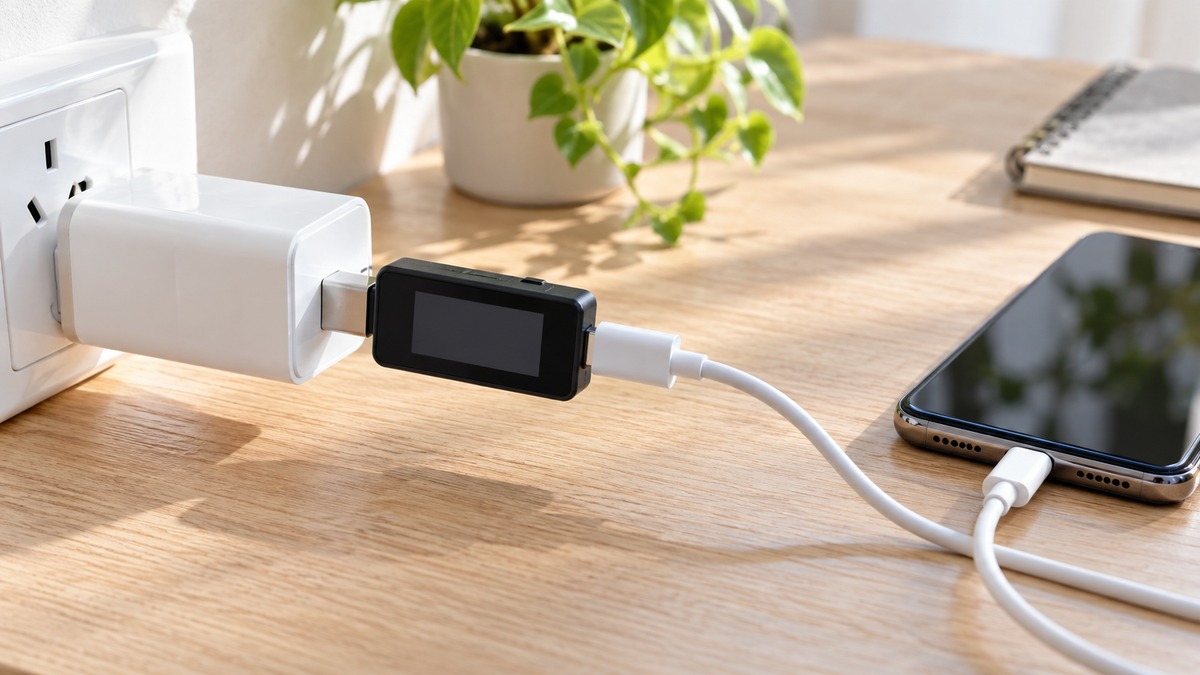
YOJOCK USB Tester Review: USB-C Voltage, Current and Capacity
As an Amazon Associate we earn from qualifying purchases. Details
If you are considering the YOJOCK USB tester, the first question is what you want to measure. This is a USB meter that reads voltage, current and capacity on a USB or USB-C line. It is not a meter for household wiring, and the listing does not state a CAT rating. Mains electricity can kill, so do not use this tool on wall outlets, panels or any circuit where the listing does not state a rating for that use. This review covers only what the listing states about input range, measurement functions, display, connectors and fast-charge modes. It does not report any test of the tester, and it does not describe how to measure a charger or a device. Use it to decide whether the listing matches your need.
Quick answer
The YOJOCK tester is a black, USB-powered digital meter listed with an input voltage range of 4.5 to 24.0 volts and a current range of 0 to 3.000 amps. It shows voltage, current, power, capacity and cable impedance on a 1.44-inch LCD, and it lists QC 2.0 and QC 3.0 fast-charge recognition. The listing says it supports Micro USB or Type C connectors. The listing does not state a CAT rating or a warranty term. It suits a reader who wants to check a USB charging line, and it is the wrong tool for mains work.
What to check in a USB tester
Four details decide whether this tester fits. Each one can rule it in or out.
1. Input range. The listing gives an input voltage of 4.5 to 24.0 volts and an input current of 0 to 3.000 amps. Those figures cover USB charging, not household voltage. A USB tester is not a substitute for a multimeter on a wall outlet. For a wider look at voltage meters, the best voltage meter tester guide compares the categories.
2. Measurement functions. The bullets and specs list voltage, current, power, capacity, energy, time and cable impedance, with a temperature range of minus 10 to 80 degrees Celsius. The voltage resolution is 0.01 volt and the current resolution is 0.001 amp. The listing gives accuracy of plus or minus 1 percent for both voltage and current. Read these against the job you have in mind.
3. Connectors and fast-charge modes. The bullets say the tester supports Micro USB or Type C, and it lists QC 2.0 and QC 3.0 fast-charge recognition. It has five connection ports, according to the bullets. The bullets also say the screen rotates 360 degrees, which helps when the tester is plugged in at an awkward angle.
4. Electrical rating and safety notes. The listing does not state a CAT rating for this tester. A CAT rating is a method of classifying live circuits used in measurement, and the source describes CAT II as circuits directly connected to the low-voltage installation, and CAT IV as the source of the high-voltage installation. A tester without a stated CAT rating is not a tool for household mains. The bullets note that if the display does not light up, you should flip the Type C cable and try again, and that both the charger and the device must support quick charge.
Use these rules to choose:
- Choose this tester if you want to read voltage, current and capacity on a USB or USB-C charging line, and you accept that the listing does not state a CAT rating.
- Choose a different tool if you need to measure mains voltage, because the listing gives an input range of 4.5 to 24.0 volts and no CAT rating.
- Choose a different tool if you need a stated warranty term, because the listing does not state one.
1. YOJOCK USB Tester Meter USB C Voltage Tester, 2-in-1 Digital USB Current Watt Multimeter, PD (Review verdict)
Specs from the listing (checked 2026-10-11):
- Input voltage: 4.5-24.0V
- Input current: 0-3.000A
- Voltage measurement accuracy: ±1%
- Fast charge recognition mode: QC2.0 QC3.0
- Item Weight: 0.04 kg
Pros
- Input range of 4.5 to 24.0 volts and current of 0 to 3.000 amps, per the specs
- Voltage, current, power, capacity and cable impedance readings, per the specs and bullets
- QC 2.0 and QC 3.0 fast-charge recognition, per the specs
Cons
- No CAT rating stated in the listing, so it is not a mains meter
- Power is not supplied by default unless both charger and device support quick charge
- No warranty term stated
Best for: A reader who wants to read voltage, current and capacity on a USB or USB-C charging line.
Skip if: Skip if you need a CAT rating, need to measure mains voltage, or need a stated warranty.
View on Amazon (affiliate link)
The YOJOCK USB tester
The YOJOCK tester is a digital USB meter with a 1.44-inch LCD, four operation buttons and five connection ports. The specs give the item weight as 0.04 kilograms, the color as black, and the power source as USB. The included component is the USB tester. The listing names the model as A3-FT and the part number as A3. The compatible devices list includes a PC, laptop, desktop computer, mobile phone, power bank, charger, car charger and cable.
The tester fits a reader who charges phones, tablets or power banks over USB and wants a quick look at the voltage, current and capacity on the line. The two-way display rotates and the screen brightness has six levels.
The listing has several things to check. The title says USB tester meter with a USB-C voltage tester and a power meter, and the bullets describe a Micro USB or Type C connector. The bullets say the tester can detect safety and protect devices, but the listing does not state a protection rating. The bullets also say the power is not supplied by default when the charger and the device do not both support quick charge, so the tester may not show a reading in that case.
Who should skip it: a reader who needs a CAT rating, a reader who needs to measure mains voltage, and a reader who needs a stated warranty.
Electrical safety first
Mains electricity can kill. A USB tester is built for low-voltage DC lines, and the listing’s input range of 4.5 to 24.0 volts reflects that use. Do not use it on a wall outlet, a light fixture, a panel or any circuit that is not a USB line. If you need to check mains wiring, use a meter whose listing states a CAT rating for that circuit, and follow its manual and your local electrical rules. The non-contact voltage tester vs multimeter comparison explains why the two tool types are not interchangeable. Panel and service work belongs to a licensed electrician.
Worked example: how far a 5-volt USB reading sits below the 24-volt top
Compare that reading with the top of the listed input range, so you can see how much room the range leaves.
- Top of the listed input range: 24.0 volts, from the specs.
- Reading in this example: 5 volts.
- Margin below the top: 24.0 minus 5 = 19.0 volts.
Check the arithmetic again. 24.0 minus 5 is 19.0.
The example shows that a 5-volt USB reading sits well inside the listed input range. It does not show how the tester behaves on your charger. Read the charger’s own label and the listing’s note on quick-charge support before you rely on a reading.
Why the connector is not the whole story
USB-C is a 24-pin reversible connector, according to the Wikipedia overview of USB-C. The source says the C refers only to the connector’s physical form, not to its capabilities, which depend on the protocols the cable, host and device support. A tester plugged into a USB-C port therefore shows what the whole chain delivers, and a connector that fits tells you nothing about how much power will flow.
What fast-charge recognition means
The listing says the tester recognizes QC 2.0 and QC 3.0. Quick Charge is a proprietary charging protocol from Qualcomm, and it works only when both the power supply and the device support it. If either side does not, the phone charges over standard USB, according to the same source. The Wikipedia USB hardware article says standard battery-charging specifications provide up to 7.5 watts, and that USB Power Delivery specifications reach up to 240 watts in the latest revision.
For a reader, the practical point is that a reading above the standard level suggests a negotiated fast-charge profile, and a lower reading may mean the charger or the cable is limiting the power. The listing’s bullets say the power is not supplied by default when both charger and device do not support quick charge, which matches that description. This review does not test any charger.
Five common mistakes
- Using it on mains. The listed input range is 4.5 to 24.0 volts, and the listing states no CAT rating.
- Expecting a reading without quick-charge support. The bullets say power is not supplied by default unless both sides support it.
- Trusting the connector alone. The bullets say to flip the Type C cable if the display does not light up.
- Assuming a warranty. The listing does not state a warranty term.
- Ignoring the model label. The listing names A3-FT, and the part number is A3.
FAQ
Is it rated for household mains?
No. The listing does not state a CAT rating, and its input range is 4.5 to 24.0 volts.
What does it measure?
The specs list voltage, current, power, capacity, energy, time and cable impedance.
What is the current range?
The listing gives an input current of 0 to 3.000 amps.
Does it support fast charging?
The listing gives QC 2.0 and QC 3.0 fast-charge recognition, and the bullets say both the charger and the device must support quick charge.
What connectors does it use?
The bullets say it supports Micro USB or Type C.
What is the display?
The bullets describe a 1.44-inch LCD that rotates 360 degrees.
Bottom line
The YOJOCK USB tester suits a reader who wants to read voltage, current and capacity on a USB or USB-C charging line, with Micro USB or Type C connectors and QC 2.0 or QC 3.0 recognition. The listing gives an input range of 4.5 to 24.0 volts, states no CAT rating, and gives no warranty term. It is not a mains meter. Mains electricity can kill, so use it only on low-voltage USB lines and follow the listing and the manual.
Sources
- Measurement category, Wikipedia: CAT II for circuits directly connected to the low-voltage installation, and CAT IV for the source of the high-voltage installation.
- USB-C, Wikipedia: a 24-pin reversible connector; the C names the physical form, not the capabilities.
- Quick Charge, Wikipedia: both device and charger must support it; standard USB charging is up to 7.5 watts.
- USB hardware, Wikipedia: USB Power Delivery specifications, from 60 watts in PD 1.0 to 240 watts in PD 3.1.