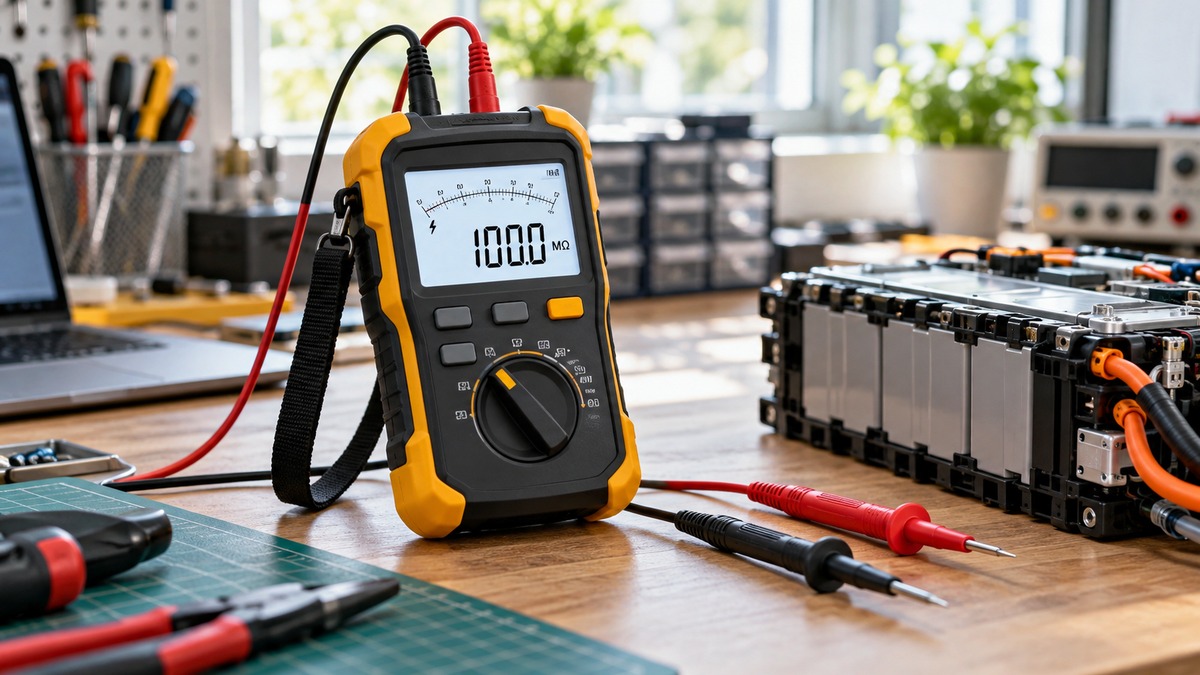
Gulitech VC60B+ Insulation Resistance Tester Review: Ranges and Safety
As an Amazon Associate we earn from qualifying purchases. Details
If you are considering the Gulitech VC60B+ insulation resistance tester, the first question is what it tests and whether its test voltages suit your work. An insulation tester applies a high test voltage, and that voltage can be dangerous to people and equipment. This review covers only what the listing states about test voltages, resistance ranges, display, safety notes, power and warranty. It does not report any test of the tester, and it does not describe how to run an insulation test. Use it to decide whether the listing matches your work, and follow the manual and your local electrical rules for any test.
Quick answer
The VC60B+ is a battery-powered insulation resistance tester with test voltages of 250, 500 and 1000 volts, and resistance ranges up to 4,999 megohms at 1000 volts. It also measures DC and AC voltage from 20 to 1000 volts. The listing gives a 1-year warranty and says it is not waterproof. Its listed display counts disagree across the title, bullets and specs, so confirm the count on the product page. The listing does not state a CAT category, so check the manual before you use it on any circuit.
What to check in an insulation resistance tester
Four details decide whether this tester fits. Each one can rule it in or out.
1. Test voltage and range. The listing gives three test voltages. At 250 volts it covers 0.4 to 999 megohms, at 500 volts it covers 0.6 to 1,999 megohms, and at 1000 volts it covers 0.8 to 4,999 megohms. Choose the test voltage that matches the equipment you test, and check the manual for the voltage the equipment allows. For a wider look at insulation testers, the insulation resistance tester guide compares the options.
2. Voltage measurement. The listing also gives DC voltage from plus or minus 20 to 1,000 volts and AC voltage from 20 to 750 volts. These are measuring functions, separate from the insulation test. Read the accuracy line for the function you use. For a general voltage meter comparison, the digital multimeter for home use guide covers that category.
3. Safety notes and rating. The bullets say the tester is certified to a safety standard written as 0T845.1, and that it has automatic voltage release, lockable test switches and alarm functions. The specs give different compliance markers: EMC, ISO 9001 and RoHS. The listing does not state a CAT category. The CAT system classifies live circuits used in measurement, and the source describes CAT II as circuits connected to the low-voltage installation and CAT IV as the source of the high-voltage installation. Check the rating before use on any circuit.
4. Display, battery and use conditions. The display counts differ. The title says 5,000 counts, the bullets say a dual 4,999-count LCD, and the specs say 2,000 digits. The listing gives eight 1.5-volt AA alkaline batteries or an AC adapter, a low battery symbol, and use indoors and outdoors at up to 2,000 meters above sea level. The tester is not waterproof, and the listing gives a moisture limit of 85 percent without condensation.
Use these rules to choose:
- Choose this tester if you need insulation resistance tests at 250, 500 or 1,000 volts, and you will confirm the rating and the display count.
- Choose a different tester if you need a stated CAT category on the listing, because this listing does not state one.
- Choose a different tester if you need a waterproof instrument, because the listing says it is not waterproof.
1. Victor Ohm Meters VC60B+ Digital Insulation Rresistance Tester Megohmmeter, DC AC Voltage Testing (Review verdict)
Specs from the listing (checked 2026-10-12):
- Range: 250V/0.4MΩ~999MΩ,500V/ 0.6MΩ~1999MΩ,1000V/ 0.8MΩ~4999MΩ
- Display Screen: displays in 2000 digits; white backlight
- Specification Met: EMC, ISO 9001, RoHS
- Warranty Description: 1 year warranty
- Battery Type: 8* 1.5V Alkaline (LR6) batteries
Pros
- Three test voltages, 250, 500 and 1,000 volts, per the specs
- Resistance ranges up to 4,999 megohms at 1,000 volts, per the specs
- One-year warranty, per the specs
Cons
- Display count differs across the title, bullets and specs
- No CAT category stated; the specs list EMC, ISO 9001 and RoHS
- Not waterproof, per the bullets
Best for: A reader who needs insulation resistance tests at three listed voltages and a basic voltage check, once the display count and rating are confirmed.
Skip if: Skip if you need a stated CAT category, a waterproof tester, or a confirmed display count.
View on Amazon (affiliate link)
The Gulitech VC60B+ insulation resistance tester
The VC60B+ is a handheld insulation resistance tester, also called a megohmmeter, with a white backlit display, an overrange indication and an automatic shut-down. The specs give the item weight as 0.5 kilograms, the color as multicolored and the warranty as one year. The included component is listed as the VC60B+ tester. The bullets describe a hand strap, simultaneous voltage and resistance display, and panel calibration.
The tester fits a reader who needs insulation resistance tests at the three listed voltages and a basic DC and AC voltage check in one unit. The hand strap and backlight help during long sessions and dim work spaces.
The listing has several things to check. The display count differs across the title, bullets and specs. The safety standard named in the bullets does not appear in the specs. The specs give the compliance markers as EMC, ISO 9001 and RoHS. The included-components field names only the model, so check the box contents. The bullets say the unit can be powered by an AC adapter or batteries without removing the batteries, but the adapter is not named in the specs.
Who should skip it: a reader who needs a stated CAT category, a reader who needs a waterproof tester, and a reader who needs a confirmed display count before buying.
Safety before any insulation test
Insulation testing applies a high test voltage, and that voltage can injure a person or damage equipment. Before any test, make sure the equipment is isolated and that the test is allowed by the equipment’s own instructions. The listing’s bullets describe automatic voltage release and lockable test switches, which are features to read in the manual, not a substitute for a safe setup.
Mains electricity can kill. The source explains that the CAT system classifies circuits, and that a meter’s category must suit the circuit’s position in the installation. The listing does not state a CAT category for this tester, so do not use it on a circuit you cannot confirm. Follow the manual for every step, and follow your local electrical rules. If the work is outside your training, ask a licensed electrician. This review does not describe how to run a test.
Battery and environment from the listing
The listing gives eight 1.5-volt alkaline batteries of type LR6, which are AA cells. The low battery symbol appears on the display when the batteries need replacing. The tester is rated for use indoors and outdoors at up to 2,000 meters above sea level, and the listing gives an operating temperature of 0 to 40 degrees Celsius. The bullets say the tester is not waterproof, so keep it dry.
Store the tester in a dry place, and check the leads and the case for damage before each use.
Worked example: how far a 500-volt test sits below the 1000-volt setting
Compare the two voltages, so you can see the margin between them.
- Highest listed test voltage: 1,000 volts.
- Test voltage in this example: 500 volts.
- Difference between them: 1,000 minus 500 = 500 volts.
Check the arithmetic again. 1,000 minus 500 is 500.
The example shows that a 500-volt test sits half the listed maximum below the 1,000-volt setting. The test voltage must match the equipment and the manual, and a higher setting is not a reason to choose one. Use the voltage the equipment’s instructions allow.
What an insulation test is for
A megohmmeter, also called an insulation resistance tester, measures the electrical resistance of insulators. The Wikipedia overview of the megohmmeter says insulating components, such as cable jackets, must be tested for insulation strength when equipment is commissioned and during maintenance of high-voltage installations. The same source says these instruments provide high DC voltages, typically from 500 volts to 5 kilovolts, and some reach 15 kilovolts. Acceptable insulation resistance is typically 1 to 10 megohms, depending on the standard used.
The VC60B+ listing gives test voltages of 250, 500 and 1,000 volts. The 500-volt and 1,000-volt settings sit inside the typical 500-volt to 5-kilovolt range the source describes. The 250-volt setting sits below that range, so check the test standard for the equipment you plan to test before you choose a setting. The listing does not state which standard its settings follow.
Reading the display and the test
The bullets describe an overrange indication and an automatic shut-down, and the specs list simultaneous voltage and resistance display. The listing does not describe a test procedure. The Wikipedia overview describes the older analog megger, where a hand-cranked generator produces the test voltage, and an electronic type where a battery does. The overview says the reading depends on how the test voltage and current interact, and that an open circuit reads as infinity while a short reads as zero.
This review does not explain how to run an insulation test on any equipment. Follow the equipment’s instructions, the tester’s manual and your local electrical rules, and ask a licensed electrician to run a test on any installation.
Five common mistakes
- Trusting one display count. The title says 5,000, the bullets say 4,999, and the specs say 2,000 digits.
- Assuming a CAT category. The listing does not state one.
- Trusting the safety standard as stated in the specs. The bullets name a standard that the specs do not list.
- Using it in wet conditions. The listing says it is not waterproof.
- Skipping the manual. Follow the manual for every test step and the isolation of the equipment.
FAQ
What test voltages does it offer?
The listing gives 250, 500 and 1,000 volts.
What resistance range does it cover?
The listing gives 0.4 to 999 megohms at 250 volts, 0.6 to 1,999 megohms at 500 volts, and 0.8 to 4,999 megohms at 1,000 volts.
What power does it use?
The listing gives eight 1.5-volt alkaline AA batteries, and the bullets mention an AC adapter.
Is it waterproof?
No. According to the listing, the tester is not built to be waterproof, so keep it dry.
Does it come with a warranty?
The specs give a one-year warranty.
Does it have a CAT rating?
The listing does not state a CAT category, so check the manual before use on any circuit.
Bottom line
The VC60B+ suits a reader who needs insulation resistance tests at 250, 500 or 1,000 volts and a basic voltage check in one unit, after confirming the display count and the rating. The listing does not state a CAT category, its display counts disagree, and it is not waterproof. Before use, read the manual, isolate the equipment, follow the equipment’s instructions, and follow your local electrical rules. Mains electricity can kill.
Sources
- Measurement category, Wikipedia: CAT II for circuits directly connected to the low-voltage installation, and CAT IV for the source of the high-voltage installation.
- Megohmmeter, Wikipedia: typical megohmmeter test voltages from 500 V to 5 kV, and acceptable insulation resistance of about 1 to 10 megohms depending on the standard.
- OSHA, Electrical overview: electrical hazards and the ways to reduce the risk of injury.