Agilent 34410A Digital Multimeter: What the Datasheet Says
As an Amazon Associate we earn from qualifying purchases.
Agilent 34410A Digital Multimeter: What the Datasheet Says
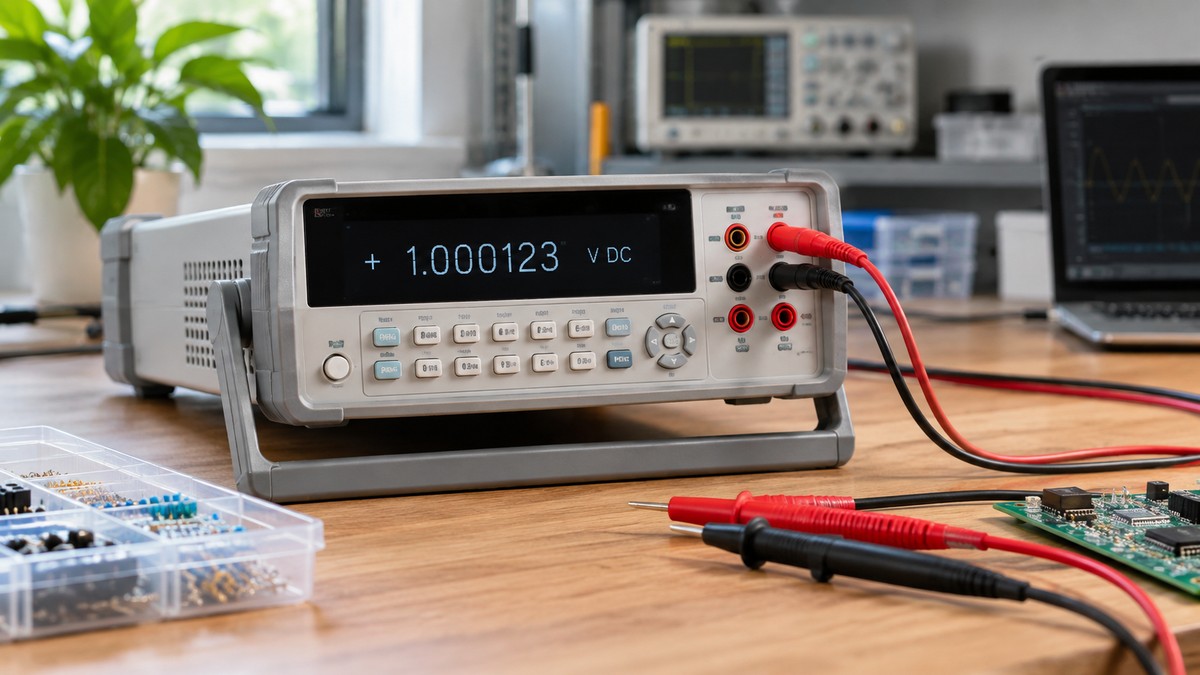
The Agilent 34410A is a 6½-digit bench digital multimeter, now sold under the Keysight name. Keysight’s data sheet describes it as a high-performance meter that follows the 34401A, with 30 ppm basic one-year DC accuracy, LAN, USB and GPIB interfaces, and a data logger. It covers DC and AC voltage and current, two- and four-wire resistance, frequency, period, continuity, diode, capacitance and temperature. The same data sheet also covers the faster 34411A. The data sheet also states a measurement category rating, covered below.
Quick answer
- 6½-digit resolution, with 30 ppm basic one-year DC accuracy (data sheet, page 2).
- Up to 10,000 readings per second at 5½ digits, or 1,000 readings per second at 6½ digits, sent direct to a PC (page 2).
- A data logger with 50 k readings of non-volatile memory (page 2).
- LAN, USB and GPIB standard (page 2).
- The data sheet states Measurement CAT II 300 V and CAT I 1000 V, with Pollution Degree 2 (page 6). Read that line before using the meter on any circuit.
What the 34410A is for
Its listed resolution, accuracy and logging suit work where small differences matter. The data sheet’s own framing is about measurement confidence and throughput. It describes the 34410A as a next step from the 34401A, with improved accuracy, expanded ranges, and faster throughput through modern interfaces.
The useful question is whether your work needs the resolution and logging the data sheet describes, or whether a simpler meter does the job.
The figures the datasheet publishes
The table below lists only figures printed in the data sheet we opened. Accuracy is given as a percent or parts-per-million term of reading plus a term of range, and it applies under the conditions in the data sheet’s footnotes.
| Item | What the data sheet states | Page |
|---|---|---|
| Resolution | 6½ digits for the 34410A (the 34411A is also 6½ digits) | 2 |
| Basic DC accuracy | 30 ppm, one year | 2 |
| Reading rate | 10,000 readings/s at 5½ digits, or 1,000 readings/s at 6½ digits, direct to PC | 2 |
| Memory | Data logger with 50 k readings of non-volatile memory | 2 |
| Interfaces | LAN, USB and GPIB standard | 2 |
| DC current | Ranges expanded down to 100 µA, giving 100 pA resolution | 2 |
| Current shunts and fuse | Shunt values listed for 100 µA to 3 A ranges; 3 A, 250 V fuse on current input | 4, 6 |
| Input protection (voltage) | 1000 V on all ranges | 6 |
| Safety rating | Measurement CAT II 300 V, CAT I 1000 V; Pollution Degree 2 | 6 |
| Line power | 100 V, 120 V, 220 V or 240 V, ±10 %; 45 Hz to 66 Hz and 360 Hz to 440 Hz | 6 |
| Power consumption | 25 VA | 6 |
| Warranty | 1 year | 6 |
How the accuracy is specified
The 30 ppm figure is a basic one-year DC accuracy, which is the headline number. The data sheet attaches conditions to it: a warm-up period, a long integration time, and calibration standards. The table for each function then gives a more detailed accuracy for each range and integration setting. Compare meters on the same range and the same integration time, or the numbers are not comparable.
The data sheet also covers the 34411A, which trades resolution for speed. Its listed reading rate is 50,000 readings per second at 4½ digits. If your work needs fast capture, check which model’s rate figure you are reading.
Current measurement and the shunts
The DC current ranges go down to 100 µA, which the data sheet says gives 100 pA resolution. The current path uses shunts. The data sheet lists a 200 Ω shunt for the 100 µA and 1 mA ranges, a 2 Ω shunt for 10 mA and 100 mA, and a 0.1 Ω shunt for 1 A and 3 A. The 3 A input is protected by a 250 V fuse.
This matters in practice. When you put the meter in series to read current, you add its shunt resistance to the circuit. On the higher current ranges the shunt is small, but on the 100 µA and 1 mA ranges it is 200 Ω, which can change a low-current circuit. Check the shunt value before you measure a sensitive circuit, and keep the current input fuse rating in mind.
Voltage input and protection
The data sheet’s input protection line lists 1000 V on all ranges. That is a protection rating, not a promise that the meter is suitable for any test at that voltage. Work out the highest voltage the circuit can produce, and compare it with the measurement category and the input limits on the data sheet.
Safety rating: read it before you buy
The data sheet lists safety compliance with IEC 61010-1, EN 61010-1, UL 61010-1 and CAN/CSA-C22.2 No. 61010-1. It then states Measurement CAT II 300 V and CAT I 1000 V, with Pollution Degree 2. In practice that means the meter is rated for measurements on certain circuits at stated voltages. It does not mean it is rated for service-panel or main-supply work. Mains work belongs to a licensed electrician, and you should choose a meter whose rating matches the circuit and category you will test.
If you want to measure household outlets, read the category line carefully and compare it with the circuit. A CAT II 300 V rating does not cover every point in a service entrance.
Power and environment
The data sheet lists a line supply of 100 V, 120 V, 220 V or 240 V, each ±10 percent, and a line frequency of 45 Hz to 66 Hz or 360 Hz to 440 Hz, sensed at power-on. Power consumption is listed as 25 VA. Check that your bench supply matches before you connect it.
What to check before you buy
- Your resolution need. The 34410A is 6½ digits. If you only need 3½ or 4½ digits for everyday work, a simpler meter may be enough.
- Your speed need. The 10,000 readings per second figure is at 5½ digits. If you need faster capture, read the 34411A rate figure in the same data sheet.
- Your interface. LAN, USB and GPIB are all standard, so check which one your PC or rack uses.
- Your current measurements. Confirm the shunt values and the 3 A, 250 V fuse before using the meter in series.
- Your safety category. Match the CAT rating to the circuit, and do not rely on the voltage protection figure alone.
- Your warranty. The data sheet lists a one-year warranty.
Common mistakes to avoid
- Comparing the 30 ppm headline figure with another meter’s headline figure without checking the range and integration time.
- Reading the 10,000 readings per second figure as if it applied at 6½ digits. The data sheet gives 1,000 readings per second at 6½ digits.
- Putting the meter in series on a sensitive low-current circuit without checking the shunt value.
- Treating the 1000 V input protection figure as a safety rating for the whole measurement.
How we chose
This article covers the 34410A because it is on this batch’s list of models. We did not rank it against other meters. The figures come only from the Keysight data sheet we opened on 2026-10-27, and each figure is attributed to a page. The data sheet covers the 34410A and the 34411A together, and we used only the 34410A figures and the shared general specifications.
What we could not verify
The copy of the data sheet we opened is hosted on a third-party site. The official Keysight product page did not come up in our search, so we did not compare revisions. The data sheet pages we read do not give a price or a full accessory list, and they do not give the figures for every range and integration setting. The data sheet is one document, so the three sources we used are three pages of it.
FAQ
Is the 34410A a handheld multimeter?
It is a bench instrument with LAN, USB and GPIB interfaces, and the data sheet presents it that way. For handheld field work, look at a meter sold for that purpose.
What does 6½-digit mean?
It means the display can show six full digits plus a half digit, which gives finer resolution than a 3½ or 4½-digit meter. The data sheet lists 6½-digit resolution for the 34410A.
Can it log readings without a PC?
Yes. The data sheet lists a data logger function with 50 k readings of non-volatile memory, which can make paced measurements over a fixed time or number of events.
Is it rated for household wiring?
The data sheet lists Measurement CAT II 300 V and CAT I 1000 V. That is a specific rating for specific circuits, not a general approval for household or service-panel work. Check the category against the circuit before use.
What is the difference between the 34410A and the 34411A?
The data sheet describes the 34411A as the enhanced model, with 50,000 readings per second at 4½ digits, a 1 million reading volatile memory, analog level triggering and programmable pre- and post-triggering.
Bottom line
The 34410A is a 6½-digit bench multimeter with fast readings, a data logger and standard LAN, USB and GPIB interfaces. Choose it for precise bench and logging work, and read the shunt, fuse and safety category lines before you use it on a circuit. For household or automotive electrical checks, a simpler meter with a clear CAT rating is usually the better fit. For a quick comparison of meter types, see our guides to true RMS multimeters and multimeters for electricians.
Sources
- Keysight Technologies, 34410A and 34411A Multimeters Data Sheet, document 5989-3738EN, page 2 (features, accuracy, reading rates, memory). Opened 2026-10-27 from a copy hosted at https://docs.ampnuts.ru/eevblog.docs/HP_Agilent_Keysight/English%20_%202013-04-02%20_%20PDF%20178%20KB%205989-3738EN%20c20140829%20%5B8%5D.pdf
- Same data sheet, page 4 (DC current ranges and resolution). Opened 2026-10-27 from the same copy.
- Same data sheet, page 6 (input protection, current shunts, safety ratings, power and warranty). Opened 2026-10-27 from the same copy.