Best Volt Meter Display: Specs and Fit Compared
As an Amazon Associate we earn from qualifying purchases. Details
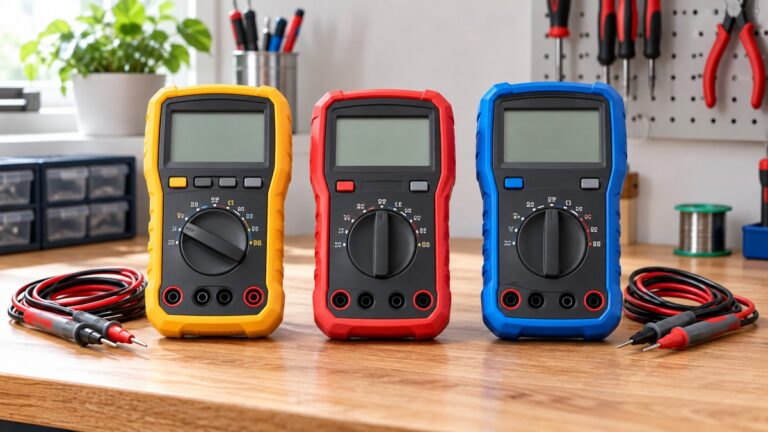
Three digital multimeters are covered here, each with a voltage function and a digital display. None of the listings is a standalone volt meter display unit that works apart from a meter body, so the picks are multimeters. The listing data was checked on 11 October 2026. A plug-in energy monitor and an EMF meter in the same research file were left out, because their listings describe appliance power and field readings rather than a volt meter.
Quick answer: for reading a 12 V car battery, the AstroAI listing gives the most detail: a 2000-count display, a named 20 V range and a DC accuracy figure. The ANENG listing states a similar 2000-count display with a stated accuracy and a capacitance function. The LJPXHHU listing gives a backlit 2.7-inch display but no accuracy figure, so it is the hardest of the three to check against a number.
The three picks at a glance
| Meter | Display (as listed) | DC voltage ranges (as listed) | Accuracy figure stated |
|---|---|---|---|
| AstroAI 2000 Counts (B01ISAMUA6) | 2000 counts, 3 1/2 digit | 200 mV, 2 V, 20 V, 200 V, 600 V | DC: ±(0.5% + 3) |
| LJPXHHU 2000 Counts (B0CXM242J1) | 2000 counts, 2.7-inch backlit LCD | Not listed | Not stated |
| ANENG SZ301 (B0BYD32JZV) | 2000 max count, LED screen | 200 mV to 600 V (span only) | DC: ±(1% + 5) |
1. AstroAI Digital Multimeter 2000 Counts
The listing states a 2000-count, 3 1/2 digit display, with DC voltage ranges of 200 mV, 2 V, 20 V, 200 V and 600 V, each at ±(0.5% + 3). Its AC voltage ranges are 200 V and 600 V at ±(0.8% + 5). The DC current ranges are 200 µA, 200 mA and 10 A, and the resistance ranges run from 200 Ω to 200 kΩ. It samples three times a second and runs on two 1.5 V AAA batteries. The listing gives fuses of F250 mA/250 V and F10 A/250 V, and a rating of CAT II 600 V, CAT III 300 V. Data checked 11 October 2026.
The figures disagree in one place. The title says the meter measures “Current”, while a bullet says it measures DC current and “can not test all AC Current”. A second bullet says it cannot read AC voltage below 100 mV. A separate field in the same listing names a 9 V 6F22 battery among the included components, while the power field says two 1.5 V AAA batteries. Both are shown here as the seller states them.
Check the AstroAI 2000 Counts Multimeter on Amazon
2. LJPXHHU Digital Multimeter 2000 Counts
The listing states 2000 counts on a 2.7-inch backlit LCD, with a data hold function and a low-battery indicator. It says the meter measures AC and DC voltage, DC current, resistance, continuity, diodes and batteries, and that it has overload protection on all ranges. The listed weight is 166 g, the dimensions are 5.51 x 2.56 x 1.18 inches, and the model is XL830L. The listing gives no range table and no accuracy figure, and it does not name a battery type. Data checked 11 October 2026.
Check the LJPXHHU 2000 Counts Multimeter on Amazon
3. ANENG SZ301 Digital Multimeter
The listing states a maximum count of 2000 on an LED screen. Its DC voltage range runs from 200 mV to 600 V at ±(1% + 5), and its AC voltage range runs from 200 mV to 600 V at ±(2.0% + 10). It lists DC and AC current from 2 mA to 10 A, resistance from 0 Ω to 200 MΩ, and capacitance from 0 nF to 2 mF at ±(5% + 10). It includes NCV sensing and a battery test for 12 V, 9 V and 7.5 V batteries, and it weighs 155 g. The DC range is given as a span, so the 20 V range is not named in the listing. Data checked 11 October 2026.
Check the ANENG SZ301 Multimeter on Amazon
Worked example: reading a 12.6 V battery
A 2000-count display on a 20 V range gives 20 V divided by 2000, which is 0.01 V per count. A 12.6 V battery therefore reads to two decimal places, and 12.60 V is the finest reading that range can show. The AstroAI DC figure is ±(0.5% + 3 counts). At 12.6 V, 0.5% is 0.063 V and 3 counts is 0.03 V, so the total is ±0.093 V. A reading between about 12.51 V and 12.69 V falls within the listed accuracy.
The ANENG figure is ±(1% + 5 counts). At 12.6 V, 1% is 0.126 V and 5 counts is 0.05 V, a total of ±0.176 V, or about 12.42 V to 12.78 V. The ANENG listing does not name a 20 V range, so this sum assumes the same 2000-count, 0.01 V step. The LJPXHHU listing gives no accuracy figure, so the same sum cannot be worked for it.
What the display does and does not show
The keyword asked about a volt meter display. The three listings describe digital multimeters with a built-in screen and a rotary function switch. None of them lists a display that can be mounted or used apart from the meter. The screen counts are the number of steps the display can show, not a measure of how bright or readable the screen is, and the listings do not compare screen brightness in a way that can be checked.
How the picks were chosen
Each pick is a multimeter whose listing names a voltage function and a digital display count. The selection uses only the listing data. The site has not used or tested any of these meters, and no reading here is a measurement made by the site.
- Stated display: a count or screen type the listing gives.
- Stated ranges: the voltage range table where the listing gives one.
- Accuracy figure: a DC accuracy figure, where one is stated.
Fit by use
- Car battery checks: the AstroAI listing names a 20 V range and a DC accuracy figure, so a result can be checked against a number.
- Capacitor checks: the ANENG listing is the only one of the three that states capacitance, from 0 nF to 2 mF.
- Simple continuity and battery checks: the LJPXHHU listing states a continuity buzzer and a battery test, with a larger 2.7-inch backlit screen.
What the listings do not say
None of the three listings gives a battery life figure. The LJPXHHU listing gives no power type and no voltage range table. The AstroAI title and bullets disagree on current, and its battery field disagrees with its included-components field, as shown above. The ANENG listing states a 0 nF to 2 mF capacitance range but gives no accuracy figure for capacitance beyond the ±(5% + 10) shown. None of the listings gives an independent test result.
Frequently asked questions
Is a volt meter display the same as a digital multimeter?
The three listings are digital multimeters with a built-in display. None lists a separate display unit that can be mounted or used apart from the meter body.
How fine a reading does a 2000-count display give?
The AstroAI and ANENG listings both state 2000 counts. On a 20 V range that is 0.01 V per count, so a 12.6 V reading shows two decimal places.
Which of these measures AC current?
The ANENG listing states AC current from 2 mA to 10 A. The AstroAI listing says it cannot test all AC current, and the LJPXHHU listing names DC current only.
Which one has a capacitance function?
Only the ANENG SZ301 listing states capacitance, from 0 nF to 2 mF. The AstroAI and LJPXHHU listings do not mention it.
What batteries do these meters use?
The AstroAI power field states two 1.5 V AAA batteries, while its included-components field names a 9 V battery, so check the battery when the meter arrives. The ANENG listing gives battery test ranges but does not state its own battery type, and the LJPXHHU listing does not state one.
Conclusion
For a car battery, the AstroAI listing gives the most checkable figures: a 20 V range, a 2000-count display and a DC accuracy figure. For a meter that also lists capacitance, the ANENG SZ301 is the one to compare. The LJPXHHU listing suits basic continuity and battery checks, but it gives no accuracy figure to test a reading against.
For related meters, see best digital volt meter, best DC volt meter, and best multimeter. For a car-specific option, see best digital voltage meter for car.
AstroAI 2000 Counts on Amazon · LJPXHHU 2000 Counts on Amazon · ANENG SZ301 on Amazon