Keithley DMM6500 Explained: Specs, Uses and What to Check
As an Amazon Associate we earn from qualifying purchases.
Keithley’s DMM6500 is a 6.5-digit bench multimeter, sold under the Keithley name and now part of Tektronix. This explainer covers what the meter measures, how to read its published specification sheet, and the points to check before buying. It draws on the manufacturer’s specification sheet, its product page and its flyer. Where those documents do not give a figure, the text says so rather than filling the gap.
Quick answer
- The Keithley DMM6500 is a 6.5-digit bench multimeter. The manufacturer describes it as having up to 15 built-in measurement functions, including digitizing, capacitance and temperature.
- Its published sensitivity figures start at 100 nV for voltage, 10 pA for current and 1 µΩ for resistance.
- The manufacturer lists a standard 3-year warranty on the product page.
- The specification sheet the manufacturer publishes gives accuracy as percent of reading plus percent of range, for 24-hour, 90-day, 1-year and 2-year periods. Read the period that matches your calibration plan.
- The sources we opened do not state a CAT rating for the DMM6500. Do not assume a safety category for mains work. Check the instruction manual.
What a bench 6.5-digit multimeter is
A bench multimeter sits on a table and is powered from the mains. It is built for lab, production and calibration work, where you need more resolution and more stable readings than a handheld meter usually gives. “6.5 digits” means the display can show a reading with six full digits plus a leading digit that can only be 0 or 1. In practice this gives many more decimal places of resolution than a common 3.5 or 4.5-digit handheld meter.
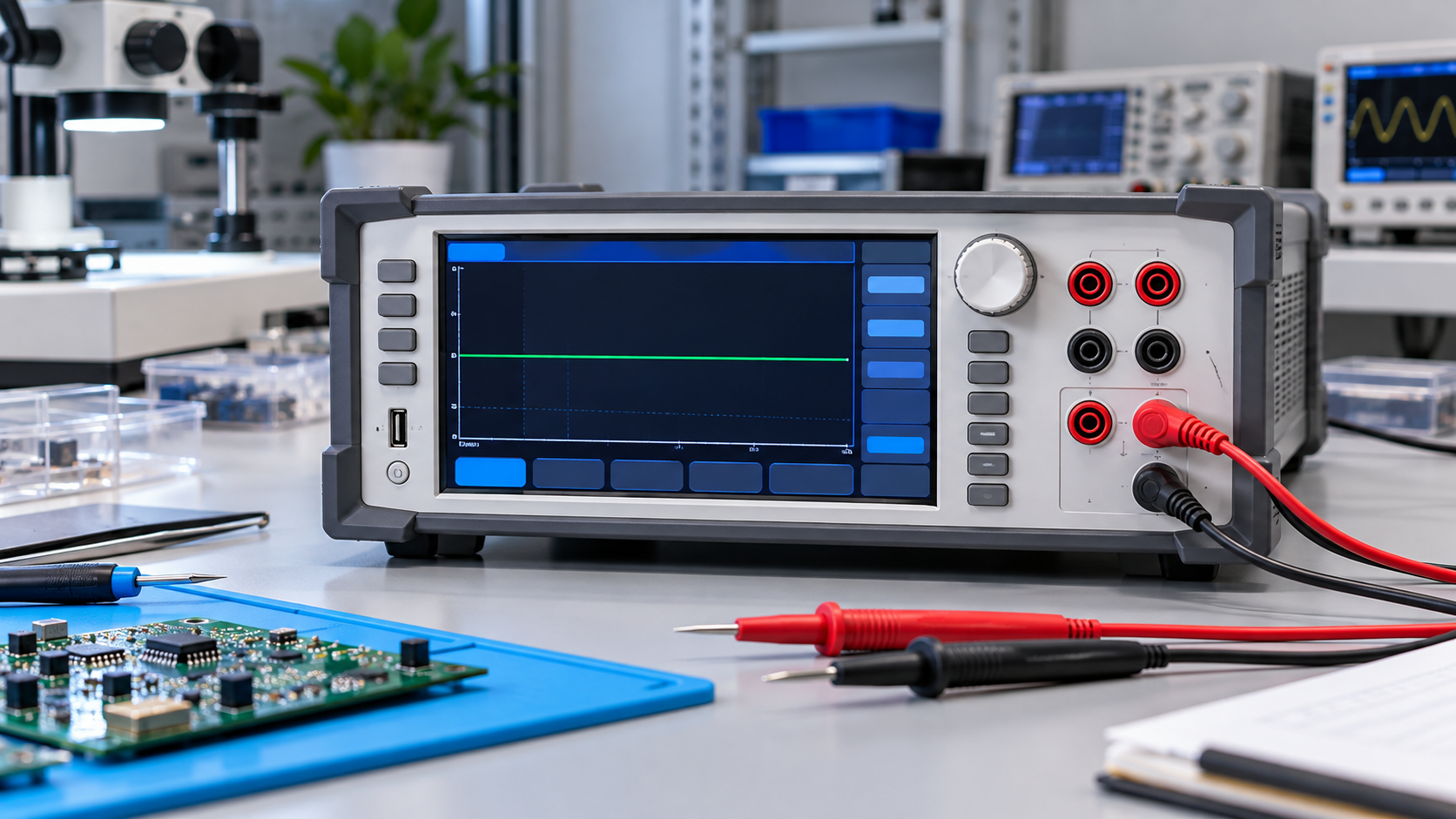
The DMM6500 belongs to this class. The manufacturer describes it as a “6½-digit bench/system multimeter,” and the specification sheet uses the same description. A bench meter like this is usually chosen for work such as bench-testing electronic components, checking low-voltage power supplies, logging readings over time or sending measurements to a computer.
Resolution and accuracy are not the same thing. Resolution is the smallest step the display can show. Accuracy is how close the reading is to the true value, and it depends on the range, the period since calibration and the temperature. A meter can show many digits and still be less accurate than its display suggests.
What the manufacturer says the DMM6500 measures
The Tektronix product page for the DMM6500 says the meter has up to 15 built-in measurement functions. The page names digitizing, capacitance and temperature among them. The manufacturer’s flyer for the DMM6500 and the DAQ6510 data acquisition system lists voltage, current and resistance ranges, along with capacitance up to 100 µF.
The published sensitivity figures are:
| Quantity | Published figure |
|---|---|
| DC voltage sensitivity | 100 nV |
| Current sensitivity | 10 pA |
| Resistance sensitivity | 1 µΩ |
| Digitizer | 1 MS/s, 16-bit |
The product page also describes the built-in digitizer as sampling at up to 1 million samples per second with 16-bit resolution. The flyer says the meter can capture waveforms and transients on its touchscreen, with pinch-and-zoom, cursors and statistics. That is useful for watching a signal change over time, not just for taking a single steady reading.
The flyer also states a 10 A current range, and it gives a 0.0025 % basic DC voltage accuracy figure. Treat that headline figure as a starting point only. The full accuracy depends on the range and the period in the specification sheet.
Reading the specification sheet
The Keithley specification sheet is titled “6½ Digit Bench/System Multimeter Specifications” and is marked Rev. A, April 2018. It is 14 pages long. The sheet states that supplemental and typical values are non-warranted and apply at 23 °C. Those are the figures to read carefully.
The DC voltage table is split by range. Each range has a resolution, an input impedance and an accuracy column for each period. The table uses two terms:
- Percent of reading: the error that scales with the value you are measuring.
- Percent of range: the error tied to the range you selected, which stays the same whatever the reading.
Accuracy is written as a sum of these two terms, for example “0.0025 + 0.0005”. To estimate the error on a reading, multiply the first number by the reading, multiply the second by the full scale of the range, and add them together. The sheet includes separate tables for resistance, current, temperature sensors and AC voltage, so you need the table for the function you actually plan to use.
The specification sheet also lists the power line frequencies the meter accepts, which it senses automatically at power-up. It lists its safety compliance as NRTL listed to UL 61010-1 and CSA C22.2 No. 61010-1, and says the product conforms to the European Union Low Voltage Directive. The sheet also lists front and rear safety banana jacks, and it notes a fuse on the 11 A and 1000 V input path.
What the sources do not state
We opened three documents for this article. None of them gives a CAT rating for the DMM6500, and the specification sheet we read does not mention measurement categories at all. Earlier search results from resellers mention a CAT II rating, but those are secondary listings and we did not verify them against the manufacturer. Do not take a reseller’s category label as the rating.
The sources also do not give the instrument’s physical size or weight in the sections we read, and they do not describe the touchscreen’s exact size. If those matter to your bench, check the dimensions in the manual or on the manufacturer’s page.
The specification sheet we opened is dated April 2018. The Tektronix product page is more recent, but the revision number on the sheet is what sets the accuracy values. Check tek.com for the current revision before you rely on any accuracy figure in a purchase decision or a calibration plan.
Who this meter suits
The DMM6500 is aimed at people who need a benchtop instrument with more resolution than a handheld meter, and who want to capture changing signals or record readings over time. It is a poor match for a person who only checks batteries, household outlets or car circuits. For those tasks a handheld meter with a clear CAT rating and a set of fused test leads is the more suitable tool, and it costs less to maintain.
The manufacturer lists both LAN LXI and USB as standard interfaces. GPIB, RS-232 and TSP-Link are optional, and the sources say they are user-installable accessories. If your system uses GPIB, confirm the accessory is included before ordering.
The DMM6500 can emulate the command set of the Keithley 2000 and the Keysight 34401A, according to the flyer. That helps if you already have test code written for those instruments. Check the emulation details in the manual against your own code before you rely on it.
Checks before you buy
- Confirm the measurement functions you need. The meter has many functions, but you may only use three or four. Match those to the specification table for each.
- Choose the accuracy period. A 90-day figure and a 2-year figure differ, and your calibration schedule decides which applies.
- Check the interfaces. LAN and USB come standard. Add GPIB, RS-232 or TSP-Link only if your system needs them.
- Check the safety rating in the manual for the exact model and option you plan to buy. Do not assume a rating from a listing.
- Plan for the leads. The sources we opened do not describe the leads included with the meter. Test leads for the meter are sold separately in the manufacturer’s accessory list, so count them in your budget.
- Confirm the warranty terms. The product page says 3 years. Read the warranty terms in the manufacturer’s documentation for the model you buy.
Mistakes to avoid
Do not buy on resolution alone. A 6.5-digit display shows more decimal places than a handheld meter, but the accuracy figure decides whether those extra digits mean anything.
Do not use a bench meter on a live mains circuit without knowing its safety rating and the rating of the leads you plan to use. Work on mains wiring can cause electric shock or fire. If you are not sure, leave panel and service work to a licensed electrician.
Do not read the “typical” values as guarantees. The specification sheet says supplemental and typical values are not warranted. Use the specified accuracy values for any decision that matters.
FAQ
Is the DMM6500 a multimeter or a data acquisition system?
It is a 6.5-digit bench multimeter. The flyer describes a separate DAQ6510 data acquisition system that combines the DMM6500 with plug-in switching modules.
Does the DMM6500 measure capacitance?
The product page lists capacitance among its built-in measurement functions. The flyer lists a capacitance range up to 100 µF. Check the specification sheet for the accuracy table for capacitance before you rely on the figure.
What does the 3-year warranty cover?
The product page states a standard 3-year warranty. The sources do not list the exclusions. Read the warranty document for your exact model.
What is the basic DC voltage accuracy?
The flyer quotes 0.0025 % basic DC voltage accuracy. The full figure depends on the range and the period in the specification sheet.
Is there a CAT rating for the DMM6500?
The sources we opened do not state one. Check the instruction manual for the model you buy.
Bottom line
Buy the DMM6500 only if you need bench-level resolution, waveform capture or logging, and you have read the accuracy table for the function and period you plan to use. If your work is mains or automotive checking, choose a handheld meter with a clear CAT rating instead.
How we chose
This article covers one model in one post, because a reader who searches for the model needs its published figures and its buying checks together. We read the manufacturer’s own documents first. Where the original was not reachable to us, we opened a copy hosted elsewhere and say so in the source list. We did not use reseller listings, forums or used-equipment pages as a source for any figure. Every number quoted is one printed in a document we opened, with its revision or date where the document gives one.
What we could not verify
None of the sources gives a CAT rating or a measurement category for the DMM6500, so this article does not state one.
The specification sheet is Rev. A dated April 2018, and the product page we read does not show a revision date. Check the current revision before relying on an accuracy figure.
The sources do not give physical size, weight or warranty exclusions. Availability is not covered here.
Sources
- Keithley, “DMM6500 6½ Digit Bench/System Multimeter Specifications,” SPEC-DMM6500 Rev. A, April 2018. Opened and read, hosted at https://xDevs.com/doc/Keithley/DMM6500/doc/SPEC-DMM6500A_April_2018.pdf
- Tektronix, “Keithley DMM6500 6.5 Digit Multimeter with Graphical Touchscreen,” product page. Opened and read, https://www.tek.com/tektronix-and-keithley-digital-multimeter/dmm6500
- Keithley/Tektronix, “DAQ6510 Data Acquisition and DMM6500 6½-Digit Bench/Logging Multimeter System,” flyer 1KW-61384-0, 2018. Opened and read, https://xdevs.com/doc/Keithley/DMM6500/doc/1KW-61384-0_DMM6500_DAQ6510%2520Flyer_042518.pdf
Related guides: Best Digital Multimeters, How to Read Multimeter Symbols and Dial Positions, Best Digital Multimeters for Electrical Work: Specs Compared.