Digital Amp Gauge: How a Digital Meter Reads Current
As an Amazon Associate we earn from qualifying purchases.
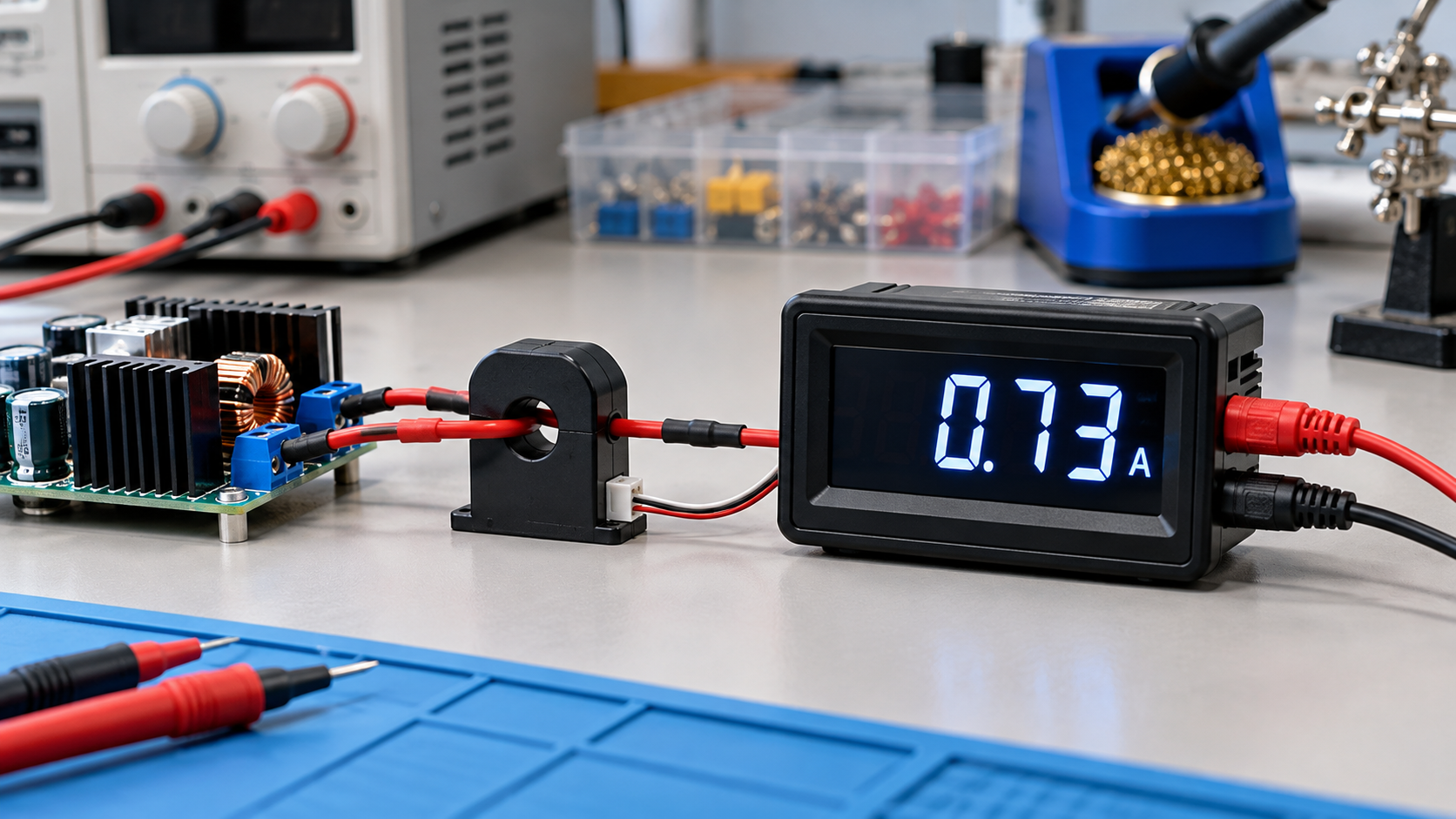
A digital amp gauge is a digital meter that shows electric current in amperes. It works in one of two ways: a probe-style meter that you connect in series in the circuit, or a clamp meter that senses the magnetic field around one conductor and does not need the circuit broken. Which one you need depends on whether you can open the circuit safely and whether the current is AC, DC or both.
Quick answer
- A digital amp gauge reads current in amps. Probe-style meters go in series with the load; clamp meters read current around a single conductor.
- An ammeter must be connected in series. Connected across a voltage source, it can draw a large current and damage the meter or the circuit.
- Clamp meters read current without breaking the circuit. Many clamps read AC only, and some read both AC and DC.
- Check the current range, the DC capability and the fuse ratings in the listing before you buy or connect anything.
How a digital amp gauge reads current
Current is the flow of charge through a conductor, measured in amperes. A meter that displays amps has to respond to that flow. Two methods are common.
Series measurement. The meter becomes part of the path. Current flows through the meter, which has a very low internal resistance so it does not change the circuit much. A university physics lab page states the rule plainly: “Ammeters MUST be connected in series.” The same page warns that connecting an ammeter in parallel with a resistor sends a large current through the meter’s internal resistance, which can burn out the circuit.
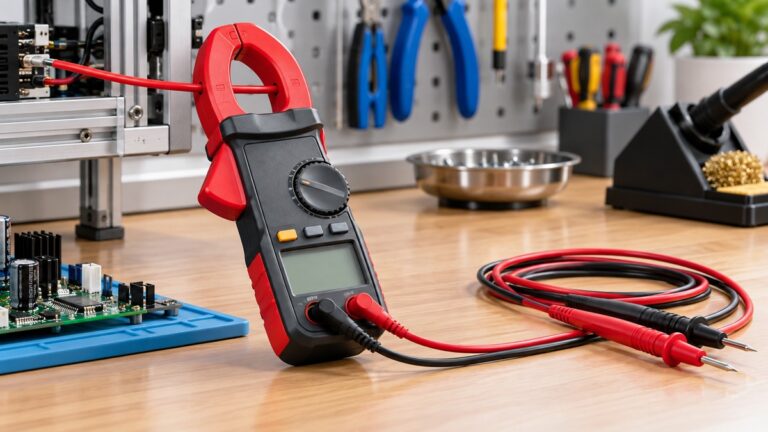
Clamp measurement. The jaws open around one conductor. According to Fluke’s explainer on clamp meters, the jaws are made of ferrite iron that concentrates the magnetic field produced by the current, and a Hall effect sensor converts that field into an electrical signal. Because the wire does not have to be disconnected, clamp meters are used for live checks where opening the circuit is not practical.
The two methods are not interchangeable. A clamp reads the field around the conductor you enclose, so a second conductor nearby can distort the reading. Zeroing the clamp before use helps offset outside magnetic influence, as Fluke’s explainer notes.
AC, DC and the sensor question
Whether a digital amp gauge measures AC, DC or both depends on its sensor. Fluke’s explainer says Hall effect clamp meters measure both alternating current and direct current. It also says current transformer clamps and flexible Rogowski-coil clamps measure AC only. So a listing that says “AC current clamp” should not be read as a DC current meter.
The listings in our research file show the same split. One digital multimeter listing states DC current ranges of 200 µA, 200 mA and 10 A, and a 10 A fuse. A separate clamp listing states an AC auto-ranging range up to 400 A and says it is a clamp meter for AC current. The listing does not give a DC current range for the clamp, so it should not be used for DC current work without confirming the spec.
Current ranges and fuses: what the listings state
The table below uses only figures in the listing text or the research file. Where a listing does not state a figure, the cell says so.
| Feature | Digital multimeter listing (AM33D) | Clamp meter listing (CL120) |
|---|---|---|
| Current type | DC current listed; AC current not listed in the current row | AC current via clamp (listing) |
| Current ranges | DC: 200 µA, 200 mA, 10 A (listing) | AC: auto-ranging up to 400 A (listing) |
| Fuse protection | F250 mA/250 V for mA input; F10 A/250 V for 10 A input (listing) | Not stated |
| Safety rating | CAT II 600 V; CAT III 300 V (listing) | Test leads with CAT III/CAT IV safety caps (listing); meter rating not stated |
| Non-contact voltage | Not stated | Integrated into the clamp jaw (listing) |
The fuse rows matter. An ammeter with a 10 A input can be damaged by currents above its rating, and a fuse is the protection the listing describes. The fuse is not a substitute for choosing the right range, and it does not make a series connection safe on a live circuit.
A simple calculation for current on a known voltage
If you know the voltage and the load, you can estimate the current before you measure it. Current equals power divided by voltage, I = P ÷ V. For example, a 1200 W heater on a 120 V circuit draws I = 1200 ÷ 120 = 10 A. That is the current a 10 A range would need to handle, and it sits at the edge of the 10 A ranges listed in the research file. The example uses a typical load and voltage chosen for the arithmetic; it is not a measurement of any particular device.
The same formula shows why probe-style meters are limited. A 10 A input may be fine for that heater, but a 400 A clamp is the right tool for a feeder conductor. Pick the range before the measurement, not after the meter has already shown an overload.
What to do before you connect a probe-style meter
- Set the meter to the current function and a range above the current you expect, and check the range against the listing before connecting.
- De-energize the circuit before inserting a series meter, and confirm the probe plugs are in the correct jacks.
- Use only leads rated for the category of the circuit. Fluke’s catalog explains that a meter’s real limit depends on both the category and the voltage rating together.
- Do not measure current across a voltage source. A meter on a current input placed across a source can short it through its low resistance.
Any work on mains panels or service equipment belongs to a licensed electrician. A clamp meter does not make a live panel safe to work in.
Choosing between a probe amp gauge and a clamp meter
Use a probe-style digital amp gauge when you can open the circuit, you need a DC current reading, or you are checking a low-current device such as an electronics board. Use a clamp when you need to measure a live conductor without breaking it, and confirm the clamp’s AC or DC capability before you rely on it. Our guide on best AC and DC current clamp meters covers the clamp side, and our overview of amp clamps lists the features that matter most. For a meter that handles true-RMS readings on distorted waveforms, see our true-RMS clamp meter guide.
Listings in the research file
These are the two listings in the research file that fit the description above. The links are provided for reference and do not change the specifications above.
- View on Amazon – AstroAI digital multimeter listing (AM33D)
- View on Amazon – Klein Tools CL120 clamp meter listing
Claims we did not use
The research file includes a listing that makes health and “dirty electricity” claims. Those claims are not supported by any source we opened, so this article does not use them.
How we chose
The research file for this topic was read on 2026-10-13 and holds several meter and clamp listings. We kept the two that match the topic directly: a digital multimeter with DC current ranges and fuse ratings, and a clamp meter with an AC current range. We left out listings for a tape measure and a meter sold for a purpose the sources we opened do not support. The criteria were the current type, the stated ranges and the fuse and category ratings in the listing text. Ratings for the method were checked against the Fluke pages and the university page, all opened on 2026-10-27.
What we could not verify
- The sources we opened do not give a specific resistance value for any particular meter’s ammeter input, so we do not state one.
- The clamp listing does not state a DC current range, so this article does not assume one.
- The university physics page does not show an author or date, and it does not describe a specific meter model.
- Accuracy figures in the listings are not reproduced here, because the sources we opened do not confirm them.
FAQ
What is a digital amp gauge?
It is a digital meter that displays current in amperes. Some are probe-style meters that go in series, and others are clamp meters that read the magnetic field around one conductor.
Can a digital amp gauge measure DC current?
Some can. Clamps based on Hall effect sensors can measure both AC and DC, while current transformer and Rogowski clamps measure AC only. Check the listing’s current type.
Why does an ammeter have to be connected in series?
Because it measures the current flowing through the path. Its internal resistance is very low, so connected across a source it can draw a large current and cause damage.
Do I need to turn off the circuit to use a clamp meter?
No, that is the point of a clamp. But a clamp still reads only the conductor you enclose, and you must still follow safe working practice on live circuits.
What does the fuse on a meter do?
It protects the current input from overloads. The listing states the fuse rating, and the fuse is not a reason to choose a range above what you expect to measure.
Is a clamp meter enough for electrical work?
A clamp is one tool. Its CAT rating, the leads and the task all matter, and panel or service work belongs to a licensed electrician.
Bottom line
Choose a probe-style digital amp gauge when you can open the circuit and need a DC reading, and choose a clamp when you need a live AC reading without breaking the conductor. Confirm the current type, the range and the fuse rating in the listing before you connect anything.
Sources
- Fluke Learn. “What is a clamp meter?” https://www.fluke.com/en-ca/learn/blog/clamps/abcs-of-clamp-meters (opened 2026-10-27)
- University physics lab page. “Introduction to Electric Measurement.” https://academic.mu.edu/vigilm/elecmeas.html (opened 2026-10-27; author and date not shown)
- Fluke. “TTC-2014 Catalog, page 12: overvoltage categories.” https://content.fluke.com/pdf/catalog/catalog-eng/files/assets/basic-html/page12.html (opened 2026-10-27)