Milwaukee 2235-20 400 Amp Clamp Meter: Specs, Safe Use and Buying Checks
As an Amazon Associate we earn from qualifying purchases.
Milwaukee 2235-20 400 Amp Clamp Meter: Specs, Safe Use and Buying Checks
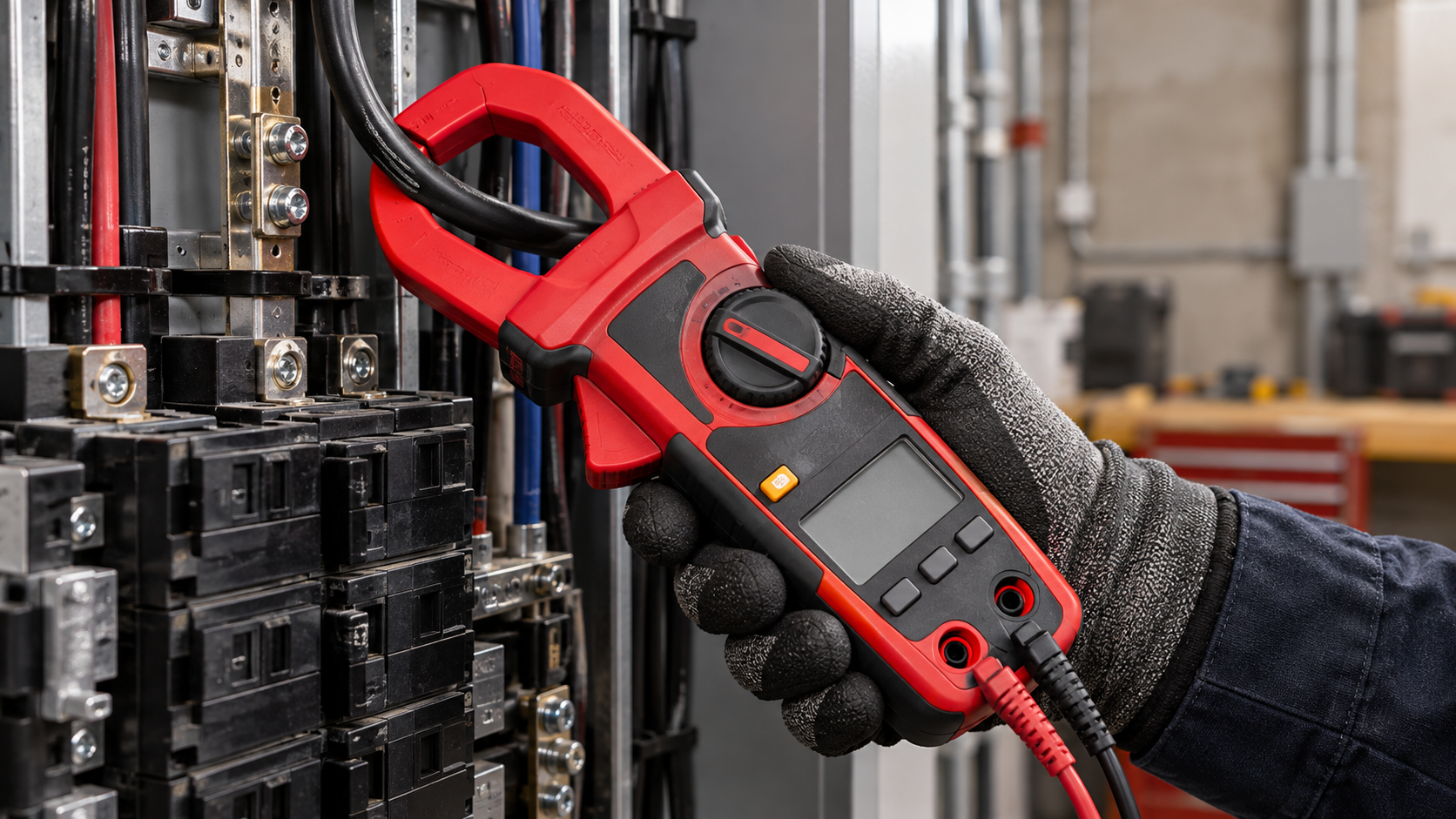
The 2235 20 is a Milwaukee 400 amp clamp meter that measures AC current by clamping around one conductor, and also reads AC voltage, resistance and continuity with test leads. According to the maker’s operator’s manual, it is rated CAT III 600V, it is True-RMS sensing, and its jaw opens to 1.0 inch (25.4 mm). It is a sound choice for basic AC current checks on conductors up to that jaw size. It is not a meter for work above its CAT rating, and the manual’s ranges and limits are the numbers to plan around.
Quick answer
- Measures: AC current up to 400 A, AC voltage up to 600 V, resistance up to 4000 ohms, and continuity with a buzzer.
- Rating: CAT III 600V, stated for the terminal and earth ground. Choose a meter whose category suits your circuit.
- Jaw: 1.0 inch (25.4 mm) maximum conductor size.
- Power: 2 AAA batteries, listed at about 20 hours with the backlight on.
- Limits to plan for: the manual says never measure a circuit where voltage over 600 volts AC exists.
What the 2235-20 measures, by the manual’s numbers
The figures below come from the specification table in the Milwaukee operator’s manual. Where a figure is not in the copies we opened, the table says so.
| Function | Range stated in the manual | Resolution | Accuracy stated in the manual |
|---|---|---|---|
| Current AC | 40.00 / 400.0 A | 0.01 A / 0.1 A | ±1.8% rdg ±5 dgt (50/60 Hz); ±3.0% rdg ±5 dgt (60 to 400 Hz) |
| Voltage AC | 400.0 / 600 V | 0.1 V / 1 V | ±1.2% rdg ±5 dgt (50 to 400 Hz) |
| Resistance | 4000 ohms | 1 ohm | ±1.0% rdg ±3 dgt |
| Continuity | Buzzer | 0.1 | Beeper sounds at 30 ohms and below |
| DC current | Not stated in the rows we read | Not stated | Not stated |
The manual states that all voltage and current readings are True-RMS values, and that all AC ranges are specified from 0.25% to 100% of range. In plain terms, True-RMS means the meter estimates the heating value of a waveform rather than assuming a clean sine wave. That helps when loads distort the waveform, but the accuracy figures above still set the limit of what you can rely on.
Safe use: the steps the manual puts first
Electrical work can cause shock, burns and arc flash. Mains wiring and panel or service work belong to a licensed electrician. If you are not sure a circuit is safe to measure, stop and call one.
- Check the category before you start. The meter is rated CAT III 600V. Do not use it on a circuit where the category or voltage is higher than the rating allows.
- Never measure over 600 volts AC. The manual says so directly. Do not clamp or probe a circuit where voltage over 600 volts AC exists.
- Keep fingers behind the jaw guard. The manual warns to keep fingers away from the jaws during measurement.
- Inspect the test leads before each use. The manual says to use only Milwaukee test leads with this meter and to inspect them first.
- Set the dial and mode before clamping. The manual notes that a measurement cannot be made correctly if the rotary dial, the measurement mode or the hold function is wrong.
- Do not open the battery cover during a measurement, and do not use the meter with the cover removed.
- Keep the jaws fully closed. The manual says an open gap can affect the reading.
Reading the specs that matter for your job
Jaw size. The jaw opens to 1.0 inch (25.4 mm). The manual gives this as the maximum conductor size. Check that your cable, or the bundle you need to clamp, fits. A bundle of several conductors may not give a single-wire reading.
Operating conditions. The manual gives an operating temperature of 14°F to 122°F (-10°C to 50°C), and an operating altitude of 2000 meters or less. It states the accuracy figures apply at 64°F to 82°F (18°C to 28°C), and gives a temperature coefficient outside that band. Store the meter between -40°F and 140°F (-40°C to 60°C).
Power and backlight. The meter uses two AAA batteries. The manual lists about 20 hours with all lights on and about 100 hours without the backlight. The backlight turns off after about 10 minutes without activity. The manual notes a low-battery indicator; replace batteries when it shows.
Standards. The manual lists EN 61010-1, UL 61010-1 and EN 61010-031 (probes). Certifications are listed as cULus and CE. Those are product-level statements from the maker, not a guarantee for every use.
How we chose
We chose the 2235-20 because it is a well-known Milwaukee clamp meter with a stated CAT III 600V rating and True-RMS sensing, and because its manual is available from the maker’s own document host. The comparison rule for this guide is simple: a meter is a fit only if its stated category, range and jaw size cover the circuit you plan to measure. We read two copies of the operator’s manual and the maker’s product page. We did not compare this model against other clamp meters in this article; the comparison belongs in our clamp meter roundup.
What we could not verify
- The copies of the manual we opened do not show a print date. We cite the document numbers printed in their file names, 58-14-2235d2 and 58-14-2235d1.
- The manual rows we read do not state a DC current range. Do not assume DC current capability from this article.
- The product page’s specification table did not load when we opened it. Its overview bullets state CAT III 600V, 400 A AC, 600 V AC/DC, 1.0 inch jaw and True-RMS. We did not treat any figure beyond those bullets as confirmed.
- The sources we opened do not cover how the meter performs on your particular equipment, in your environment, or over time. Those depend on the setup and on the people using it.
Buying checklist
- Confirm the circuit’s voltage is within 600 V AC and that the meter’s CAT III 600V rating suits the location you will measure.
- Confirm the conductor or bundle fits the 1.0 inch (25.4 mm) jaw.
- Confirm you need AC current only. The rows we read do not list DC current.
- Check that you have the Milwaukee test leads and two AAA batteries on hand, or budget for them.
- Confirm the operating temperature and altitude suit where you will work.
Mistakes to avoid
- Clamping over 600 V AC. The manual says never to measure a circuit where voltage over 600 volts AC exists.
- Assuming a bundle reading equals one conductor. The jaw takes a maximum conductor size of 1.0 inch, and a bundle reading does not isolate one wire.
- Ignoring the battery cover. The manual says not to use the meter with the cover removed.
- Using a damaged lead. Inspect leads before each use, as the manual directs.
FAQ
Does the 2235 20 measure DC current?
The specification rows we read in the operator’s manual list AC current, with ranges of 40.00 and 400.0 A. They do not list a DC current range, so do not buy this meter expecting DC current readings unless you confirm it in the manual for your copy.
What does CAT III 600V mean?
CAT III describes the category of transient overvoltage the meter is designed to withstand in certain installations, and 600V is the stated voltage rating for that category. The manual gives this rating for the terminal and earth ground. It is a safety limit, not a promise that the meter is suited to every circuit at that voltage.
Is the 2235 20 True-RMS?
Yes. The manual states that all voltage and current readings are True-RMS values.
What is the largest wire it will clamp?
The manual gives a jaw opening of 1.0 inch (25.4 mm) as the maximum conductor size.
What batteries does it use?
The manual lists two AAA batteries, IEC LR03 or NEDA 24A.
Can it measure voltage over 600 volts?
No. The manual gives 600 V as the AC voltage range maximum and says not to measure a circuit where voltage over 600 volts AC exists.
Related guides
If you are choosing between a clamp meter and a multimeter, read Clamp Meter vs Multimeter: Which One Do You Need? For the symbols on the dial, see How to Read Multimeter Symbols and Dial Positions. To understand what the category number means before you buy, see What Is a CAT Rating on a Multimeter.
Bottom line
Buy the 2235 20 only for AC current checks within its stated 400 A, 600 V AC and CAT III 600V limits, on conductors that fit the 1.0 inch jaw. If your work involves DC current, circuits above 600 V, or panel and service work, use a meter and method suited to that job, and call a licensed electrician when the work is beyond your training.
Sources
- Milwaukee Tool, Operator’s Manual, Cat. No. 2235-20, 400 Amp Clamp Meter, document 58-14-2235d2. https://documents.milwaukeetool.com/58-14-2235d2.pdf (opened 2026-10-27; print date not shown in the copy)
- Milwaukee Tool, Operator’s Manual, Cat. No. 2235-20, 400 Amp Clamp Meter, document 58-14-2235d1. https://documents.milwaukeetool.com/58-14-2235d1.pdf (opened 2026-10-27; print date not shown in the copy)
- Milwaukee Tool, 2235-20 product page. https://www.milwaukeetool.com/products/instruments/2235-20 (opened 2026-10-27)