FieldSense Fluke Explained: What the Technology Measures and How to Use It Safely
As an Amazon Associate we earn from qualifying purchases.
FieldSense Fluke Explained: What the Technology Measures and How to Use It Safely
FieldSense is a measuring technique that Fluke builds into its T6 electrical testers, including the T6-600 and T6-1000. It lets the tester read AC voltage, AC current and frequency through the open jaw of the tester, without you touching metal test leads to a live conductor. The name describes a product family and a technology, not a single meter. The Fluke documents below describe the T6 family. Read the ratings for the exact model you plan to buy, because the two main models differ in voltage range and resistance range.
Quick answer
- FieldSense is a Fluke technology used in the T6 electrical tester family, which includes the T6-600 and T6-1000 in the Fluke documents we opened.
- With FieldSense, the tester measures AC voltage, AC current and frequency through the fork, without test leads. Fluke’s data sheet states 45 Hz to 66 Hz for these measurements.
- The T6-1000 is rated for AC voltage up to 1000 V on the FieldSense range; the T6-600 is rated up to 600 V.
- Electrical work on mains circuits can cause serious injury or death. Panel and service work belongs to a licensed electrician.
What the name FieldSense covers
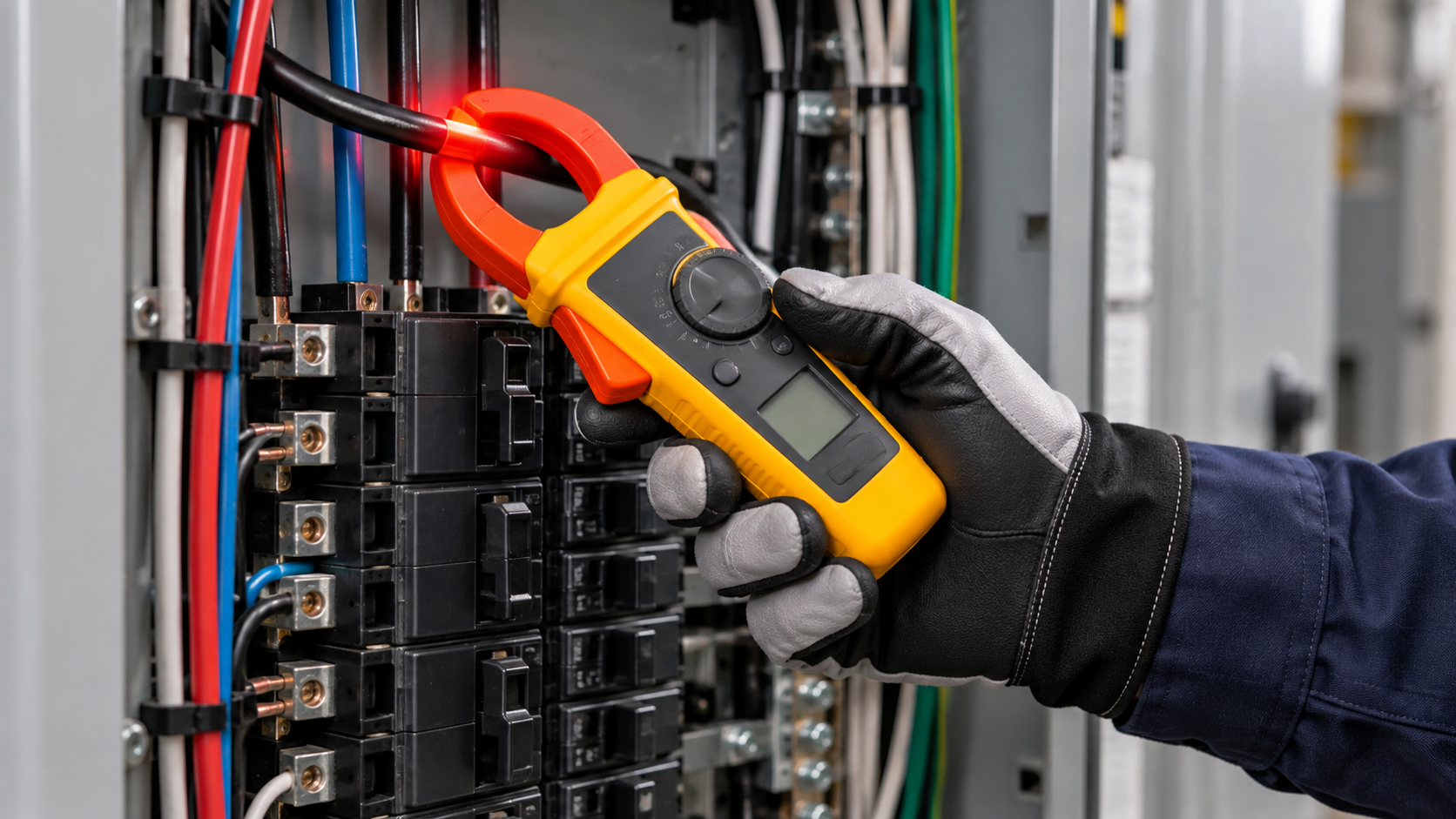
Fluke’s Quick Reference Guide for the T6-600 and T6-1000 describes FieldSense as a measurement technique, and the data sheet calls it FieldSense technology for AC voltage, current and frequency measurement without making electrical contact to live voltage. In practice, the front of the tester is a fork. You place a single wire in the fork, and the tester reads the wire through the jaw opening. The Fluke data sheet gives a fork opening of 17.8 mm and says the tester works with wires up to AWG 4/0 (120 mm2).
When people search for “fieldsense fluke”, they usually want to know which Fluke tool to buy, so it helps to separate three things. The first is the technology, FieldSense. The second is the product family that carries it, the T6 electrical testers. The third is the model, such as the T6-600 or the T6-1000. The documents we opened describe all three, but they do not present FieldSense as a separate product you can buy by itself.
What FieldSense measures, and the stated ranges
The Fluke Quick Reference Guide lists the FieldSense functions in a table that separates them from the functions that need test leads. The table in the guide and the data sheet agree on the main figures:
- FieldSense AC voltage, with no test leads: 1000 V range on the T6-1000 and 600 V range on the T6-600, 1 V resolution, accuracy of plus or minus 3 percent plus 3 counts, 45 Hz to 66 Hz.
- FieldSense AC current, with no test leads: 200.0 A range on both models, 0.1 A resolution, accuracy of plus or minus 3 percent plus 3 counts, 45 Hz to 66 Hz.
- FieldSense frequency: 45 Hz to 66 Hz, 1 Hz resolution, accuracy of plus or minus 1 percent plus 2 counts.
The same guide lists the functions that do need test leads. AC voltage and DC voltage with leads are rated 1000 V on the T6-1000 and 600 V on the T6-600, with 1 V resolution. The resistance ranges are different between the two models. The data sheet gives resistance from 1 ohm to 100 kohm on the T6-1000 and from 1 ohm to 2 kohm on the T6-600.
The guide notes that the FieldSense function is specified from 16 V to 100 percent of range. Readings below that level are outside the stated accuracy, so a low reading should not be treated as zero without a second check with test leads.
Where the Fluke documents say a reading needs extra care
Fluke’s footnotes add conditions that change the result. The Quick Reference Guide says that the FieldSense AC voltage reading adds 3 percent when there is no external ground connection. It also says that an external ground connection is required for a user who wears insulated gloves, stands on an insulated ladder, or is otherwise insulated from earth ground. The data sheet adds that FieldSense needs a capacitive path to ground, which in most applications is provided by the user. In some situations a ground connection through a test lead may also be needed.
These notes matter for real work. A tester that reads correctly on a bench can read differently on a ladder or in a panel with a wet floor. If the footnotes say a ground path is needed, make that connection before you rely on the reading, and treat any unexpected value as a reason to stop and check with test leads and the right category rating.
Ratings and safety: what Fluke publishes
The Quick Reference Guide shows CAT 1000 V and CAT 600 V markings on the front-panel graphic of the T6-1000. The text we could extract from the documents we opened does not spell out the full measurement category wording for each model, so do not assume a category from the marking alone. Check the Fluke safety information sheet and the product page for the exact category before you buy or use the tester on any circuit.
The Quick Reference Guide defines a hazardous voltage warning at 30 V and above, and it asks you to test with the fork and the FieldSense ground contact for the warning symbol. It also says to consult the user documentation for the other symbol. The Fluke safety information sheet opens by telling the user to read all safety information before using the product, and it names the T6-600, T6-1000 and T6-1000 PRO. We did not extract the full safety text, so read the sheet itself before the first use.
Electrical rules apply on every job. Confirm the tester works on a known live source before and after each test. Keep your fingers behind the finger guard. Do not work on a live panel or a service entrance unless you are qualified to do so. Work on mains circuits can kill, and the category rating of the tester must suit the circuit you are measuring.
How to use FieldSense safely, step by step
The steps below follow the order that the Fluke documents imply: check the tester, check the circuit, then measure. They are a general outline, not a replacement for the safety sheet.
- Read the safety information sheet for your exact model and note the category and voltage rating.
- Check the battery. The data sheet lists two AA cells, and the Quick Reference Guide shows a low battery symbol that means replace the batteries.
- Confirm the tester reads a known live source before you rely on it, and check again after the test.
- Place one wire in the fork, with the finger guard between your hand and the conductor. The fork is designed for one wire only.
- If the footnote for your situation requires an external ground path, make that connection first.
- Read the value, then check it with test leads and the correct category rating if the result matters for a decision.
- Remove the tester from the wire only after the circuit is in a safe state, and store it in its holder or dock.
Buying checklist
- Pick the model first. The T6-1000 and T6-600 differ in AC voltage range and resistance range, and that changes which jobs fit.
- Check the category rating for your circuit in the safety sheet before you buy.
- Check whether you need the resistance and DC functions that use test leads. FieldSense alone does not cover them.
- Check the wire size. The fork opening of 17.8 mm and the stated AWG 4/0 limit set the largest conductor the tester accepts.
- Check the battery type and life. The data sheet lists 360 hours continuous and about 200 hours typical using the FieldSense function, on two AA cells.
- Check the operating temperature range of -10 to +50 degrees C and the altitude limit of 2000 m in the Quick Reference Guide.
Mistakes to avoid
- Do not treat FieldSense as a replacement for a clamp meter when you need a current reading on a large or unusual conductor. The stated AC current range is 200.0 A.
- Do not ignore the ground footnotes. The guide says the reading can change when the ground path is missing.
- Do not read a value below the 16 V FieldSense threshold as zero.
- Do not assume one model covers the other’s ranges. The resistance and voltage ranges differ between the T6-600 and T6-1000.
- Do not use a tester on a circuit above its stated category or voltage rating.
How we chose
We opened the Fluke documents for the T6 family that were readable as text, and used only Fluke-hosted copies. The three sources are listed below. Each was opened on 2026-10-27 and contains a Fluke title and a part number or code.
What we could not verify
The full safety text of the Fluke safety information sheet, the exact CAT category wording for each model, and the Fluke product page’s category wording. The sources we opened do not cover the price, stock, or how the tester compares with other brands, and this article does not compare them. We also did not confirm the operating behavior of the FieldSense function on every wire type, because the documents do not say so in the text we extracted.
FAQ
Is FieldSense the same as a non-contact voltage tester?
No. A non-contact voltage tester usually detects a field near a wire and gives a simple indication. FieldSense, as the Fluke data sheet describes it, reads a voltage and a current value in numbers through the fork, with stated accuracy and ranges. The two tools serve different jobs.
Does FieldSense need test leads?
For the AC voltage, AC current and frequency functions that Fluke labels FieldSense, the table in the Quick Reference Guide says no test leads are needed. Resistance and DC voltage use test leads.
Which model should I buy?
The T6-1000 has the larger AC voltage range and the larger resistance range in the Fluke tables. Choose it when your work needs the higher voltage range. The T6-600 covers up to 600 V on the same functions. Confirm your need against the category rating in the safety sheet.
Is there a way to confirm the reading?
Yes. Use test leads and a meter with the correct category rating to check a reading that matters. Do not rely on one tool alone for a decision that affects safety.
Can I use it to check an outlet?
Outlet checks are electrical work. Follow the safety sheet, and if you are not trained for it, call a licensed electrician. Do not open a panel to test a circuit unless you are qualified.
Bottom line
FieldSense is the Fluke measuring technique in the T6 electrical tester family. It reads AC voltage, AC current and frequency through the fork without test leads, within the ranges and footnotes that Fluke publishes. Pick the model by its stated ranges, read the category rating in the safety sheet, and follow the ground conditions before you trust a reading.
Related guides
- Fluke Multimeter Lineup: 7 Meters Compared by Stated Function covers the wider Fluke range and the functions each meter states.
- Best Fluke 1000 Amp Clamp Meter explains the clamp meter route for high current readings.
Sources
- Fluke Corporation, “T6-600/T6-1000 Quick Reference Guide”, PN 4897598, September 2017, Rev. 2, 11/17. https://media.fluke.com/36d189e0-2c98-4bd6-9c24-b32a01523f6d_original%20file.pdf (opened 2026-10-27)
- Fluke Corporation, “Fluke T6 Electrical Testers with FieldSense technology”, Data Sheet 6009251. https://media.fluke.com/e81c9b2e-756b-43e5-b92d-b1060068fe24_original%20file.pdf (opened 2026-10-27)
- Fluke Corporation, “T6-600/T6-1000/T6-1000 PRO Electrical Tester with FieldSense Technology, Safety Information”, PN 4897580, September 2017, Rev. 2, 3/20. https://media.fluke.com/85858817-9683-48be-971a-b10800c0a594_original%20file.pdf (opened 2026-10-27)