Best LCR Meter
As an Amazon Associate we earn from qualifying purchases. Details
The best LCR meter is the one that measures your parts over the ranges and frequencies you need, through a connection that keeps lead errors out of the reading. This guide compares six LCR meter listings on Amazon.com by what each one states: inductance, capacitance and resistance ranges, test frequencies, Kelvin input and power. It also covers the safety steps the sources and listings require before you connect a part. Read the ranges and the test frequency first, then the connection, then the power and extras.
Quick answer
- Choose the FNIRSI LC1020E if you want the widest stated capacitance and inductance ranges in this set, with a four-terminal Kelvin input.
- Choose the Proster LCR meter for a 9 V handheld with stated inductance, capacitance and resistance ranges, and accept its lower display count.
- Choose the ET4401 bench meter if you need a stated 0.1% basic accuracy, RS232 and handler interfaces, and a corded bench setup.
- Choose the Extech LCR200 if you want primary and secondary values on one dual display with a built-in fixture, and confirm its ranges in the manual.
What an LCR meter measures
An LCR meter measures inductance (L), capacitance (C) and resistance (R). Most of the listings also show secondary values, such as Q, D and ESR. The IET LCR meter guide says most LCR meters today use an AC test signal over a frequency range of 10 Hz to 2 MHz. The listings here that state a test frequency top out at 100 kHz, or at 10 kHz for the ET4401, so the frequency range they state is narrower than that general figure.
Test frequency is a setting you have to choose, not a fixed property of the meter. The IET primer lists test frequency as one of the factors behind errors between the device under test and the instrument connection, alongside test voltage and impedance range. Several listings let you choose the test level as well. The FNIRSI lists 0.1 V, 0.3 V and 0.6 V, and the ET4401 lists six levels from 0.1 V to 2 V.
The secondary values follow the same logic. The Extech listing shows Q, D, phase and ESR beside the primary reading on a dual display. The FNIRSI shows X, D, Q, theta and ESR, and it says the main and secondary parameters appear at the same time. The IET primer ties errors to test frequency and test voltage, so record both with every reading.
Kelvin connections: why the four terminals matter
A Kelvin connection, also called a four-terminal connection, separates the path that carries the current from the path that senses the voltage. The IET primer explains that with a second pair of terminals, one pair measures the voltage across the device while the other pair applies the current. It says this removes the series inductance and resistance error, including contact resistance. The IET LCR meter guide says a typical LCR meter has a four-terminal Kelvin connection, and that the connection minimizes errors due to cabling and to the connection to the device.
Three listings state a Kelvin input. The FNIRSI describes four-terminal measurement through 3-pin sockets and 5-slot jacks, with professional fixtures. The ZOTEK ZT-DQ02 names 4-wire Kelvin measurement and says separate current and voltage sensing helps reduce lead and contact resistance effects. The ET4401 title names a Kelvin clamp. The Extech listing describes a built-in fixture and external test leads, and it states no Kelvin input. The Proster and DE-5000 text names no Kelvin input in the bullets we read.
Open and short calibration is a separate step. The Extech listing says it eliminates stray impedance from measurements, and the IET primer says the OPEN/SHORT should be performed with a true open or short at the test terminals. Three listings name open and short calibration: the FNIRSI, the Extech and the ET4401. The Proster title mentions zero adjustment, and the DE-5000 text describes no calibration step.
Ranges and frequencies, side by side
The table below lists what each listing states in its bullets, title or specification text. A dash means the text we read does not give the item.
| Listing | Test frequencies stated | Inductance | Capacitance | Resistance | Kelvin input stated | Power stated |
|---|---|---|---|---|---|---|
| FNIRSI LC1020E | 100 Hz, 120 Hz, 1 kHz, 10 kHz, 100 kHz | 1 µH to 100 H | 1 pF to 100 mF | 10 mΩ to 10 MΩ | Yes, four-terminal | 3000 mAh battery, Type-C charging |
| Extech LCR200 | 100 Hz, 120 Hz, 1 kHz, 10 kHz, 100 kHz | — | — | — | Not stated; built-in fixture and leads | 9 V battery |
| ZOTEK ZT-DQ02 | 100 Hz, 120 Hz, 1 kHz, 10 kHz, 100 kHz | — | — | — | Yes, 4-wire | Battery powered, USB-C for PC control |
| Proster LCR meter | — | 200 µH to 20 H (6 ranges) | 200 pF to 2000 µF (8 ranges) | 200 Ω to 20 MΩ (5 ranges) | — | 9 V battery |
| ET4401 bench meter | 100 Hz to 10 kHz (10 fixed) | — | — | DC resistance (range not stated) | Yes, Kelvin clamp in title | Corded electric |
| DE-5000 handheld | 100 Hz, 120 Hz, 1 kHz, 10 kHz, 100 kHz | — | — | — | — | DC 9 V battery |
Two small calculations come out of the table. Both are our planning estimates. The FNIRSI’s stated 100 mF top capacitance is 100,000 µF, and 100000 / 2000 = 50, so the top is fifty times the Proster’s 2000 µF top. The ET4401’s top test frequency is 10 kHz against the FNIRSI’s 100 kHz, and 10 / 100 = 0.1, so the ET4401 reaches one tenth of the top frequency. A bench job that needs the high frequencies should not use the ET4401.
The table shows where the detail is thin. Only the FNIRSI and Proster give all three parameter ranges in the text we read. The Extech, ZOTEK and DE-5000 give test frequencies but no parameter range. The ET4401 gives frequencies and a resistance mode, but no inductance or capacitance range.
Safety before you connect a part
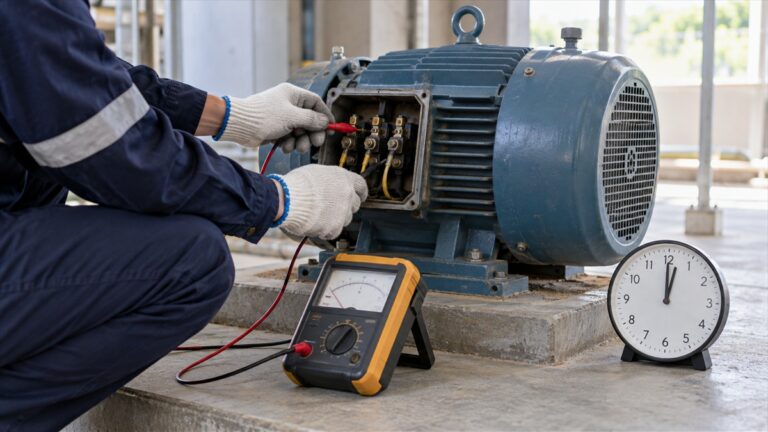
The safety step for a part is to release any stored energy and switch the circuit off first. OSHA’s 1910.333 says capacitors shall be discharged, and high capacitance elements shall be short-circuited and grounded, if the stored electric energy might endanger personnel. The same rule says live parts shall be de-energized before a worker works on or near them, unless the employer can show that de-energizing adds hazards or is not feasible. OSHA’s electrical page adds that its standards protect workers from electric shock, electrocution, fires and explosions.
The FNIRSI listing gives the same steps in its own words. It says to fully discharge capacitors and inductors, to make sure the circuit is powered off for onboard components, and not to measure live circuits. Treat that note as the rule for every meter in this set, whatever its listing says.
The other listings say less. The ZOTEK adds a battery test mode with its own connector and clips, and its listing gives a DC voltage range of within ±100 V for that input. The ET4401 is corded electric, so it is a bench meter rather than a handheld. None of the sources we opened covers the category rating of an LCR meter, and none of the six listings states one in the text we read. Check the manual before you use one on powered equipment.
How to choose an LCR meter
Start with the ranges. Match the top and bottom of each parameter to the parts you test. The Proster and FNIRSI state the most detail in their text, and the Extech, ZOTEK and DE-5000 give test frequencies without parameter ranges. A listing without a range is a question for the manual, not a quick comparison.
Next, the test frequency. The four listings that state 100 Hz to 100 kHz (the FNIRSI, Extech, ZOTEK and DE-5000) offer a higher top frequency than the ET4401, which tops out at 10 kHz. If you measure parts at the frequency they will see in use, a higher top frequency matters more than a long list of low frequencies. The IET guide’s general range runs from 10 Hz to 2 MHz, and none of the six listings reaches that top.
Then the connection. A Kelvin input is the stated choice when you want the leads kept out of the reading, and the IET primer explains the reason. A built-in fixture, which the Extech listing describes as ready to use immediately, saves a setup step, but its listing gives no error figure for it.
Then the power and the extras. The FNIRSI and ZOTEK are battery powered, the Extech and Proster take 9 V batteries, and the ET4401 is corded. The FNIRSI and ZOTEK add sorting or component-matching features, the DE-5000 sorts to a selectable tolerance, and the ET4401 offers comparator sorting and a list scan. For capacitor checks that you run on a multimeter instead of an LCR meter, see the capacitor multimeter roundup. For resistance-only work, the ohm meter roundup covers that job.
1. FNIRSI LC1020E 100kHz LCR Meter, 19,999 Counts Resistor Inductor Capacitor Tester, Auto Component (Widest stated capacitance and inductance ranges with a Kelvin input)
Pros
- The bullets state capacitance from 1 pF to 100 mF and inductance from 1 µH to 100 H
- The bullets describe four-terminal measurement through 3-pin sockets and 5-slot jacks
- The bullets list five test frequencies from 100 Hz to 100 kHz and three test levels
Cons
- The listing states no basic accuracy figure in the text we read
- The bullets describe the battery and charging but give no battery life
Best for: A technician who wants a handheld with wide inductance and capacitance ranges and a Kelvin input
Skip if: You need a stated basic accuracy percentage before you buy
View on Amazon (affiliate link)
2. Extech LCR200 – Passive Component LCR Meter (Passive component meter with primary and secondary values on one display)
Pros
- The bullets say the dual backlit display shows primary and secondary parameters at the same time
- The bullets state five test frequencies from 100 Hz to 100 kHz, in series or parallel modes
- The listing includes a built-in test fixture and external test leads, with auto power off that can be disabled
Cons
- The bullets name no inductance, capacitance or resistance range
- The listing names no Kelvin input in the text we read
Best for: A user who wants Q, D and ESR beside the main reading on one handheld
Skip if: You need a stated range for each parameter, or a Kelvin input
View on Amazon (affiliate link)
3. ZOYI ZT-DQ02 2-in-1 Digital LCR Meter&Voltage Battery Internal Resistance Tester, Auto Component (Two-in-one LCR and battery internal resistance tester)
Pros
- The bullets name 4-wire Kelvin measurement for LCR tests and separate current and voltage sensing
- The bullets describe a battery mode for internal resistance from 0.1 mΩ to 200 Ω
- The bullets describe PC control over USB-C with SCPI support and PASS/FAIL sorting
Cons
- The bullets state no inductance, capacitance or resistance range
- The listing gives no battery life for its battery-powered operation
Best for: A technician who tests components and batteries with one meter
Skip if: You only need a basic LCR meter and do not need battery tests or PC control
View on Amazon (affiliate link)
4. Proster LCR Meter Multimeter Capacitance Inductance Resistance Tester | Rotatable LCD Data Hold (Battery-powered handheld with stated L, C and R ranges)
Pros
- The bullets give eight capacitance ranges from 200 pF to 2000 µF
- The bullets give six inductance ranges from 200 µH to 20 H and five resistance ranges from 200 Ω to 20 MΩ
- The bullets list a 9 V battery, a rotatable display and a kit with leads, clips and a storage bag
Cons
- The display is a 3½-digit LCD with a 1999 maximum count, which gives less resolution than the 19,999-count meters here
- The listing states no test frequency and no Kelvin input
Best for: A hobbyist who wants simple inductance, capacitance and resistance checks on a 9 V handheld
Skip if: You need a stated test frequency or a Kelvin input
View on Amazon (affiliate link)
5. ET4401 Bench LCR Meter, 0.1% Accuracy, 100Hz-10kHz, DCR, 3.5 TFT | 3.5-Inch LCD, Kelvin Clamp, Auto (Bench meter with stated 0.1% basic accuracy and RS232 and handler interfaces)
Pros
- The bullets state 0.1% basic accuracy and ten fixed test frequencies from 100 Hz to 10 kHz
- The bullets list USB, RS232 and handler interfaces with SCPI communication
- The bullets describe comparator sorting, list scan and MAX/MIN/AVG data recording
Cons
- The listing is corded electric, and its bullets describe no battery mode
- The bullets give no inductance or capacitance range, and the top frequency is 10 kHz
Best for: A lab or production user who wants PC control and sorting on a bench
Skip if: You need a battery meter for field work or a test frequency above 10 kHz
View on Amazon (affiliate link)
6. DE-5000 Handheld LCR Meter (Handheld with selectable tolerance sorting and a test-lead kit)
Pros
- The bullets list five test frequencies up to 100 kHz and fully automatic ranging
- The bullets say the meter selects serial or parallel mode for each part without a function key
- The listing includes tweezers, alligator clips, a lead case and a guard line
Cons
- The text shows two display counts, 19999/9999 in the bullets and 19999/1999 in the description
- The bullets give no inductance, capacitance or resistance range, and the IR to USB cable is not included
Best for: A user who sorts a batch of parts against a tolerance and wants automatic serial or parallel mode
Skip if: You need a stated parameter range or a Kelvin input
View on Amazon (affiliate link)
Mistakes to avoid
- Measuring a charged part. The OSHA rule and the FNIRSI listing both say to discharge capacitors and inductors before measurement.
- Measuring with the circuit powered. The FNIRSI listing says not to measure live circuits and to power the circuit off for onboard components.
- Skipping open and short calibration on a meter that offers it. The IET primer says the OPEN/SHORT step should use a true open or short at the test terminals.
- Recording a value without its frequency. The IET primer lists test frequency as a source of error, so a value without its frequency cannot be compared with another reading.
- Using a battery input for a component. The ZOTEK lists a separate battery connector and clips, so use the component terminals for parts and the battery connector for batteries.
Which meter fits which bench
A hobbyist who works on a home bench and needs stated ranges for all three parameters has a clear choice in the Proster, which is battery powered and includes a set of leads, crocodile clips and a storage bag. The Proster states no test frequency and no Kelvin input, so it fits simple checks better than precision work.
A technician who needs a Kelvin input and a stated frequency range should look at the FNIRSI first. It states the widest capacitance and inductance ranges in this set, and it names four-terminal measurement with its own sockets.
A lab or production user who needs computer control and a stated basic accuracy should look at the ET4401 and the ZOTEK. The ET4401 gives 0.1% basic accuracy and RS232 and handler interfaces, but only on corded power and up to 10 kHz. The ZOTEK gives PC control over USB-C and SCPI support, but its listing states no basic accuracy.
How we chose
We searched Amazon.com for “lcr meter” in a browser on 21 October 2026 and read the first results page. We kept listings whose titles or bullets describe an LCR meter that measures inductance, capacitance and resistance. We left out meters whose titles name them mainly as transistor testers or SMD tweezers, such as the LCR-P1 and LCR-ST1, and we left out a multimeter with an LCR function, the LCR600, whose bullets describe a 6000-count digital multimeter with LCR measurement.
We opened seven LCR listing pages and kept six, one from each of six brands. The brands are FNIRSI, Extech, ZOTEK, Proster, mytithger and DER EE. We read the listing text only: the title, bullets, product description and the specification text that appeared on each page. We did not use prices, ratings or review counts to choose the picks.
What we could not verify
- The accuracy of any reading. Only the ET4401 states a basic accuracy (0.1%) in the text we read. The other five state none.
- The inductance, capacitance and resistance ranges of the Extech, ZOTEK, ET4401 and DE-5000, because their text gives none for at least one parameter.
- The display counts of the DE-5000. Its bullets give 19999/9999 counts, and its product description gives 19999/1999.
- Whether the Extech, Proster and DE-5000 accept a Kelvin connection at all. Their text names no Kelvin input.
- The test levels for the Extech, Proster and DE-5000. Only the FNIRSI, ZOTEK and ET4401 list test levels.
- Battery life on any battery-powered meter. No listing states it.
- The category rating of any LCR meter in this set. None of the sources we opened covers it, and none of the listings states one.
- The brand of the ZOTEK ZT-DQ02. Its title reads ZOYI, but its brand field and storefront read ZOTEK, so this guide uses the brand field.
- PC control on the DE-5000. Its text names no interface, and the IR to USB cable is not included.
FAQ
Do I need a Kelvin connection for every measurement?
No, but a Kelvin input is the better choice when lead and contact resistance could affect the reading. The IET guide says the Kelvin connection minimizes errors due to cabling and the connection to the device. Three listings state a Kelvin input: the FNIRSI, the ZOTEK and the ET4401. The Extech uses a built-in fixture that its listing describes as ready to use immediately, but the listing gives no error figure for it.
Why does test frequency matter?
The IET primer lists test frequency as one of the factors behind errors between the device under test and the instrument connection. The FNIRSI lets you choose 100 Hz, 120 Hz, 1 kHz, 10 kHz or 100 kHz, and the ET4401 offers ten fixed frequencies between 100 Hz and 10 kHz. Choose the frequency that matters for your part, write it down with the reading, and use the same setting when you compare parts.
Should I calibrate before each reading?
Calibrate with open and short when the meter offers it. The IET primer says the OPEN/SHORT should be performed with a true open or short at the test terminals. The FNIRSI, Extech and ET4401 listings name this step. The Proster title mentions zero adjustment, and the DE-5000 text describes no calibration step in the text we read.
Can I measure a capacitor or coil while it is still on a board?
Not on a powered circuit. The FNIRSI listing says to power the circuit off for onboard components and not to measure live circuits. OSHA’s 1910.333 says live parts shall be de-energized before a worker works on or near them, unless the employer can show that this adds hazards or is not feasible. The sources we opened do not address in-circuit LCR readings, so check the meter’s manual for how it handles a part that sits on a board.
Which meter is the easiest starting point?
The Proster is the simplest starting point in this set if you want stated ranges for all three parameters on a 9 V handheld. It states no test frequency and no Kelvin input, so it suits simple component checks better than precision work. If you expect to need a Kelvin input later, the FNIRSI states one and also gives the widest capacitance and inductance ranges here.
Bottom line
Choose the FNIRSI LC1020E if a wide stated range and a Kelvin input matter most. Choose the Proster for stated ranges on a 9 V handheld, and accept the lack of a stated frequency. Choose the ET4401 for stated 0.1% accuracy and bench interfaces, on corded power. Before any of these, discharge the part, power off the circuit, and run the open and short calibration the manual describes.
Sources
- OSHA, Electrical: OSHA’s statement on electrical hazards and the protection its standards provide
- OSHA, 29 CFR 1910.333 Selection and use of work practices: de-energizing live parts and discharging capacitors
- IET Labs, LCR Measurement Primer (PDF): four-terminal measurement, open and short compensation, and error sources
- IET Labs, LCR Meter guide: the Kelvin connection on a typical LCR meter and the AC test signal range