How to Test an Outlet with a Multimeter
As an Amazon Associate we earn from qualifying purchases. Details
Safety first: a wall outlet is a live mains connection, and mains can kill. Use only a meter whose listing states a CAT rating and a voltage rating at or above the circuit, keep the outlet cover on while you test the face, and keep your fingers off the metal probe tips. A multimeter tells you the voltage between the points you touch. It does not confirm wiring, grounding or GFCI operation. If you see scorching, a loose plate or damage, stop and call a licensed electrician. Panel and service work always belongs to a licensed electrician.
Someone typing “how to test an outlet with a multimeter” usually wants to know whether an outlet has power, and sometimes whether it is wired correctly, using a meter they own or are about to buy. This page covers the voltage check. It does not cover wiring diagnosis.
Quick answer
Set the meter to AC voltage, connect the leads as Step 2 shows, touch the probes to the two vertical slots, not the round ground hole, and read the display. Fluke’s guidance for a standard residential outlet is 110 V to 125 V AC. A reading near zero means no voltage at that outlet, so stop and check the breaker. A multimeter cannot confirm polarity or GFCI trip action; see our GFCI open ground guide for that.
Step 1: Pick a meter with a stated CAT rating
A CAT rating describes the environment a meter is built for, and the voltage rating tells you the highest voltage it is rated to handle. The listings in our research file state these ratings:
- Fluke 87V: “CAT III 1000V, CAT IV 600V safety rated” in the listing text.
- UNI-T UT161E: “Cat III 1000v/Cat IV 600v” in the specification field.
- Proster T28B: “CAT III 600V / CAT II 1000V safety rating” in a bullet.
- DEASOMIYE T21D: “passed overvoltage category III 600V” in a bullet; the specification field lists UL only.
- TESMEN TSM-599 and Gardner Bender GMT-318: the listing does not state a CAT rating.
Use a meter with a stated rating for household mains. A meter whose listing states no rating is for low-voltage electronics only, as far as this page is concerned.
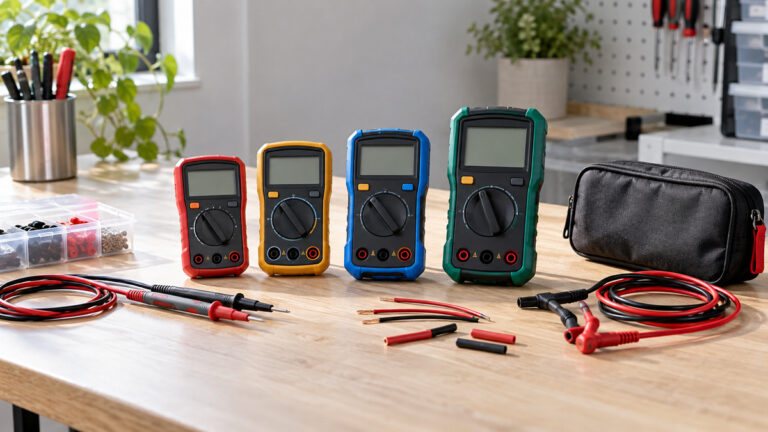
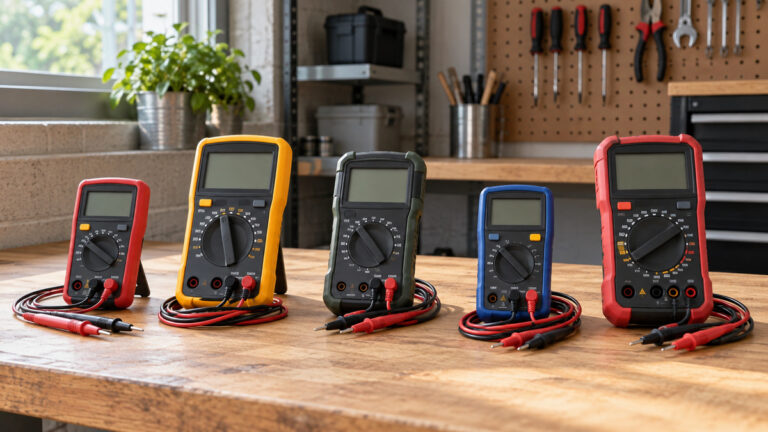
The meters side by side
| Meter (ASIN) | AC voltage (from listing) | CAT rating (from listing) | Other notes from listing |
|---|---|---|---|
| Fluke 87V (B0002YFD1K) | Up to 1000 V AC and DC | CAT III 1000V, CAT IV 600V | True RMS style; peak min/max; 6000 to 20,000 counts |
| UNI-T UT161E (B0B1CZBPX7) | Up to 1000 V AC | CAT III 1000 V / CAT IV 600 V | True RMS; NCV; backlight; 22,000 counts |
| Proster T28B (B0CQR9F26L) | AC/DC voltage listed; range not stated in the bullets | CAT III 600V / CAT II 1000V (bullet) | 6000 counts; auto and manual ranging |
| DEASOMIYE T21D (B0B31YC3YD) | AC/DC voltage listed; style reads “up to 600V/10A” | Overvoltage category III 600V (bullet) | Auto-ranging; NCV; 6000 counts |
| TESMEN TSM-599 (B0D5LSQL58) | AC/DC voltage listed | The listing does not state one | 10A/250V fuse; auto and manual modes |
| Gardner Bender GMT-318 (B00291X79O) | AC/DC volts; 500 V in the title | The listing does not state one | Analog display; 14 ranges |
The table uses the listings’ own wording. Checked 2026-10-11. We did not test any of these meters.
Step 2: Set the meter and connect the leads
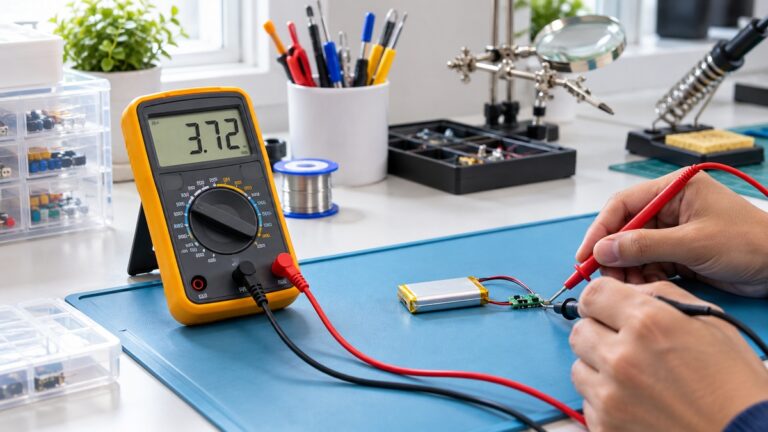
Turn the dial to AC voltage, marked with a tilde (ṽ). If the voltage is unknown, start on the highest voltage setting, or use autorange if the meter has it. Put the black lead in COM and the red lead in the VΩ jack. Do not put the red lead in the A or mA jack for a voltage check: Fluke says that setup “will create a short in the measurement circuit.”
Check both leads for cracked insulation or bare metal before you start. Replace a damaged lead first.
Step 3: Test the two slots
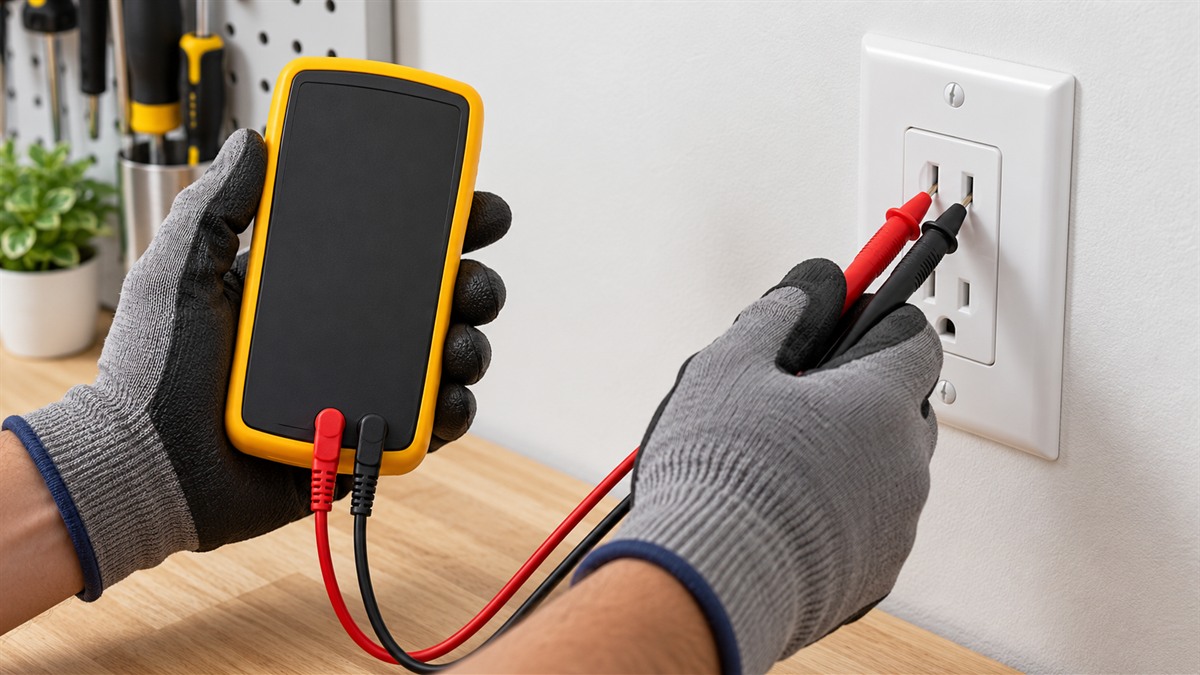
Hold the probes by the insulated barrels, with your fingers behind the finger guards. Touch one tip to each vertical slot. AC voltage has no polarity, so the order does not change the reading. Fluke advises not letting fingers touch the lead tips, and not allowing the tips to contact one another.
Read the display. A reading in the 110 V to 125 V range fits a standard residential outlet.
Step 4: Check the ground hole
Fluke’s outlet article describes a grounding check: one probe in a vertical slot and the other in the round ground hole. The reading should be similar to the reading between the hot and neutral slots. If there is no reading, Fluke says that points to a grounding problem. This page does not give a separate number for neutral-to-ground, so the check is only a comparison.
Step 5: Remove the probes and decide the next step
Remove the red lead first, then the black, as Fluke’s procedure describes. If the outlet reads 110 V to 125 V, it has voltage at the slots. If it reads zero, the outlet is not live at that point. Turn off the breaker before you remove the cover or touch wiring, and follow lockout practice. Call an electrician for anything beyond the voltage check.
Worked example: reading the number
For example, a reading of 118 V AC between the two slots falls inside Fluke’s 110 V to 125 V range for a standard residential outlet. That means the slots have voltage. A reading of 0 V means the outlet is not live at that point, and you should check the breaker before you do anything else. A reading far outside that range is not a result to act on. Stop, and have an electrician check the circuit.
Mistakes to avoid
- Using the wrong jack. Fluke calls using the A or mA jack for a voltage check “this common and serious mistake,” and says it “can lead to a dangerous arc flash.”
- Trusting a meter with no stated CAT rating. If the listing does not state one, do not use the meter on household mains.
- Treating a voltage reading as a wiring check. The reading shows voltage between two points. It does not show polarity, a loose terminal or a GFCI fault.
- Touching the tips. Keep fingers behind the guards while the probes are in the outlet.
What a multimeter does not tell you
A multimeter reads voltage between the points you touch. It does not show whether the ground path is sound, whether hot and neutral are reversed, or whether a GFCI trips. Those checks need a receptacle tester or the lamp test in our GFCI guide.
Who should skip this test
If you do not have a meter with a stated CAT rating, do not test mains outlets. If the outlet is scorched, loose, buzzing or warm, or if you are not comfortable with the procedure, call a licensed electrician.
Two meters with stated CAT ratings
1. Fluke 87V: best for an industrial True RMS meter
Specs (from the listing, checked 2026-10-11): measures up to 1000 V AC and DC; CAT III 1000V and CAT IV 600V safety rating; peak min/max; low-pass filter; 6000 to 20,000 counts; operating altitude 2000 m; TL75 test leads included; 10-year warranty per the listing.
Pros: CAT III 1000V and CAT IV 600V are stated in the listing text; True RMS style. Cons: the listing’s item dimensions (9.49 x 6.5 x 3.5 inches) make it a bench-size meter rather than a pocket meter.
Best for: someone who wants an industrial-style meter for voltage and fault work. Skip if: you want a pocket meter for occasional outlet checks.
View on Amazon (affiliate link)
2. UNI-T UT161E: best for a rated meter with NCV and backlight
Specs (from the listing, checked 2026-10-11): measures AC/DC voltage up to 1000 V and AC/DC current up to 20 A; CAT III 1000 V / CAT IV 600 V in the specification field; True RMS; NCV detection; backlight; 22,000 counts; USB data transmission.
Pros: a stated CAT rating; NCV for a presence check; backlight. Cons: NCV is a presence check only and gives no voltage reading; the listing is a long bullet list with no separate fuse rating in the text we have.
Best for: a DIYer who wants one rated meter with a backlit display. Skip if: the CAT rating on the product page does not match the circuit you plan to test.
View on Amazon (affiliate link)
Related guides
- AC outlet tester covers outlet testers, a tool for checks a multimeter cannot make.
- Multimeter helps you choose between a voltage meter and a current meter.
- Test wall outlet covers testing a wall outlet.
FAQ
Which meter setting should I use to test an outlet?
Use AC voltage, marked with a tilde. Fluke’s advice for an unknown voltage is to start on the highest setting. Meters with autorange can pick the range themselves.
Can I test an outlet with a cheap meter?
Only if its listing states a CAT rating that covers the circuit. Several listings in our research file state none, so this page does not recommend them for mains outlets.
What reading means the outlet has power?
Fluke gives 110 V to 125 V AC as the expected range for a standard residential outlet, measured between the two slots. A reading of zero means the outlet is not live at that point.
What if the meter reads nothing?
Check the meter’s battery, fuse and lead connections first. Then check the breaker. If the problem continues, call a licensed electrician. Do not open the outlet to look for the fault.
Sources
The steps and jack warnings come from Fluke’s guide: How to Measure AC Voltage with a Digital Multimeter. The 110 V to 125 V range and the no-reading guidance come from Fluke’s outlet troubleshooting article: Troubleshooting Electrical Outlets in Residential Applications.
Conclusion
Use a meter whose listing states a CAT rating, set it to AC voltage, and read the two slots. A reading in the 110 V to 125 V range means voltage is present. A zero reading means the outlet is not live at that point. A multimeter does not confirm wiring or GFCI operation, so use the lamp test for those, and call an electrician for anything beyond a voltage check. Confirm the CAT rating and current price on each listing before you buy.