Best 110 Outlet Tester: Outlet and Breaker Finder Kits
As an Amazon Associate we earn from qualifying purchases. Details
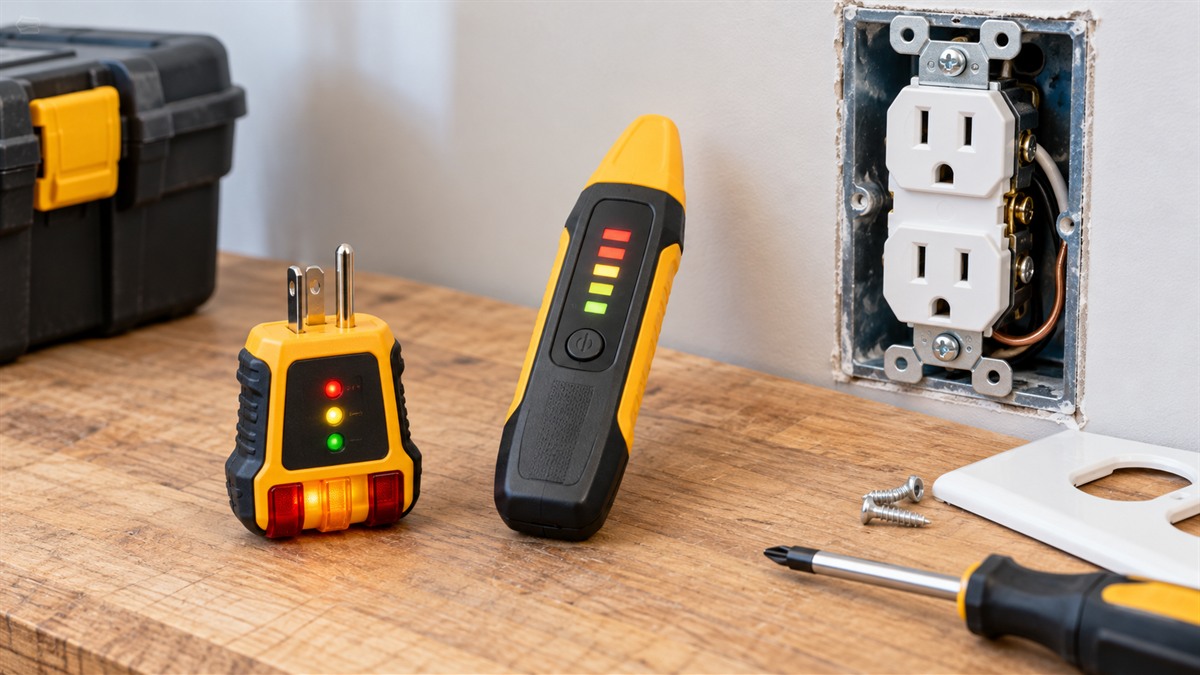
An outlet tester for a standard wall outlet checks wiring conditions such as an open ground, an open neutral or reversed polarity, and some models also check GFCI protection. A circuit breaker finder helps you match an outlet or light to its breaker. This guide compares five entries in this roundup, mostly kits that pair an outlet tester with extra functions. It explains what each listing says about fault indication, GFCI testing and voltage span, and what to confirm before you order.
Quick answer
For a direct outlet check with a GFCI test, the Klein two-piece kit is the most straightforward entry here. For a breaker finder with a seven-state wiring readout and a live voltage display, look at the entry that names seven wiring faults on its LCD. Buyers who want an outlet tester plus adapters for lamp circuits and older two-slot outlets should compare the kits with the most adapters. The kit with a multimeter adds a second job. Confirm each listing’s voltage span, GFCI function and battery needs before you order.
What matters for this keyword
Fault indication
Outlet testers show wiring conditions through lights or a display. One listing names seven conditions on its LCD, including open ground and open neutral. Simple three-light testers show fewer states, and the bullets of one kit use that contrast directly. Pick the indication style that matches how much detail you want to read at the outlet.
GFCI function
A residual-current device, also called a ground fault circuit interrupter, interrupts a circuit when line and neutral currents are unequal. That indicates current leaking to ground or to an unintended path. A GFCI outlet tester checks whether that protection responds. Several entries here include a GFCI tester, and the listings present it either as a separate part or as a built-in function. For a dedicated guide to that fault, see the open ground outlet guide.
Voltage span
Each listing gives a span. One states 90-135V, another gives 90-150V in one line and 90-120V in another, and a third shows live voltage on its LCD. Use each tool only inside the span it gives. The conflicting figures on one listing mean its span should be confirmed with the seller before you rely on it.
Breaker finding
A circuit breaker finder sends a signal through the wiring so a receiver can help match an outlet or light to its breaker. One listing says its transmitter shows a 1-second breaker ID when the receiver scans the breaker box. Another kit in the group does not list a breaker function at all. Use the manual to learn each scan step before you start. For a plug-in check, see the plug tester guide.
Adapters
Lamp adapters, older two-slot adapters and alligator clip adapters appear across these kits. They help you reach a lighting circuit or an older outlet. Check the adapter list against the outlets you plan to test, because not every kit includes the same set. For wall receptacle checks, see the receptacle tester guide.
The picks
Each card below shows the specs the listing gives, followed by pros and cons from the same listing. The paragraphs here give the short version for each pick.
Best for a two-piece outlet and GFCI kit. The Klein entry combines a GFCI outlet tester with a non-contact voltage tester pen. Its bullets name green and red LEDs and a warning tone for voltage, along with wiring checks for standard and GFCI receptacles. It is the most direct outlet-checking option in this roundup.
Best for a breaker finder with adapters. The focemta kit combines a breaker finder, an outlet tester and a GFCI tester, with an LCD that shows live voltage over 90-135V. Its accessories include a light socket adapter and a 3-prong to 2-prong adapter. It suits buyers who want a breaker tool that also checks outlets.
Best for a seven-state wiring readout. The SwiftStep kit reads seven wiring conditions on its transmitter LCD and adds live voltage and frequency in Hz. Its package includes a light socket adapter, a 3-prong to 2-prong adapter and an alligator clip adapter. It suits buyers who want the readout to name the fault rather than rely on indicator lights.
Best for a breaker finder with a multimeter. The KUYTN set bundles a breaker finder, a GFCI outlet tester and a digital multimeter in one case. Its bullets describe a Model 2027 version, while the part number reads V100X, so confirm the version before you order. It suits buyers who want more than one tool in a single carrying case.
Best for a broad set of adapters. The Vansdon kit combines a breaker locator, an outlet tester and a GFCI tester, and it includes three adapter types and a carrying case. Its receiver uses an analog bar graph, and its bullets give two different voltage spans. It suits buyers who want adapters first and can work with a bar graph instead of a number.
1. Klein Tools 80025 Outlet Tester Kit, 2-Piece (Best for a two-piece outlet and GFCI kit)
Specs from the listing (checked 2026-10-11):
- Model: 80025
- Included Components: GFCI Outlet Tester (Cat. No. RT210)
- Measurement Type: Voltmeter
- Warranty Description: See Manufacturer Website
- Power Source: Corded Electric
Pros
- Two-piece kit with a GFCI outlet tester (RT210) and a non-contact voltage pen (NCVT1P)
- Non-contact pen detects voltage in cables, breakers, fixtures and switches
- Green LED for operational status and a red LED with a warning tone for voltage
Cons
- Power Source field reads corded electric, so confirm how the GFCI tester is powered
- Warranty field points to the manufacturer website, with no term given in the listing
Best for: Users who want a branded two-piece kit covering outlet wiring and voltage detection.
Skip if: Skip it if you want a combined circuit breaker finder, since this kit does not list that function.
View on Amazon (affiliate link)
2. Circuit Breaker Finder Kit with GFCI Outlet Tester for 90-135V AC Circuits,includes Light Socket (Best for a breaker finder with adapters)
Specs from the listing (checked 2026-10-11):
- Model: FTCT 01
- Specification Met: ETL
- Power Source: Battery Powered
- Included Components: 1 circuit breaker finder kit,3 batteries,1 user manual,1 accessory kit
- Style: Handy
Pros
- One kit combining a breaker finder, an outlet tester and a GFCI tester
- Dual-function LCD shows live voltage over the 90-135V span
- Includes a light socket adapter and a 3-to-2 prong grounding adapter for lamp circuits and older outlets
Cons
- Its only stated voltage span is 90-135V, so it is limited to that range
- The package uses a 9V battery and two AAA batteries, so keep spares on hand
Best for: Users who want a breaker finder with a GFCI check and a lighted adapter kit for outlet work.
Skip if: Skip it if your job needs voltage ranges above 135V, since the title caps the span at that figure.
View on Amazon (affiliate link)
3. Circuit Breaker Finder Kit – 1-Second Breaker ID, 7 Wiring Faults Diagnosis, Live Voltage & Hz (Best for a seven-state wiring readout)
Specs from the listing (checked 2026-10-13):
- Style: Circuit Breaker Finder
- Part Number: RIV001
- Compatible Devices: Circuit Breaker Panels
- Maximum Alternating Current: 100 milliamps
- Specification Met: Ul Listed
- Included Components: Circuit Breaker Finder Transmitter, Receiver, 1.5v Battery*4,
Pros
- LCD names seven wiring conditions, including open ground and open neutral
- Shows live voltage and circuit frequency in Hz on the transmitter
- Accessories include a light socket adapter, a 3-prong to 2-prong adapter and an alligator clip adapter
Cons
- Four 1.5v batteries are part of the kit, so check the battery level before a job
- Its Maximum Alternating Current field lists 100 milliamps, which the bullets do not explain
Best for: Users who want a breaker ID and a wiring-fault readout on one LCD for outlets and lights.
Skip if: Skip it if you want a basic three-light outlet tester with no display.
View on Amazon (affiliate link)
4. Circuit Breaker Finder Kit, Electrical Circuit Tracer with Digital Multimeter, GFCI Outlet Tester (Best for a breaker finder with a multimeter)
Specs from the listing (checked 2026-10-13):
- Part Number: V100X
- Power Source: Battery Powered
- Style: Industry
- Color: Orange
Pros
- Three-piece set includes a breaker finder, a GFCI outlet tester and a digital multimeter
- Non-contact voltage detection built in
- Multimeter section lists detection up to 600V
Cons
- Bullets refer to a Model 2027 version while the part number reads V100X, so confirm which version you buy
- The multimeter section adds a second job, so the outlet test is only one part of the kit
Best for: Users who want a breaker finder, a GFCI tester and a multimeter in one case.
Skip if: Skip it if you want only an outlet tester, since this kit is three tools.
View on Amazon (affiliate link)
5. Vansdon Circuit Breaker Finder with LCD, GFCI Outlet Tester,Circuit Tracer (Best for a broad set of adapters)
Specs from the listing (checked 2026-10-13):
- Model: BF-2000
- Specification Met: Cat II 300v
- Warranty Description: 2 Years Manufactuer
- Compatible Devices: Electrical circuits,Wiring,Standard electrical outlets and fixtures
- Item Weight: 0.49 kg
Pros
- Three functions in one device: breaker locator, outlet tester and GFCI tester
- Non-contact voltage test function in the receiver
- A 7-in-1 set with three adapter types and a carrying case
Cons
- Its bullets give a 90-150 V range in one place and 90-120V in another, so confirm the span with the seller
- Its receiver uses an analog bar graph, which reads as a trend rather than an exact number
Best for: Users who want a breaker locator, GFCI and non-contact voltage checks in one set with adapters.
Skip if: Skip it if you need an exact voltage readout, since its receiver shows an analog bar graph.
View on Amazon (affiliate link)
How to choose
Start with the job. An outlet check, a breaker match and a multimeter reading each call for a different kit.
- Choose a GFCI-and-outlet kit when your main job is checking outlets.
- Choose a breaker-finder kit when you need to match outlets or lights to their breakers.
- Choose the multimeter bundle only if you want more than one tool in one case.
- Skip any kit whose stated span does not cover the outlets you check.
Before you order, confirm the voltage span, the GFCI function, the adapter list and the battery types. If a field conflicts with the title, ask the seller first.
Safety note. Outlet work means reading a live circuit, so follow the manual and local electrical rules. A breaker finder points you toward the breaker, but panel or service work belongs to a licensed electrician. OSHA lists lack of ground-fault protection among the most frequent causes of electrical injuries, which is one reason a GFCI check is worth doing.
Worked example: a floor of outlets
- Outlet checks: 10 x 2 = 20 checks.
- Check time: 20 x 1 = 20 minutes.
- Total with setup: 20 + 1 = 21 minutes.
A floor takes about 21 minutes under these assumptions. If you repeat the outlet check after a change, count the checks again and add the setup once for the floor.
Common mistakes
- Reading a seven-state display as a measured voltage.
- Assuming a GFCI tester does the same job as a breaker finder.
- Skipping the adapter list before a job.
- Ignoring conflicting voltage spans on the same listing.
- Treating a breaker finder as a substitute for a licensed electrician’s panel work.
FAQ
What does an outlet tester check?
Typical outlet testers show wiring conditions such as open ground, open neutral and reversed polarity, as named in these listings.
What is a GFCI outlet tester?
It checks whether ground fault circuit interrupter protection responds. A residual-current device interrupts a circuit when line and neutral currents are unequal.
What does a circuit breaker finder do?
It sends a signal along the wiring so a receiver can help match an outlet or light to its breaker. Check the manual for the scan steps before you start.
Can these tools check any voltage?
No. Each listing gives a span, and those spans differ. Use each tool only inside the span its listing gives.
Do I need a multimeter too?
Not always. A multimeter measures voltage, resistance and current, which is a wider job than an outlet check.
Which adapters do I need?
Check the adapter list against the outlets you plan to test. Lamp, older two-slot and alligator clip adapters appear across these kits, but not every kit includes all three.
When should I call an electrician?
Panel or service work belongs to a licensed electrician. If an outlet check shows a fault you cannot explain, call one.
Bottom line
For a direct outlet and GFCI check, the Klein kit is the simplest entry. For a breaker match with a clear readout, the SwiftStep kit suits the job. For adapters and a bar-graph receiver, the Vansdon kit is the broadest set. Confirm the voltage span and adapter list before ordering, and leave panel or service work to a licensed electrician.
Sources
- Residual-current device (Wikipedia): what an RCD interrupts and why current imbalance indicates leakage
- Test light (Wikipedia): non-contact test lights and how they detect voltage
- OSHA electrical safety: lack of ground-fault protection among the most frequent causes of electrical injuries