Soonkoda Digital Infrared Thermometer gun for cooking Review
As an Amazon Associate, this site earns from qualifying purchases. Nothing here comes from running the device, and no sales figures are included.
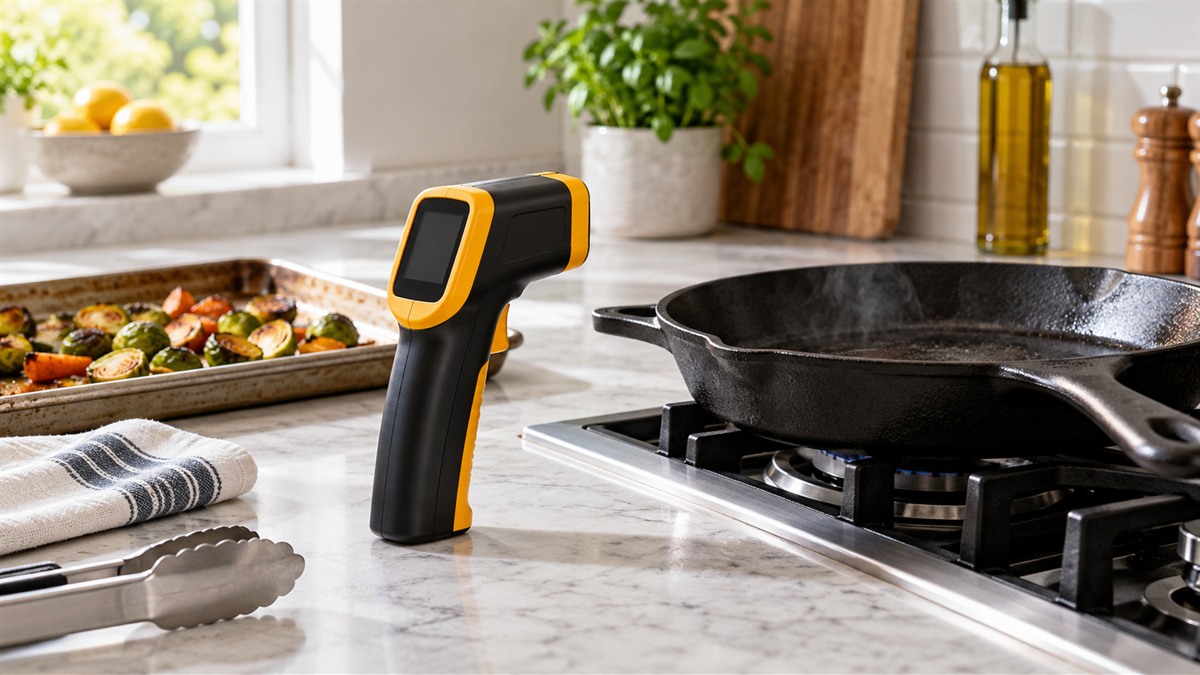
A non-contact thermometer answers one question well: how hot is this surface right now? It does not tell you what is happening inside a steak, a loaf, or a pizza crust. That distinction is the first thing to understand about the Soonkoda GM50, a handheld infrared thermometer sold for cooking, BBQ, and pizza oven work. Aim it at a griddle, a grill grate, or the floor of a pizza oven, and it reports the surface temperature in seconds. Used that way, it is a practical tool for the cook who wants to know whether a surface is ready.
What a surface thermometer can and cannot tell you
An infrared thermometer reads the heat radiating from a surface. That makes it useful for checking a preheated cast-iron pan, a pizza stone, the floor of a smoker, or the grate of a grill before you cook. It is less useful for food, because the surface can be far hotter or cooler than the middle of what you are cooking. Use it to set up your equipment, then rely on a probe thermometer for internal food temperature.
The product title describes the unit as not for human use. Do not point it at a person to measure body temperature. Keep it on cooking surfaces and equipment only.
Who should buy, and who should skip it
Buy it if you cook on a grill, a griddle, a flat-top, or a pizza oven, and you want to check hot spots on the cooking surface before you start. It also suits a home cook who wants to confirm that a pan or oven floor has reached the target before a batch goes on. Skip it if your main need is internal food temperature, since a probe is the right tool for that. Skip it too if you need a reading of a liquid or a food’s core, because an infrared sensor cannot see below the surface.
Specifications, translated into cooking use
- Range of -50 to 500 degrees Celsius (-58 to 932 degrees Fahrenheit). The upper limit covers high-heat cooking surfaces, including a hot pizza oven floor. The lower limit covers chilled equipment and cold storage.
- Resolution of 0.1 degrees. A tenth-degree display helps when you are comparing two spots on the same surface.
- Accuracy of plus or minus 1.5 degrees Celsius (2.7 degrees Fahrenheit), or 1.5 percent. The copy says the greater of the two applies from 0 to 500 degrees Celsius. Below zero, the stated accuracy is plus or minus 3 degrees Celsius (5 degrees Fahrenheit).
- Repeatability of 1 percent of reading or 1 degree Celsius. Repeat readings on the same spot should agree closely, which helps when you check the same grill grate at intervals.
- Distance-to-spot ratio of 12 to 1. At 12 inches away, the spot being measured is about 1 inch across. Stand close to the surface you want to read, and keep the aim tight to avoid picking up a neighboring hot spot.
- Spectral response of 8 to 14 micrometers. This is the infrared band the sensor reads. It is a technical figure, and it confirms the sensor responds to infrared heat radiation, which is what a surface reading depends on.
- Emissivity preset at 0.95. This sets how the unit interprets the surface it reads. Matte surfaces such as cast iron and most painted or seasoned metals are close to this value. Shiny surfaces can read differently, which is covered below.
Figures that differ across the sources
The two differ by a factor of twenty, so confirm the figure with the manufacturer before you rely on a quick check during a busy cook.
The two do not agree at the low end, so store the unit within a moderate range and confirm the limit before you keep it in a cold garage.
Emissivity and the surface you are reading
Emissivity is the surface’s ability to radiate heat. The unit is preset at 0.95, which works well for dull, dark surfaces. Shiny metal, such as polished stainless or a bright griddle, can read lower than its true temperature, so treat readings on shiny surfaces as a guide rather than a precise figure.
A practical workaround is to tape a small piece of matte, dark tape to the surface and read the tape, then compare it to a bare patch. Other products in the category research let you adjust emissivity from 0.1 to 1.0, which makes shiny-surface work easier. This unit does not list an adjustment, so the preset is the setting you have.
Using it at the grill, griddle, and pizza oven
- Grill grate. Read two or three spots across the grate before you place food. Hot spots near the burner or the firebox show up quickly.
- Griddle or flat-top. Check the zones before you cook. Read the center and the edges to see whether the heat is even.
- Cast iron pan. Read the pan floor after several minutes on the burner. Cast iron heats slowly and holds heat well, so a reading taken too early can mislead you.
- Pizza oven floor or stone. Read the floor away from the flame. Check it again after the oven settles, since the temperature changes with each load.
- Oil temperature. Aim at the oil surface in a pan. Keep the oil clear of splatter on the lens, and wipe the lens clean before each reading.
Work with the unit at a steady distance and angle. Readings taken from far away cover a wider area, which mixes hot and cool zones into one number.
A simple order of checks helps. Start with the hottest zone on the surface, then the coolest, then the middle. Recording each spot as you go shows whether the heat is even or whether one zone needs more time before food goes down. Repeat the same spots after the surface has been in use for a while, because a cooking surface changes as it heats and as the fat and moisture on it burn off.
Battery, care, and automatic shutoff
The unit runs on two AAA batteries, and both are included. The listing gives a battery life of about 12 hours with the laser off. That figure implies a laser aiming feature, which the title also describes, so expect a shorter runtime when the laser is in use.
- Backlight. The display backlight helps when you cook at night. The copy notes that any operation activates it while it is on.
- Scan and hold. Pull the trigger to scan, and release it to hold the reading on screen. The hold function lets you read a value after you move the unit away from the surface.
- Automatic shutoff. The unit powers down after about 8 seconds of inactivity, which saves the battery when you put it down between checks.
- Unit switch. You can switch between Celsius and Fahrenheit.
The product care instruction is to wipe the unit clean, so use a dry or lightly damp cloth on the housing and keep the lens free of grease and cooking residue. Oil splatter or steam can cloud the lens and change the reading, so wipe it before each check. For long storage, remove the batteries and keep the unit in a dry place.
Strengths and limits
Strengths. The unit is handheld, lightweight, and simple to operate. The scan-and-hold function, the backlight, the Celsius and Fahrenheit switch, and the wide range suit cooking surfaces. The unit is marked CE and the package lists the batteries and a manual, so it is ready to use once the batteries are in.
Shiny surfaces need care because the emissivity is preset. The unit reads surfaces only, so it is not a food probe. The product title’s not-for-human warning means it is limited to equipment and food-prep surfaces. Finally, the storage range has a conflict, so keep the unit in a moderate environment.
How it compares within the category
Other models in the same category research show what the trade-offs look like. These figures belong to those models and are not specifications of the GM50.
- TempPro TempScan Infrared Thermometer Gun for Pizza Oven Griddle HVAC (TP30): a 0.5-second response, 12-to-1 distance-to-spot, an emissivity range from 0.1 to 1.0 that the copy describes as adjustable, a rechargeable design, and a stated upper range of 1,022 degrees Fahrenheit. It is the option to weigh if shiny surfaces are a large part of your cooking.
- KNINE OUTDOORS Infrared Thermometer Gun: the copy highlights a large display. It is the option to weigh if you read the screen from a distance.
The GM50 sits in the same field, with a 12-to-1 spot ratio and a fixed 0.95 emissivity. Compare the response figure once it is confirmed, and check whether the adjustable emissivity matters for your cookware.
Model details, box contents, and size
Several details in the listing help with setup and support, and they are worth noting before you buy. The model number is GM50, and the manufacturer field names Dongguan Dongyida Electronics Co., Ltd.
- Box contents. The included components field names the host, AAA batteries, a manual and the packaging. The listing names two AAA batteries as required and included.
- Size. The item length is 5.83 inches, so measure the drawer or hook where you will keep the unit before you buy.
- Use setting. The indoor and outdoor usage field reads outdoor, which fits a grill or pizza oven area. The title also states the unit is not for human use.
- Reuse and display. The reusability field reads reusable, and the display type field reads LCD.
Buying checklist: check these before you order
- Confirm you need a surface thermometer, not a food probe, for your main cooking.
- Confirm the response time with the manufacturer, since the sources disagree.
- Check how much shiny cookware you use, given the preset emissivity.
- Decide where you will store the unit, given the storage range question.
- Keep two spare AAA batteries on hand for long grilling sessions.
- Confirm the unit is for cooking surfaces only, as the title states.
If the checklist fits how you cook, the thermometer is available here: Soonkoda GM50 Digital Infrared Thermometer Gun on Amazon.
Related reading: multimeter picks and multi-meter comparisons.
Frequently asked questions
Can I check the temperature of meat with it? You can read the surface of meat, but the reading does not show the center. Use a probe thermometer for the internal temperature.
Why does my reading jump? A wide distance covers more area and mixes hot and cool zones. Move closer and aim at the spot you want to measure.
Can it read through glass? Infrared sensors do not read through glass reliably, because glass reflects and blocks the infrared band. Read the surface inside the glass, such as the oven floor rather than the door window.
Is it accurate for body temperature? No. The title states it is not for human use, so do not use it for body temperature.
How far away should I hold it? Close enough that the spot you want to read fills most of the aim area. At a 12-to-1 ratio, a unit held 24 inches from a surface reads a spot about 2 inches across, so a smaller target needs a shorter distance.
Who is the manufacturer? The manufacturer field reads Dongguan Dongyida Electronics Co., Ltd, and the part number field reads Soonkoda.
What color is it? The color field reads black.
Does it have a backlight? Yes. The listing describes an LCD backlight that turns on with any operation while it is on.
Final verdict
The Soonkoda GM50 is a practical infrared surface thermometer for grills, griddles, cast iron, and pizza ovens. Its wide range, 12-to-1 spot ratio, scan-and-hold function, backlight, and included batteries make it simple to use at the cooking surface. Its open items are the response time and the storage range, which the sources do not agree on, and its fixed emissivity affects shiny cookware. Confirm the response figure, keep the unit to cooking surfaces, and pair it with a probe for the food itself. For a reading inside the food, a probe is the right tool, and this unit is for everything around it.